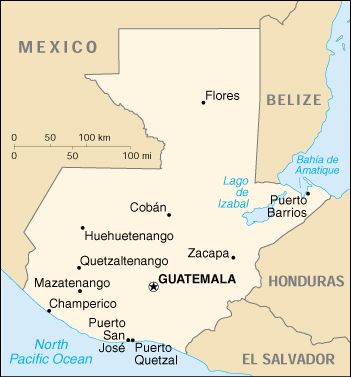
Background: Guatemala was freed of Spanish colonial rule in 1821. During the second half of the 20th century, it experienced a variety of military and civilian governments as well as a 36-year guerrilla war. In 1996, the government signed a peace agreement formally ending the conflict, which had led to the death of more than 100,000 people and had created some 1 million refugees.
Government type: constitutional democratic republic
Capital: Guatemala City
Currency: 1 quetzal (Q) = 100 centavos
Geography of Guatemala
Location: Middle America, bordering the Caribbean Sea, between Honduras and Belize and bordering the North Pacific Ocean, between El Salvador and Mexico
Geographic coordinates: 15 30 N, 90 15 W
Area:
total: 108,890 sq. km
land: 108,430 sq. km
water: 460 sq. km
Land boundaries:
total: 1,687 km
border countries: Belize 266 km, El Salvador 203 km, Honduras 256 km, Mexico 962 km
Coastline: 400 km
Maritime claims:
continental shelf: 200-m depth or to the depth of exploitation
exclusive economic zone: 200 nm
territorial sea: 12 nm
Climate: tropical; hot, humid in lowlands; cooler in highlands
Terrain: mostly mountains with narrow coastal plains and rolling limestone plateau (Peten)
Elevation extremes:
lowest point: Pacific Ocean 0 m
highest point: Volcan Tajumulco 4,211 m
Natural resources: petroleum, nickel, rare woods, fish, chicle, hydropower
Land use:
arable land: 12%
permanent crops: 5%
permanent pastures: 24%
forests and woodland: 54%
other: 5% (1993 est.)
Irrigated land: 1,250 sq. km (1993 est.)
Natural hazards: numerous volcanoes in mountains, with occasional violent earthquakes; Caribbean coast subject to hurricanes and other tropical storms.
Environment – current issues: deforestation; soil erosion; water pollution; Hurricane Mitch damage
Environment – international agreements:
party to: Antarctic Treaty, Biodiversity, Climate Change, Climate Change-Kyoto Protocol, Desertification, Endangered Species, Environmental Modification, Hazardous Wastes, Law of the Sea, Marine Dumping, Nuclear Test Ban, Ozone Layer Protection, Ship Pollution, Wetlands
signed, but not ratified: Antarctic-Environmental Protocol
Geography – note: no natural harbors on west coast
People of Guatemala
More than half of Guatemalans are descendants of indigenous Mayan peoples. Westernized Mayans and mestizos (mixed European and indigenous ancestry) are known as Ladinos. Most of Guatemala’s population is rural, though urbanization is accelerating. The predominant religion is Roman Catholicism, into which many indigenous Guatemalans have incorporated traditional forms of worship. Protestantism and traditional Mayan religions are practiced by an estimated 40% and 1% of the population, respectively.
Though the official language is Spanish, it is not universally understood among the indigenous population. However, the Peace Accords signed in December 1996 provide for the translation of some official documents and voting materials into several indigenous languages.
Population: 14,655,189 (July 2005 est.)
Age structure:
0-14 years: 42.11%
15-64 years: 54.25%
65 years and over: 3.64%
Population growth rate: 2.6%
Birth rate: 34.61 births/1,000 population
Death rate: 6.79 deaths/1,000 population
Net migration rate: -1.84 migrant(s)/1,000 population
Infant mortality rate: 45.79 deaths/1,000 live births
Life expectancy at birth:
total population: 66.51 years
male: 63.85 years
female: 69.31 years
Total fertility rate: 4.58 children born/woman
Nationality:
noun: Guatemalan(s)
adjective: Guatemalan
Ethnic groups: Mestizo (mixed Amerindian-Spanish or assimilated Amerindian – in local Spanish called Ladino), approximately 55%, Amerindian or predominantly Amerindian, approximately 43%, whites and others 2%
Religions: Roman Catholic, Protestant, indigenous Mayan beliefs
Languages: Spanish 60%, Amerindian languages 40% (more than 20 Amerindian languages, including Quiche, Cakchiquel, Kekchi, Mam, Garifuna, and Xinca)
Literacy:
definition: age 15 and over can read and write
total population: 63.6%
male: 68.7%
female: 58.5% (2000 est.)
History of Guatemala
The Mayan civilization flourished throughout much of Guatemala and the surrounding region long before the Spanish arrived, but it was already in decline when the Mayans were defeated by Pedro de Alvarado in 1523-24. During Spanish colonial rule, most of Central America came under the control of the Captaincy General of Guatemala.
The first colonial capital, Ciudad Vieja, was ruined by floods and an earthquake in 1542. Survivors founded Antigua, the second capital, in 1543. In the 17th century, Antigua became one of the richest capitals in the New World. Always vulnerable to volcanic eruptions, floods, and earthquakes, Antigua was destroyed by two earthquakes in 1773, but the remnants of its Spanish colonial architecture have been preserved as a national monument. The third capital, Guatemala City, was founded in 1776, after Antigua was abandoned.
Guatemala gained independence from Spain on September 15, 1821; it briefly became part of the Mexican Empire and then for a period belonged to a federation called the United Provinces of Central America. From the mid-19th century until the mid-1980s, the country passed through a series of dictatorships, insurgencies (particularly beginning in the 1960s), coups, and stretches of military rule with only occasional periods of representative government.
1944 to 1986
In 1944, Gen. Jorge Ubico’s dictatorship was overthrown by the “October Revolutionaries,”a group of dissident military officers, students, and liberal professionals. A civilian president, Juan Jose Arevalo, was elected in 1945 and held the presidency until 1951. Social reforms initiated by Arevalo were continued by his successor, Col. Jacobo Arbenz. Arbenz permitted the communist Guatemalan Labor Party to gain legal status in 1952. By the mid-point of Arbenz’s term, communists controlled key peasant organizations, labor unions, and the governing political party, holding some key government positions. Despite most Guatemalans’ attachment to the original ideals of the 1944 uprising, some private sector leaders and the military viewed Arbenz’s policies as a menace. The army refused to defend the Arbenz government when a U.S.-backed group led by Col. Carlos Castillo Armas invaded the country from Honduras in 1954 and quickly took over the government.
In response to the increasingly autocratic rule of Gen. Ydigoras Fuentes, who took power in 1958 following the murder of Col. Castillo Armas, a group of junior military officers revolted in 1960. When they failed, several went into hiding and established close ties with Cuba. This group became the nucleus of the forces that were in armed insurrection against the government for the next 36 years.
Four principal left-wing guerrilla groups–the Guerrilla Army of the Poor (EGP), the Revolutionary Organization of Armed People (ORPA), the Rebel Armed Forces (FAR), and the Guatemalan Labor Party (PGT)–conducted economic sabotage and targeted government installations and members of government security forces in armed attacks. These organizations combined to form the Guatemalan National Revolutionary Unity (URNG) in1982. At the same time, extreme right-wing groups of self-appointed vigilantes, including the Secret Anti-Communist Army (ESA) and the White Hand, tortured and murdered students, professionals, and peasants suspected of involvement in leftist activities.
Shortly after President Julio Cesar Mendez Montenegro took office in 1966, the army launched a major counterinsurgency campaign that largely broke up the guerrilla movement in the countryside. The guerrillas then concentrated their attacks in Guatemala City, where they assassinated many leading figures, including U.S. Ambassador John Gordon Mein in 1968. Between 1966 and 1982, there were a series of military or military-dominated governments.
On March 23, 1982, army troops commanded by junior officers staged a coup to prevent the assumption of power by Gen. Angel Anibal Guevara, the hand-picked candidate of outgoing President and Gen. Romeo Lucas Garcia. They denounced Guevara’s electoral victory as fraudulent. The coup leaders asked retired Gen. Efrain Rios Montt to negotiate the departure of Lucas and Guevara. Rios Montt had been the candidate of the Christian Democracy Party in the 1974 presidential elections and was widely regarded as having been denied his own victory through fraud.
Rios Montt was by this time a lay pastor in the evangelical protestant “Church of the Word.” In his inaugural address, he stated that his presidency resulted from the will of God. He formed a three-member military junta that annulled the 1965 constitution, dissolved Congress, suspended political parties and cancelled the electoral law. After a few months, Rios Montt dismissed his junta colleagues and assumed the de facto title of “President of the Republic.”
Guerrilla forces and their leftist allies denounced Rios Montt. Rios Montt sought to defeat the guerrillas with military actions and economic reforms; in his words, “rifles and beans.” In May 1982, the Conference of Catholic Bishops accused Rios Montt of responsibility for growing militarization of the country and for continuing military massacres of civilians. General Rios Montt was quoted in the New York Times of July 18, 1982 as telling an audience of indigenous Guatemalans, “If you are with us, we’ll feed you; if not, we’ll kill you.”
The government began to form local civilian defense patrols (PACs). Participation was in theory voluntary, but in practice, many Guatemalans, especially in the heavily indigenous northwest, had no choice but to join either the PACs or the guerrillas. Rios Montt’s conscript army and PACs recaptured essentially all guerrilla territory–guerrilla activity lessened and was largely limited to hit-and-run operations. However, Rios Montt won this partial victory at an enormous cost in civilian deaths.
Rios Montt’s brief presidency was probably the most violent period of the 36-year internal conflict, which resulted in about 200,000 deaths of mostly unarmed indigenous civilians. Although leftist guerrillas and right-wing death squads also engaged in summary executions, forced disappearances, and torture of noncombatants, the vast majority of human rights violations were carried out by the Guatemalan military and the PACs they controlled. The internal conflict is described in great detail in the reports of the Historical Clarification Commission (CEH) and the Archbishop’s Office for Human Rights (ODHAG). The CEH estimates that government forces were responsible for 93% of the violations; ODHAG earlier estimated that government forces were responsible for 80%.
On August 8, 1983, Rios Montt was deposed by his own Minister of Defense, Gen. Oscar Humberto Mejia Victores, who succeeded him as de facto president of Guatemala. Mejia justified his coup, saying that “religious fanatics” were abusing their positions in the government and also because of “official corruption.” Seven people were killed in the coup, although Rios Montt survived to found a political party–the Guatemalan Republic Front–and to be elected President of Congress in 1995 and 2000. Awareness in the United States of the conflict in Guatemala, and its ethnic dimension, increased with the 1983 publication of I, Rigoberta Menchu, An Indian Woman in Guatemala.
General Mejia allowed a managed return to democracy in Guatemala, starting with a July 1, 1984 election for a Constituent Assembly to draft a democratic constitution. On May 30, 1985, after 9 months of debate, the Constituent Assembly finished drafting a new constitution, which took effect immediately. Vinicio Cerezo, a civilian politician and the presidential candidate of the Christian Democracy Party, won the first election held under the new constitution with almost 70% of the vote, and took office on January 14, 1986.
1986 to 2001
Upon its inauguration in January 1986, President Cerezo’s civilian government announced that its top priorities would be to end the political violence and establish the rule of law. Reforms included new laws of habeas corpus and amparo (court-ordered protection), the creation of a legislative human rights committee, and the establishment in 1987 of the Office of Human Rights Ombudsman. The Supreme Court also embarked on a series of reforms to fight corruption and improve legal system efficiency.
With Cerezo’s election, the military moved away from governing and returned to the more traditional role of providing internal security, specifically by fighting armed insurgents. The first 2 years of Cerezo’s administration were characterized by a stable economy and a marked decrease in political violence. Dissatisfied military personnel made two coup attempts in May 1988 and May 1989, but military leadership supported the constitutional order. The government was heavily criticized for its unwillingness to investigate or prosecute cases of human rights violations.
The final 2 years of Cerezo’s government also were marked by a failing economy, strikes, protest marches, and allegations of widespread corruption. The government’s inability to deal with many of the nation’s problems–such as infant mortality, illiteracy, deficient health and social services, and rising levels of violence–contributed to popular discontent.
Presidential and congressional elections were held on November 11, 1990. After a runoff ballot, Jorge Serrano was inaugurated on January 14, 1991, thus completing the first transition from one democratically elected civilian government to another. Because his Movement of Solidarity Action (MAS) Party gained only 18 of 116 seats in Congress, Serrano entered into a tenuous alliance with the Christian Democrats and the National Union of the Center (UCN).
The Serrano administration’s record was mixed. It had some success in consolidating civilian control over the army, replacing a number of senior officers and persuading the military to participate in peace talks with the URNG. He took the politically unpopular step of recognizing the sovereignty of Belize. The Serrano government reversed the economic slide it inherited, reducing inflation and boosting real growth.
On May 25, 1993, Serrano illegally dissolved Congress and the Supreme Court and tried to restrict civil freedoms, allegedly to fight corruption. The “autogolpe” (or self-initiated coup) failed due to unified, strong protests by most elements of Guatemalan society, international pressure, and the army’s enforcement of the decisions of the Court of Constitutionality, which ruled against the attempted takeover. In the face of this resistance, Serrano fled the country.
On June 5, 1993, the Congress, pursuant to the 1985 constitution, elected the Human Rights Ombudsman, Ramiro De Leon Carpio, to complete Serrano’s presidential term. De Leon, not a member of any political party and lacking a political base, but with strong popular support, launched an ambitious anticorruption campaign to “purify” Congress and the Supreme Court, demanding the resignations of all members of the two bodies.
Despite considerable congressional resistance, presidential and popular pressure led to a November 1993 agreement brokered by the Catholic Church between the administration and Congress. This package of constitutional reforms was approved by popular referendum on January 30, 1994. In August 1994, a new Congress was elected to complete the unexpired term. Controlled by the anti-corruption parties–the populist Guatemalan Republican Front (FRG) headed by ex-Gen. Efrain Rios Montt, and the center-right National Advancement Party (PAN)–the new Congress began to move away from the corruption that characterized its predecessors.
Under De Leon, the peace process, now brokered by the United Nations, took on new life. The government and the URNG signed agreements on human rights (March 1994), resettlement of displaced persons (June 1994), historical clarification (June 1994), and indigenous rights (March 1995). They also made significant progress on a socioeconomic and agrarian agreement.
National elections for president, the Congress, and municipal offices were held in November 1995. With almost 20 parties competing in the first round, the presidential election came down to a January 7, 1996 runoff in which PAN candidate Alvaro Arzu defeated Alfonso Portillo of the FRG by just over 2% of the vote. Arzu won because of his strength in Guatemala City, where he had previously served as mayor, and in the surrounding urban area. Portillo won all of the rural departments except Peten. Under the Arzu administration, peace negotiations were concluded, and the government signed peace accords ending the 36-year internal conflict in December 1996. (See section on peace process) The human rights situation also improved during Arzu’s tenure, and steps were taken to reduce the influence of the military in national affairs.
Guatemala held presidential, legislative, and municipal elections on November 7, 1999, and a runoff presidential election December 26. In the first round the Guatemalan Republican Front (FRG) won 63 of 113 legislative seats, while the National Advancement Party (PAN) won 37. The New Nation Alliance (ANN) won 9 legislative seats, and three minority parties won the remaining four. In the runoff on December 26, Alfonso Portillo (FRG) won 68% of the vote to 32% for Oscar Berger (PAN). Portillo carried all 22 departments and Guatemala City, which was considered the PAN’s stronghold.
Portillo was criticized during the campaign for his relationship with the FRG’s chairman, former Gen. Efrain Rios Montt, the de facto president of Guatemala in 1982-83. Many charge that some of the worst human rights violations of the internal conflict were committed under Rios Montt’s rule. Nevertheless, Portillo’s impressive electoral triumph, with two-thirds of the vote in the second round, gave him a claim to a mandate from the people to carry out his reform program.
President Portillo pledged to maintain strong ties to the United States, further enhance Guatemala’s growing cooperation with Mexico, and participate actively in the integration process in Central America and the Western Hemisphere. Domestically, he vowed to support continued liberalization of the economy, increase investment in human capital and infrastructure, establish an independent central bank, and increase revenue by stricter enforcement of tax collections rather than increasing taxation. Portillo also promised to continue the peace process, appoint a civilian defense minister, reform the armed forces, replace the military presidential security service with a civilian one, and strengthen protection of human rights. He appointed a pluralist cabinet, including indigenous members and others not affiliated with the FRG ruling party.
Progress in carrying out Portillo’s reform agenda during his first two years in office was slow. As a result, public support for the government sank to record lows by early 2001. Although the administration made progress on such issues as taking state responsibility for past human rights cases, supporting human rights in international fora, and pressing labor rights reforms, it failed to show significant advances on combating impunity in past human rights cases, military reforms, a fiscal pact to help finance peace implementation, and legislation to increase political participation.
Faced with a high crime rate, a serious and worsening public corruption problem, often violent harassment and intimidation by unknown assailants of human rights activists, judicial workers, journalists, and witnesses in human rights trials, the government began serious attempts in 2001 to open a national dialogue to discuss the considerable challenges facing the country. As of early 2002, no such dialogue has taken place, despite the creation of the Guatemalan Forum, a coalition of civil society and private sector interests calling for political reforms.
Guatemala Economy
Guatemala’s GDP for 2001 was estimated at $20.0 billion, with real growth slowing to approximately 2.3%. After the signing of the final peace accord in December 1996, Guatemala was well-positioned for rapid economic growth over the next several years, though a financial crisis in 1998 limited its ability to achieve its potential growth rates.
Guatemala’s economy is dominated by the private sector, which generates about 85% of GDP. Agriculture contributes 23% of GDP and accounts for 75% of exports. Most manufacturing is light assembly and food processing, geared to the domestic, U.S., and Central American markets. Over the past several years, tourism and exports of textiles, apparel, and nontraditional agricultural products such as winter vegetables, fruit, and cut flowers have boomed, while more traditional exports such as sugar, bananas, and coffee continue to represent a large share of the export market. Because of Guatemala’s continued reliance on coffee exports, the recent downturn in world prices has contributed to Guatemala’s relatively slow growth over the past 2 years.
The United States is the country’s largest trading partner, providing 35% of Guatemala’s imports and receiving 27% of its exports. The government sector is small and shrinking, with its business activities limited to public utilities–some of which have been privatized–ports and airports and several development-oriented financial institutions.
Guatemala was certified to receive export trade benefits under the United States’ Caribbean Basic Trade and Partnership Act (CBTPA) in October 2000, and enjoys access to U.S. Generalized System of Preferences (GSP) benefits. Due to concerns over serious worker rights protection issues Guatemala’s benefits under both the CBTPA and GSP were reviewed in 2001. After passage of labor code reforms in May 2001, and the successful prosecution of labor rights violations against banana union workers dating to 1999, the review was lifted.
Current economic priorities include:
- Liberalizing the trade regime
- Financial services sector reform
- Overhauling Guatemala’s public finances
- Simplifying the tax structure, enhancing tax compliance, and broadening the tax base
Import tariffs have been lowered in conjunction with Guatemala’s Central American neighbors so that most fall between 0% and 15%, with further reductions planned. Responding to Guatemala’s changed political and economic policy environment, the international community has mobilized substantial resources to support the country’s economic and social development objectives. The United States, along with other donor countries–especially France, Italy, Spain, Germany, Japan, and the international financial institutions–have increased development project financing. Donors’ response to the need for international financial support funds for implementation of the Peace Accords is, however, contingent upon Guatemalan Government reforms and counterpart financing. The International Monetary Fund approved a program for Guatemala on April 1, 2002 but plans to closely monitor progress toward financial sector reform.
Problems hindering economic growth include high crime rates, illiteracy and low levels of education, and an inadequate and underdeveloped capital market. The distribution of income and wealth remains highly skewed. The wealthiest 10% of the population receives almost one-half of all income; the top 20% receives two-thirds of all income. As a result, approximately 80% of the population lives in poverty, and two-thirds of that number live in extreme poverty. Guatemala’s social indicators, such as infant mortality and illiteracy, are among the worst in the hemisphere. A rural economic crisis caused by drought and low coffee prices hit in 2001, and continued into 2002, causing severe malnutrition among the rural poor. U.S. disaster assistance and food aid was provided to address the crisis, which continues.
GDP: purchasing power parity – $46.2 billion (2000 est.)
GDP – real growth rate: 3.5% (1999 est.), 3% (2000 est.)
GDP – per capita: purchasing power parity – $3,700 (2000 est.)
GDP – composition by sector:
agriculture: 23%
industry: 20%
services: 57% (2000 est.)
Population below poverty line: 60% (2000 est.)
Household income or consumption by percentage share:
lowest 10%: 0.6%
highest 10%: 46.6% (1989)
Inflation rate (consumer prices): 6.8% (1999 est.), 6% (2000 est.)
Labor force: 4.2 million (1999 est.)
Labor force – by occupation: agriculture 50%, industry 15%, services 35% (1999 est.)
Unemployment rate: 7.5% (1999 est.)
Budget:
revenues: $2.2 billion
expenditures: $1.8 billion, including capital expenditures of $NA (2001 est.)
Industries: sugar, textiles and clothing, furniture, chemicals, petroleum, metals, rubber, tourism
Industrial production growth rate: 4.1% (1999)
Electricity – production: 3.785 billion kWh (1999)
Electricity – production by source:
fossil fuel: 38.31%
hydro: 61.69%
nuclear: 0%
other: 0% (1999)
Electricity – consumption: 3.295 billion kWh (1999)
Electricity – exports: 435 million kWh (1999)
Electricity – imports: 210 million kWh (1999)
Agriculture – products: sugarcane, corn, bananas, coffee, beans, cardamom; cattle, sheep, pigs, chickens
Exports: $2.4 billion (f.o.b., 1999), $2.9 billion (f.o.b., 2000)
Exports – commodities: coffee, sugar, bananas, fruits and vegetables, meat, apparel, petroleum, electricity
Exports – partners: US 51.4%, El Salvador 8.7%, Honduras 5%, Costa Rica 3.4%, Germany 2.7% (1998)
Imports: $4.5 billion (c.i.f., 1999), $4.4 billion (f.o.b., 2000)
Imports – commodities: fuels, machinery and transport equipment, construction materials, grain, fertilizers, electricity
Imports – partners: US 42.8%, Mexico 9.9%, Japan 4.8%, El Salvador 4.3%, Venezuela 3.8% (1998)
Debt – external: $4.4 billion (1998 est.), $4.7 billion (2000 est.)
Economic aid – recipient: $212 million (1995)
Currency: quetzal (GTQ), US dollar (USD), others allowed
Map of Guatemala