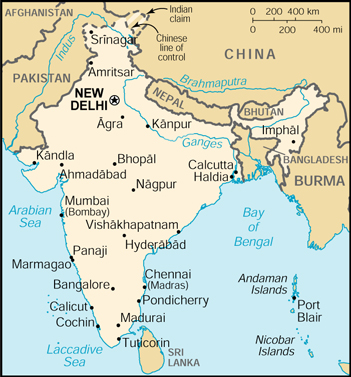
Background: The Indus Valley civilization, one of the oldest in the world, goes back at least 5,000 years. Aryan tribes from the northwest invaded about 1500 B.C.; their merger with the earlier inhabitants created classical Indian culture. Arab incursions starting in the 8th century and Turkish in 12th were followed by European traders beginning in the late 15th century. By the 19th century, Britain had assumed political control of virtually all Indian lands. Nonviolent resistance to British colonialism under Mohandas GANDHI and Jawaharlal NEHRU led to independence in 1947. The subcontinent was divided into the secular state of India and the smaller Muslim state of Pakistan. A third war between the two countries in 1971 resulted in East Pakistan becoming the separate nation of Bangladesh. Fundamental concerns in India include the ongoing dispute with Pakistan over Kashmir, massive overpopulation, environmental degradation, extensive poverty, and ethnic strife, all this despite impressive gains in economic investment and output.
Government type: federal republic
Capital: New Delhi
Currency: 1 Indian rupee (Re) = 100 paise
Geography of India
Location: Southern Asia, bordering the Arabian Sea and the Bay of Bengal, between Burma and Pakistan
Geographic coordinates: 20 00 N, 77 00 E
Map references: Asia
Area:
total: 3,287,590 sq. km
land: 2,973,190 sq. km
water: 314,400 sq. km
Land boundaries:
total: 14,103 km
border countries: Bangladesh 4,053 km, Bhutan 605 km, Burma 1,463 km, China 3,380 km, Nepal 1,690 km, Pakistan 2,912 km
Coastline: 7,000 km
Maritime claims:
contiguous zone: 24 nm
continental shelf: 200 nm or to the edge of the continental margin
exclusive economic zone: 200 nm
territorial sea: 12 nm
Climate: varies from tropical monsoon in south to temperate in north
Terrain: upland plain (Deccan Plateau) in south, flat to rolling plain along the Ganges, deserts in west, Himalayas in north
Elevation extremes:
lowest point: Indian Ocean 0 m
highest point: Kanchenjunga 8,598 m
Natural resources: coal (fourth-largest reserves in the world), iron ore, manganese, mica, bauxite, titanium ore, chromite, natural gas, diamonds, petroleum, limestone, arable land.
Land use:
arable land: 56%
permanent crops: 1%
permanent pastures: 4%
forests and woodland: 23%
other: 16% (1993 est.)
Irrigated land: 535,100 sq. km (1995/96 est.)
Natural hazards: droughts, flash floods, severe thunderstorms common; earthquakes
Environment – current issues: deforestation; soil erosion; overgrazing; desertification; air pollution from industrial effluents and vehicle emissions; water pollution from raw sewage and runoff of agricultural pesticides; tap water is not potable throughout the country; huge and growing population is overstraining natural resources.
Environment – international agreements:
party to: Antarctic-Environmental Protocol, Antarctic-Marine Living Resources, Antarctic Treaty, Biodiversity, Climate Change, Desertification, Endangered Species, Environmental Modification, Hazardous Wastes, Law of the Sea, Nuclear Test Ban, Ozone Layer Protection, Ship Pollution, Tropical Timber 83, Tropical Timber 94, Wetlands, Whaling
signed, but not ratified: none of the selected agreements
Geography – note: dominates South Asian subcontinent; near important Indian Ocean trade routes
People of India
Although India occupies only 2.4% of the world’s land area, it supports over 15% of the world’s population. Only China has a larger population. Almost 40% of Indians are younger than 15 years of age. About 70% of the people live in more than 550,000 villages, and the remainder in more than 200 towns and cities. Over thousands of years of its history, India has been invaded from the Iranian plateau, Central Asia, Arabia, Afghanistan, and the West; Indian people and culture have absorbed and changed these influences to produce a remarkable racial and cultural synthesis.
Religion, caste, and language are major determinants of social and political organization in India today. The government has recognized 18 languages as official; Hindi is the most widely spoken.
Although 81% of the people are Hindu, India also is the home of more than 120 million Muslims–one of the world’s largest Muslim populations. The population also includes Christians, Sikhs, Jains, Buddhists, and Parsis.
The caste system reflects Indian occupational and religiously defined hierarchies. Traditionally, there are four broad categories of castes (varnas), including a category of outcastes, earlier called “untouchables” but now commonly referred to as “dalits.” Within these broad categories there are thousands of castes and subcastes , whose relative status varies from region to region. Despite economic modernization and laws countering discrimination against the lower end of the class structure, the caste system remains an important source of social identification for most Hindus and a potent factor in the political life of the country.
Population: 1,080,264,388 (July 2005 est.)
Age structure:
0-14 years: 33.12%
15-64 years: 62.2%
65 years and over: 4.68%
Population growth rate: 1.4%
Birth rate: 24.28 births/1,000 population
Death rate: 8.74 deaths/1,000 population
Net migration rate: -0.08 migrant(s)/1,000 population
Infant mortality rate: 63.19 deaths/1,000 live births
Life expectancy at birth:
total population: 62.86 years
male: 62.22 years
female: 63.53 years
Total fertility rate: 3.04 children born/woman
Nationality:
noun: Indian(s)
adjective: Indian
Ethnic groups: Indo-Aryan 72%, Dravidian 25%, Mongoloid and other 3% (2000)
Religions: Hindu 81.3%, Muslim 12%, Christian 2.3%, Sikh 1.9%, other groups including Buddhist, Jain, Parsi 2.5% (2000)
Languages: English enjoys associate status but is the most important language for national, political, and commercial communication. Hindi is the national language and primary tongue of 30% of the people, Bengali, Telugu, Marathi, Tamil, Urdu, Gujarati, Malayalam, Kannada, Oriya, Punjabi, Assamese, Kashmiri, Sindhi, Sanskrit, Hindustani (a popular variant of Hindi/Urdu are spoken widely throughout northern India).
note: 24 languages each spoken by a million or more persons; numerous other languages and dialects, for the most part mutually unintelligible
Literacy:
definition: age 15 and over can read and write
total population: 52%
male: 65.5%
female: 37.7% (1995 est.)
History of India
INDIA IS A LAND of ancient civilization, with cities and villages, cultivated fields, and great works of art dating back 4,000 years. India’s high population density and variety of social, economic, and cultural configurations are the products of a long process of regional expansion. In the last decade of the twentieth century, such expansion has led to the rapid erosion of India’s forest and wilderness areas in the face of ever-increasing demands for resources and gigantic population pressures–India’s population is projected to exceed 1 billion by the twenty-first century.
Such problems are a relatively recent phenomenon. Rhinoceros inhabited the North Indian plains as late as the sixteenth century. Historical records and literature of earlier periods reveal the motif of the forest everywhere. Stories of merchant caravans typically included travel through long stretches of jungle inhabited by wild beasts and strange people; royal adventures usually included a hunting expedition and meetings with unusual beings. In the Mahabharata and the Ramayana , early epics that reflect life in India before 1000 B.C. and 500 B.C., respectively, the forest begins at the edge of the city, and the heroes regularly spend periods of exile wandering far from civilization before returning to rid the world of evil. The formulaic rituals of the Vedas also reflect attempts to create a regulated, geometric space from the raw products of nature.
The country’s past serves as a reminder that India today, with its overcrowding and scramble for material gain, its poverty and outstanding intellectual accomplishments, is a society in constant change. Human beings, mostly humble folk, have within a period of 200 generations turned the wilderness into one of the most complicated societies in the world. The process began in the northwest in the third millennium B.C., with the Indus Valley, or Harappan, civilization, when an agricultural economy gave rise to extensive urbanization and long-distance trade. The second stage occurred during the first millennium B.C., when the Ganga-Yamuna river basin and several southern river deltas experienced extensive agricultural expansion and population growth, leading to the rebirth of cities, trade, and a sophisticated urban culture.
By the seventh century A.D., a dozen core regions based on access to irrigation-supported kingdoms became tied to a pan-Indian cultural tradition and participated in increasing cross-cultural ties with other parts of Asia and the Middle East. India’s inclusion within a global trading economy after the thirteenth century culminated in the arrival of Portuguese explorers, traders, and missionaries, beginning in 1498. Although there were ebbs and flows in the pattern, the overall tendency was for peasant cultivators and their overlords to expand agriculture and animal husbandry into new ecological zones, and to push hunting and gathering societies farther into the hills.
By the twentieth century, most such tribal groups, although constituting a substantial minority within India, lived in restricted areas under severe pressure from the caste-based agricultural and trading societies pressing from the plains. Because this evolution took place over more than forty centuries and encompassed a wide range of ecological niches and peoples, the resulting social pattern is extremely complicated and alters constantly.
India had its share of conquerors who moved in from the northwest and overran the north or central parts of the country. These migrations began with the Aryan peoples of the second millennium B.C. and culminated in the unification of the entire country for the first time in the seventeenth century under the Mughals. Mostly these conquerors were nomadic or seminomadic people who adopted or expanded the agricultural economy and contributed new cultural forms or religions, such as Islam.
The Europeans, primarily the English, arrived in force in the early seventeenth century and by the eighteenth century had made a profound impact on India. India was forced, for the first time, into a subordinate role within a world system based on industrial production rather than agriculture. Many of the dynamic craft or cottage industries that had long attracted foreigners to India suffered extensively under competition with new modes of mass production fostered by the British. Modern institutions, such as universities, and technologies, such as railroads and mass communication, broke with Indian intellectual traditions and served British, rather than Indian, economic interests. A country that in the eighteenth century was a magnet for trade was, by the twentieth century, an underdeveloped and overpopulated land groaning under alien domination. Even at the end of the twentieth century, with the period of colonialism well in the past, Indians remain sensitive to foreign domination and are determined to prevent the country from coming under such domination again.
Through India’s long history, religion has been the carrier and preserver of culture. One distinctive aspect of the evolution of civilization in India has been the importance of hereditary priesthoods, often Brahmans, who have functioned as intellectual elites. The heritage preserved by these groups had its origin in the Vedas and allied bodies of literature in the Sanskrit language, which evolved in North India during the second millennium B.C. This tradition always accepted a wide range of paths to ultimate truth, and thus encompassed numerous rituals and forms of divinity within a polytheistic system. Generally, Brahmans supported the phenomenon known as Sanskritization, or the inclusion of local or regional traditions within Sanskrit literary models and pan-Indian cultural motifs. In this way, there has been a steady spread of North Indian cultural and linguistic forms throughout the country. This process has not gone unopposed. Siddhartha Gautama (the Buddha) and Mahavira (founder of Jainism) in the fifth century B.C. represented alternative methods for truth-seekers; they renounced the importance of priesthoods in favor of monastic orders without reference to birth. The largest challenge came from Islam, which rests on Arabic rather than Sanskritic cultural traditions, and has served, especially since the eleventh century, as an important alternative religious path. The interaction of Brahmanical religious forms with local variations and with separate religions creates another level of complexity in Indian social life.
Closely allied with religious belief, and deeply rooted in history, caste remains an important feature of Indian society. Caste in many Indian languages is jati , or birth–a system of classifying and separating people from birth within thousands of different groups labeled by occupation, ritual status, social etiquette, and language. Scholars have long debated the origins of this system, and have suggested as the origin religious concepts of reincarnation, the incorporation of many ethnic groups within agricultural systems over the millennia, or occupational stratification within emerging class societies. What is certain is that nineteenth-century British administrators, in their drive to classify and regulate the many social groups they encountered in everyday administration, established lists or schedules of different caste groups. At that time, it seemed that the rules against intermarriage and interdining that defined caste boundaries tended to freeze these groups within unchanging little societies, a view that fit well with imperialistic models imposed on India as a whole. Experience during the twentieth century has demonstrated that the caste system is capable of radical change and adaptation.
Modernization and urbanization have led to a decline in the outward display of caste exclusiveness, so that issues of caste may never emerge directly on public transit or in the workplace. Entire castes have changed their status, claiming higher positions as they shed their traditional occupations or accumulate money and power. In many villages, however, the segregation of castes by neighborhood and through daily behavior still exists at the end of the twentieth century. In the cities, segregation takes more subtle forms, emerging directly at times of marriage but existing more often as an undercurrent of discrimination in educational opportunities, hiring, and promotion. The British schedules of different castes, especially those of very low or Untouchable groups, later became the basis for affirmative-action programs in independent India that allowed some members of the most oppressed caste groups access to good education and high-paying jobs. The reservation of positions for Backward Classes has remained a sore point with higher-ranked groups and has contributed to numerous political confrontations. Meanwhile, attempts by low-ranking (and desperately poor) castes to organize and agitate against discrimination have been met with violence in most Indian states and territories. Caste, therefore, is a very live issue.
Religious, caste, and regional diversity exist in India against a background of poverty. At independence in 1947, the British left India in terrible condition. The country emerged from World War II with a rudimentary scientific and industrial base and a rapidly expanding population that lived primarily in villages and was divided by gross inequalities in status and wealth. Under the leadership of Jawaharlal Nehru, India’s first prime minister (1947-64), India addressed its economic crisis through a combination of socialist planning and free enterprise. During the 1950s and 1960s, large government investments made India as a whole into one of the most industrialized nations in the world. Considerable expenditure on irrigation facilities and fertilizer plants, combined with the introduction of high-yield variety seeds in the 1960s, allowed the Green Revolution to banish famine. The abolition of princely states and large land holdings, combined with (mostly ineffective) land redistribution schemes, also eliminated some of the most glaring inequalities in the countryside and in some areas, such as Punjab, stimulated the growth of middle-sized entrepreneurial farms. Building on the education system bequeathed by the British, India established an infrastructure of universities, basic research institutes, and applied research facilities that trained one of the world’s largest scientific and technical establishments.
The socialist model of development remained dominant in India through the 1970s, under the leadership of Prime Minister Indira Gandhi, Nehru’s daughter. Government-owned firms controlled iron and steel, mining, electronics, cement, chemicals, and other major industries. Telecommunications media, railroads, and eventually the banking industry were nationalized. Import-substitution policies, designed to encourage Indian firms and push out multinational corporations, included strict and time-consuming procedures for obtaining licenses and laws that prohibited firms from operating in India without majority ownership by Indian citizens or corporations. These rules were instrumental, for example, in driving IBM from India in the 1970s, leading to the growth of an indigenous Indian computer industry. By the late 1980s, however, after Mrs. Gandhi’s 1984 assassination, the disadvantages of the centrally planned economy began to outweigh its benefits. Inefficiency in public-sector firms, lack of entrepreneurial innovation, excessive bureaucracy, and the inability of the Indian scientific and technical apparatus to transfer technology to marketable goods kept many Indian firms from being competitive in international markets.
Under Prime Minister Rajiv Gandhi and his successors, the national and state-level (states, union territories, and the national capital territory) governments liberalized licensing requirements and eventually rescinded rules on foreign ownership, while taking steps to scale down government market share in a number of high-technology markets. Multinational firms began to reenter India in the late 1980s and the early 1990s, as the government encouraged private enterprise and international sales in its search for foreign exchange. India began to open its economy to the world.
Indian-style socialism was probably necessary in the years after independence to protect the nation from foreign economic domination, but its biggest problem was that it did not eliminate poverty. The vast majority of India’s population continued to live in small agricultural villages with few public amenities. A significant minority of the population in the 1990s live below the Indian definition of the poverty line, surviving at subsistence level, unemployed or underemployed, with little education or opportunity for training, and suffering from a variety of curable health problems. There are also some 200 million people who live above the official poverty line, but whose lives remain precariously balanced on the border of destitution. The per capita income of India as a whole remains among the lowest in the world. One of the biggest issues facing India as its economy has changed direction is that free-market capitalism offers little help for this large mass of people, who lack the skills or opportunity to participate in the new economy.
The big social story of India in the 1980s and the 1990s is the emergence of the middle class. This group includes members of prosperous farming families, as well as the primarily urban-based professional, administrative, and business elites who benefited from forty years of government protection and training. By the mid-1990s, the drive toward modernization had transformed 26.1 percent of the country into urban areas, where, amid masses of impoverished citizens, a sizable class of consumers has arisen. The members of this increasingly vocal middle class chafe under the older, regulated economy and demand a loosening of economic controls to make consumer goods available on the free market. They want education for their children that prepares them for technical and professional careers, increasingly in the private sector instead of the traditional sinecures in government offices. They build their well-appointed brick houses in exclusive suburban neighborhoods or surround their lots with high walls amid urban squalor, driving their scooters or automobiles to work while their children attend private schools.
The result of these processes over the course of fifty years is a dynamic, modernizing India with major class cleavages. The upper 1 or 2 percent of the population includes some of the wealthiest people in the world, who can be seen at the racetrack in the latest fashions from Paris or Tokyo, who travel extensively outside India for business, pleasure, or advanced medical care, and whose children attend the most exclusive English-language schools within India and abroad. For the middle class, which makes up between 15 and 25 percent of the population, the end of the twentieth century is a time of relative prosperity: incomes generally keep pace with inflation and jobs may still be obtained through family connections. The increase in consumer goods, such as washing machines and electric kitchen appliances, makes life easier and reduces dependence on lower-class (and low-caste) servants. For the industrial working class, the 1990s are a period of transition as dynamic new industries grow, mostly in the private sector, while many large government-sponsored plants are in jeopardy. The trade union movement, closely connected in some states with communist parties, finds itself under considerable pressure during a period of structural change in the economy. For large numbers of peasants and dwellers in urban slums, a way out of poverty remains as elusive as it had seemed for their grandparents at independence.
The political system responsible for these gigantic successes and failures has been democratic; India has called itself “the world’s largest democracy.” Paradoxically, it was the autocratic rule of the British that gave birth to the rule of the people. Democratization started when a group of concerned British citizens in India and well-to-do Indian professionals gathered in Bombay in 1885 to form a political debating society, the Indian National Congress. Originally conceived as a lobbying group, the Congress after 1900 became radicalized and took the forefront in a drive for home rule that encompassed elected assemblies and parliamentary procedure. In the face of British intransigence, the Congress soon became the leading organization within a broad-based freedom struggle that finally forced the British out in 1947. Mohandas Karamchand Gandhi (the Mahatma or Great Soul) was a central figure in this struggle because he was able to turn the Congress from an elite pressure group into a mass movement that mobilized hundreds of millions of people against the immorality of a foreign, nondemocratic system.
Gandhi perfected nonviolent techniques for general strikes and civil disobedience, and coordinated demonstrations with mass publicity; the techniques that he popularized have played a part in later Indian and world politics (including the United States civil rights movement). He evolved a philosophy of political involvement as sacrifice for the good of the world and played the role of a holy man who was also a cagey politician–an image that remained important for Indian political figures after independence.
In a move to undercut British industrial superiority, Gandhi encouraged a return to a communal, rustic life and village handicrafts as the most humane way of life. Finally, he railed against the segregation of the caste system and religious bigotry that reduced large minorities within India to second-class citizenship. Gandhi was thus able to unite European humanistic and democratic ideas with Indian concepts of an interdependent, responsible community to create a unique political philosophy complete with action plan. In the last years before his assassination in 1948, Gandhi’s idiosyncratic program fell out of step with the modernization paradigm of Nehru and the leadership of an independent India, and his ideas became a background theme within Indian political economy. On a regular basis, however, Indian leaders continue to hearken back to his message and employ his organizational and media tactics on the independent Indian political scene.
The Congress remained the most important political organization in India after independence. Except for brief periods in the late 1970s and late 1980s and until the mid-1990s, the Congress always controlled Parliament and chose the prime minister. The political dynasty of Jawaharlal Nehru (1947-64), his daughter Indira Gandhi (1965-77, 1980-84), and her son Rajiv Gandhi (1984-89) was crucial in keeping the Congress in power and also providing continuity in leadership for the country. The party was able to appeal to a wide segment of the poor (including low castes and Muslims) through its ideology of social equality and welfare programs, while appealing to the more prosperous voters–usually from upper castes–by preserving private property and supporting village community leadership. Because it stayed in power so long, the Congress was able to dispense government benefits to a wide range of constituencies, which prompted charges of corruption and led to Congress reversals in the late 1980s. Because it affected a type of socialist policy, the Congress diffused or incorporated left-wing political rhetoric and prevented the growth of a communist-led insurrection that might have been expected under the difficult social conditions existing in India.
Although a vibrant communist movement remains a force in Indian politics, it manifests itself at the state level of government rather than in national political power or large-scale revolutionary turmoil. Challenges from the right were small as well until the early 1990s, when the Bharatiya Janata Party (BJP–Indian People’s Party) emerged as a serious contender for national leadership. The BJP advocated a blend of Hindu nationalism that inserted religious issues into the heart of national political debates, unlike the secular ideology that officially dominated Indian political thought after independence. In the early 1990s, however, the Congress, after having entered its second century of dominance over the Indian political landscape, continued to hold on to power with a middle-of-the-road message and smaller majorities.
The federal structure of India, embodied in the constitution of 1951, attempts to strike a balance between a strong central government and the autonomous governments of the nation-sized states, each with a distinct culture and deep historical roots, that make up the union. A formidable array of powers at the center makes it possible for the central government to intervene in state issues; these powers include control over the military, the presence of an appointed governor to monitor affairs within each state, and the ability of the president to suspend state-level legislatures in times of internal disorder and declare direct President’s Rule. In theory, these powers should come into play rarely because the regular administration of the states resides with elected assemblies and chief ministers appointed through parliamentary procedures. State governments have extensive powers over almost all of their internal affairs. The framers of the national constitution constructed a series of checks and balances among the legislative, executive, and judicial branches at the center, and between the center and the states, designed to provide national security while allowing a maximum of state autonomy within the diversified union.
The Indian political system has proven to be flexible and durable, but major internal conflicts have threatened the constitution. In practice, the elected office of the nation’s president has gravitated toward the formal and ritual aspects of executive power, while the office of the prime minister, backed up by a majority in Parliament, the cabinet, national security forces, and the bureaucracy of the Indian Administrative Service, has wielded the actual power. The national Parliament has not developed an independent committee structure and critical tradition that could stand against the force of the executive branch. The judiciary, while remaining independent and at times crucial in determining national policy, has stayed in the background and is subject to future change through constitutional amendments. The constitution itself has been subject to numerous amendments since its adoption in 1950. By August 1996, the constitution had been amended eighty times.
National politics have become contests to set up the appointment of the prime minister, who then has considerable power to interfere directly or through a cooperative president in all aspects of national life. The most drastic example of this power occurred in 1975, when Indira Gandhi implemented the constitutional provision for a declaration of Emergency, suspending civil rights for eighteen months, using Parliament as a tool for eliminating opposition, and ruling with the aid of a small circle of advisers. The more common form of executive interference has been the suspension of state legislatures under a variety of pretexts and the implementation of President’s Rule. This typically has occurred when opposition parties have captured state legislatures and set in motion policies unfavorable to the prime minister’s party. After Indira Gandhi’s assassination in 1984, her successors engaged in such overt acts of interference less often.
The main opposition to the national executive comes from the states, in a variety of legal and extralegal struggles for regional autonomy. Most of the states have developed specific political identities based on forms of ethnicity that claim a long historical past. The most common identifying characteristic is language. Agitation in what became the state of Andhra Pradesh led the way in the 1950s, resulting in the reorganization of state boundaries along linguistic lines. Agitations in the state of Tamil Nadu in the 1960s resulted in domination of the state by parties dedicated officially to Tamil nationalism.
In the northeast, regional struggles have coalesced around tribal identities, leading to the formation of a number of small states based on dominant tribal groupings. Farther south, in Kerala and West Bengal, communist parties have upheld the banner of regionalism by capturing state assemblies and implementing radical socialist programs against the wishes of the central government.
The regional movements most threatening to national integration have occurred in the northwest. The state of Punjab was divided by the Indian government twice after independence–Haryana and Himachal Pradesh were sliced off–before it achieved a Sikh majority population in what remained of Punjab. That majority allowed the Sikh-led Akali Dal (Eternal Party) to capture the state assembly in the early 1980s. By then radical separatist elements were determined to fight for an independent Sikh Punjab. The result was an army attack on Sikh militants occupying the Golden Temple in Amritsar, Indira Gandhi’s assassination by her Sikh bodyguards, both in 1984, and a ten-year internal security struggle that has killed thousands. In India’s state of Jammu and Kashmir (often referred to as Kashmir), where Muslims constitute the majority of the population, regional struggle takes a different religious form and has created intense security problems that keep bilateral relations with Pakistan, which also lays claim to Kashmir, in a tense mode.
The central government usually has been able to defuse regional agitations by agreeing to redefinition of state boundaries or by guaranteeing differing degrees of regional autonomy, including acquiescence in the control of the state government by regional political parties. This strategy defused the original linguistic agitations through the 1970s, and led to the resolution of the destructive political and ethnic crises in Assam in the mid-1980s. When national security interests came into play, however, as in Punjab and Jammu and Kashmir, the central government did not hesitate to use force.
In the mid-1990s, India remains a strong unified nation, with a long history of constitutional government and democracy, but at any moment there are half a dozen regional political agitations underway and a dozen guerrilla movements in different parts of the country advocating various types of official recognition or outright independence based on ethnic affiliation. The unity of the country as a whole has never been seriously threatened by these movements. Because the benefits of union within India have outweighed the advantages of independence for most people within each state, there have always been moderate elements within the states willing to make deals with the central government, and security forces have proven capable of repressing any armed struggle at the regional level. In addition, state-level opposition, whether in the legislatures or in the streets, has been an effective means of preventing massive interference from New Delhi in the day-to-day lives of citizens, and thus has provided a crucial check that has preserved the democratic system and the constitution.
One of the most serious challenges to India’s internal security and democratic traditions has come from so-called communal disorders, or riots, based on ethnic cleavages. The most typical form is a religious riot, mostly between Hindus and Muslims, although some of these disturbances also occur between different castes or linguistic groups. Most of these struggles start with neighborhood squabbles of little significance, but rapidly escalate into mob looting and burning, street fighting, and violent intervention by the police or paramilitary forces.
Religious ideology has played only a small part in these events. Instead, the pressures of urban life in overcrowded, poorer neighborhoods, combined with competition for limited economic opportunities, create an environment in which ethnic differences become convenient labels for defining enemies, and criminal behavior becomes commonplace. Whether ignited by a street accident or a major political event, passions in these areas may be directed into mob action. However, after the catastrophe of independence (when hundreds of thousands in North India died during the partition of India and Pakistan and at least 12 million became refugees), and because the pattern of rioting has continued annually in various cities, a culture of distrust has grown up among a sizable minority of Hindus and Muslims. This distrust has manifested itself in the nationwide agitations fomented by elements of the BJP and communal Hindu parties in the early 1990s. It reached a peak in December 1992 with the dramatic destruction of the Babri Masjid, a mosque in Ayodhya (in Uttar Pradesh), and communal riots and bombings in major cities throughout India in early 1993. In this manner, the frictions of daily life in an overcrowded, poor nation have had a major impact on the national political agenda.
The internal conflict between Hindus and Muslims has received some of its stimulus since 1947 from the international conflict between India and Pakistan. One of the great tragedies of the freedom struggle was the relentless polarization of opinion between the Congress, which came to represent mostly Hindus, and the All-India Muslim League, which eventually stood behind a demand for a separate homeland for a Muslim majority. This division, encouraged under British rule by provisions for separate electorates for Muslims, led to the partition of Pakistan from India and the outbreak of hostilities over Kashmir. Warfare between India and Pakistan occurred in 1947, 1965, and 1971; the last conflict led to the independence of Bangladesh (formerly East Pakistan) and a major strategic victory by India.
The perception of Pakistan as an enemy nation has overshadowed all other Indian foreign policy considerations because neither country has relinquished claims over Kashmir, and a series of border irritations continue to bedevil attempts at rapprochement. In the late 1980s, tensions over large-scale military maneuvers almost led to war, and regular fighting over glacial wastelands in Kashmir continues to keep the pressure high. An added dimension emerged in 1987 when Pakistan publicly admitted that it possessed nuclear weapons capability, matching Indian nuclear capabilities demonstrated in 1974. In the mid-1990s, both nations continue to devote a large percentage of their military budgets to developing or to purchasing advanced weaponry, which is mostly aimed at each other–a serious drain of resources needed for economic growth.
Nehru and the early leadership of independent India had envisioned a nation at peace with the rest of the world, in keeping with Gandhian ideals and socialist goals. Under Nehru’s guidance, India distanced itself from Cold War politics and played a major part in the Nonaligned Movement. Until the early 1960s, India spent relatively little on national defense and enjoyed an excellent relationship with the United States, a relationship that peaked in John F. Kennedy’s presidency. India’s strategic position changed after China defeated the Indian army in the border war of 1962 and war with Pakistan occurred in 1965. During this period, the situation became more precarious because India had opponents on two fronts. In addition, Pakistan began to receive substantial amounts of military assistance from the United States, ostensibly to support anticommunism, but it was no secret that most of the weapons purchased with United States aid were a deterrent projected against India. Under these circumstances, India began to move closer to the Soviet Union, purchasing outright large amounts of military hardware or making agreements to produce it indigenously.
Relations between the United States and India reached a low point in 1971 during the Bangladesh war of independence, when a United States naval force entered the Bay of Bengal to show support for Pakistan although doing nothing to forestall its defeat. This display of force, which could not be opposed by India or the Soviet Union, served only to strain the relationship between India and the United States and heightened Cold War tensions in South Asia. During the 1970s, as the United States and China improved relations and China became closer in turn to Pakistan, India’s strategic position became more entwined with Cold War issues, and the Soviet connection became even more important. These international postures contrasted dramatically with the increasing importance to India of American scientific and economic links, which were strengthened by the increasing emigration of Indian citizens to North America. The overall result, however, was India’s weaker international situation in the view of some Americans.
During the 1980s, then, India was still officially a nonaligned nation but in fact found itself deeply embedded in Cold War strategy. India’s reaction to the Soviet occupation of Afghanistan was a disquieting feature of Indian foreign policy, in that India decried the Soviet military presence but did nothing against it. Continued United States support for Pakistan, plus the buildup of United States strike forces on the small island of Diego Garcia in the Indian Ocean, heightened tensions. It was no coincidence, therefore, that the 1980s witnessed a major expansion of Indian naval forces, with the addition of two aircraft carriers, a submarine fleet, and major surface ships, including transport craft. But although the Indian buildup made the United States unhappy, India’s technological capacities remained inferior to those of the United States Navy, and the Indian navy was never a large threat to United States interests. Instead, the growth of the Indian navy had major implications for the regional balance of power within South Asia. The Indian navy could potentially create a second front against Pakistan should major hostilities recur.
India’s military buildup allowed it to intervene in low-intensity conflicts throughout South Asia. From 1987 to 1990, the Indian Peace Keeping Force of more than 60,000 personnel was active in Sri Lanka and became embroiled in a fruitless war against Tamil separatist guerrillas. And, in 1988 Indian forces briefly intervened in Maldives to prevent a coup. Regular border problems with Bangladesh after 1971, the Indian annexation of Sikkim in 1975, and the 1989 closure of the border with Nepal over economic disagreements all added up to the picture of a big country bullying its smaller neighbors, a vision Indian leaders took great pains to dispel. Thus, even though the country officially remained at peace during the 1980s, India’s growing military power and the intersecting problems of regional dominance and Cold War ambivalence drove an ambitious foreign policy.
The Indian strategic position changed dramatically in the early 1990s. The end of the Cold War, and then the disintegration of the Soviet Union itself, deprived India of a great ally but also put a stop to many of the worldwide tensions that had relentlessly pulled India into global alignments. When the United States cut off military aid to Pakistan in 1990, it defused one of the most intractable barriers to good relations with India. Then, in 1992, the Persian Gulf War against Iraq brought India grudgingly into an alignment with both Pakistan and the United States, a connection strengthened in 1994 when troops from all three nations cooperated in Somalia under the aegis of the United Nations.
The possession of nuclear weapons by Pakistan and India immersed them in a familiar scenario of mutually assured destruction and made it more problematic for India, despite its military superiority, to overrun Pakistan. Thus, in the mid-1990s, despite continuing hostility over Kashmir, which intensified as the internal situation there disintegrated in the 1990s, the long-term possibilities for official peace between the two countries remained good. Threats from other South Asian nations were negligible. Issues with China were unresolved but not very significant. No other country in the world presented a strategic threat. As budgetary problems beset the government in the mid-1990s, therefore, the Indian military began cutbacks. The military also expanded contacts with a variety of other nations, including Russia and the United States. India hence has entered a period of relative security and multilateral contacts quite different from its twenty-five-year Cold War immersion.
India is a complex geographic, historical, religious, social, economic, and political entity. India is one of the oldest human civilizations and yet displays no cultural features common to all its members. It is one of the richest nations in history, but most of its people are among the poorest in the world. Its ideology rests on some of the most sublime concepts of humanism and nonviolence, but deep-seated discrimination and violent responses are daily news. It has one of the world’s most stable political structures, but that structure is constantly in crisis. The nation is seeking a type of great power status, but no one is sure what that involves. India, in the end, defies easy analysis.
India Economy
Economy – overview: India’s economy encompasses traditional village farming, modern agriculture, handicrafts, a wide range of modern industries, and a multitude of support services. More than a third of the population is too poor to be able to afford an adequate diet. India’s international payments position remained strong in 2000 with adequate foreign exchange reserves, moderately depreciating nominal exchange rates, and booming exports of software services. Growth in manufacturing output slowed, and electricity shortages continue in many regions.
GDP: purchasing power parity – $2.2 trillion (2000 est.)
GDP – real growth rate: 5.5% (1999 est.), 6% (2000 est.)
GDP – per capita: purchasing power parity – $2,200 (2000 est.)
GDP – composition by sector:
agriculture: 25%
industry: 24%
services: 51% (2000)
Population below poverty line: 35% (1994 est.)
Household income or consumption by percentage share:
lowest 10%: 3.5%
highest 10%: 33.5% (1997)
Inflation rate (consumer prices): 6.7% (1999 est.), 5.4% (2000 est.)
Labor force – by occupation: agriculture 67%, services 18%, industry 15% (1995 est.)
Budget:
revenues: $44.3 billion
expenditures: $73.6 billion (FY00/01 est.)
Industries: textiles, chemicals, food processing, steel, transportation equipment, cement, mining, petroleum, machinery, software
Industrial production growth rate: 6% (1999 est.), 7.5% (2000 est.)
Electricity – production: 454.561 billion kWh (1999)
Electricity – production by source:
fossil fuel: 79.41%
hydro: 17.77%
nuclear: 2.52%
other: 0.3% (1999)
Electricity – consumption: 424.032 billion kWh (1999)
Electricity – exports: 200 million kWh (1999)
Electricity – imports: 1.49 billion kWh (1999)
Agriculture – products: rice, wheat, oilseed, cotton, jute, tea, sugarcane, potatoes; cattle, water buffalo, sheep, goats, poultry; fish
Exports: $36.3 billion (f.o.b., 1999 est.), $43.1 billion (f.o.b., 2000)
Exports – commodities: textile goods, gems and jewelry, engineering goods, chemicals, leather manufactures
Exports – partners: US 22%, UK 6%, Germany 5%, Japan 5%, Hong Kong 5%, UAE 4% (1999)
Imports: $50.2 billion (f.o.b., 1999 est.), $60.8 billion (f.o.b., 2000)
Imports – commodities: crude oil, machinery, gems, fertilizer, chemicals
Imports – partners: US 9%, Benelux 8%, UK 6%, Saudi Arabia 6%, Japan 6%, Germany 5% (1999)
Debt – external: $99.6 billion (2000)
Economic aid – recipient: $2.9 billion (FY98/99)
Currency: Indian rupee (INR)
Map of India