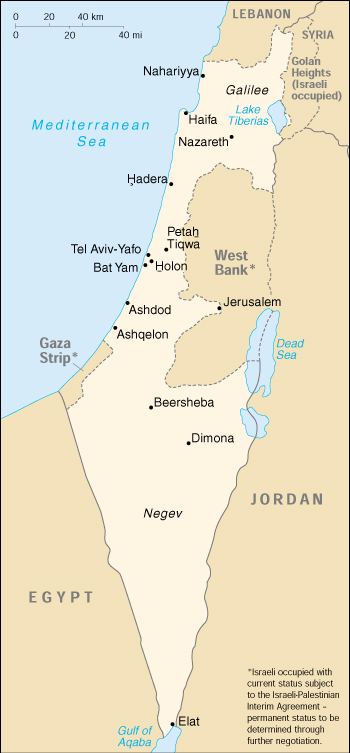
Background: Following World War II, the British withdrew from their mandate of Palestine, and the UN partitioned the area into Arab and Jewish states, an arrangement rejected by the Arabs. Subsequently, the Israelis defeated the Arabs in a series of wars without ending the deep tensions between the two sides. The territories occupied by Israel since the 1967 war are not included in the Israel country profile, unless otherwise noted. In keeping with the framework established at the Madrid Conference in October 1991, bilateral negotiations are being conducted between Israel and Palestinian representatives (from the Israeli-occupied West Bank and Gaza Strip) and Israel and Syria, to achieve a permanent settlement. On 25 April 1982, Israel withdrew from the Sinai pursuant to the 1979 Israel-Egypt Peace Treaty. Outstanding territorial and other disputes with Jordan were resolved in the 26 October 1994 Israel-Jordan Treaty of Peace. On 25 May 2000, Israel withdrew unilaterally from southern Lebanon, which it had occupied since 1982.
Government type: parliamentary democracy
Capital: Jerusalem
Currency: 1 new Israeli shekel (NIS) = 100 new agorot
Geography of Israel
Location: Middle East, bordering the Mediterranean Sea, between Egypt and Lebanon
Geographic coordinates: 31 30 N, 34 45 E
Area:
total: 20,770 sq. km
land: 20,330 sq. km
water: 440 sq. km
Land boundaries:
total: 1,006 km
border countries: Egypt 255 km, Gaza Strip 51 km, Jordan 238 km, Lebanon 79 km, Syria 76 km, West Bank 307 km
Coastline: 273 km
Maritime claims:
continental shelf: to depth of exploitation
territorial sea: 12 nm
Climate: temperate; hot and dry in southern and eastern desert areas
Terrain: Negev desert in the south; low coastal plain; central mountains; Jordan Rift Valley
Elevation extremes:
lowest point: Dead Sea -408 m
highest point: Har Meron 1,208 m
Natural resources: copper, phosphates, bromide, potash, clay, sand, sulfur, asphalt, manganese, small amounts of natural gas and crude oil
Land use:
arable land: 17%
permanent crops: 4%
permanent pastures: 7%
forests and woodland: 6%
other: 66% (1993 est.)
Irrigated land: 1,800 sq. km (1993 est.)
Natural hazards: sandstorms may occur during spring and summer
Environment – current issues: limited arable land and natural fresh water resources pose serious constraints; desertification; air pollution from industrial and vehicle emissions; groundwater pollution from industrial and domestic waste, chemical fertilizers, and pesticides.
Environment – international agreements:
party to: Biodiversity, Climate Change, Desertification, Endangered Species, Hazardous Wastes, Nuclear Test Ban, Ozone Layer Protection, Ship Pollution, Wetlands
signed, but not ratified: Climate Change-Kyoto Protocol, Marine Life Conservation
Geography – note: there are 231 Israeli settlements and civilian land use sites in the West Bank, 42 in the Israeli-occupied Golan Heights, 25 in the Gaza Strip, and 29 in East Jerusalem (August 2000 est.); Sea of Galilee is an important freshwater source.
People of Israel
Of the approximately 6.4 million Israelis (Nov. 2001), about 5.2 million were counted as Jewish, though some of those are not considered Jewish under Orthodox Jewish law. Since 1989, nearly a million immigrants from the former Soviet Union have arrived in Israel, making this the largest wave of immigration since independence. In addition, almost 50,000 members of the Ethiopian Jewish community have immigrated to Israel, 14,000 of them during the dramatic May 1991 Operation Solomon airlift. Thirty-six percent of Israelis were born outside Israel.
The three broad Jewish groupings are the Ashkenazim, or Jews who trace their ancestry to western, central, and eastern Europe; the Sephardim, who trace their origin to Spain, Portugal, southern Europe, and North Africa; and Eastern or Oriental Jews, who descend from ancient communities in Islamic lands. Of the non-Jewish population, about 80% are Muslims, 10% are Christian, and about 10% are Druze.
Education is compulsory from age 6 to 16 and is free up to age 18. The school system is organized into kindergartens, 6-year primary schools, 3-year junior secondary schools, and 3-year senior secondary schools, after which a comprehensive examination is offered for university admissions. There are seven university-level institutions in Israel, a number of regional colleges, and an Open University program.
With a population drawn from more than 100 countries on 5 continents, Israeli society is rich in cultural diversity and artistic creativity. The arts are actively encouraged and supported by the government. The Israeli Philharmonic Orchestra performs throughout the country and frequently tours abroad. The Jerusalem Symphony and the New Israel Opera also tour frequently, as do other musical ensembles. Almost every municipality has a chamber orchestra or ensemble, many boasting the talents of gifted performers from the countries of the former Soviet Union.
Israel has several professional ballet and modern dance companies, and folk dancing, which draws upon the cultural heritage of many immigrant groups, continues to be very popular. There is great public interest in the theater; the repertoire covers the entire range of classical and contemporary drama in translation as well as plays by Israeli authors. Of the three major repertory companies, the most famous, Habimah, was founded in 1917.
Population: 6,276,883 (July 2005 est.)
Age structure:
0-14 years: 27.36%
15-64 years: 62.73%
65 years and over: 9.91%
Population growth rate: 1.58%
Birth rate: 19.12 births/1,000 population
Death rate: 6.22 deaths/1,000 population
Net migration rate: 2.85 migrant(s)/1,000 population
Infant mortality rate: 7.72 deaths/1,000 live births
Life expectancy at birth:
total population: 78.71 years
male: 76.69 years
female: 80.84 years
Total fertility rate: 2.57 children born/woman
Nationality:
noun: Israeli(s)
adjective: Israeli
Ethnic groups: Jewish 80.1% (Europe/America-born 32.1%, Israel-born 20.8%, Africa-born 14.6%, Asia-born 12.6%), non-Jewish 19.9% (mostly Arab) (1996 est.)
Religions: Jewish 80.1%, Muslim 14.6% (mostly Sunni Muslim), Christian 2.1%, other 3.2% (1996 est.)
Languages: Hebrew (official), Arabic used officially for Arab minority, English most commonly used foreign language
Literacy:
definition: age 15 and over can read and write
total population: 95%
male: 97%
female: 93% (1992 est.)
Israel is located at the eastern end of the Mediterranean Sea. It is bounded on the north by Lebanon, on the northeast by Syria, on the east and southeast by Jordan, on the southwest by Egypt, and on the west by the Mediterranean Sea. Before June 1967, the area composing Israel (resulting from the armistice lines of 1949 and 1950) was about 20,700 square kilometers, which included 445 square kilometers of inland water. Thus Israel was roughly the size of the state of New Jersey, stretching 424 kilometers from north to south. Its width ranged from 114 kilometers to, at its narrowest point, 10 kilometers. The area added to Israel after the June 1967 War, consisting of occupied territories (the West Bank–see Glossary–and the Gaza Strip) and annexed territories (East Jerusalem and the Golan Heights) totaled an additional 7,477 square kilometers. The areas comprised the West Bank, 5,879 kilometers; the Gaza Strip, 378; East Jerusalem, 70; and the Golan Heights, 1,150.
Topography
The country is divided into four regions: the coastal plain, the central hills, the Jordan Rift Valley, and the Negev Desert. The Mediterranean coastal plain stretches from the Lebanese border in the north to Gaza in the south, interrupted only by Cape Carmel at Haifa Bay. It is about forty kilometers wide at Gaza and narrows toward the north to about five kilometers at the Lebanese border. The region is fertile and humid (historically malarial) and is known for its citrus and viniculture. The plain is traversed by several short streams, of which only two, the Yarqon and Qishon, have permanent water flows.
East of the coastal plain lies the central highland region. In the north of this region lie the mountains and hills of Upper Galilee and Lower Galilee; farther to the south are the Samarian Hills with numerous small, fertile valleys; and south of Jerusalem are the mainly barren hills of Judea. The central highlands average 610 meters in height and reach their highest elevation at Mount Meron, at 1,208 meters, in Galilee near Zefat (Safad). Several valleys cut across the highlands roughly from east to west; the largest is the Yizreel or Jezreel Valley (also known as the Plain of Esdraelon), which stretches forty-eight kilometers from Haifa southeast to the valley of the Jordan River, and is nineteen kilometers across at its widest point.
East of the central highlands lies the Jordan Rift Valley, which is a small part of the 6,500-kilometer-long Syrian-East African Rift. In Israel the Rift Valley is dominated by the Jordan River, Lake Tiberias (known also as the Sea of Galilee and to Israelis as Lake Kinneret), and the Dead Sea. The Jordan, Israel’s largest river (322 kilometers long), originates in the Dan, Baniyas, and Hasbani rivers near Mount Hermon in the Anti-Lebanon Mountains and flows south through the drained Hula Basin into the freshwater Lake Tiberias. Lake Tiberias is 165 square kilometers in size and, depending on the season and rainfall, is at about 213 meters below sea level. With a capacity estimated at 3 billion cubic meters, it serves as the principal reservoir of the National Water Carrier (also known as the Kinneret-Negev Conduit). The Jordan River continues its course from the southern end of Lake Tiberias (forming the boundary between the West Bank and Jordan) to its terminus in the highly saline Dead Sea. The Dead Sea is 1,020 square kilometers in size and, at 399 meters below sea level, is the lowest point in the world. South of the Dead Sea, the Rift Valley continues in the Nahal HaArava (Wadi al Arabah in Arabic), which has no permanent water flow, for 170 kilometers to the Gulf of Aqaba.
The Negev Desert comprises approximately 12,000 square kilometers, more than half of Israel’s total land area. Geographically it is an extension of the Sinai Desert, forming a rough triangle with its base in the north near Beersheba (also seen as Beersheva), the Dead Sea, and the southern Judean Hills, and it has its apex in the southern tip of the country at Elat. Topographically, it parallels the other regions of the country, with lowlands in the west, hills in the central portion, and the Nahal HaArava as its eastern border.
Climate
Israel has a Mediterranean climate characterized by long, hot, dry summers and short, cool, rainy winters, as modified locally by altitude and latitude. The climate is determined by Israel’s location between the subtropical aridity characteristic of Egypt and the subtropical humidity of the Levant or eastern Mediterranean. January is the coldest month, with temperatures from 5 C to 10 C, and August is the hottest month at 18 C to 38 C. About 70 percent of the average rainfall in the country falls between November and March; June through August are often rainless. Rainfall is unevenly distributed, decreasing sharply as one moves southward. In the extreme south, rainfall averages less than 100 millimeters annually; in the north, average annual rainfall is 1,128 millimeters. Rainfall varies from season to season and from year to year, particularly in the Negev Desert. Precipitation is often concentrated in violent storms, causing erosion and flooding. During January and February, it may take the form of snow at the higher elevations of the central highlands, including Jerusalem. The areas of the country most cultivated are those that receive more than 300 millimeters of rainfall annually; about one-third of the country is cultivable.
History of Israel
The creation of the State of Israel in 1948 was preceded by more than 50 years of efforts to establish a sovereign nation as a homeland for Jews. These efforts were initiated by Theodore Herzl, founder of the Zionist movement, and were given added impetus by the Balfour Declaration of 1917, which asserted the British Government’s support for the creation of a Jewish homeland in Palestine.
Zionism historically has taken different forms, and these variations were reflected in twentieth-century Israeli society. The leading type of early Zionism, political Zionism, came out of Western Europe in large measure as a response to the failure of the emancipation of Jews in France in 1791 to produce in the succeeding century the degree of the anticipated reduction in anti-Semitism. Jewish assimilation into West European society was inhibited by the anti-Jewish prejudice resulting from the 1894 trial of Alfred Dreyfus, a French Jewish officer. Theodor Herzl, a Hungarian Jew, in 1896 published a book advocating the creation of a Jewish state to which West European Jews would immigrate, thus solving the Jewish problem. Rather than emphasizing creation of a political entity, cultural Zionism, a product of oppressed East European Jewry, advocated the establishment in Palestine of self-reliant Jewish settlements to create a Hebrew cultural renaissance. Herzl was willing to have the Jewish state located in Uganda but East European Jews insisted on the state’s being in Palestine, and after Herzl’s death in 1904, the cultural Zionists prevailed. Meanwhile, the need arose for practical implementation of the Zionist dream and Labor Zionism came to the fore, appealing particularly to young Jews who were influenced by socialist movements in Russia and who sought to flee the pogroms in Eastern Europe. Labor Zionism advocated socialism to create an equitable Jewish society and stressed the integration of class and nation. David Ben-Gurion, who came to Palestine in 1906, became a leader of this group, which favored a strong economic basis for achieving political power. Labor Zionism in turn was challenged by the Revisionist Zionism of Vladimir Jabotinsky, a Russian Jew who glorified nationalism and sought to promote Jewish immigration to Palestine and the immediate declaration of Jewish statehood.
The Zionist cause was furthered during World War I by Chaim Weizmann, a British Jewish scientist, skilled in diplomacy, who recognized that Britain would play a major role in the postwar settlement of the Middle East. At that time Britain was seeking the wartime support of the Arabs, and in the October 1915 correspondence between Sharif Husayn of Mecca and Sir Henry McMahon, British high commissioner in Egypt, Britain endorsed Arab postwar independence in an imprecisely defined area that apparently included Palestine. In November 1917, however, Britain committed itself to the Zionist cause by the issuance of the Balfour Declaration, which stated that the British government viewed with favor “the establishment in Palestine of a National Home for the Jewish People,” while the “civil and religious rights of existing non-Jewish communities in Palestine” were not to suffer. These two concurrent commitments ultimately proved irreconcilable.
During the succeeding decades until the Holocaust conducted by Nazi Germany during World War II, Jewish immigration to Palestine continued at a fairly steady pace. The Holocaust, in which nearly 6 million Jews lost their lives, gave an impetus to the creation of the state of Israel: thousands of Jews sought to enter Palestine while Britain, as the mandatory power, imposed limits on Jewish immigration to safeguard the indigenous Arab inhabitants. An untenable situation developed, and in 1947 Britain referred the Palestine problem to the United Nations General Assembly. The latter body approved a resolution on November 29, l947, calling for a complex partition of Palestine into an Arab and a Jewish state. The Arab Higher Committee rejected the resolution, and violence increased. The establishment of the State of Israel was declared on May 14, 1948, and Arab military forces began invading the territory the following day. By January 1949, Israel had gained more territory than had been allotted by the partition; East Jerusalem and the West Bank of the Jordan River remained in Jordanian hands as a result of fighting by the Arab Legion of Transjordan, and the Gaza area, and Gaza remained in Egyptian hands. Israel held armistice talks with the Arab states concerned in the first half of 1949 and armistice lines were agreed upon, but no formal peace treaties ensued.
Having achieved statehood, the new government faced numerous problems. These included the continued ingathering of Jews from abroad, the provision of housing, education, health and welfare facilities, and employment for the new immigrants; the establishment of all requisite government services as well as expanding the country’s infrastructure; the expropriation of Arab lands–including lands left by Arabs who had fled during the 1948 war as well as by Arabs obliged by the government to relocate–so as to provide a livelihood for new immigrants; the establishment of a military government to administer Arab population areas; and the growth of the Israel Defense Forces (IDF) to safeguard national security.
In 1956, French, British, and Israeli forces engaged Egypt in response to its nationalization of the Suez Canal and blockade of the Straits of Tiran. Israeli forces withdrew in March 1957, after the United Nations established the UN Emergency Force (UNEF) in the Gaza Strip and Sinai. This war resulted in no territorial shifts and was followed by several years of terrorist incidents and retaliatory acts across Israel’s borders.
In June 1967, Israeli forces struck targets in Egypt, Jordan, and Syria in response to Egyptian President Nasser’s ordered withdrawal of UN peacekeepers from the Sinai Peninsula and the buildup of Arab armies along Israel’s borders. All parties agreed to a cease-fire after 6 days of fighting, under which Israel retained control of the Sinai Peninsula, the Golan Heights, the Gaza Strip, the formerly Jordanian-controlled West Bank of the Jordan River, and East Jerusalem. On November 22, 1967, the Security Council adopted Resolution 242, the “land for peace” formula, which called for the establishment of a just and lasting peace based on Israeli withdrawal from territories occupied in 1967 in return for the end of all states of belligerency, respect for the sovereignty of all states in the area, and the right to live in peace within secure, recognized boundaries.
The following years were marked by continuing violence across the Suez Canal, punctuated by the 1969-70 war of attrition. On October 6, 1973–Yom Kippur (the Jewish Day of Atonement), the armies of Syria and Egypt launched an attack against Israel. Although the Egyptians and Syrians initially made significant advances, Israel was able to push the invading armies back beyond the 1967 cease-fire lines by the time the United States and the Soviet Union helped bring an end to the fighting. In the UN Security Council, the United States supported Resolution 338, which reaffirmed Resolution 242 as the framework for peace and called for peace negotiations between the parties.
In the years that followed, sporadic clashes continued along the cease-fire lines but guided by the U.S., Egypt, and Israel continued negotiations. In November 1977, Egyptian President Anwar Sadat made an historic visit to Jerusalem, which opened the door for the 1978 Israeli-Egyptian peace summit convened at Camp David by President Carter. These negotiations led to a 1979 peace treaty between Israel and Egypt, pursuant to which Israel withdrew from the Sinai in 1982, signed by President Sadat of Egypt and Prime Minister Menachem Begin of Israel.
In the years following the 1948 war, Israel’s border with Lebanon was quiet relative to its borders with other neighbors. After the expulsion of Palestinian fighters from Jordan in 1970 and their influx into southern Lebanon, however, hostilities along Israel’s northern border increased and Israeli forces crossed into Lebanon. After passage of Security Council Resolution 425, calling for Israeli withdrawal and the creation of the UN Interim Force in Lebanon peacekeeping force (UNIFIL), Israel withdrew its troops.
In June 1982, following a series of cross-border terrorist attacks and the attempted assassination of the Israeli Ambassador to the U.K., Israel invaded Lebanon to fight the forces of Yasser Arafat’s Palestine Liberation Organization (PLO). The PLO withdrew its forces from Lebanon in August 1982. Israel, having failed to finalize an agreement with Lebanon, withdrew most of its troops in June 1985 save for a residual force which remained in southern Lebanon to act as a buffer against attacks on northern Israel. These remaining forces were completely withdrawn in May 2000 behind a UN-brokered delineation of the Israel-Lebanon border (the Blue Line). Hizballah forces in Southern Lebanon continued to attack Israeli positions south of the Blue Line in the Sheba Farms/Har Dov area of the Golan Heights.
The victory of the U.S.-led coalition in the Persian Gulf War of 1991 opened new possibilities for regional peace. In October 1991, the United States and the Soviet Union convened the Madrid Conference, in which Israeli, Lebanese, Jordanian, Syrian, and Palestinian leaders laid the foundations for ongoing negotiations designed to bring peace and economic development to the region. Within this framework, Israel and the PLO signed a Declaration of Principles on September 13, 1993, which established an ambitious set of objectives relating to a transfer of authority from Israel to an interim Palestinian authority. Israel and the PLO subsequently signed the Gaza-Jericho Agreement on May 4, 1994, and the Agreement on Preparatory Transfer of Powers and Responsibilities on August 29, 1994, which began the process of transferring authority from Israel to the Palestinians.
On October 26, 1994, Israel and Jordan signed a historic peace treaty, witnessed by President Clinton. This was followed by Israeli Prime Minister Rabin and PLO Chairman Arafat’s signing of the historic Israeli-Palestinian Interim Agreement on September 28, 1995. This accord, which incorporated and superseded previous agreements, broadened Palestinian self-government and provided for cooperation between Israel and the Palestinians in several areas.
Israeli Prime Minister Yitzhak Rabin was assassinated on November 4, 1995, by a right-wing Jewish radical, bringing the increasingly bitter national debate over the peace process to a climax. Subsequent Israeli governments continued to negotiate with the PLO resulting in additional agreements, including the Wye River and the Sharm el-Sheikh memoranda. However, ongoing Israeli-Palestinian violence led to a crisis of confidence between the two sides, which continues into 2001.
A summit hosted by President Clinton at Camp David in July 2000 to address permanent status issues–including the status of Jerusalem, Palestinian refugees, Israeli settlements in the West Bank and Gaza, final security arrangements, borders, and relations and cooperation with neighboring states–failed to produce an agreement.
Following the failed talks, widespread violence broke out in Israel, the West Bank, and Gaza in September 2000. In April 2001 the Sharm el-Sheikh Fact Finding Committee, commissioned by the October 2000 Middle East Peace Summit and chaired by former U.S. Senator George Mitchell, submitted its report, which recommended an immediate end to the violence followed by confidence-building measures and a resumption of security cooperation and peace negotiations. The United States has worked intensively to help bring an end to the violence between Israelis and Palestinians and bring about the implementation of the recommendations of the Mitchell Committee as a bridge back to political negotiations.
Historical Setting
ON MAY 14, 1948, in the city of Tel Aviv, David Ben-Gurion proclaimed the Declaration of the Establishment of the State of Israel. The introductory paragraph affirmed that “Eretz Ysrael (the Land of Israel) was the birthplace of the Jewish people. Here they first attained statehood, created cultural values of national and universal significance, and gave the world the eternal Book of Books.” The issuance of the proclamation was signaled by the ritual blowing of the shofar (ram’s-horn trumpet) and was followed by the recitation of the biblical verse (Lev. 25:10): “Proclaim liberty throughout the land and to all the inhabitants thereof.” The same verse is inscribed on the American Liberty Bell in Independence Hall in Philadelphia.
The reestablishment of the Jewish nation-state in Palestine has been the pivotal event in contemporary Jewish history. After nearly two millennia of exile, the Jewish people were brought together in their ancient homeland. Despite the ancient attachments of Jews to biblical Israel, the modern state of Israel is more deeply rooted in nineteenth- and twentieth- century European history than it is in the Bible. Thus, although Zionism–the movement to establish a national Jewish entity–is rooted in the messianic impulse of traditional Judaism and claims a right to Palestine based on God’s promise to Abraham, the vast majority of Zionists are secularists.
For nearly 2,000 years following the destruction of the Second Temple in A.D. 70, the attachment of the Jewish Diaspora to the Holy Land was more spiritual then physical. The idea of an ingathering of the exiles and a wholesale return to the Holy Land, although frequently expressed in the liturgy, was never seriously considered or acted upon. Throughout most of the exilic experience, the Jewish nation connoted the world Jewish community that was bound by the powerful moral and ethical ethos of the Jewish religion. The lack of a state was seen by many as a virtue, for it ensured that Judaism would not be corrupted by the exigencies of statehood. Despite frequent outbreaks of anti- Semitism, Jewish communities survived and in many cases thrived as enclosed communities managed by a clerical elite in strict accordance with Jewish law.
Zionism called for a revolt against the old established order of religious orthodoxy. It repudiated nearly 2,000 years of Diaspora existence, claiming that the Judaism of the Exile, devoid of its national component, had rendered the Jews a defenseless pariah people. As such, Zionism is the most radical attempt in Jewish history to escape the confines of traditional Judaism. The new order from which Zionism sprang and to which the movement aspired was nineteenth-century liberalism: the age of reason, emancipation, and rising nationalism.
Before Napoleon emancipated French Jewry in 1791, continental and Central European Jews had been forced to reside in designated Jewish “ghettos” apart from the non-Jewish community. Emancipation enabled many Jews to leave the confines of the ghetto and to attain unprecedented success in business, banking, the arts, medicine, and other professions. This led to the assimilation of many Jews into non-Jewish European society. The concomitant rise of ethnically based nationalisms, however, precluded Jewish participation in the political leadership of most of the states where they had settled. Political Zionism was born out of the frustrated hopes of emancipated European Jewry. Political Zionists aspired to establish a Jewish state far from Europe but modeled after the postemancipation European state.
In Eastern Europe, where the bulk of world Jewry lived, any hope of emancipation ended with the assassination of the reform- minded Tsar Alexander II in 1881. The pogroms that ensued led many Russian Jews to emigrate to the United States, while others joined the communist and socialist movements seeking to overthrow the tsarist regime and a much smaller number sought to establish a Jewish state in Palestine. Zionism in its East European context evolved out of a Jewish identity crisis; Jews were rapidly abandoning religious orthodoxy, but were unable to participate as equal citizens in the countries where they lived. This was the beginning of cultural Zionism, which more than political Zionism attached great importance to the economic and cultural content of the new state.
The most important Zionist movement in Palestine was Labor Zionism, which developed after 1903. Influenced by the Bolsheviks, the Labor movement led by David Ben-Gurion created a highly centralized Jewish economic infrastructure that enabled the Jewish population of Palestine to absorb waves of new immigrants and to confront successfully the growing Arab and British opposition during the period of the British Mandate (1920- 48). Following independence in May 1948, Ben-Gurion’s Labor Zionism would guide Israel through the first thirty years of statehood.
The advent of Zionism and the eventual establishment of the State of Israel posed anew a dilemma that has confronted Jews and Judaism since ancient times: how to reconcile the moral imperatives of the Jewish religion with the power politics and military force necessary to maintain a nation-state. The military and political exigencies of statehood frequently compromised Judaism’s transcendent moral code. In the period before the Exile, abuses of state power set in rapidly after the conquests of Joshua, in the reign of Solomon, in both the northern and southern kingdoms, under the Hasmoneans, and under Herod the Great.
In the twentieth century, the Holocaust transformed Zionism from an ideal to an urgent necessity for which the Yishuv and world Jewry were willing to sacrifice much. From that time on, the bulk of world Jewry would view Jewish survival in terms of a Jewish state in Palestine, a goal finally achieved by the creation of the state of Israel in 1948. The Nazi annihilation of 6 million Jews, on whose behalf the West proved unwilling to intervene, and the hostility of Israel’s Arab neighbors, some of which systematically evicted their Jewish communities, later combined to create a sense of siege among many Israelis. As a result, the modern State of Israel throughout its brief history has given security priority over the country’s other needs and has considerably expanded over time its concept of its legitimate security needs. Thus, for reasons of security Israel has justified the dispossession of hundreds of thousands of Palestinian Arabs, the limited rights granted its Arab citizens, and harsh raids against bordering Arab states that harbored Palestinian guerrillas who had repeatedly threatened Israel.
The June 1967 War was an important turning point in the history of Israel. The ease of victory and the reunification of Jerusalem spurred a growing religio- nationalist movement. Whereas Labor Zionism was a secular movement that sought to sow the land within the Green Line, the new Israeli nationalists, led by Gush Emunim and Rabbi Moshe Levinger, called for Jewish settlement in all of Eretz Yisrael. The June 1967 War also brought under Israel’s control the Sinai Peninsula, the Golan Heights, the West Bank, the Gaza Strip, and East Jerusalem. From the beginning, control of Jerusalem was a nonnegotiable item for Israel. The Gaza Strip and especially the West Bank, however, posed a serious demographic problem that continued to fester in the late 1980s.
In contrast to the euphoria that erupted in June 1967, the heavy losses suffered in the October 1973 War ushered in a period of uncertainty. Israel’s unpreparedness in the early stages of the war discredited the ruling Labor Party, which also suffered from a rash of corruption charges. Moreover, the demographic growth of Oriental Jews (Jews of African or Asian origin), a large number of whom felt alienated from Labor’s blend of socialist Zionism, tilted the electoral balance for the first time in Israel’s history away from the Labor Party. In the May 1977 elections Menachem Begin’s Likud Bloc unseated Labor.
The early years of the Begin era were dominated by the historic peace initiative of President Anwar as Sadat of Egypt. His trip to Jerusalem in November 1977 and the subsequent signing of the Camp David Accords and the Treaty of Peace between Egypt and Israel ended hostilities between Israel and the largest and militarily strongest Arab country. The proposed Palestinian autonomy laid out in the Camp David Accords never came to fruition because of a combination of Begin’s limited view of autonomy–he viewed the West Bank as an integral part of the State of Israel–and because of the refusal of the other Arab states and the Palestinians to participate in the peace process. As a result, violence in the occupied territories increased dramatically in the late 1970s and early 1980s.
Following Likud’s victory in the 1981 elections, Begin and his new minister of defense, Ariel Sharon, pursued a harder line toward the Arabs in the territories. After numerous attempts to quell the rising tide of Palestinian nationalism failed, Begin, on the advice of Sharon and Chief of Staff General Raphael Eitan, decided to destroy the Palestine Liberation Organization (PLO) major base of operations in Lebanon. On June 6, 1982, Israeli troops crossed the border into Lebanon initiating Operation Peace for Galilee. This was the first war in Israel’s history that lacked wide public support.
ANCIENT ISRAEL
The history of the evolving relationship between God and the Jewish people set forth in the the Hebrew Bible–the five books of the Torah, neviim (prophets), and ketuvim (writings)–known to Christians as the Old Testament, begins with myths. The stories of creation, the temptation and sin of the first humans, their expulsion from an idyllic sanctuary, the flood, and other folkloric events have analogies with other early societies. With the appearance of Abraham, however, the biblical stories introduce a new idea–that of a single tribal God. Over the course of several centuries, this notion evolved into humanity’s first complete monotheism. Abraham looms large in the traditions of the Jewish people and the foundation of their religion. Whether Jews by birth or by conversion, each male Jew is viewed as “a son of Abraham.”
It was with Abraham that God, known as Yahweh, made a covenant, promising to protect Abraham and his descendants, to wage wars on their behalf, and to obtain for them the land of Canaan, an area roughly approximate to modern Israel and the occupied West Bank (in another part of the Torah, God pledges to Abraham’s descendants “the land from the river of Egypt to the great river, the river Euphrates,” an area much larger than historic Canaan). In exchange, the ancient Hebrews were bound individually and collectively to follow the ethical precepts and rituals laid down by God.
Canaan, the land promised to Abraham and his descendants, was a narrow strip, 130 kilometers wide, bounded by the Mediterranean Sea to the west, the Arabian Desert to the east, Egypt to the south, and Mesopotamia to the north. Situated between the great Mesopotamian and Egyptian cultures, Canaan served as a burgeoning trading center for caravans between the Nile Valley and the Euphrates and as a cultural entrepôt. The clash of cultures and the diverse commercial activities gave Canaan a dynamic spiritual and material creativity. Prior to the emergence of Abraham, however, Egyptian and Mesopotamian hostility, continuous invasions of hostile peoples, and Canaan’s varied topography had resulted in frequent fighting and general instability.
In the last quarter of the second millennium B.C., the collapse of the Hittite Empire to the north, and the decline of Egyptian power to the south at a time when the Assyrians had not yet become a major force set the stage for the emergence of the Hebrews. As early as the latter part of the third millennium B.C., invasions from the east significantly disrupted Middle Eastern society. The people who moved from Mesopotamia to the Mediterranean spoke western Semitic languages of which Hebrew is one. The term Hebrew apparently came from the word habiru (also hapiru or apiru), a term that was common to the Canaanites and many of their neighbors. The word was used to designate a social class of wanderers and seminomads who lived on the margins of, and remained separate from, sedentary settlements. Abraham was the leader of one of these immigrant habiru groups. He is depicted as a wealthy seminomad who possessed large flocks of sheep, goats, and cattle, and enough retainers to mount small military expeditions.
The Canaanite chieftains urged Abraham to settle and join with them. Abraham remained in the land, but when it came time to select a wife for his and Sarah’s son Isaac, the wife was obtained from their relatives living in Haran, near Urfa in modern Turkey. This endogamous practice was repeated by Isaac’s son Jacob, who became known as Israel because he had wrestled with God (Gen. 32:28).
During Jacob-Israel’s lifetime the Hebrews completely severed their links with the peoples of the north and east and his followers began to think of themselves as permanently linked to Canaan. By his two wives, Leah and Rachel, and their two serving maids, Bilhah and Zilpah, Israel fathered twelve sons, the progenitors of the twelve tribes of Israel, the “children of Israel.” The term Jew derives from the name of one of the tribes, Judah, which was not only one of the largest and most powerful of the tribes but also the tribe that produced David and from which, according to biblical prophecy and postbiblical legend, a messiah will emerge.
Some time late in the sixteenth or early in the fifteenth century B.C., Jacob’s family–numbering about 150 people–migrated to Egypt to escape the drought and famine in Canaan. Beginning in the third millennium B.C. large numbers of western Semites had migrated to Egypt, usually drawn by the richness of the Nile Valley. They came seeking trade, work, or escape from hunger, and sometimes they came as slaves. The period of Egyptian oppression that drove the Israelites to revolt and escape probably occurred during the reign of Ramses II (1304-1237 B.C.). Most scholars believe that the Exodus itself took place under his successor Merneptah. A victory stela dated 1220 B.C. relates a battle fought with the Israelites beyond Sinai in Canaan. Taken together with other evidence, it is believed that the Exodus occurred in the thirteenth century B.C. and had been completed by about 1225 B.C.
The Book of Exodus describes in detail the conditions of slavery of the Jews in Egypt and their escape from bondage. The Exodus episode is a pivotal event in Jewish history. The liberation of a slave people from a powerful pharaoh–the first such successful revolt in recorded antiquity–through divine intervention tied successive generations of Hebrews (Jews) to Yahweh. The scale of the revolt and the subsequent sojourn in Sinai created a self-awareness among the Hebrews that they were a separate people sharing a common destiny. Moreover, the giving of the Law to Moses at Mount Sinai set down a moral framework that has guided the Jewish people throughout their history. The Mosaic Code, which includes the Ten Commandments and a wide body of other laws derived from the Torah, not only proclaimed the unity of God but also set forth the revolutionary idea that all men, because they were created in God’s image, were equal. Thus, the Hebrews believed that they were to be a people guided by a moral order that transcended the temporal power and wealth of the day.
The conquest of Canaan under the generalship of Joshua took place over several decades. The biblical account depicts a primitive, outnumbered confederation of tribes slowly conquering pieces of territory from a sedentary, relatively advanced people who lived in walled cities and towns. For a long time the various tribes of Israel controlled the higher, less desirable lands, and only with the advent of David did the kingdoms of Israel and Judah come into being with a capital in Jerusalem.
Prior to the emergence of David, the Hebrew tribes, as portrayed in the last three chapters of the Book of Judges, were fighting among themselves when the Philistines (whence the term Palestine) appeared on the coast and pushed eastward. The Philistines were a warlike people possessing iron weapons and organized with great discipline under a feudal-military aristocracy. Around 1050 B.C., having exterminated the coastal Canaanites, they began a large-scale movement against the interior hill country, now mainly occupied by the Israelites. To unify the people in the face of the Philistine threat, the prophet Samuel anointed the guerrilla captain Saul as the first king of the Israelites. Only one year after his coronation, however, the Philistines destroyed the new royal army at Mount Gilboa, near Bet Shean, southeast of the Plain of Yizreel (also known as the Plain of Jezreel and the Plain of Esdraelon), killing Saul and his son Jonathan.
Facing imminent peril, the leadership of the Israelites passed to David, a shepherd turned mercenary who had served Saul but also trained under the Philistines. Although David was destined to be the most successful king in Jewish history, his kingdom initially was not a unified nation but two separate national entities, each of which had a separate contract with him personally. King David, a military and political genius, successfully united the north and south under his rule, soundly defeated the Philistines, and expanded the borders of his kingdom, conquering Ammon, Moab, Edom, Zobah (also seen as Aram-Zobah), and even Damascus (also seen as Aram-Damascus) in the far northeast. His success was caused by many factors: the establishment of a powerful professional army that quelled tribal unrest, a regional power vacuum (Egyptian power was on the wane and Assyria and Babylon to the east had not yet matured), his control over the great regional trade routes, and his establishment of economic and cultural contacts with the rich Phoenician city of Tyre. Of major significance, David conquered from the Jebusites the city of Jerusalem, which controlled the main interior north-south route. He then brought the Ark of the Covenant, the most holy relic the Israelites possessed and the symbol of their unity, into the newly constituted “City of David,” which would serve as the center of his united kingdom.
Despite reigning over an impressive kingdom, David was not an absolute monarch in the manner of other rulers of his day. He believed that ultimate authority rested not with any king but with God. Throughout his thirty-three-year reign, he never built a grandiose temple associated with his royal line, thus avoiding the creation of a royal temple-state. His successor and son Solomon, however, was of a different ilk. He was less attached to the spiritual aspects of Judaism and more interested in creating sumptuous palaces and monuments. To carry out his large-scale construction projects, Solomon introduced corvées, or forced labor; these were applied to Canaanite areas and to the northern part of the kingdom but not to Judah in the south. He also imposed a burdensome tax system. Finally, and most egregious to the northern tribes of Israel, Solomon ensured that the Temple in Jerusalem and its priestly caste, both of which were under his authority, established religious belief and practice for the entire nation. Thus, Solomon moved away from the austere spirituality founded by Moses in the desert toward the pagan cultures of the Mediterranean Coast and Nile Valley.
When Solomon died in 925 or 926 B.C., the northerners refused to recognize his successor Rehoboam. Subsequently the north broke away and was ruled by the House of Omri. The northern kingdom of Israel, more populous than the south, possessing more fertile land and closer to the trading centers of the time, flourished until it was completely destroyed and its ten tribes sent into permanent exile by the Assyrians between 740 and 721 B.C. The destruction of the north had a sobering effect on the south. The prophet Isaiah eloquently proclaimed that rather than power and wealth, social justice and adherence to the will of God should be the focus of the Israelites.
At the end of the sixth century B.C., the Assyrian Empire collapsed and the Babylonians under Nebuchadnezzar besieged the city of Jerusalem, captured the king, and ended the first commonwealth. Even before the first Exile, the prophet Jeremiah had stated that the Israelites did not need a state to carry out the mission given to them by God. After the Exile, Ezekiel voiced a similar belief: what mattered was not states and empires, for they would perish through God’s power, but man.
From the time of the destruction of the First Temple in 586 B.C., the majority of Jews have lived outside the Holy Land. Lacking a state and scattered among the peoples of the Near East, the Jews needed to find alternative methods to preserve their special identity. They turned to the laws and rituals of their faith, which became unifying elements holding the community together. Thus, circumcision, sabbath observance, festivals, dietary laws, and laws of cleanliness became especially important.
In the middle of the sixth century B.C., the Persian emperor Cyrus the Great defeated the Babylonians and permitted the Jews to return to their homeland “to rebuild the house of the Lord.” The majority of Jews, however, preferred to remain in the Diaspora, especially in Babylon, which would become a great center of Jewish culture for 1,500 years. During this period Ezra, the great codifier of the laws, compiled the Torah from the vast literature of history, politics, and religion that the Jews had accumulated. The written record depicting the relationship between God and the Jewish people contained in the Torah became the focal point of Judaism.
HELLENISM AND THE ROMAN CONQUEST
In 332 B.C., Alexander the Great of Macedon destroyed the Persian Empire but largely ignored Judah. After Alexander’s death, his generals divided–and subsequently fought over–his empire. In 301 B.C., Ptolemy I took direct control of the Jewish homeland, but he made no serious effort to interfere in its religious affairs. Ptolemy’s successors were in turn supplanted by the Seleucids, and in 175 B.C. Antiochus IV seized power. He launched a campaign to crush Judaism, and in 167 B.C. he sacked the Temple.
The violation of the Second Temple, which had been built about 520-515 B.C., provoked a successful Jewish rebellion under the generalship of Judas (Judah) Maccabaeus. In 140 B.C. the Hasmonean Dynasty began under the leadership of Simon Maccabaeus, who served as ruler, high priest, and commander in chief. Simon, who was assassinated a few years later, formalized what Judas had begun, the establishment of a theocracy, something not found in any biblical text.
Despite priestly rule, Jewish society became Hellenized except in its generally staunch adherence to monotheism. Although rural life was relatively unchanged, cities such as Jerusalem rapidly adopted the Greek language, sponsored games and sports, and in more subtle ways adopted and absorbed the culture of the Hellenes. Even the high priests bore such names as Jason and Menelaus. Biblical scholars have identified extensive Greek influence in the drafting of commentaries and interpolations of ancient texts during and after the Greek period. The most obvious influence of the Hellenistic period can be discerned in the early literature of the new faith, Christianity.
Under the Hasmonean Dynasty, Judah became comparable in extent and power to the ancient Davidic dominion. Internal political and religious discord ran high, however, especially between the Pharisees, who interpreted the written law by adding a wealth of oral law, and the Sadducees, an aristocratic priestly class who called for strict adherence to the written law. In 64 B.C., dynastic contenders for the throne appealed for support to Pompey, who was then establishing Roman power in Asia. The next year Roman legions seized Jerusalem, and Pompey installed one of the contenders for the throne as high priest, but without the title of king. Eighty years of independent Jewish sovereignty ended, and the period of Roman dominion began.
In the subsequent period of Roman wars, Herod was confirmed by the Roman Senate as king of Judah in 37 B.C. and reigned until his death in 4 B.C. Nominally independent, Judah was actually in bondage to Rome, and the land was formally annexed in 6 B.C. as part of the province of Syria Palestina. Rome did, however, grant the Jews religious autonomy and some judicial and legislative rights through the Sanhedrin. The Sanhedrin, which traces its origins to a council of elders established under Persian rule (333 B.C. to 165 B.C.) was the highest Jewish legal and religious body under Rome. The Great Sanhedrin, located on the Temple Mount in Jerusalem, supervised smaller local Sanhedrins and was the final authority on many important religious, political, and legal issues, such as declaring war, trying a high priest, and supervising certain rituals. Scholars have sharply debated the structure and composition of the Sanhedrin. The Jewish historian Josephus and the New Testament present the Sanhedrin as a political and judicial council whereas the Talmud describes it as a religious, legislative body headed by a court of seventy-one sages. Another view holds that there were two separate Sanhedrins. The political Sanhedrin was composed primarily of the priestly Sadducee aristocracy and was charged by the Roman procurator with responsibility for civil order, specifically in matters involving imperial directives. The religious Sanhedrin of the Pharisees was concerned with religious law and doctrine, which the Romans disregarded as long as civil order was not threatened. Foremost among the Pharisee leaders of the time were the noted teachers, Hillel and Shammai.
Chafing under foreign rule, a Jewish nationalist movement of the fanatical sect known as the Zealots challenged Roman control in A.D. 66. After a protracted siege begun by Vespasian, the Roman commander in Judah, but completed under his son Titus in A.D. 70, Jerusalem and the Second Temple were seized and destroyed by the Roman legions. The last Zealot survivors perished in A.D. 73 at the mountain fortress of Massada, about fifty-six kilometers southwest of Jerusalem above the western shore of the Dead Sea.
During the siege of Jerusalem, Rabbi Yohanan Ben-Zakki received Vespasian’s permission to withdraw to the town of Yibna (also seen as Jabneh) on the coastal plain, about twenty-four kilometers southwest of present-day Tel Aviv. There an academic center or academy was set up and became the central religious authority; its jurisdiction was recognized by Jews in Palestine and beyond. Roman rule, nevertheless, continued. Emperor Hadrian (A.D. 117-38) endeavored to establish cultural uniformity and issued several repressive edicts, including one against circumcision.
The edicts sparked the Bar-Kochba Rebellion of 132-35, which was crushed by the Romans. Hadrian then closed the Academy at Yibna, and prohibited both the study of the Torah and the observance of the Jewish way of life derived from it. Judah was included in Syria Palestina, Jerusalem was renamed Aelia Capitolina, and Jews were forbidden to come within sight of the city. Once a year on the anniversary of the destruction of the Temple, controlled entry was permitted, allowing Jews to mourn at a remaining fragment on the Temple site, the Western Wall, which became known as the Wailing Wall. The Diaspora, which had begun with the Babylonian captivity in the sixth century B.C.,and which had resumed early in the Hellenistic period, now involved most Jews in an exodus from what they continued to view as the land promised to them as the descendants of Abraham.
Following the destruction of the Temple in 70 A.D., and especially after the suppression of the Bar-Kochba Rebellion in 135 A.D., religio-nationalist aspects of Judaism were supplanted by a growing intellectual-spiritual trend. Lacking a state, the survival of the Jewish people was dependent on study and observance of the written law, the Torah. To maintain the integrity and cohesiveness of the community, the Torah was enlarged into a coherent system of moral theology and community law. The rabbi and the synagogue became the normative institutions of Judaism, which thereafter was essentially a congregationalist faith.
The focus on study led to the compilation of the Talmud, an immense commentary on the Torah that thoroughly analyzed the application of Jewish law to the day-to-day life of the Jewish community. The complexity of argument and analysis contained in the Palestinian Talmud (100-425 A.D.) and the more authoritative Babylonian Talmud (completed around 500) reflected the high level of intellectual maturity attained by the various schools of Jewish learning. This inward-looking intellectualism, along with a rigid adherence to the laws and rituals of Judaism, maintained the separateness of the Jewish people, enabling them to survive the exilic experience despite the lure of conversion and frequent outbreaks of anti-Semitism.
PALESTINE BETWEEN THE ROMANS AND MODERN TIMES
As a geographic unit, Palestine extended from the Mediterranean on the west to the Arabian Desert on the east and from the lower Litani River in the north to the Gaza Valley in the south. It was named after the Philistines, who occupied the southern coastal region in the twelfth century B.C. The name Philistia was used in the second century A.D. to designate Syria Palestina, which formed the southern third of the Roman province of Syria.
Emperor Constantine (ca. 280-337) shifted his capital from Rome to Constantinople in 330 and made Christianity the official religion. With Constantine’s conversion to Christianity, a new era of prosperity came to Palestine, which attracted a flood of pilgrims from all over the empire. Upon partition of the Roman Empire in 395, Palestine passed under eastern control. The scholarly Jewish communities in Galilee continued with varying fortunes under Byzantine rule and dominant Christian influence until the Arab-Muslim conquest of A.D. 638. The period included, however, strong Jewish support of the briefly successful Persian invasion of 610-14.
The Arab caliph, Umar, designated Jerusalem as the third holiest place in Islam, second only to Mecca and Medina. Under the Umayyads, based in Damascus, the Dome of the Rock was erected in 691 on the site of the Temple of Solomon, which was also the alleged nocturnal resting place of the Prophet Muhammad on his journey to heaven. It is the earliest Muslim monument still extant. Close to the shrine, to the south, the Al Aqsa Mosque was built. The Umayyad caliph, Umar II (717-720), imposed humiliating restrictions on his non-Muslim subjects that led many to convert to Islam. These conversions, in addition to a steady tribal flow from the desert, changed the religious character of the inhabitants of Palestine from Christian to Muslim. Under the Abbasids the process of Islamization gained added momentum as a result of further restrictions imposed on non-Muslims by Harun ar Rashid (786-809) and more particularly by Al Mutawakkil (847-61).
The Abbasids were followed by the Fatimids who faced frequent attacks from Qarmatians, Seljuks, and Byzantines, and periodic beduin opposition. Palestine was reduced to a battlefield. In 1071 the Seljuks captured Jerusalem. The Fatimids recaptured the city in 1098, only to deliver it a year later to a new enemy, the Crusaders of Western Europe. In 1100 the Crusaders established the Latin Kingdom of Jerusalem, which remained until the famous Muslim general Salah ad Din (Saladin) defeated them at the decisive Battle of Hattin in 1187. The Crusaders were not completely evicted from Palestine, however, until 1291 when they were driven out of Acre. The fourteenth and fifteenth centuries were a “dark age” for Palestine as a result of Mamluk misrule and the spread of several epidemics. The Mamluks were slave-soldiers who established a dynasty that ruled Egypt and Syria, which included Palestine, from 1250 to 1516.
In 1516 the Ottoman Turks, led by Sultan Selim I, routed the Mamluks, and Palestine began four centuries under Ottoman domination. Under the Ottomans, Palestine continued to be linked administratively to Damascus until 1830, when it was placed under Sidon, then under Acre, then once again under Damascus. In 1887-88 the local governmental units of the Ottoman Empire were finally settled, and Palestine was divided into the administrative divisions (sing., mutasarrifiyah) of Nabulus and Acre, both of which were linked with the vilayet (largest Ottoman administrative division, similar to a province) of Beirut and the autonomous mutasarrifiyah of Jerusalem, which dealt directly with Constantinople.
For the first three centuries of Ottoman rule, Palestine was relatively insulated from outside influences. At the end of the eighteenth century, Napoleon’s abortive attempt to establish a Middle East empire led to increased Western involvement in Palestine. The trend toward Western influence accelerated during the nine years (1831-40) that the Egyptian viceroy Muhammad Ali and his son Ibrahim ruled Palestine. The Ottomans returned to power in 1840 with the help of the British, Austrians, and Russians. For the remainder of the nineteenth century, Palestine, despite the growth of Christian missionary schools and the establishment of European consulates, remained a mainly rural, poor but self-sufficient, introverted society. Demographically its population was overwhelmingly Arab, mainly Muslim, but with an important Christian merchant and professional class residing in the cities. The Jewish population of Palestine before 1880 consisted of fewer than 25,000 people, two-thirds of whom lived in Jerusalem where they made up half the population (and from 1890 on more than half the population). These were Orthodox Jews, many of whom had immigrated to Palestine simply to be buried in the Holy Land, and who had no real political interest in establishing a Jewish entity. They were supported by alms given by world Jewry.
ORIGINS OF ZIONISM
The major event that led to the growth of the Zionist movement was the emancipation of Jews in France (1791), followed shortly thereafter by their emancipation in the rest of continental and Central Europe. After having lived for centuries in the confines of Jewish ghettos, Jews living in Western and Central Europe now had a powerful incentive to enter mainstream European society. Jews, who had previously been confined to petty trade and to banking, rapidly rose in academia, medicine, the arts, journalism, and other professions. The accelerated assimilation of Jews into European society radically altered the nature of relations between Jews and non-Jews. On the one hand, Jews had to reconcile traditional Judaism, which for nearly 2,000 years prior to emancipation had developed structures designed to maintain the integrity and separateness of Jewish community life, with a powerful secular culture in which they were now able to participate. On the other hand, many non-Jews, who prior to the emancipation had had little or no contact with Jews, increasingly saw the Jew as an economic threat. The rapid success of many Jews fueled this resentment.
The rise of ethnically based nationalism in the mid-nineteenth century gave birth to yet another form of anti-Semitism. Before the mid-nineteenth century, European anti-Semitism was based mainly on Christian antipathies toward Jews because of their refusal to convert to Christianity. As a result, an individual Jew could usually avoid persecution by converting, as many did over the centuries. The emergence of ethnically based nationalism, however, radically changed the status of the Jew in European society. The majority gentile population saw Jews as a separate people who could never be full participants in the nation’s history.
The vast majority of Jews in Western and Central Europe responded by seeking even deeper assimilation into European culture and a secularization of Judaism. A minority, who believed that greater assimilation would not alter the hostility of non-Jews, adopted Zionism. According to this view, the Jew would remain an outsider in European society regardless of the liberalism of the age because Jews lacked a state of their own. Jewish statelessness, then, was the root cause of anti-Semitism. The Zionists sought to solve the Jewish problem by creating a Jewish entity outside Europe but modeled after the European nation-state. After more then half a century of emancipation, West European Jewry had become distanced from both the ritual and culture of traditional Judaism. Thus, Zionism in its West European Jewish context envisioned a purely political solution to the Jewish problem: a state of Jews rather than a Jewish state.
For the bulk of European Jewry, however, who resided in Eastern Europe’s Pale of Settlement –on the western fringe of the Russian Empire, between the Baltic and the Black seas–there was no emancipation. East European Jewry had lived for centuries in kehilot (sing., kehilah), semiautonomous Jewish municipal corporations that were supported by wealthy Jews. Life in the kehilot was governed by a powerful caste of learned religious scholars who strictly enforced adherence to the Jewish legal code. Many Jews found the parochial conformity enforced by the kehilot leadership onerous. As a result, liberal stirring unleashed by the emancipation in the West had an unsettling effect upon the kehilot in the East.
By the early nineteenth century, not only was kehilot life resented but the tsarist regimes were becoming increasingly absolute. In 1825 Tsar Nicholas I, attempting to centralize control of the empire and Russify its peoples, enacted oppressive measures against the Jews; he drafted a large number of under-age Jews for military service, forced Jews out of their traditional occupations, such as the liquor trade, and generally repressed the kehilot. Facing severe economic hardship and social upheaval, tens of thousands of Jews migrated to the cities, especially Odessa on the Russian coast. In their new urban environments, the restless and highly literate Jews clamored for the liberalization of tsarist rule.
In 1855 the prospects for Russian Jewry appeared to improve significantly when the relatively liberal-minded Tsar Alexander II ascended the throne. Alexander II ended the practice of drafting Jewish youth into the military and granted Jews access, albeit limited, to Russian education institutions and various professions previously closed to them. Consequently, a thriving class of Jewish intellectuals, the maskalim (enlightened), emerged in cities like Odessa, just as they had in Western Europe and Central Europe after emancipation. The maskalim believed that Tsar Alexander II was ushering in a new age of Russian liberalism which, as in the West, would eventually lead to the emancipation of Russian Jewry.
The hopes of the maskalim and of Russian Jewry in general, however, were misplaced. Alexander II was assassinated in 1881, and a severe pogrom ensued that devastated Jewish communities throughout the Pale of Settlement. The new Tsar, Alexander III, enacted oppressive policies against the Jews and denied police protection to those Jews who remained in the countryside. As a result, a floodtide of impoverished Jews entered the cities where they joined various movements that sought to overthrow the tsar.
The openly anti-Semitic policies pursued by the new tsar and the popularity of these policies among large segments of the nonJewish population posed serious political, economic, and spiritual dilemmas for Russian Jewry. On the economic level, the tsar’s antiSemitic policies severely limited Jewish economic opportunities and undermined the livelihood of the Jewish masses. Many impoverished East European Jews, therefore, emigrated from the Russian Empire. Between 1881 and 1914, an estimated 2.5 million Jews left the empire, 2 million of whom settled in the United States.
For many Jews, especially the maskalim, however, the pogroms and the anti-Semitism of the new tsar not only meant economic hardship and physical suffering but also a deep spiritual malaise. Before 1881, they had been abandoning the strict confines of the kehilot en masse and rebelling against religious orthodoxy, anxiously waiting for the expected emancipation to reach Russia. The 1881 pogroms and their aftermath shattered not only the faith of the maskalim in the inevitable liberalization of tsarist Russia but also their belief that the non-Jewish Russian intellectual would take an active role in opposing anti-Semitism. Most of the Russian intelligentsia were either silent during the pogroms or actually supported them. Having lost their faith in God and in the inevitable spread of liberalism, large numbers of Russian Jews were forced to seek new solutions. Many flocked to the revolutionary socialist and communist movements opposing the tsar, while others became involved with the Bund, a cultural society that sought to establish a Yiddish cultural renaissance within Russia.
A smaller but growing number of Jews were attracted to the ancient but newly formulated notion of reconstituting a Jewish nation-state in Palestine. Zionism as it evolved in Eastern Europe, unlike Zionism in the West, dealt not only with the plight of Jews but with the crisis of Judaism. Thus, despite its secularism, East European Zionism remained attached to the Jewish biblical home in Palestine. It also was imbued with the radical socialist fervor challenging the tsarist regime.
Zionism’s reformulation of traditional Judaism was deeply resented by Orthodox Jews, especially the Hasidim. Most East European Jews rejected the notion of a return to the promised land before the appearance of the messiah. They viewed Zionism as a secular European creation that aspired to change the focus of Judaism from devotion to Jewish law and religious ritual to the establishment of a Jewish nation-state.
Zionist Precursors
The impulse and development of Zionism was almost exclusively the work of Ashkenazim–Jews of European origin; few Sephardim were directly engaged in the movement in its formative years. (In 1900 about 9.5 million of the world’s 10.5 million Jews were Ashkenazim, and about 5.2 million of the Ashkenazim lived in the Pale of Settlement.)
The first writings in what later came to be known as Zionism appeared in the mid-1800s. In 1840 the Jews of Eastern Europe and the Balkans had been aroused by rumors that the messianic era was at hand. Various writers, most prominently Rabbi Judah Alkalai and Rabbi Zevi Hirsch Kalisher but including many others, were impressed by the nationalist fervor of Europe that was creating new nation-states and by the resurgence of messianic expectations among Jews. Kalisher wrote that Jewish nationalism was directly akin to other nationalist movements and was the logical continuation of the Jewish enlightenment that had begun in France in 1791 when Jews were granted civil liberties. Alkalai consciously altered his expectations from a miraculous messianic salvation to a redemption by human effort that would pave the way for the arrival of the messiah. Both authors urged the development of Jewish national unity, and Kalisher in particular foresaw the ingathering to Palestine of many of the world’s Jews as part of the process of emancipation.
Another important early Zionist was Moses Hess, a German Jew and socialist comrade of Karl Marx. In his book Rome and Jerusalem, published in 1862, Hess called for the establishment of a Jewish socialist commonwealth in Palestine. He was one of the first Jewish thinkers to see that emancipation would ultimately exacerbate anti-Semitism in Europe. He concluded that the only solution to the Jewish problem was the establishment of a national Jewish society managed by a Jewish proletariat. Although his synthesis of socialism and Jewish nationalism would later become an integral part of the Labor Zionist movement, during his lifetime the prosperity of European Jewry lessened the appeal of his work.
Political Zionism
Political Zionism was emancipated West European Jewry’s response to the pervasiveness of anti-Semitism and to the failure of the enlightenment to alter the status of the Jew. Its objective was the establishment of a Jewish homeland in any available territory–not necessarily in Palestine–through cooperation with the Great Powers. Political Zionists viewed the “Jewish problem” through the eyes of enlightenment rationalism and believed that European powers would support a Jewish national existence outside Europe because it would rid them of the Jewish problem. These Zionists believed that Jews would come en masse to the new entity, which would be a secular nation modeled after the post-emancipation European state.
The first Jew to articulate a political Zionist platform was not a West European but a Russian physician residing in Odessa. A year after the 1881 pogroms, Leo Pinsker, reflecting the disappointment of other Jewish maskalim, wrote in a pamphlet entitled Auto-Emancipation that anti-Semitism was a modern phenomenon, beyond the reach of any future triumphs of “humanity and enlightenment.” Therefore Jews must organize themselves to find their own national home wherever possible, not necessarily in their ancestral home in the Holy Land. Pinsker’s work attracted the attention of Hibbat Tziyyon (Lovers of Zion), an organization devoted to Hebrew education and national revival. Ignoring Pinsker’s indifference toward the Holy Land, members of Hibbat Tziyyon took up his call for a territorial solution to the Jewish problem. Pinsker, who became leader of the movement, obtained funds from the wealthy Jewish philanthropist, Baron Edmond de Rothschild- -who was not a Zionist–to support Jewish agricultural settlement in Palestine at Rishon LeZiyyon, south of Tel Aviv, and Zikhron Yaaqov, south of Haifa. Although the numbers were meager–only 10,000 settlers by 1891–especially when compared to the large number of Jews who emigrated to the United States, the First Aliyah (1882-1903), or immigration, was important because it established a Jewish bridgehead in Palestine espousing political objectives.
The impetus to the founding of a Zionist organization with specific goals was provided by Theodor Herzl. Born in Budapest on May 2, 1860, Herzl grew up in an environment of assimilation. He was educated in Vienna as a lawyer but instead became a journalist and playwright. By the early 1890s, he had achieved some recognition in Vienna and other major European cities. Until that time, he had only been identified peripherally with Jewish culture and politics. He was unfamiliar with earlier Zionist writings, and he noted in his diary that he would not have written his book had he known the contents of Pinsker’s Auto-Emancipation.
While working as Paris correspondent for a Viennese newspaper, Herzl became aware of the pervasiveness of anti-Semitism in French society. He saw that emancipation rather than dissipating antiSemitism had exacerbated popular animosity toward the Jews. The tearing down of the ghetto walls placed Jews in competition with non-Jews. Moreover, the newly liberated Jew was blamed by much of non-Jewish French society for the socioeconomic upheaval caused by both emancipation and accelerated industrialization.
The turning point in Herzl’s thinking on the Jewish question occurred during the 1894 Paris trial of Alfred Dreyfus, a Jewish officer in the French army, on charges of treason (the sale of military secrets to Germany). Dreyfus was convicted, and although he was eventually cleared, his career was ruined. The trial and later exoneration sharply divided French society and unleashed widespread anti-Semitic demonstrations and riots throughout France. To Herzl’s shock and dismay, many members of the French intellectual, social, and political elites–precisely those elements of society into which the upwardly mobile emancipated Jews wished to be assimilated–were the most vitriolic in their antiSemitic stance.
The Dreyfus affair proved for Herzl, as the 1881 pogroms had for Pinsker, that Jews would always be an alien element in the societies in which they resided as long as they remained stateless. He believed that even if Jewish separateness in religion and social custom were to disappear, the Jews would continue to be treated as outsiders.
Herzl put forth his solution to the Jewish problem in Der Judenstaat (The Jewish State) published in 1896. He called for the establishment of a Jewish state in any available territory to which the majority of European Jewry would immigrate. The new state would be modeled after the postemancipation European state. Thus, it would be secular in nature, granting no special place to the Hebrew language, Judaism, or to the ancient Jewish homeland in Palestine.
Another important element contained in Herzl’s concept of a Jewish state was the enlightenment faith that all men–including anti-Semites–are basically rational and will work for goals that they perceive to be in their best interest. He was convinced, therefore, that the enlightened nations of Europe would support the Zionist cause to rid their domains of the problem-creating Jews. Consequently, Herzl actively sought international recognition and the cooperation of the Great Powers in creating a Jewish state.
Herzl’s ideas were not original, his belief that the Great Powers would cooperate in the Zionist enterprise was naive, and his indifference to the final location of the Jewish state was far removed from the desires of the bulk of the Jewish people residing in the Pale of Settlement. What he accomplished, however, was to cultivate the first seeds of the Zionist movement and to bestow upon the movement a mantle of legitimacy. His stature as a respected Western journalist and his meetings with the pope, princes of Europe, the German kaiser, and other world figures, although not successful, propelled the movement into the international arena. Herzl sparked the hopes and aspirations of the mass of East European Jewry living under Russian oppression. It was the oppressed Jewish masses of the Pale, however–with whom Herzl, the assimilated bourgeois of the West, had so little in common–who absorbed his message most deeply.
In 1897 Herzl convened the First Zionist Congress in Basel, Switzerland. The first congress adopted the goal: “To create for the Jewish people a home in Palestine secured by Public Law.” The World Zionist Organization was founded to work toward this goal, and arrangements were made for future congresses. The WZO established a general council, a central executive, and a congress, which was held every year or two. It developed member societies worldwide, continued to encourage settlement in Palestine, registered a bank in London, and established the Jewish National Fund (Keren Kayemet) to buy land in Palestine. The First Zionist Congress was vital to the future development of Zionism, not only because it established an institutional framework for Zionism but also because it came to symbolize for many Jews a new national identity, the first such identity since the destruction of the Second Temple in A.D. 70.
Cultural Zionism
The counterpoint to Herzl’s political Zionism was provided by Asher Ginsberg, better known by his pen name Ahad HaAm (One of the People). Ahad HaAm, who was the son of a Hasidic rabbi, was typical of the Russian maskalim. In 1886, at the age of thirty, he moved to Odessa with the vague hope of modernizing Judaism. His views on Zionism were rooted in the changing nature of Jewish communal life in Eastern Europe. Ahad HaAm realized that a new meaning to Jewish life would have to be found for the younger generation of East European Jews who were revolting against traditional Jewish practice. Whereas Jews in the West could participate in and benefit from a secular culture, Jews in the East were oppressed. While Herzl focused on the plight of Jews alone, Ahad HaAm was also interested in the plight of Judaism, which could no longer be contained within the limits of traditional religion.
Ahad HaAm’s solution was cultural Zionism: the establishment in Palestine of small settlements aimed at reviving the Jewish spirit and culture in the modern world. In the cultural Zionist vision, a small number of Jewish cadres well versed in Jewish culture and speaking Hebrew would settle in Palestine. Ahad HaAm believed that by settling in that ancient land, religious Jews would replace their metaphysical attachment to the Holy Land with a new Hebrew cultural renaissance. Palestine and the Hebrew language were important not because of their religious significance but because they had been an integral part of the Jewish people’s history and cultural heritage.
Inherent in the cultural Zionism espoused by Ahad HaAm was a deep mistrust of the gentile world. Ahad HaAm rejected Herzl’s notion that the nations of the world would encourage Jews to move and establish a Jewish state. He believed that only through Jewish self-reliance and careful preparation would the Zionist enterprise succeed. Although Ahad HaAm’s concept of a vanguard cultural elite establishing a foothold in Palestine was quixotic, his idea of piecemeal settlement in Palestine and the establishment of a Zionist infrastructure became an integral part of the Zionist movement.
The ascendancy of Ahad HaAm’s cultural Zionism and its emphasis on practical settlement in Eretz Yisrael climaxed at the Sixth Zionist Congress in 1903. After an initial discussion of settlement in the Sinai Peninsula, which was opposed by Egypt, Herzl came to the congress apparently willing to consider, as a temporary shelter, a British proposal for an autonomous Jewish entity in East Africa. The Uganda Plan, as it was called, was vehemently rejected by East European Zionists who, as before, insisted on the ancient political identity with Palestine. Exhausted, Herzl died of pneumonia in 1904, and from that time on the mantle of Zionism was carried by the cultural Zionists led by Ahad HaAm and his close colleague, Chaim Weizmann. They took over the WZO, increased support for Hibbat Tziyyon, and sought Jewish settlement in Palestine as a prerequisite to international support for a Jewish state.
Labor Zionism
The defeat of Herzl’s Uganda Plan ensured that the fate of the Zionist project would ultimately be determined in Palestine. In Palestine the Zionist movement had to devise a practical settlement plan that would ensure its economic viability in the face of extremely harsh conditions. Neither Herzl’s political Zionism nor Ahad HaAm’s cultural Zionism articulated a practical plan for settlement in Palestine. Another major challenge facing the fledgling movement was how to appeal to the increasing number of young Jews who were joining the growing socialist and communist movements in Russia. To meet these challenges, Labor Zionism emerged as the dominant force in the Zionist movement.
The intellectual founders of Labor Zionism were Nachman Syrkin and Ber Borochov. They inspired the founding of Poalei Tziyyon –the first Labor Zionist party, which grew quickly from 1906 until the start of World War I. The concepts of Labor Zionism first emerged as criticisms of the Rothschild-supported settlements of the First Aliyah. Both Borochov and Syrkin believed that the Rothschild settlements, organized on purely capitalist terms and therefore hiring Arab labor, would undermine the Jewish enterprise. Syrkin called for Jewish settlement based on socialist modes of organization: the accumulation of capital managed by a central Jewish organization and employment of Jewish laborers only. He believed that “antiSemitism was the result of unequal distribution of power in society. As long as society is based on might, and as long as the Jew is weak, anti-Semitism will exist.” Thus, he reasoned, the Jews needed a material base for their social existence–a state and political power.
Ber Borochov’s contribution to Labor Zionism was his synthesis of the concepts of class and nation. In his most famous essay, entitled Nationalism and Class Struggle, Borochov showed how the nation, in this case the Jewish nation, was the best institution through which to conduct the class struggle. According to Borochov, only through the establishment of a Jewish society controlling its own economic infrastructure could Jews be integrated into the revolutionary process. His synthesis of Marxism and Zionism attracted many Russian Jews caught up in the revolutionary fervor of the Bolshevik movement.
Another important Labor Zionist and the first actually to reside in Palestine was Aaron David Gordon. Gordon believed that only by physical labor and by returning to the land could the Jewish people achieve national salvation in Palestine. Gordon became a folk hero to the early Zionists by coming to Palestine in 1905 at a relatively advanced age–forty-seven–and assiduously working the land. He and his political party, HaPoel HaTzair (The Young Worker), were a major force behind the movement to collectivize Jewish settlements in Palestine. The first kibbutz was begun by Gordon and his followers at Deganya in eastern Galilee.
Before Gordon’s arrival, the major theorists of Labor Zionism had never set foot in Palestine. Zionism in its theoretical formulations only took practical effect with the coming to Palestine of the Second Aliyah. Between 1904 and 1914, approximately 40,000 Jews immigrated to Palestine in response to the pogroms that followed the attempted Russian revolution of 1905. By the end of the Second Aliyah, the Jewish population of Palestine stood at about 85,000, or 12 percent of the total population. The members of the Second Aliyah, unlike the settlers of the first, were dedicated socialists set on establishing Jewish settlement in Palestine along socialist lines. They undertook a number of measures aimed at establishing an autonomous Jewish presence in Palestine, such as employing only Jewish labor, encouraging the widespread use of Hebrew, and forming the first Jewish self-defense organization, HaShomer (The Watchmen).
The future leadership cadre of the state of Israel emerged out of the Second Aliyah. The most important leader of this group and the first prime minister of Israel was David Ben-Gurion. Ben-Gurion, who arrived in Palestine in 1906, believed that economic power was a prerequisite of political power. He foresaw that the fate of Zionist settlement in Palestine depended on the creation of a strong Jewish economy. This aim, he believed, could only be accomplished through the creation of a Hebrew-speaking working class and a highly centralized Jewish economic structure. Beginning in the 1920s, he set out to create the immense institutional framework for a Jewish workers’ state in Palestine.
Revisionist Zionism
Labor Zionism, although by far the largest organization in the Yishuv (the prestate Jewish community in Palestine), did not go unchallenged. The largest and most vocal opposition came from a Russian-born Jewish intellectual residing in Odessa, Vladimir Jabotinsky. Jabotinsky was both a renowned writer and the first military hero of the Zionist revival; he was commander of the Jewish Legion. While residing in Italy, Jabotinsky became attached to the notions of romantic nationalism espoused by the great Italian nationalist Giuseppe Garibaldi. Like Garibaldi, Jabotinsky viewed nationalism as the highest value to which humans can aspire. He called for massive Jewish immigration to Palestine and the immediate declaration of Jewish statehood in all of biblical Palestine. He viewed the world in Machiavellian terms: military and political power ultimately determine the fate of peoples and nations. Therefore, he called for the establishment of a well-armed Jewish self-defense organization.
Jabotinsky sharply criticized Ben-Gurion’s single-minded focus on creating a Jewish working-class movement, which he felt distracted the Zionist movement from the real issue at hand, Jewish statehood. He gained wide popularity in Poland, where his criticisms of socialism and his calls for Jewish self-defense appealed to a Jewish community of small entrepreneurs hounded as a result of anti-Semitism.
Arab Nationalism, World War I and the British Mandate
Arab Nationalism
Before the Second Aliyah, the indigenous Arab population of Palestine had worked for and generally cooperated with the small number of Jewish settlements. The increased Jewish presence and the different policies of the new settlers of the Second Aliyah aroused Arab hostility. The increasing tension between Jewish settler and Arab peasant did not, however, lead to the establishment of Arab nationalist organizations. In the Ottoman-controlled Arab lands the Arab masses were bound by family, tribal, and Islamic ties; the concepts of nationalism and nation-state were viewed as alien Western categories. Thus, an imbalance evolved between the highly organized and nationalistic settlers of the Second Aliyah and the indigenous Arab population, who lacked the organizational sophistication of the Zionists.
There were, however, small groups of Western-educated Arab intellectuals and military officers who formed nationalist organizations demanding greater local autonomy. The primary moving force behind this nascent Arab nationalist movement was the Committee of Union and Progress, a loose umbrella organization of officers and officials within the Ottoman Empire in opposition to the policies of Sultan Abdul Hamid. The removal of Sultan Abdul Hamid by the Committee of Union and Progress in 1908 was widely supported by both Arab nationalists and Zionists. The committee’s program of constitutional reform and promised autonomy aroused hope of independence on the part of various nationalities throughout the Ottoman Empire.
After 1908, however, it quickly became clear to Zionists and Arabs alike that the nationalism of Abdul Hamid’s successors was Turkish nationalism, bent on Turkification of the Ottoman domain rather than granting local autonomy. In response, Arab intellectuals in Beirut and Damascus formed clandestine political societies, such as the Ottoman Decentralization Party, based in Cairo; Al Ahd (The Covenant Society), formed primarily by army officers in 1914; and Al Fatat (The Young Arabs), formed by students in 1911. The Arab nationalism espoused by these groups lacked support, however, among the Arab masses.
World War I: Diplomacy and Intrigue
On the eve of World War I, the anticipated break-up of the enfeebled Ottoman Empire raised hopes among both Zionists and Arab nationalists. The Zionists hoped to attain support from one of the Great Powers for increased Jewish immigration and eventual sovereignty in Palestine, whereas the Arab nationalists wanted an independent Arab state covering all the Ottoman Arab domains. From a purely demographic standpoint, the Zionist argument was not very strong–in 1914 they comprised only 12 percent of the total population of Palestine. The nationalist ideal, however, was weak among the Arabs, and even among articulate Arabs competing visions of Arab nationalism–Islamic, pan-Arab, and statism–inhibited coordinated efforts to achieve independence.
A major asset to Zionism was that its chief spokesman, Chaim Weizmann, was an astute statesman and a scientist widely respected in Britain and he was well versed in European diplomacy. Weizmann understood better than the Arab leaders at the time that the future map of the Middle East would be determined less by the desires of its inhabitants than by Great Power rivalries, European strategic thinking, and domestic British politics. Britain, in possession of the Suez Canal and playing a dominant role in India and Egypt, attached great strategic importance to the region. British Middle East policy, however, espoused conflicting objectives, and as a result London became involved in three distinct and contradictory negotiations concerning the fate of the region.
The earliest British discussions of the Middle East question revolved around Sharif Husayn ibn Ali, scion of the Hashimite (also seen as Hashemite) family that claimed descent from the Prophet and acted as the traditional guardians of Islam’s most holy sites of Mecca and Medina in the Arabian province of Hijaz. In February 1914, Amir Abdullah, son of Sharif Husayn, went to Cairo to visit Lord Kitchener, British agent and consul general in Egypt, where he inquired about the possibility of British support should his father stage a revolt against Turkey. Turkey and Germany were not yet formally allied, and Germany and Britain were not yet at war; Kitchener’s reply was, therefore, noncommittal.
Shortly after the outbreak of World War I in August 1914, Kitchener was recalled to London as secretary of state for war. By 1915, as British military fortunes in the Middle East deteriorated, Kitchener saw the usefulness of transferring the Islamic caliphate- -the caliph, or successor to the Prophet Muhammad, was the traditional leader of the Islamic world–to an Arab candidate indebted to Britain, and he energetically sought Arab support for the war against Turkey. In Cairo Sir Henry McMahon, the first British high commissioner in Egypt, conducted an extensive correspondence from July 1915 to January 1916 with Husayn, two of whose sons–Abdullah, later king of Jordan, and Faysal, later king of Syria (ejected by the French in 1920) and of Iraq (1921-33)– were to figure prominently in subsequent events.
In a letter to McMahon enclosed with a letter dated July 14, 1915, from Abdullah, Husayn specified an area for Arab independence under the “Sharifian Arab Government” consisting of the Arabian Peninsula (except Aden) and the Fertile Crescent of Palestine, Lebanon, Syria, and Iraq. In his letter of October 24, 1915, to Husayn, McMahon, on behalf of the British government, declared British support for postwar Arab independence, subject to certain reservations and exclusions of territory not entirely Arab or concerning which Britain was not free “to act without detriment to the interests of her ally, France.” The territories assessed by the British as not purely Arab included: “The districts of Mersin and Alexandretta, and portions of Syria lying to the west of the districts of Damascus, Homs, Hama, and Aleppo.” As with the later Balfour Declaration, the exact meaning was not clear, although Arab spokesmen since then have usually maintained that Palestine was within the pledged area of independence. Although the Husayn- McMahon correspondence was not legally binding on either side, on June 5, 1916, Husayn launched the Arab Revolt against Turkey and in October declared himself “King of the Arabs.”
While Husayn and McMahon corresponded over the fate of the Middle East, the British were conducting negotiations with the French over the same territory. Following the British military defeat at the Dardanelles in 1915, the Foreign Office sought a new offensive in the Middle East, which it thought could only be carried out by reassuring the French of Britain’s intentions in the region. In February 1916, the Sykes-Picot Agreement (officially the “Asia Minor Agreement”) was signed, which, contrary to the contents of the Husayn-McMahon correspondence, proposed to partition the Middle East into French and British zones of control and interest. Under the Sykes-Picot Agreement, Palestine was to be administered by an international “condominium” of the British, French, and Russians (also signatories to the agreement).
The final British pledge, and the one that formally committed the British to the Zionist cause, was the Balfour Declaration of November 1917. Before the emergence of David Lloyd George as prime minister and Arthur James Balfour as foreign secretary in December 1916, the Liberal Herbert Asquith government had viewed a Jewish entity in Palestine as detrimental to British strategic aims in the Middle East. Lloyd George and his Tory supporters, however, saw British control over Palestine as much more attractive than the proposed British-French condominium. Since the Sykes-Picot Agreement, Palestine had taken on increased strategic importance because of its proximity to the Suez Canal, where the British garrison had reached 300,000 men, and because of a planned British attack on Ottoman Syria originating from Egypt. Lloyd George was determined, as early as March 1917, that Palestine should become British and that he would rely on its conquest by British troops to obtain the abrogation of the Sykes-Picot Agreement.
In the new British strategic thinking, the Zionists appeared as a potential ally capable of safeguarding British imperial interests in the region. Furthermore, as British war prospects dimmed throughout 1917, the War Cabinet calculated that supporting a Jewish entity in Palestine would mobilize America’s influential Jewish community to support United States intervention in the war and sway the large number of Jewish Bolsheviks who participated in the 1917 Bolshevik Revolution to keep Russia in the war. Fears were also voiced in the Foreign Office that if Britain did not come out in favor of a Jewish entity in Palestine the Germans would preempt them. Finally, both Lloyd George and Balfour were devout churchgoers who attached great religious significance to the proposed reinstatement of the Jews in their ancient homeland.
The negotiations for a Jewish entity were carried out by Weizmann, who greatly impressed Balfour and maintained important links with the British media. In support of the Zionist cause, his protracted and skillful negotiations with the Foreign Office were climaxed on November 2, 1917, by the letter from the foreign secretary to Lord Rothschild, which became known as the Balfour Declaration. This document declared the British government’s “sympathy with Jewish Zionist aspirations,” viewed with favor “the establishment in Palestine of a National Home for the Jewish People,” and announced an intent to facilitate the achievement of this objective. The letter added the provision of “it being clearly understood that nothing shall be done which may prejudice the civil and religious rights of existing non-Jewish communities in Palestine or the rights and political status enjoyed by Jews in any other country.”
The Balfour Declaration radically changed the status of the Zionist movement. It promised support from a major world power and gave the Zionists international recognition. Zionism was transformed by the British pledge from a quixotic dream into a legitimate and achievable undertaking. For these reasons, the Balfour Declaration was widely criticized throughout the Arab world, and especially in Palestine, as contrary to the spirit of British pledges contained in the Husayn-McMahon correspondence. The wording of the document itself, although painstakingly devised, was interpreted differently by different people, according to their interests. Ultimately, it was found to contain two incompatible undertakings: establishment in Palestine of a national home for the Jews and preservation of the rights of existing non-Jewish communities, i.e., the Arabs. The incompatibility sharpened over the succeeding years and became irreconcilable.
On December 9, 1917, five weeks after the Balfour Declaration, British troops led by General Sir Edmund Allenby took Jerusalem from the Turks; Turkish forces in Syria were subsequently defeated; an armistice was concluded with Turkey on October 31, 1918; and all of Palestine came under British military rule. British policy in the Arab lands of the now moribund Ottoman Empire was guided by a need to reduce military commitments, hold down expenditures, prevent a renewal of Turkish hegemony in the region, and safeguard Britain’s strategic interest in the Suez Canal. The conflicting promises issued between 1915 and 1918 complicated the attainment of these objectives.
Between January 1919 and January 1920, the Allied Powers met in Paris to negotiate peace treaties with the Central Powers. At the conference, Amir Faysal, representing the Arabs, and Weizmann, representing the Zionists, presented their cases. Although Weizmann and Faysal reached a separate agreement on January 3, 1919, pledging the two parties to cordial cooperation, the latter wrote a proviso on the document in Arabic that his signature was tied to Allied war pledges regarding Arab independence. Since these pledges were not fulfilled to Arab satisfaction after the war, most Arab leaders and spokesmen have not considered the Faysal-Weizmann agreement as binding.
British Mandate
The conferees faced the nearly impossible task of finding a compromise between the generally accepted idea of self- determination, wartime promises, and plans for a division of the spoils. They ultimately decided upon a mandate system whose details were laid out at the San Remo Conference of April 1920. The terms of the British Mandate were approved by the League of Nations Council on July 24, 1922, although they were technically not official until September 29, 1923. The United States was not a member of the League of Nations, but a joint resolution of the United States Congress on June 30, 1922, endorsed the concept of the Jewish national home.
The Mandate’s terms recognized the “historical connection of the Jewish people with Palestine,” called upon the mandatory power to “secure establishment of the Jewish National Home,” and recognized “an appropriate Jewish agency” for advice and cooperation to that end. The WZO, which was specifically recognized as the appropriate vehicle, formally established the Jewish Agency in 1929. Jewish immigration was to be facilitated, while ensuring that the “rights and position of other sections of the population are not prejudiced.” English, Arabic, and Hebrew were all to be official languages. At the San Remo Conference, the French also were assured of a mandate over Syria. They drove Faysal out of Damascus in the summer; the British provided him with a throne in Iraq a year later. In March 1921, Winston Churchill, then colonial secretary, established Abdullah as ruler of Transjordan under a separate British mandate.
To the WZO, which by 1921 had a worldwide membership of about 770,000, the recognition in the Mandate was seen as a welcome first step. Although not all Zionists and not all Jews were committed at that time to conversion of the Jewish national home into a separate political state, this conversion became firm Zionist policy during the next twenty-five years. The patterns developed during these years strongly influenced the State of Israel proclaimed in 1948.
Arab spokesmen, such as Husayn and his sons, opposed the Mandate’s terms because the Covenant of the League of Nations had endorsed popular determination and thereby, they maintained, supported the cause of the Arab majority in Palestine. Further, the covenant specifically declared that all other obligations and understandings inconsistent with it were abrogated. Therefore, Arab argument held that both the Balfour Declaration and the Sykes-Picot Agreement were null and void. Arab leaders particularly objected to the Mandate’s numerous references to the “Jewish community,” whereas the Arab people, then constituting about 88 percent of the Palestinian population, were acknowledged only as “the other sections.”
Prior to the Paris Peace Conference, Palestinian Arab nationalists had worked for a Greater Syria under Faysal. The British military occupation authority in Palestine, fearing an Arab rebellion, published an Anglo-French Joint Declaration, issued after the armistice with Turkey in November 1918, which called for self-determination for the indigenous people of the region. By the end of 1919, the British had withdrawn from Syria (exclusive of Palestine), but the French had not yet entered (except in Lebanon) and Faysal had not been explicitly repudiated by Britain. In March 1920, a General Syrian Congress meeting in Damascus elected Faysal king of a united Syria, which included Palestine. This raised the hope of the Palestinian Arab population that the Balfour Declaration would be rescinded, setting off a feverish series of demonstrations in Palestine in the spring of 1920. From April 4 to 8, Arab rioters attacked the Jewish quarter of Jerusalem. Faysal’s ouster by the French in the summer of 1920 led to further rioting in Jaffa (contemporary Yafo) as a large number of Palestinian Arabs who had been with Faysal returned to Palestine to fight against the establishment of a Jewish nation.
The end of Faysal’s Greater Syria experiment and the application of the mandate system, which artificially carved up the Arab East into new nation-states, had a profound effect on the history of the region in general and Palestine in particular. The mandate system created an identity crisis among Arab nationalists that led to the growth of competing nationalisms: Arab versus Islamic versus the more parochial nationalisms of the newly created states. It also created a serious legitimacy problem for the new Arab elites, whose authority ultimately rested with their European benefactors. The combination of narrowly based leadership and the emergence of competing nationalisms stymied the Arab response to the Zionist challenge in Palestine.
To British authorities, burdened with heavy responsibilities and commitments after World War I, the objective of the Mandate administration was peaceful accommodation and development of Palestine by Arabs and Jews under British control. Sir Herbert Samuels, the first high commissioner of Palestine, was responsible for keeping some semblance of order between the two antagonistic communities. In pursuit of this goal, Samuels, a Jew, was guided by two contradictory principles: liberalism and Zionism. He called for open Jewish immigration and land acquisition, which enabled thousands of highly committed and well-trained socialist Zionists to enter Palestine between 1919 and 1923. The Third Aliyah, as it was called, made important contributions to the development of Jewish agriculture, especially collective farming. Samuels, however, also promised representative institutions, which, if they had emerged in the 1920s, would have had as their first objective the curtailment of Jewish immigration. According to the census of 1922, the Jews numbered only 84,000, or 11 percent of the population of Palestine. The Zionists, moreover, could not openly oppose the establishment of democratic structures, which was clearly in accordance with the Covenant of the League of Nations and the mandatory system.
The Arabs of Palestine, however, believing that participation in Mandate-sanctioned institutions would signify their acquiescence to the Mandate and thus to the Balfour Declaration, refused to participate. As a result, Samuels’s proposals for a legislative council, an advisory council, and an Arab agency envisioned as similar to the Jewish Agency, were all rejected by the Arabs. After the collapse of the bid for representative institutions, any possibility of joint consultation between the two communities ended.
The Arab and Jewish Communities During the Mandate
The Arab Community During the Mandate
The British Mandate and the intensification of Jewish settlement in Palestine significantly altered Palestinian leadership structures and transformed the socioeconomic base of Palestinian Arab society. First, British policy in Palestine, as elsewhere in the Middle East, was based on patronage. This policy entailed granting wide powers to a small group of competing traditional elites whose authority would depend upon the British high commissioner. In Palestine, Samuels granted the most important posts to two competing families, the Husaynis (also seen as Husseinis) and the Nashashibis. Of the two clans, the Husaynis were given the most powerful posts, many of which had no precedent under Ottoman rule. In 1921 Samuels appointed Hajj Amin al Husayni, an ardent anti-Zionist and a major figure behind the April 1920 riots, as mufti (chief Muslim religious jurist) of Jerusalem. In 1922 he augmented Hajj Amin’s power by appointing him president of the newly constituted Supreme Muslim Council (SMC), which was given wide powers over the disbursement of funds from religious endowments, fees, and the like.
By heading the SMC, Hajj Amin controlled a vast patronage network, giving him power over a large constituency. This new patronage system competed with and threatened the traditional family-clan and Islamic ties that existed under the Ottoman Empire. Traditional Arab elites hailing from other locales, such as Hebron and Haifa, resented the monopoly of power of the British-supported Jerusalem-based elite. Furthermore, as an agricultural depression pushed many Arabs westward into the coastal cities, a new urbanbased elite emerged that challenged the Nashashibis and Husaynis.
Tension between members of Arab elites was exacerbated because Hajj Amin, who was not an elected official, increasingly attempted to dictate Palestinian politics. The competition between the major families and the increased use of the Zionist threat as a political tool in interelite struggles placed a premium on extremism. Hajj Amin frequently incited his followers against the Nashashibis by referring to the latter as Zionist collaborators. As a result, Palestinian leadership during the Mandate was fragmented and unable to develop a coherent policy to deal with the growing Zionist movement.
The other major transformation in Palestinian Arab society during the Mandate concerned the issue of land ownership. During the years of Ottoman rule, the question of private property rights was never fully articulated. The tenuous nature of private property rights enabled the Zionist movement to acquire large tracts of land that had been Arab owned. The sale of land to Jewish settlers, which occurred even during the most intense phases of the Palestinian Revolt, reflected the lack of national cohesion and institutional structure that might have enabled the Palestinian Arabs to withstand the lure of quick profits. Instead, when increased Jewish land purchases caused property prices to spiral, both the Arab landowning class and absentee landlords, many of whom resided outside Palestine, were quick to sell for unprecedented profits. In the 1930s, when Palestine was beset by a severe economic depression, large numbers of Arab peasants, unable to pay either their Arab landlords or taxes to the government, sold their land. The British did not intervene in the land purchases mainly because they needed the influx of Jewish capital to pay for Jewish social services and to maintain the Jewish economy.
The Jewish Community under the Mandate
The greatest asset brought by the Zionists settling Palestine was their organizational acumen, which allowed for the institutionalization of the movement despite deep ideological cleavages. The WZO established an executive office in Palestine, thus implementing the language of the Mandate prescribing such an agency. In August 1929, the formalized Jewish Agency was established with a council, administrative committee, and executive. Each of these bodies consisted of an equal number of Zionist and nominally non-Zionist Jews. The president of the WZO was, however, ex officio president of the agency. Thereafter, the WZO continued to conduct external diplomatic, informational, and cultural activities, and the operational Jewish Agency took over fundraising, activities in Palestine, and local relations with the British Mandate Authority (administered by the colonial secretary). In time, the World Zionist Organization and the Jewish Agency became two different names for virtually the same organization.
Other landmark developments by the WZO and the Jewish Agency under the Mandate included creation of the Asefat Hanivharim and the Vaad Leumi (National Council) in 1920 to promote religious, educational, and welfare services; establishment of the chief rabbinate in 1921; centralized Zionist control of the Hebrew school system in 1919, opening of the Technion (Israel Institute of Technology) in Haifa in 1924, and dedication of the Hebrew University of Jerusalem in 1925; and continued acquisition of land–largely via purchases by the Jewish National Fund–increasing from 60,120 hectares in 1922 to about 155,140 hectares in 1939, and the concurrent growth of Jewish urban and village centers.
The architect of the centralized organizational structure that dominated the Yishuv throughout the Mandate and afterward was Ben- Gurion. To achieve a centralized Jewish economic infrastructure in Palestine, he set out to form a large-scale organized Jewish labor movement including both urban and agricultural laborers. In 1919 he founded the first united Labor Zionist party, Ahdut HaAvodah (Unity of Labor), which included Poalei Tziyyon and affiliated socialist groups. This achievement was followed in 1920 by the formation of the Histadrut, or HaHistadrut HaKlalit shel HaOvdim B’Eretz Yisrael (General Federation of Laborers in the Land of Israel).
The Histadrut was the linchpin of Ben-Gurion’s reorganization of the Yishuv. He designed the Histadrut to form a tightly controlled autonomous Jewish economic state within the Palestinian economy. It functioned as much more than a traditional labor union, providing the Yishuv with social services and security, setting up training centers, helping absorb new immigrants, and instructing them in Hebrew. Its membership was all-inclusive: any Jewish laborer was entitled to belong and to obtain shares in the organization’s assets. It established a general fund supported by workers’ dues that provided all members with social services previously provided by individual political parties. The Histadrut also set up Hevrat HaOvdim (Society of Workers) to fund and manage large-scale agricultural and industrial enterprises. Within a year of its establishment in 1921, Hevrat HaOvdim had set up Tenuvah, the agriculture marketing cooperative; Bank HaPoalim, the workers’ bank; and Soleh Boneh, the construction firm. Originally established by Ahdut HaAvodah after the Arab riots in 1920, the Haganah under the Histadrut rapidly became the major Jewish defense force.
From the beginning, Ben-Gurion and Ahdut HaAvodah dominated the Histadrut and through it the Yishuv. As secretary general of the Histadrut, Ben-Gurion oversaw the development of the Jewish economy and defense forces in the Yishuv. This centralized control enabled the Yishuv to endure both severe economic hardship and frequent skirmishes with the Arabs and British in the late 1920s. The resilience of the Histadrut in the face of economic depression enabled Ben-Gurion to consolidate his control over the Yishuv. In 1929 many private entrepreneurs were forced to look to Ahdut HaAvodah to pull them through hard economic times. In 1930 Ahdut HaAvodah was powerful enough to absorb its old ideological rival, HaPoel HaTzair. They merged to form Mifleget Poalei Eretz Yisrael (better known by its acronym Mapai), which would dominate political life of the State of Israel for the next two generations.
The hegemony of Ben-Gurion’s Labor Zionism in the Yishuv did not go unchallenged. The other major contenders for power were the Revisionist Zionists led by Vladimir Jabotinsky, who espoused a more liberal economic structure and a more zealous defense policy than the Labor movement. Jabotinsky, who had become a hero to the Yishuv because of his role in the defense of the Jews of Jerusalem during the riots of April 1920, believed that there was an inherent conflict between Zionist objectives and the aspirations of Palestinian Arabs. He called for the establishment of a strong Jewish military force capable of compelling the Arabs to accept Zionist claims to Palestine. Jabotinsky also thought that Ben- Gurion’s focus on building a socialist Jewish economy in Palestine needlessly diverted the Zionist movement from its true goal: the establishment of a Jewish state in Palestine.
The appeal of Revisionist Zionism grew between 1924 and 1930 as a result of an influx of Polish immigrants and the escalating conflict with the Arabs. In the mid-1920s, a political and economic crisis in Poland and the Johnson-Lodge Immigration Act passed by the United States Congress, which curtailed mass immigration to America, spurred Polish-Jewish immigration to Israel. Between 1924 and 1931, approximately 80,000 Jews arrived in Palestine from Central Europe. The Fourth Aliyah, as it was called, differed from previous waves of Jewish immigration. The new Polish immigrants, unlike the Bolshevik-minded immigrants of the Second Aliyah, were primarily petty merchants and small-time industrialists with their own capital to invest. Not attracted to the Labor Party’s collective settlements, they migrated to the cities where they established the first semblance of an industrialized urban Jewish economy in Palestine. Within five years, the Jewish populations of Jerusalem and Haifa doubled, and the city of Tel Aviv emerged. These new immigrants disdained the socialism of the Histadrut and increasingly identified with the laissez-faire economics espoused by Jabotinsky.
Another reason for Jabotinsky’s increasing appeal was the escalation of Jewish-Arab violence. Jabotinsky’s belief in the inevitable conflict between Jews and Arabs and his call for the establishment of an “iron wall” that would force the Arabs to accept Zionism were vindicated in the minds of many Jews after a confrontation over Jewish access to the Wailing Wall in August 1929 turned into a violent Arab attack on Jews in Hebron and Jerusalem. By the time the fighting ended, 133 Jews had been killed and 339 wounded. The causes of the disturbances were varied: an inter- Palestinian power struggle, a significant cutback in British military presence in Palestine, and a more conciliatory posture by the new British authorities toward the Arab position.
The inability of the Haganah to protect Jewish civilians during the 1929 riots led Jewish Polish immigrants who supported Jabotinsky to break away from the Labor-dominated Haganah. They were members of Betar, an activist Zionist movement founded in 1923 in Riga, Latvia, under the influence of Jabotinsky. The first Betar congress met at Danzig in 1931 and elected Jabotinsky as its leader. In 1937, a group of Haganah members left the organization in protest against its “defensive” orientation and joined forces with Betar to set up a new and more militant armed underground organization, known as the Irgun. The formal name of the Irgun was the Irgun Zvai Leumi (National Military Organization), sometimes also called by the acronym, Etzel, from the initial letters of the Hebrew name. The more extreme terrorist group, known to the British as the Stern Gang, split off from the Irgun in 1939. The Stern Gang was formally known as the Lohamei Herut Israel (Fighters for Israel’s Freedom), sometimes identified by the acronym Lehi. Betar and Irgun rejected the Histadrut/Haganah doctrine of havlaga (self-restraint) and favored retaliation.
Although the 1929 riots intensified the Labor-Revisionist split over the tactics necessary to attain Jewish sovereignty in Palestine, their respective visions of the indigenous Arab population coalesced. Ben-Gurion, like Jabotinsky, came to realize that the conflict between Arab and Jewish nationalisms was irreconcilable and therefore that the Yishuv needed to prepare for an eventual military confrontation with the Arabs. He differed with Jabotinsky, however, on the need to make tactical compromises in the short term to attain Jewish statehood at a more propitious time. Whereas Jabotinsky adamantly put forth maximalist demands, such as the immediate proclamation of statehood in all of historic Palestine–on both banks of the Jordan River–Ben-Gurion operated within the confines of the Mandate. He understood better than Jabotinsky that timing was the key to the Zionist enterprise in Palestine. The Yishuv in the 1930s lacked the necessary military or economic power to carry out Jabotinsky’s vision in the face of Arab and British opposition.
Another development resulting from the 1929 riots was the growing animosity between the British Mandate Authority and the Yishuv. The inactivity of the British while Arab bands were attacking Jewish settlers strengthened Zionist anti-British forces. Following the riots, the British set up the Shaw Commission to determine the cause of the disturbances. The commission report, dated March 30, 1930, refrained from blaming either community but focused on Arab apprehensions about Jewish labor practices and land purchases. The commission’s allegations were investigated by an agrarian expert, Sir John Hope Simpson, who concluded that about 30 percent of the Arab population was already landless and that the amount of land remaining in Arab hands would be insufficient to divide among their offspring. This led to the Passfield White Paper (October 1930), which recommended that Jewish immigration be stopped if it prevented Arabs from obtaining employment and that Jewish land purchases be curtailed. Although the Passfield White Paper was publicly repudiated by Prime Minister Ramsay MacDonald in 1931, it served to alienate further the Yishuv from the British.
The year 1929 also saw the beginning of a severe economic crisis in Germany that launched the rise of Adolf Hitler. Although both Germany and Austria had long histories of anti-Semitism, the genocide policies preached by Hitler were unprecedented. When in January 1930 he became chancellor of the Reich, a massive wave of mostly German Jewish immigration to Palestine ensued. Recorded Jewish immigration was 37,000 in 1933, 45,000 in 1934, and an all- time record for the Yishu of 61,000 in 1935. In addition, the British estimated that a total of 40,000 Jews had entered Palestine without legal certificates during the period from 1920 to 1939. Between 1929, the year of the Wailing Wall disturbances, and 1936, the year the Palestinian Revolt began, the Jewish population of Palestine increased from 170,000 or 17 percent of the population, to 400,000, or approximately 31 percent of the total. The immigration of thousands of German Jews accelerated the pace of industrialization and made the concept of a Jewish state in Palestine a more formidable reality.
The Palestinian Revolt, 1936-39
By 1936 the increase in Jewish immigration and land acquisition, the growing power of Hajj Amin al Husayni, and general Arab frustration at the continuation of European rule, radicalized increasing numbers of Palestinian Arabs. Thus, in April 1936 an Arab attack on a Jewish bus led to a series of incidents that escalated into a major Palestinian rebellion. An Arab Higher Committee (AHC), a loose coalition of recently formed Arab political parties, was created. It declared a national strike in support of three basic demands: cessation of Jewish immigration, an end to all further land sales to the Jews, and the establishment of an Arab national government.
The intensity of the Palestinian Revolt, at a time when Britain was preparing for the possibility of another world war, led the British to reorient their policy in Palestine. As war with Germany became imminent, Britain’s dependence on Middle Eastern oil, and therefore the need for Arab goodwill, loomed increasingly large in its strategic thinking. Jewish leverage in the Foreign Office, on the other hand, had waned; the pro-Zionists, Balfour and Samuels, had left the Foreign Office and the new administration was not inclined toward the Zionist position. Furthermore, the Jews had little choice but to support Britain against Nazi Germany. Thus, Britain’s commitment to a Jewish homeland in Palestine dissipated, and the Mandate authorities pursued a policy of appeasement with respect to the Arabs.
Britain’s policy change in Palestine was not, however, easily implemented. Since the 1917 Balfour Declaration, successive British governments had supported (or at least not rejected) a Jewish national home in Palestine. The Mandate itself was premised on that pledge. By the mid-1930s, the Yishuv had grown to about 400,000, and the Jewish economic and political structures in Palestine were well ensconced. The extent of the Jewish presence and the rapidly deteriorating fate of European Jewry meant that the British would have an extremely difficult time extricating themselves from the Balfour Declaration. Furthermore, the existing Palestinian leadership, dominated by Hajj Amin al Husayni, was unwilling to grant members of the Jewish community citizenship or to guarantee their safety if a new Arab entity were to emerge. Thus, for the British the real options were to impose partition, to pull out and leave the Jews and Arabs to fight it out, or to stay and improvise.
In 1937 the British, working with their regional Arab allies, Amir Abdullah of Transjordan, King Ghazi of Iraq, and King Abdul Aziz ibn Saud of Saudi Arabia, mediated an end to the revolt with the AHC. A Royal Commission on Palestine (known as the Peel Commission) was immediately dispatched to Palestine. Its report, issued in July 1937, described the Arab and Zionist positions and the British obligation to each as irreconcilable and the existing Mandate as unworkable. It recommended partition of Palestine into Jewish and Arab states, with a retained British Mandate over Nazareth, Bethlehem, and Jerusalem and a corridor from Jerusalem to the coast.
In 1937 the Twentieth Zionist Congress rejected the proposed boundaries but agreed in principle to partition. Palestinian Arab nationalists rejected any kind of partition. The British government approved the idea of partition and sent a technical team to make a detailed plan. This group, the Woodhead Commission, reversed the Peel Commission’s findings and reported in November 1937 that partition was impracticable; this view in its turn was accepted. The Palestinian Revolt broke out again in the autumn of 1937. The British put down the revolt using harsh measures, shutting down the AHC and deporting many Palestinian Arab leaders.
With their leadership residing outside Palestine, the Arabs were unable to match the Zionists’ highly sophisticated organization. Another outcome of the Palestinian Revolt was the involvement of the Arab states as advocates of the Palestinian Arabs. Whereas Britain had previously tended to deal with its commitments in Palestine as separate from its commitments elsewhere in the Middle East, by 1939 pan-Arab pressure carried increasing weight in London.
In the Yishuv, the Palestinian Revolt reinforced the already firm belief in the need for a strong Jewish defense network. Finally, the Arab agricultural boycott that began in 1936 forced the Jewish economy into even greater self-sufficiency.
World War II and Zionism
In May 1939, the British published a White Paper that marked the end of its commitment to the Jews under the Balfour Declaration. It provided for the establishment of a Palestinian (Arab) state within ten years and the appointment of Palestinian ministers to begin taking over the government as soon as “peace and order” were restored to Palestine; 75,000 Jews would be allowed into Palestine over the next five years, after which all immigration would be subject to Arab consent; all further land sales would be severely restricted. The 1939 White Paper met a mixed Arab reception and was rejected by the AHC. The Jewish Agency rejected it emphatically, branding it as a total repudiation of Balfour and Mandate obligations. In September 1939, at the outset of World War II, Ben-Gurion, then chairman of the Jewish Agency, declared: “We shall fight the war against Hitler as if there were no White Paper, and we shall fight the White Paper as if there were no war.”
Ben-Gurion’s statement of 1939 set the tone for Jewish Agency policy and operations during World War II. In May 1940, however, when Winston Churchill, a longtime Zionist sympathizer, became prime minister, it appeared that the 1939 White Paper might be rescinded. A brief period of close British-Jewish military cooperation ensued, and there was talk (which never came to fruition) of establishing a Jewish division within the British Army. The British trained Jewish commando units, the first elements of the famous Palmach–the strategic reserve of the Haganah–and they also gave Jewish volunteers intensive training in sabotage, demolition, and partisan warfare. Ironically, this training proved indispensable in the Yishuv’s efforts after the war to force the British to withdraw from Palestine.
The entry of Italy into the war in May 1940, which brought the war closer to the Middle East, convinced Churchill and his military advisers that the immigration provisions of the White Paper needed to be enforced so as not to antagonize the Arabs. Thus, the British strictly enforced the immigration limits at a time when European Jewry sought desperately to reach the shores of Palestine. Despite rising British-Jewish tensions, thousands of Jewish volunteers served in the British army, and on September 14, 1944, the Jewish Brigade was established.
The event that did the most to turn the Zionist movement against Churchill’s Britain was the Struma affair. The Struma, a ship carrying Jewish refugees from Romania, was denied entry into Palestine, after which the ship sank in the Black Sea leaving all but two of its passengers dead. In the aftermath of the loss of the Struma in April 1942, young Menachem Begin, then a soldier in the Polish army-in-exile, first came to Palestine. Begin was a disciple of Jabotinsky, but he rejected Jabotinsky’s pro-British sympathies. Upon entering Palestine, Begin immediately set out to draw together the whole underground, including Lehi, in preparation for a Jewish war of liberation against the British.
By 1943 as news regarding Nazi persecution of Jews in Europe increased, the Irgun and Stern Gang stepped up harassment of British forces in an attempt to obtain unrestricted Jewish immigration. In November 1944, Lord Moyne, the British ministerresident in Cairo and a close personal friend of Churchill, was assassinated by Lehi. Lord Moyne’s assassination alienated the British prime minister, who until then had supported a Jewish national home in Palestine. Subsequently, no British government considered setting up a Jewish state in Palestine. The assassination also led the Jewish Agency’s clandestine military arm, Haganah, to cooperate with the British against the Irgun.
Another result of the anti-Zionist trend in British policy was the Yishuv’s increasing reliance on the United States. In May 1942, Zionist policy and objectives were clarified at a conference of Zionist parties held at the Biltmore Hotel in New York City. This conference was called at the initiative of Ben-Gurion, who had come to solicit the support of American Jews. Ben-Gurion was determined to seek a resolution that Jewish immigration to Palestine and the establishment of a Jewish state would proceed despite British opposition. Weizmann, who objected to the idea of severing ties with Britain, was outflanked at the conference. The Biltmore Program adopted at the conference and approved by the Zionist General Council in November 1942 called for unlimited Jewish immigration to Palestine and control of immigration by the Jewish commonwealth, the word commonwealth thus replacing homeland.
The Holocaust
The impact of the Holocaust on world Jewry, either on contemporaries of the horror or on succeeding generations, cannot be exaggerated. The scope of Hitler’s genocidal efforts can be quickly summarized. In 1939 about 10 million of the estimated 16 million Jews in the world lived in Europe. By 1945 almost 6 million had been killed, most of them in the nineteen main concentration camps. Of prewar Czechoslovakia’s 281,000 Jews, about 4,000 survived. Before the German conquest and occupation, the Jewish population of Greece was estimated to be between 65,000 and 72,000; about 2,000 survived. Only 5,000 of Austria’s prewar Jewish community of 70,000 escaped. In addition, an estimated 4.6 million Jews were killed in Poland and in those areas of the Soviet Union seized and occupied by the Germans.
The magnitude of the Holocaust cast a deep gloom over the Jewish people and tormented the spirit of Judaism. The faith of observant Jews was shaken, and the hope of the assimilationists smashed. Not only had 6 million Jews perished, but the Allies, who by 1944 could have easily disrupted the operation of the death camps, did nothing. In this spiritual vacuum, Zionism alone emerged as a viable Jewish response to this demonic anti-Semitism. Zionist thinkers since the days of Pinsker had made dire predictions concerning the fate of European Jewry. For much of world Jewry that had suffered centuries of persecution, Zionism and its call for a Jewish national home and for the radical transformation of the Jew from passive victim to self-sufficient citizen residing in his own homeland became the only possible positive response to the Holocaust. Zionism unified the Jewish people, entered deeply into the Jewish spirit, and became an integral part of Jewish identity and religious experience.
Prelude to Statehood
The British position in Palestine at the end of World War II was becoming increasingly untenable. Hundreds of thousands of Jewish Holocaust survivors temporarily housed in displaced persons camps in Europe were clamoring to be settled in Palestine. The fate of these refugees aroused international public opinion against British policy. Moreover, the administration of President Harry S Truman, feeling morally bound to help the Jewish refugees and exhorted by a large and vocal Jewish community, pressured Britain to change its course in Palestine. Postwar Britain depended on American economic aid to reconstruct its war-torn economy. Furthermore, Britain’s staying power in its old colonial holdings was waning; in 1947 British rule in India came to an end and Britain informed Washington that London could no longer carry the military burden of strengthening Greece and Turkey against communist encroachment.
In May 1946, the Anglo-American Committee of Inquiry unanimously declared its opposition to the White Paper of 1939 and proposed, among other recommendations, that the immigration to Palestine of 100,000 European Jews be authorized at once. The British Mandate Authority rejected the proposal, stating that such immigration was impossible while armed organizations in Palestine– both Arab and Jewish–were fighting the authority and disrupting public order.
Despite American, Jewish, and international pressure and the recommendations of the Anglo-American Committee of Inquiry, the new Labour Party government of Prime Minister Clement Atlee and his foreign minister, Ernest Bevin, continued to enforce the policy articulated in the White Paper. British adamancy on immigration radicalized the Yishuv. Under Ben-Gurion’s direction, the Jewish Agency decided in October 1945 to unite with Jewish dissident groups in a combined rebellion against the British administration in Palestine. The combined Jewish resistance movement organized illegal immigration and kidnapping of British officials in Palestine and sabotaged the British infrastructure in Palestine. In response Bevin ordered a crackdown on the Haganah and arrested many of its leaders. While the British concentrated their efforts on the Haganah, the Irgun and Lehi carried out terrorist attacks against British forces, the most spectacular of which was the bombing of the King David Hotel in Jerusalem in July 1946. The latter event led Ben-Gurion to sever his relationship with the Irgun and Lehi.
By 1947 Palestine was a major trouble spot in the British Empire, requiring some 100,000 troops and a huge maintenance budget. On February 18, 1947, Bevin informed the House of Commons of the government’s decision to present the Palestine problem to the United Nations (UN). On May 15, 1947, a special session of the UN General Assembly established the United Nations Special Committee on Palestine (UNSCOP), consisting of eleven members. The UNSCOP reported on August 31 that a majority of its members supported a geographically complex system of partition into separate Arab and Jewish states, a special international status for Jerusalem, and an economic union linking the three members. Backed by both the United States and the Soviet Union, the plan was adopted after two months of intense deliberations as the UN General Assembly Resolution of November 29, 1947. Although considering the plan defective in terms of their expectations from the League of Nations Mandate twenty-five years earlier, the Zionist General Council stated willingness in principle to accept partition. The League of Arab States (Arab League) Council, meeting in December 1947, said it would take whatever measures were required to prevent implementation of the resolution.
Despite the passage of the UN partition plan, the situation in Palestine in early 1948 did not look auspicious for the Yishuv. When the AHC rejected the plan immediately after its passage and called for a general strike, violence between Arabs and Jews mounted. Many Jewish centers, including Jerusalem, were besieged by the Arabs. In January 1948, President Truman, warned by the United States Department of State that a Jewish state was not viable, reversed himself on the issue of Palestine, agreeing to postpone partition and to transfer the Mandate to a trusteeship council. Moreover, the British forces in Palestine sided with the Arabs and attempted to thwart the Yishuv’s attempts to arm itself.
In mid-March the Yishuv’s military prospects changed dramatically after receiving the first clandestine shipment of heavy arms from Czechoslovakia. The Haganah went on the offensive and, in a series of operations carried out from early April until mid-May, successfully consolidated and created communications links with those Jewish settlements designated by the UN to become the Jewish state. In the meantime, Weizmann convinced Truman to reverse himself and pledge his support for the proposed Jewish state. In April 1948, the Palestinian Arab community panicked after Begin’s Irgun killed 250 Arab civilians at the village of Dayr Yasin near Jerusalem. The news of Dayr Yasin precipitated a flight of the Arab population from areas with large Jewish populations.
On May 14, 1948, Ben-Gurion and his associates proclaimed the establishment of the State of Israel. On the following day Britain relinquished the Mandate at 6:00 P.M. and the United States announced de facto recognition of Israel. Soviet recognition was accorded on May 18; by April 1949, fifty-three nations, including Britain, had extended recognition. In May 1949, the UN General Assembly, on recommendation of the Security Council, admitted Israel to the UN.
Meanwhile, Arab military forces began their invasion of Israel on May 15. Initially these forces consisted of approximately 8,000 to 10,000 Egyptians, 2,000 to 4,000 Iraqis, 4,000 to 5,000 Transjordanians, 3,000 to 4,000 Syrians, 1,000 to 2,000 Lebanese, and smaller numbers of Saudi Arabian and Yemeni troops, about 25,000 in all. Israeli forces composed of the Haganah, such irregular units as the Irgun and the Stern Gang, and women’s auxiliaries numbered 35,000 or more. By October 14, Arab forces deployed in the war zones had increased to about 55,000, including not more than 5,000 irregulars of Hajj Amin al Husayni’s Palestine Liberation Force. The Israeli military forces had increased to approximately 100,000. Except for the British-trained Arab Legion of Transjordan, Arab units were largely ill-trained and inexperienced. Israeli forces, usually operating with interior lines of communication, included an estimated 20,000 to 25,000 European World War II veterans.
By January 1949, Jewish forces held the area that was to define Israel’s territory until June 1967, an area that was significantly larger than the area designated by the UN partition plan. The part of Palestine remaining in Arab hands was limited to that held by the Arab Legion of Transjordan and the Gaza area held by Egypt at the cessation of hostilities. The area held by the Arab Legion was subsequently annexed by Jordan and is commonly referred to as the West Bank. Jerusalem was divided. The Old City, the Western Wall and the site of Solomon’s Temple, upon which stands the Muslim mosque called the Dome of the Rock, remained in Jordanian hands; the New City lay on the Israeli side of the line. Although the West Bank remained under Jordanian suzerainty until 1967, only two countries–Britain and Pakistan–granted de jure recognition of the annexation.
Early in the conflict, on May 29, 1948, the UN Security Council established the Truce Commission headed by a UN mediator, Swedish diplomat Folke Bernadotte, who was assassinated in Jerusalem on September 17, 1948. He was succeeded by Ralph Bunche, an American, as acting mediator. The commission, which later evolved into the United Nations Truce Supervision Organization-Palestine (UNSTOP), attempted to devise new settlement plans and arranged the truces of June 11-July 8 and July 19-October 14, 1948. Armistice talks were initiated with Egypt in January 1949, and an armistice agreement was concluded with Egypt on February 24, with Lebanon on March 23, with Transjordan on April 3, and with Syria on July 20. Iraq did not enter into an armistice agreement but withdrew its forces after turning over its positions to Trans-jordanian units.
PROBLEMS OF THE NEW STATE, 1948-67
Etatism
The War of Independence was the most costly war Israel has fought; more than 6,000 Jewish fighters and civilians died. At the war’s end in 1949, the fledgling state was burdened with a number of difficult problems. These included reacting to the absorption of hundreds of thousands of new immigrants and to a festering refugee problem on its borders, maintaining a defense against a hostile and numerically superior Arab world, keeping a war-torn economy afloat, and managing foreign policy alignments. Faced with such intractable problems, Ben-Gurion sought to ensure a fluid transition from existing prestate institutions to the new state apparatus. He announced the formation of a Provisional Council of State, actually a transformed executive committee of the Jewish Agency with himself as prime minister. Weizmann became president of the council, although Ben-Gurion was careful to make the presidency a distinctly ceremonial position. The provisional government would hold elections no later than October 1948 for the Constituent Assembly to draw up a formal constitution. The proposed constitution was never ratified, however, and on February 16, 1949 the Constituent Assembly became Israel’s first parliament or Knesset.
A key element of Ben-Gurion’s etatism was the integration of Israel’s independent military forces into a unified military structure. On May 28, 1948, Ben-Gurion ‘s provisional government created the Israel Defense Forces (IDF), the Hebrew name of which, Zvah Haganah Le Yisrael, is commonly abbreviated to Zahal, and prohibited maintenance of any other armed force. This proclamation was challenged by the Irgun, which sailed the Altalena, a ship carrying arms, into Tel Aviv harbor. Ben-Gurion ordered Haganah troops to fire on the ship, which was set aflame on the beach in Tel Aviv. With the two camps on the verge of civil war, Begin, the leader of the Irgun, ordered his troops not to fire on the Haganah. Although the Altalena affair unified the IDF, it remained a bitter memory for Begin and the Irgun. Begin subsequently converted his armed movement into a political party, the Herut (or Freedom Movement). By January 1949, Ben-Gurion had also dissolved the Palmach, the strike force of the Haganah.
Ingathering of the Exiles
The first legislative act of the Provisional Council of State was the Law and Administrative Ordinance of 1948 that declared null and void the restrictions on Jewish immigration imposed by British authorities. In July 1950, the Knesset passed the Law of Return, which stated that “Every Jew has the right to come to this country as an olah (new immigrant).”
In 1939 the British Mandate Authority had estimated that about 445,000 out of 1.5 million residents of the Mandate were Jews. Israeli officials estimated that as of May 15, 1948, about 650,000 Jews lived in the area scheduled to become Israel under the November 1947 UN partition proposal. Between May 1948 and December 31, 1951, approximately 684,000 Jewish immigrants entered the new state, thus providing a Jewish majority in the region for the first time in the modern era. The largest single group of immigrants consisted of Jews from Eastern Europe; more than 300,000 people came from refugee and displaced persons camps.
The highly organized state structure created by Ben-Gurion and the old guard Mapai leadership served the Yishuv well in the prestate era, but was ill prepared for the massive influx of nonEuropean refugees that flooded into the new state in its first years of existence. Between 1948 and 1952 about 300,000 Sephardic immigrants came to Israel. Aside from 120,000 highly educated Iraqi Jews and 10,000 Egyptian Jews, the majority of new immigrants (55,000 Turkish Jews, 40,000 Iranian Jews, 55,000 Yemeni Jews, and thousands more from Jewish enclaves in Afghanistan, the Caucasus, and Cochin in southwest India) were poorly educated, impoverished, and culturally very different from the country’s dominant European culture. They were religious Jews who had worked primarily in petty trade, while the ruling Ashkenazim of the Labor Party were secular socialists. As a result, the Ashkenazim-dominated kibbutz movement spurned them, and Mapai leadership as a whole viewed the new immigrants as “raw material” for their socialist program.
In the late 1950s, a new flood of 400,000 mainly undereducated Moroccan, Algerian, Tunisian, and Egyptian Jews immigrated to Israel following Israel’s Sinai Campaign. The total addition to Israel’s population during the first twelve years of statehood was about 1.2 million, and at least two-thirds of the newcomers were of Sephardic extraction. By 1961 the Sephardic portion of the Jewish population was about 45 percent, or approximately 800,000 people. By the end of the first decade, about four-fifths of the Sephardic population lived in the large towns, mostly development towns, and cities where they became workers in an economy dominated by Ashkenazim.
Israeli Arabs, Arab Land, and Arab Refugees
Events immediately before and during the War of Independence and during the first years of independence remain, so far as those events involved the Arab residents of Palestine, matters of bitter and emotional dispute. Palestinian Arab refugees insist that they were driven out of their homeland by Jewish terrorists and regular Jewish military forces; the government of Israel asserts that the invading Arab forces urged the Palestinian Arabs to leave their houses temporarily to avoid the perils of the war that would end the Jewish intrusion into Arab lands. Forty years after the event, advocates of Arabs or Jews continue to present and believe diametrically opposed descriptions of those events.
According to British Mandate Authority population figures in 1947, there were about 1.3 million Arabs in all of Palestine. Between 700,000 and 900,000 of the Arabs lived in the region eventually bounded by the 1949 Armistice line, the so-called Green Line. By the time the fighting stopped, there were only about 170,000 Arabs left in the new State of Israel. By the summer of 1949, about 750,000 Palestinian Arabs were living in squalid refugee camps, set up virtually overnight in territories adjacent to Israel’s borders. About 300,000 lived in the Gaza Strip, which was occupied by the Egyptian army. Another 450,000 became unwelcome residents of the West Bank of the Jordan, recently occupied by the Arab Legion of Transjordan.
The Arabs who remained inside post-1948 Israel became citizens of the Jewish state. They had voting rights equal to the state’s Jewish community, and according to Israel’s Declaration of Independence were guaranteed social and political equality. Because Israel’s parliament has never passed a constitution, however, Arab rights in the Jewish state have remained precarious. Israel’s Arab residents were seen both by Jewish Israelis and by themselves as aliens in a foreign country. They had been waging war since the 1920s against Zionism and could not be expected to accept enthusiastically residence in the Jewish state. The institutions of the new state were designed to facilitate the growth of the Jewish nation, which in many instances entailed a perceived infringement upon Arab rights. Thus, Arab land was confiscated to make way for Jewish immigrants, the Hebrew language and Judaism predominated over Arabic and Islam, foreign economic aid poured into the Jewish economy while Arab agriculture and business received only meager assistance, and Israeli security concerns severely restricted the Arabs’ freedom of movement.
After independence the areas in which 90 percent of the Arabs lived were placed under military government. This system and the assignment of almost unfettered powers to military governors were based on the Defense (Emergency) Regulations promulgated by the British Mandate Authority in 1945. Using the 1945 regulations as a legal base, the government created three areas or zones to be ruled by the Ministry of Defense. The most important was the Northern Area, also known as the Galilee Area, the locale of about twothirds of the Arab population. The second critical area was the socalled Little Triangle, located between the villages of Et Tira and Et Taiyiba near the border with Jordan (then Transjordan). The third area included much of the Negev Desert, the region traversed by the previously apolitical nomadic beduins.
The most salient feature of military government was restriction of movement. Article 125 of the Defense (Emergency) Regulations empowered military governors to declare any specified area “offlimits ” to those having no written authorization. The area was then declared a security zone and thus closed to Israeli Arabs who lacked written permission either from the army chief of staff or the minister of defense. Under these provisions, 93 out of 104 Arab villages in Israel were constituted as closed areas out of which no one could move without a military permit. In these areas, official acts of military governors were, with rare exceptions, not subject to review by the civil courts. Individuals could be arrested and imprisoned on unspecified charges, and private property was subject to search and seizure without warrant. Furthermore, the physical expulsion of individuals or groups from the state was not subject to review by the civil courts.
Another land expropriation measure evolved from the Defense (Emergency) Regulations, which were passed in 1949 and renewed annually until 1972 when the legislation was allowed to lapse. Under this law, the Ministry of Defense could, subject to approval by an appropriate committee of the Knesset, create security zones in all or part of what was designated as the “protected zone,” an area that included lands adjacent to Israel’s borders and other specified areas. According to Sabri Jiryis, an Arab political economist who based his work exclusively on Israeli government sources, the defense minister used this law to categorize “almost half of Galilee, all of the Triangle, an area near the Gaza Strip, and another along the Jerusalem-Jaffa railway line near Batir as security zones.” A clause of the law provided that permanent as well as temporary residents could be required to leave the zone and that the individual expelled had four days within which to appeal the eviction notice to an appeals committee. The decisions of these committees were not subject to review or appeal by a civil court.
Yet another measure enacted by the Knesset in 1949 was the Emergency Regulations (Cultivation of Waste Lands) Ordinance. One use of this law was to transfer to kibbutzim or other Jewish settlements land in the security zones that was lying fallow because the owner of the land or other property was not allowed to enter the zone as a result of national security legislation. The 1949 law provided that such land transfers were valid only for a period of two years and eleven months, but subsequent amending legislation extended the validity of the transfers for the duration of the state of emergency.
Another common procedure was for the military government to seize up to 40 percent of the land in a given region–the maximum allowed for national security reasons–and to transfer the land to a new kibbutz or moshav. Between 1948 and 1953, about 370 new Jewish settlements were built, and an estimated 350 of the settlements were established on what was termed abandoned Arab property.
The property of the Arabs who were refugees outside the state and the property expropriated from the Arabs who remained in Israel became a major asset to the new state. According to Don Peretz, an American scholar, by 1954 “more than one-third of Israel’s Jewish population lived on absentee property, and nearly a third of the new immigrants (250,000 people) settled in the urban areas abandoned by Arabs.” The fleeing Arabs emptied thriving cities such as Jaffa, Acre (Akko), Lydda (Lod), and Ramla, plus “338 towns and villages and large parts of 94 other cities and towns, containing nearly a quarter of all the buildings in Israel.”
To the Israeli Arabs, one of the more devastating aspects of the loss of their property was their knowledge that the loss was legally irreversible. The early Zionist settlers–particularly those of the Second Aliyah–adopted a rigid policy that land purchased or in any way acquired by a Jewish organization or individual could never again be sold, leased, or rented to a nonJew . The policy went so far as to preclude the use of non-Jewish labor on the land. This policy was carried over into the new state. At independence the State of Israel succeeded to the “state lands” of the British Mandate Authority, which had “inherited” the lands held by the government of the Ottoman Empire. The Jewish National Fund was the operating and controlling agency of the Land Development Authority and ensured that land once held by Jews– either individually or by the “sovereign state of the Jewish people”–did not revert to non-Jews. This denied Israel’s nonJewish , mostly Arab, population access to about 95 percent of the land.
The Emergence of the IDF
In February 1950, the Israeli government had discreetly negotiated a draft treaty with King Abdullah of Transjordan, including a five-year nonaggression pact, open borders, and free access to the port of Haifa. In April Abdullah annexed the West Bank and East Jerusalem, thus creating the united Hashemite Kingdom of Jordan. Ben-Gurion acquiesced because he thought this would mean an end to independent claims on Israeli territory and material claims on confiscated Arab territory. Abdullah, however, was assassinated in July 1951. Moreover, Israel was boycotted by all its Arab neighbors, and from the end of 1951 the Suez Canal and the Strait of Tiran (at the southern end of the Gulf of Aqaba, where it opens into the Red Sea) were closed to Israeli shipping.
Surrounded by enemies and having to integrate thousands of immigrants into the new state, Ben-Gurion attempted to make the IDF the new unifying symbol of the fledgling state. He realized that the socialism of the Histadrut was ill suited to solving the problems facing the new state. Above all, Israel needed a unity of purpose, which in Ben-Gurion’s thinking could only be provided by a strong army that would defend the country against its enemies and help assimilate its culturally diverse immigrants. Thus, Ben-Gurion added to the socialist ethos of the Histadrut and kibbutz movements an aggressive Israeli nationalism spearheaded by the IDF. To carry out this new orientation, he cultivated a “new guard” Mapai leadership headed by dynamic young General Moshe Dayan and technocrat Shimon Peres. Throughout the 1950s and early 1960s the Dayan-Peres supporters in Mapai and the “old guard” Labor establishment would compete for power.
In November 1953, Ben-Gurion tendered his resignation, and the less militaristic Moshe Sharett took over as prime minister. Under Sharett’s weaker leadership, the conflict between the old-guard Mapai leadership and Ben-Gurion’s new technocratic elite festered openly. This led to a major scandal in the Labor Party called the Lavon affair. Defense Minister Pinchas Lavon, an important figure in the old guard, had authorized intelligence chief Benjamin Gibly to launch Israeli spy rings in Cairo and Alexandria in an attempt to embarrass Egyptian president Gamal Abdul Nasser. The Egyptians, however, caught and later executed the spies, and the affair proved to be a major embarrassment to the Israeli government. The commission authorized to investigate the affair became embroiled in a test of strength between the young military establishment– including Dayan and Peres–and the Mapai old guard, whose support Lavon solicited.
In February 1955, Ben-Gurion returned to the Ministry of Defense, and with the malleable Sharett still as prime minister was able to promote his hard-line defense policy. This position resulted in a number of raids against the Egyptians in response to attacks on Israeli settlements originating from Egyptian-held territory. Subsequently, Ben-Gurion was restored to leadership of the Mapai government. At this time, his biggest concern was the rising power of Nasser. By October 1955, Nasser had signed an agreement to buy arms from the Soviet Union and Czechoslovakia, while President Dwight D. Eisenhower refused to supply Israel with weapons.
Ben-Gurion sought to inflict a mortal blow on the Egyptian regime. Because Nasser threatened Western interests in the Suez Canal, Ben-Gurion entered into secret talks with Britain and France about the possibility of Israel striking at the Sinai Peninsula, while Britain and France moved in on the Suez Canal, ostensibly to help protect Western shipping from combat. In late October, the IDF routed the Egyptian army at Gaza and after a week pushed to the Gidi and Mitla passes. On November 5, 1956, the French and British took over the Suez Canal area. After intense pressure from the Eisenhower administration, which was worried about the threat of Soviet military involvement, the European powers acceded to a cease-fire.
In March 1957, Israeli troops were forced to withdraw. The war served to spur Ben-Gurion’s drive toward greater militarization. Although Israel was forced to withdraw from Sinai, Ben-Gurion deemed the war a success: the raids from Gaza ceased, UN peacekeeping forces separated Egypt and Israel, greater cooperation with France led to more arms sales to Israel and the building of a nuclear reactor, and, most important, the army’s near-perfect performance vindicated his view on the centrality of the IDF.
The June 1967 War
By the spring of 1967, Nasser’s waning prestige, escalating Syrian-Israeli tensions, and the emergence of Levi Eshkol as prime minister set the stage for the third Arab-Israeli war. Throughout the 1950s and early 1960s, Nasser was the fulcrum of Arab politics. Nasser’s success, however, was shortlived; his union with Syria fell apart, a revolutionary government in Iraq proved to be a competitor for power, and Egypt became embroiled in a debilitating civil war in Yemen. After 1964, when Israel began diverting waters (of the Jordan River) originating in the Golan Heights for its new National Water Carrier, Syria built its own diverting facility, which the IDF frequently attacked. Finally, in 1963, Ben-Gurion stepped down and the more cautious Levi Eshkol became prime minister, giving the impression that Israel would be less willing to engage the Arab world in hostilities.
On April 6, 1967, Israeli jet fighters shot down six Syrian planes over the Golan Heights, which led to a further escalation of Israeli-Syrian tensions. The Soviet Union, wanting to involve Egypt as a deterrent to an Israeli initiative against Syria, misinformed Nasser on May 13 that the Israelis were planning to attack Syria on May 17 and that they had already concentrated eleven to thirteen brigades on the Syrian border for this purpose. In response Nasser put his armed forces in a state of maximum alert, sent combat troops into Sinai, notified UN Secretary General U Thant of his decision “to terminate the existence of the United Nations Emergency Force (UNEF) on United Arab Republic (UAR) soil and in the Gaza Strip,” and announced the closure of the Strait of Tiran.
The Eshkol government, to avoid the international pressure that forced Israel to retreat in 1956, sent Foreign Minister Abba Eban to Europe and the United States to convince Western leaders to pressure Nasser into reversing his course. In Israel, Eshkol’s diplomatic waiting game and Nasser’s threatening rhetoric created a somber mood. To reassure the public, Moshe Dayan, the hero of the 1956 Sinai Campaign, was appointed minister of defense and a National Unity Government was formed, which for the first time included Begin’s Herut Party, the dominant element in Gahal.
The actual fighting was over almost before it began; the Israeli Air Corps on June 5 destroyed nearly the entire Egyptian Air Force on the ground. King Hussein of Jordan, misinformed by Nasser about Egyptian losses, authorized Jordanian artillery to fire on Jerusalem. Subsequently, both the Jordanians in the east and the Syrians in the north were quickly defeated.
The June 1967 War was a watershed event in the history of Israel and the Middle East. After only six days of fighting, Israel had radically altered the political map of the region. By June 13, Israeli forces had captured the Golan Heights from Syria, Sinai and the Gaza Strip from Egypt, and all of Jerusalem and the West Bank from Jordan. The new territories more than doubled the size of pre1967 Israel, placing under Israel’s control more than 1 million Palestinian Arabs. In Israel, the ease of the victory, the expansion of the state’s territory, and the reuniting of Jerusalem, the holiest place in Judaism, permanently altered political discourse. In the Arab camp, the war significantly weakened Nasserism, and led to the emergence of the Palestine Liberation Organization (PLO) as the leading representative of the Palestinian people and effective player in Arab politics.
The heroic performance of the IDF and especially the capture of Jerusalem unleashed a wave of religious nationalism throughout Israel. The war was widely viewed in Israel as a vindication of political Zionism; the defenseless Jew of the shtetl (the typical Jewish town or village of the Pale of Settlement), oppressed by the tsar and slaughtered by the Nazis, had become the courageous soldier of the IDF, who in the face of Arab hostility and superpower apathy had won a miraculous victory. After 2,000 years of exile, the Jews now possessed all of historic Palestine, including a united Jerusalem. The secular messianism that had been Zionism’s creed since its formation in the late 1800s was now supplanted by a religious-territorial messianism whose major Yisrad objective was securing the unity of Eretz Yisrael. In the process, the ethos of Labor Zionism, which had been on the decline throughout the 1960s, was overshadowed.
In the midst of the nationalist euphoria that followed the war, talk of exchanging newly captured territories for peace had little public appeal. The Eshkol government followed a two-track policy with respect to the territories, which would be continued under future Labor governments: on the one hand, it stated a willingness to negotiate, while on the other, it laid plans to create Jewish settlements in the disputed territories. Thus, immediately following the war, Eshkol issued a statement that he was willing to negotiate “everything” for a full peace, which would include free passage through the Suez Canal and the Strait of Tiran and a solution to the refugee problem in the context of regional cooperation. This was followed in November 1967 by his acceptance of UN Security Council Resolution 242, which called for “withdrawal of Israeli armed forces from territories occupied in the recent conflict” in exchange for Arab acceptance of Israel. Concurrently, on September 24, Eshkol’s government announced plans for the resettlement of the Old City of Jerusalem, of the Etzion Bloc– kibbutzim on the Bethlehem-Hebron road wiped out by Palestinians in the war of 1948–and for kibbutzim in the northern sector of the Golan Heights. Plans were also unveiled for new neighborhoods around Jerusalem, near the old buildings of Hebrew University, and near the Hadassah Hospital on Mount Scopus.
The Arab states, however, rejected outright any negotiations with the Jewish state. At Khartoum, Sudan, in the summer of 1967, the Arab states unanimously adopted their famous “three nos”: no peace with Israel, no recognition of Israel, no negotiation with Israel concerning any Palestinian territory. The stridency of the Khartoum resolution, however, masked important changes that the June 1967 War caused in inter-Arab politics. At Khartoum, Nasser pledged to stop destabilizing the region and launching acerbic propaganda attacks against the Persian Gulf monarchies in exchange for badly needed economic assistance. This meant that Egypt, along with the other Arab states, would focus on consolidating power at home and on pressing economic problems rather than on revolutionary unity schemes. After 1967 Arab regimes increasingly viewed Israel and the Palestinian problem not as the key to revolutionary change of the Arab state system, but in terms of how they affected domestic political stability. The Palestinians, who since the late 1940s had looked to the Arab countries to defeat Israel and regain their homeland, were radicalized by the 1967 defeat. The PLO–an umbrella organization of Palestinian resistance groups led by Yasir Arafat’s Al Fatah–moved to the forefront of Arab resistance against Israel. Recruits and money poured in, and throughout 1968 Palestinian guerrillas launched a number of border raids on Israel that added to the organization’s popularity. The fedayeen (Arab guerrillas) attacks brought large-scale Israeli retaliation, which the Arab states were not capable of counteracting. The tension between Arab states’ interests and the more revolutionary aspirations of the Palestinian resistance foreshadowed a major inter-Arab political conflict.
The War of Attrition
The tarnished legitimacy of the Arab states following the June 1967 War was especially poignant in Egypt. Israeli troops were situated on the east bank of the Suez Canal, the canal was closed to shipping, and Israel was occupying a large piece of Egyptian territory. Nasser responded by maintaining a constant state of military activity along the canal–the so-called War of Attrition– between February 1969 and August 1970. Given the wide disparity in the populations of Israel and Egypt, Israel could not long tolerate trading casualties with the Egyptians. The Israeli government, now led by Golda Meir, pursued a policy of “asymmetrical response”– retaliation on a scale far exceeding any individual attack.
As the tension along the Egyptian border continued to heat, United States secretary of state William Rogers proposed a new peace plan. In effect, the Rogers Plan was an interpretation of UN Security Council Resolution 242; it called for the international frontier between Egypt and Israel to be the secure and recognized border between the two countries. There would be “a formal state of peace between the two, negotiations on Gaza and Sharm ash Shaykh, and demilitarized zones.” In November Israel rejected the offer, and in January 1970 Israeli fighter planes made their first deep penetration into Egypt.
Following the Israeli attack, Nasser went to Moscow requesting advanced surface-to-air missiles (SAMs) and other military equipment. After some wavering, the Kremlin committed itself to modernizing and retraining the Egyptian military. Egypt’s new Soviet-made arsenal threatened to alter the regional military balance with Israel. The tension in Israeli-Soviet relations escalated in July 1970, when Israeli fighter planes shot down four Egyptian planes flown by Soviet pilots about thirty kilometers west of the canal. Fearing Soviet retaliation, and uncertain of American support, Israel in August accepted a cease-fire and the application of Resolution 242.
Following the June 1967 War, the PLO established in Jordan its major base of operations for the war against Israel. Throughout the late 1960s, a cycle of Palestinian guerrilla attacks followed by Israeli retaliatory raids against Jordan caused much damage to Jordan. In September 1970, after militant factions of the PLO (who previously had stated that “the road to Tel Aviv lies through Amman”) hijacked four foreign planes and forced them to land in Jordan, King Hussein decided it was time to act. Throughout September the Jordanian military launched an attack to push the PLO out of Jordan. Jordan’s attack on the PLO led to an escalation of Syrian-Israeli tensions. It was widely believed in Washington that deployment of Israeli troops along the Jordan River had deterred a large-scale Syrian invasion of Jordan. As a result, President Richard M. Nixon increasingly viewed Israel as an important strategic asset, and the Rogers Plan was allowed to die.
While negotiating a cease-fire to the conflict in Jordan, Nasser died of a heart attack. The new Egyptian president, Anwar as Sadat, quickly realized, just as Nasser had toward the end of his life, that Egypt’s acute economic and social problems were more pressing than the conflict with Israel. Sadat believed that by making peace with Israel Egypt could reduce its huge defense burden and obtain desperately needed American financial assistance. He realized, however, that before some type of arrangement with Israel could be reached, Egypt would have to regain the territory lost to Israel in the June 1967 War. To achieve these ends, Sadat launched a diplomatic initiative as early as 1971, aimed at exchanging territory for peace. On February 4, 1971, he told the Egyptian parliament:
that if Israel withdrew her forces in Sinai to the passes I would be willing to reopen the Suez Canal; to have my forces cross to the East Bank . . . to make a solemn declaration of a cease-fire; to restore diplomatic relations with the United States and to sign a peace agreement with Israel through the efforts of Dr. Jarring, the representative of the Secretary General of the United Nations.
Sadat’s peace initiative, similar to the Rogers Plan, was not warmly received in Israel. Prime Minister Golda Meir stated unequivocally that Israel would never return to the prewar borders. She also commissioned the establishment of a settlement on occupied Egyptian territory at Yamit, near the Gaza Strip. Her rejection of the Egyptian offer reflected the hawkish but also complacent politico-military strategy that had guided Israeli policy after the June 1967 War. Advised by Minister of Defense General Moshe Dayan and ambassador to Washington General Yitzhak Rabin, the Meir government held that the IDF’s preponderance of power, the disarray of the Arab world, and the large buffer provided by Sinai, the West Bank, and the Golan Heights would deter the Arab states from launching an attack against Israel. Therefore, the Israeli government perceived no compelling reason to trade territory for peace. This view had wide Israeli public support as a result of a growing settler movement in the occupied territories, a spate of Arab terrorist attacks that hardened public opinion against compromise with the Arabs, and the widespread feeling that the Arab states were incapable of launching a successful attack on Israel. Israel’s complacency concerning an Arab attack was bolstered in July 1972 by Sadat’s surprise announcement that he was expelling most Soviet military advisers.
The October 1973 War
The Meir government’s rejection of Sadat’s peace overtures convinced the Egyptian president that to alter the status quo and gain needed legitimacy at home he must initiate a war with limited objectives. On Yom Kippur, the Jewish Day of Atonement, October 6, 1973, Syria and Egypt launched a surprise attack against Israel. In the south, waves of Egyptian infantrymen crossed the Suez Canal and overran the defense of the much touted Bar-Lev Line. In the north, Syrian forces outnumbering the Israeli defenders (1,100 Syrian tanks against 157 Israeli tanks) reached the outer perimeter of the Golan Heights overlooking the Hula Basin. In the first few days of the war, Israeli counterattacks failed, Israel suffered hundreds of casualties, and lost nearly 150 planes. Finally, on October 10 the tide of the war turned; the Syrians were driven out of all territories conquered by them at the beginning of the war and on the following day Israeli forces advanced into Syria proper, about twenty kilometers from the outskirts of Damascus. The Soviet Union responded by making massive airlifts to Damascus and Cairo, which were matched by equally large United States airlifts to Israel. In the south, an Egyptian offensive into Sinai was repelled, and Israeli forces led by General Ariel Sharon crossed the canal to surround the Egyptian Third Army. At the urgent request of the Soviet Union, United States Secretary of State Henry Kissinger went to Moscow to negotiate a cease-fire arrangement. This arrangement found expression in UN Security Council Resolution 338, which called for a cease-fire to be in place within twelve hours, for the implementation of Resolution 242, and for “negotiations between the parties concerned under appropriate auspices aimed at establishing a just and durable peace in the Middle East.” Following Kissinger’s return to Washington, the Soviets announced that Israel had broken the terms of the cease-fire and was threatening to destroy the besieged Egyptian Third Army. Soviet leader Leonid Brezhnev informed Nixon that if the siege were not lifted the Soviet Union would take unilateral steps. The United States pressured Israel, and the final cease-fire took effect on October 25.
The October 1973 War had a devastating effect on Israel. More than 6,000 troops had been killed or wounded in eighteen days of fighting. The loss of equipment and the decline of production and exports as a consequence of mobilization came to nearly US$7 billion, the equivalent of Israel’s gross national product for an entire year. Most important, the image of an invincible Israel that had prevailed since the June 1967 War was destroyed forever. Whereas the June 1967 War had given Israel in general and the declining Labor Party in particular a badly needed morale booster, the events of October 1973 shook the country’s self-confidence and cast a shadow over the competence of the Labor elite. A war-weary public was especially critical of Minister of Defense Dayan, who nonetheless escaped criticism in the report of the Agranat Commission, a body established after the war to determine responsibility for Israel’s military unpreparedness.
Israel’s vulnerability during the war led to another important development: its increasing dependence on United States military, economic, and diplomatic aid. The war set off a spiraling regional arms race in which Israel was hard pressed to match the Arab states, which were enriched by skyrocketing world oil prices. The vastly improved Arab arsenals forced Israel to spend increasingly on defense, straining its already strapped economy. The emergence of Arab oil as a political weapon further isolated Israel in the world community. The Arab oil boycott that accompanied the war and the subsequent quadrupling of world oil prices dramatized the West’s dependence on Arab oil production. Evidence of this dependence was reflected, for example, in the denial of permission during the fighting for United States transport planes carrying weapons to Israel to land anywhere in Europe except Portugal.
The dominant personality in the postwar settlement period was Kissinger. Kissinger believed that the combination of Israel’s increased dependence on the United States and Sadat’s desire to portray the war as an Egyptian victory and regain Sinai allowed for an American-brokered settlement. The key to this diplomatic strategy was that only Washington could induce a vulnerable Israel to exchange territories for peace in the south.
The first direct Israeli-Egyptian talks following the war were held at Kilometer 101 on the Cairo-Suez road. They dealt with stabilizing the cease-fire and supplying Egypt’s surrounded Third Army. Following these talks, Kissinger began his highly publicized “shuttle diplomacy,” moving between Jerusalem and the Arab capitals trying to work out an agreement. In January 1974, Kissinger, along with Sadat and Dayan, devised the First Sinai Disengagement Agreement, which called for thinning out forces in the Suez Canal zone and restoring the UN buffer zone. The published plan was accompanied by private (but leaked) assurances from the United States to Israel that Egypt would not interfere with Israeli freedom of navigation in the Red Sea and that UN forces would not be withdrawn without the consent of both sides. Following the signing of this agreement, Kissinger shuttled between Damascus and Jerusalem, finally attaining an agreement that called for Israel to withdraw from its forward positions in the Golan Heights, including the return of the Syrian town of Al Qunaytirah. The evacuated zone was to be demilitarized and monitored by a UN Disengagement Observer Force (UNDOF).
After the signing of the Israeli-Syrian Disengagement Agreement in June 1974, the public mood in Israel shifted against concessions. In part, Israel’s hardened stance was a reaction to the 1974 Arab summit in Rabat, Morocco. At that summit, both Syria and Egypt supported a resolution recognizing the PLO as the sole representative of the Palestinian people. The Israeli public viewed the PLO as a terrorist organization bent on destroying the Jewish state. Throughout 1974 Palestinian terrorism increased; in the summer alone there were attacks in Qiryat Shemona, Maalot, and Jerusalem.
Another important factor underlying Israel’s firmer stance was an internal political struggle in the newly elected government of Yitzhak Rabin. Rabin had narrowly defeated his chief rival Shimon Peres in bitterly fought internal Labor Party elections in late December 1973. Peres, who was appointed minister of defense, forced Israel into a less flexible posture by blocking any concessions proposed by Rabin. In addition, the issuing of the Agranat Commission report and the return from the front of reservists mobilized for the war further fueled public clamor for a stronger defense posture.
In Washington, President Gerald R. Ford, facing a recalcitrant Israel and under pressure from the pro-Israel lobby, decided to sweeten the offer to Israel. The United States pledged to provide Israel US$2 billion in financial aid, to drop the idea of an interim withdrawal in the West Bank, and to accept that only cosmetic changes could be expected in the Second Syrian-Israeli Disengagement Agreement. In addition, in a special secret memorandum Israel received a pledge that the United States would not deal with the PLO as long as the PLO failed to recognize Israel’s right to exist and failed to accept Security Council Resolution 242. In September 1975, Israel signed the Second Sinai Disengagement Agreement, which called for Israel to withdraw from the Sinai passes, leaving them as a demilitarized zone monitored by American technicians and the UNEF.
The Decline of the Labor Party
Even before the October 1973 War, the Labor Party was hampered by internal dissension, persistent allegations of corruption, ambiguities and contradictions in its political platform, and by the disaffection of Oriental Jews. Labor’s failure to prepare the country for the war further alienated a large segment of the electorate.
Despite Labor’s commitment to exchange occupied territories for peace, successive Labor governments beginning soon after the June 1967 War established settlements in the territories and refrained from dismantling illegal settlements, such as those established in 1968 at Qiryat Arba in Hebron by Rabbi Moshe Levinger and others set up by the extremist settler movement Gush Emunim. By 1976 more than thirty settlements had been established on the West Bank.
Another contradiction in Labor’s political platform concerned Jerusalem. All Labor governments have proclaimed that Jerusalem will always remain the undivided capital of Israel. In effect, this stance precludes the peace for territories formula contained in Resolution 242 because neither Jordan nor the Palestinians would be likely to accept any agreement by which Jerusalem remained in Israeli hands.
The post-1973 Labor Party estrangement from the Israeli public intensified throughout 1976 as the party was hit with a barrage of corruption charges that struck at the highest echelons. Rabin’s minister of housing, who was under investigation for alleged abuses during his time as director general of the Histadrut Housing Authority, committed suicide in January 1977. At the same time, the governor of the Bank of Israel, who had been nominated by Rabin, was sentenced to jail for taking bribes and evading taxes, and the director general of the Ministry of Housing was apprehended in various extortion schemes. Finally, and most egregious, Rabin himself was caught lying about money illegally kept in a bank account in the United States.
Israel’s growing defense budget (about 35 to 40 percent of GNP), along with rising world oil prices, also created chaos in the Israeli economy. Inflation was running at 40 to 50 percent annually, wages were falling, and citizen accumulation of so-called black money (unreported income) was rampant. The worsening economic situation led to greater income disparities between the Ashkenazim, who dominated the higher echelons of government, the military, and business, and the majority Oriental population, which was primarily employed in low paying blue-collar jobs.
Oriental Jews
By the mid-1970s, economic grievances, corruption, and the perceived haughtiness of the Labor elite led to a major shift in the voting patterns of Oriental Jews (those of African or Asian origin). During the first twenty years of Israel’s existence, Oriental Jews voted for the Labor Party mainly because the Histadrut, the Jewish Agency, and other state institutions on which they as new immigrants depended were dominated by Labor. But even during the early years of the state, Labor’s ideological blend of secular-socialist Zionism conflicted sharply with the Oriental Jews’ cultural heritage, which tended to be more religious and oriented toward a free market economy. As Oriental Jews became more integrated into Israeli society, especially after the June 1967 War, resentment of Labor’s cultural, political, and economic hegemony increased. Most unacceptable to the Oriental Jews was the hypocrisy of Labor slogans that continued to espouse egalitarianism while Ashkenazim monopolized the political and economic reins of power.
Despite Labor’s frequent references to closing the AshkenaziOriental socioeconomic gap, the disparity of incomes between the two groups actually widened. Between 1968 and 1971, Minister of Finance Pinchas Sapir’s program of encouraging foreign investment and subsidizing private investment led to an economic boom; GNP grew at 7 percent per year. Given the persistent dominance of Labor institutions in the economy, however, this economic growth was not evenly distributed. The kibbutzim, moshavim, and Histadrut enterprises, along with private defense and housing contractors, enriched themselves, while the majority of Oriental Jews, lacking connections with the ruling Labor elite, saw their position deteriorate. Furthermore, while Oriental Jews remained for the most part in the urban slums, the government provided new European immigrants with generous loans and new housing. This dissatisfaction led to the growth of the first Oriental protest movement–the Black Panthers–based in the Jerusalem slums in early 1971.
Oriental Jews, many of whom were forced to leave their homes in the Arab states, also supported tougher measures against Israeli Arabs and neighboring Arab states than the policies pursued by Labor. Their ill feelings were buttressed by the widely held perception that the establishment of an independent Palestinian entity would oblige Oriental Jews to accept the menial jobs performed by Arab laborers, as they had in the early years of the state.
THE BEGIN ERA
In the May 1977 elections, the Labor Party’s dominance of Israeli politics ended. The Likud Bloc–an alliance of Begin’s Herut Party, the Liberal Party, and other smaller parties formed in the aftermath of the October 1973 War–formed a ruling coalition government for the first time in Israel’s history. Likud gained forty-three seats, Labor dropped to thirty-two seats, down by nineteen from the 1973 figure. Likud’s supporters consisted of disaffected middle-class elements alienated by the series of scandals, many new immigrants from the Soviet Union, and large numbers of defecting Oriental Jews. Begin appealed to many because he was viewed as incorruptible and untarnished by scandal. He was a strong leader who did not equivocate about his plans for a strong Israel (which he believed included the occupied territories), or about his willingness to stand up to the Arabs or even the superpowers if Israel’s needs demanded. Begin also attracted some veteran Labor Zionists for whom his focus on Jewish settlement and self-reliance was reminiscent of an earlier unadulterated Labor Zionism.
Begin’s vision of Israel and its role in the region was deeply rooted in the Revisionist platform with which he had been associated since the days of Jabotinsky. He strongly advocated Israeli sovereignty over all of Eretz Yisrael, which in his view included Jerusalem and the West Bank, but not Sinai.
The Peace Process
The international climate at the time of Begin’s rise to power in May 1977 leaned strongly toward some type of superpowersanctioned settlement to the Arab-Israeli dispute. New United States president Jimmy Carter and Soviet leader Brezhnev both advocated a comprehensive Arab-Israeli settlement that would include autonomy for the Palestinians. On October 1, 1977, in preparation for a reconvened Geneva conference, the United States and the Soviet Union issued a joint statement committing themselves to a comprehensive settlement incorporating all parties concerned and all questions.
Nevertheless, the idea of a Geneva conference on the Middle East was actively opposed and eventually defeated by a constellation of Israeli, Egyptian, and powerful private American interests. Begin proclaimed that he would never accept the authority of an international forum to dictate how Israel should deal with its territory, especially because, aside from Washington, the Israelis would lack allies at such a meeting. Inside the United States, the Jewish lobby and anti-Soviet political groups vehemently opposed the Geneva conference idea. Sadat also opposed a Geneva conference, seeing it as a way for Syria, supported by the Soviet Union, to gain leverage in an Arab-Israeli settlement. Sadat realized that if an international conference were held, Egypt’s recovery of Sinai, which was his primary objective in dealing with Israel, would be secondary to the Palestinian issue and the return of the Golan Heights to Syria.
To stave off an international conference and to save Egypt’s rapidly collapsing economy, Sadat made the boldest of diplomatic moves: he offered to address the Knesset. Begin consented, and in November 1977 Sadat made his historic journey to Jerusalem, opening a new era in Egyptian-Israeli relations. Although Sadat expressed his commitment to the settlement of the Palestinian issue and to that issue’s centrality in Arab-Israeli relations, his main interest remained Israel’s return of Egyptian territory. Begin’s acceptance of the Egyptian initiative was based on the premise that Sinai, but not the West Bank, was negotiable. He foresaw that exchanging Sinai for a peace treaty with Egypt would remove Egypt from the Arab-Israeli military balance and relieve pressure on Israel to make territorial concessions on the West Bank. President Carter, who had been a major advocate of a Geneva conference, was forced by the momentum of Sadat’s initiative to drop the international conference idea. Subsequently, he played a crucial role in facilitating an Egyptian-Israeli peace settlement.
Following nearly a year of stalled negotiations, Begin, Sadat, and Carter met at Camp David near Washington, D.C., for two weeks in September 1978. The crux of the problem at Camp David was that Begin, the old-time Revisionist who had opposed territorial concessions to the Arabs for so many years, was reluctant to dismantle existing Sinai settlements. Finally, on September 17 he consented, and the Camp David Accords were signed. On the following day, Begin obtained Knesset approval of the accords.
The Camp David Accords consisted of two agreements: one dealt with the future of the West Bank and the other with the return of Sinai. The sections on the West Bank were vague and open to various interpretations. They called for Egypt, Israel, Jordan, and “the representatives of the Palestinian people to negotiate about the future of the West Bank and Gaza.” A five-year period of “transitional autonomy” was called for “to ensure a peaceful and orderly transfer of authority.” The agreement also called for peace talks between Israel and its other Arab neighbors, namely Syria. The other part of the accords was more specific. It provided for “the full exercise of Egyptian sovereignty up to the internationally recognized border,” as well as for the Israeli right of free passage through the Strait of Tiran and the Suez Canal. The agreements were accompanied by letters. A letter from Begin to Carter promised that the removal of settlers from Sinai would be put to Knesset vote. A letter from Sadat to Carter stated that if the settlers were not withdrawn from Sinai, there would be no peace treaty between Egypt and Israel. It was also understood that to make the agreement more palatable the United States would significantly increase aid to both countries.
Begin’s limited view of Palestinian autonomy in the West Bank became apparent almost immediately after the agreement known as the Treaty of Peace Between Egypt and Israel was signed in March 1979. The following month his government approved two new settlements between Ram Allah and Nabulus. The military government established civilian regional councils for the Jewish settlements. Finally, and most provocative, autonomy plans were prepared in which Israel would keep exclusive control over the West Bank’s water, communications, roads, public order, and immigration.
In effect, the acceleration of settlements, the growth of an increasingly militaristic Jewish settler movement, and Israel’s stated desire to retain complete control over resources in the territories precluded the participation in the peace process of either moderate Palestinians, such as the newly formed National Guidance Committee composed of West Bank mayors (the PLO refused from the beginning to participate in the peace process) or King Hussein of Jordan. No Arab leader could accept Begin’s truncated version of autonomy. Hussein, who had initially withheld judgment on the accords, joined hands with the Arab radicals in a meeting in Baghdad that denounced the Camp David Accords and the peace treaty and ostracized Egypt. Sadat protested Israeli actions in the occupied territories, but he was unwilling to change his course for fear that doing so would leave Sinai permanently in Israeli hands. President Carter objected to the new settlements but was unable to force the Begin government to change its settlement policy. Although ambassadors were exchanged; commercial, trade, and cultural ties were established; and Sinai was returned in May 1982, relations between Israel and Egypt remained chilly.
The Occupied Territories
During the June 1967 War, about 1.1 million Palestinian Arabs living in the West Bank, Gaza Strip, and East Jerusalem came under Israeli rule. Immediately after the war, East Jerusalem was occupied and reunited with the rest of Israel’s capital. Its Arab inhabitants–about 67,000 after the war–became citizens of Israel with the same rights as other Israeli Arabs. The West Bank, ruled by Jordan since 1948, was economically underdeveloped but possessed a relatively efficient administrative infrastructure. Its 750,000 people consisted of a settled population and refugees from Israel who had led during the 1948 War. Both the refugees and the settled population were Jordanian citizens, free to work in Jordan. Most of the leading urban families and virtually all the rural clans had cooperated with Hussein. The Gaza Strip, on the other hand, was seething with discontent when Israeli forces arrived in 1967. Its 1967 population of 350,000–the highest population density in the world at the time–had been under Egyptian rule, but the inhabitants were not accepted as Egyptian citizens or allowed to travel to Egypt proper. As a result they were unable to find work outside the camps and were almost completely dependent on the UN Relief and Works Agency (UNRWA) for Palestine Refugees in the Near East. In the Gaza Strip, Israel implemented harsh security measures to quell widespread unrest and root out the growing resistance movement.
Labor’s settlement policy in the occupied territories was based on a plan formaulated during the summer of 1965 by Yigal Allon, deputy prime minister of the Eshkol government. The plan, primarily dictated by security concerns, called for rural and urban settlements to be erected in a sparsely Arab-populated strip twelve to fifteen kilometers wide along the western bank of the Jordan River and the western shores of the Dead Sea. Labor governments sought to interfere as little as possible in the day-to-day lives of the Arab inhabitants. Political and social arrangements were, as much as possible, kept under Jordanian or pro-Jordanian control, the currency remained the Jordanian dinar, the application of Jordanian law continued, and a revised Jordanian curriculum was used in the schools.
Another aspect of Labor’s occupation policies was the integration of the territories into the Israeli economy. By the mid-1970s, Arabs from Israel and the territories provided nearly one-quarter of Israel’s factory labor and half the workers in construction and service industries. Moreover, the territories became an important market for Israeli domestic production; by 1975 about 16 percent of all Israeli exports were sold in the territories.
The final element of Labor’s occupation policies was economic and social modernization. This included the mechanization of agriculture, the spread of television, and vast improvements in education and health care. This led to a marked increase in GNP, which grew by 14.5 percent annually between 1968 and 1973 in the West Bank and 19.4 percent annually in Gaza. As a result, the traditional elites, who had cooperated with Hussein during the years of Jordanian rule, were challenged by a younger, better educated, and more radical elite that was growing increasingly impatient with the Israeli occupation and the older generation’s complacency. In the spring of 1976, Minister of Defense Shimon Peres held West Bank municipal elections, hoping to bolster the declining power of the old guard Palestinian leadership. Peres wrongly calculated that the PLO would boycott the elections. Instead, pro-PLO candidates won in every major town except Bethlehem.
Israel’s settlement policy in the occupied territories changed in 1977 with the coming to power of Begin. Whereas Labor’s policies had been guided primarily by security concerns, Begin espoused a deep ideological attachment to the territories. He viewed the Jewish right of settlement in the occupied territories as fulfilling biblical prophecy and therefore not a matter for either the Arabs or the international community to accept or reject. Begin’s messianic designs on the territories were supported by the rapid growth of religious nationalist groups, such as Gush Emunim, which established settlements in heavily populated Arab areas.
The increase in Jewish settlements and the radicalization of the settlers created an explosive situation. When in May 1980 six students of a Hebron yeshiva, a Jewish religious school, were killed by Arab gunfire, a chain of violence was set off that included a government crackdown on Hebron and the expulsion of three leaders of the Hebron Arab community. West Bank Jewish settlers increasingly took the law into their own hands; they were widely believed to be responsible for car-bomb attacks on the mayors of Ram Allah and Nabulus.
Begin’s policies toward the occupied territories became increasingly annexationist following the Likud victory in the 1981 parliamentary elections. He viewed the Likud’s margin of victory, which was larger than in 1977, as a mandate to pursue a more aggressive policy in the territories. After the election, he appointed the hawkish Ariel Sharon as minister of defense, replacing the more moderate Ezer Weizman, who had resigned in protest against Begin’s settlement policy. In November 1981, Sharon installed a civilian administration in the West Bank headed by Menachem Milson. Milson immediately set out to stifle rapidly growing Palestinian nationalist sentiments; he deposed pro-PLO mayors, dissolved the mayors’ National Guidance Committee, and shut two Arab newspapers and Bir Zeit University.
While Milson was working to quell Palestinian nationalism in the territories, the Begin regime accelerated the pace of settlements by providing low-interest mortgages and other economic benefits to prospective settlers. This action induced a number of secular Jews, who were not part of Gush Emunim, to settle in the territories, further consolidating Israel’s hold on the area. Moreover, Israel established large military bases and extensive road, electricity, and water networks in the occupied territories.
In November 1981, Milson established village leagues in the West Bank consisting of pro-Jordanian Palestinians to counter the PLO’s growing strength there. The leadership of the village leagues had a limited base of support, however, especially because the growth of Jewish settlements had adversely affected Arab villagers. The failure of the Village League Plan, the escalating violence in the occupied territories, in addition to increased PLO attacks against northern Israeli settlements, and Syria’s unwillingness to respond when the Knesset extended Israeli law to the occupied Golan Heights in December 1981 convinced Begin and Sharon of the need to intervene militarily in southern Lebanon.
Israeli Action in Lebanon, 1978-82
The precarious sectarian balance prevailing in Lebanon has presented Israeli policy makers with opportunities and risks. Lebanon’s Christian Maronites, who under French tutelage occupied the most important political and economic posts in the country, were, like Israeli Jews, a minority among the region’s Muslim majority. As early as 1954, Ben-Gurion had proposed that Israel support the establishment in part of Lebanon of a Maronite- dominated Christian ministate that would ally itself with Israel. During the Lebanese Civil War (1975-76), then Prime Minister Rabin reportedly invested US$150 million in equipping and training the Maronite Phalange Party’s militia.
The instability of Lebanon’s sectarian balance, however, enabled hostile states or groups to use Lebanon as a staging ground for attacks against Israel. The PLO, following its expulsion from Jordan in September 1970, set up its major base of operations in southern Lebanon from which it attacked northern Israel. The number and size of PLO operations in the south accelerated throughout the late 1970s as central authority deteriorated and Lebanon became a battleground of warring militias. In March 1978, following a fedayeen attack, originating in Lebanon, on the Tel Aviv-Haifa road that killed thirty-seven people, Israel launched Operation Litani, a massive military offensive that resulted in Israeli occupation of southern Lebanon up to the Litani River. By June Prime Minister Begin, under intense American pressure, withdrew Israeli forces, which were replaced by a UN Interim Force in Lebanon (UNIFIL). The withdrawal of Israeli troops without having removed the PLO from its bases in southern Lebanon became a major embarrassment to the Begin government.
By the spring of 1981, Bashir Jumayyil (also cited as Gemayel) emerged as the Maronite strong man and major Israeli ally in Lebanon. Having ruthlessly eliminated his Maronite rivals, he was attempting to extend his authority to other Lebanese Christian sects. In late 1980 and early 1981, he extended the protection of his Maronite militia to the Greek Orthodox inhabitants of Zahlah, in eastern Lebanon. Syrian president Hafiz al Assad considered Zahlah, which was located near the Beirut-Damascus road, a stronghold that was strategically important to Syria. In April 1981, Syrian forces bombed and besieged Zahlah, ousting the Phalangists, the Maronite group loyal to Jumayyil, from the city. In response to the defeat of its major Lebanese ally, Israeli aircraft destroyed two Syrian helicopters over Lebanon, prompting Assad to move Soviet-made SAMs into Lebanon. Israel threatened to destroy the missiles but was dissuaded from doing so by the administration of President Ronald Reagan. In the end, the Zahlah crisis, like the Litani Operation, badly tarnished the image of the Begin government, which had come to power in 1977 espousing a hard- line security policy.
In June 1981, Israel held Knesset elections that focused on the Likud’s failure to stop the PLO buildup in southern Lebanon or to remove Syrian missile batteries from the Biqa (Bekaa) Valley in eastern Lebanon. To remove a potential nuclear threat and also to bolster its public image, the IDF launched a successful attack on the French-built Iraqi Osiraq (acronym for Osiris-Iraq) nuclear reactor three weeks before the elections. Begin interpreted widespread public approval of the attack as a mandate for a more aggressive policy in Lebanon. The Likud also rallied a large number of undecided voters by reducing import duties on luxury goods, enabling Israeli consumers to go on an unprecedented buying spree that would later result in spiraling inflation. Although Labor regained an additional fifteen seats over its poor showing in 1977 when it won only thirty-two seats, it was unable to prevail over Likud.
Begin’s perception that the Israeli public supported a more active defense posture influenced the composition of his 1981 postelection cabinet. His new minister of defense, Ariel Sharon, was unquestionably an Israeli war hero of longstanding; he had played an important role in the 1956, 1967, and 1973 wars and was widely respected as a brilliant military tactician. Sharon, however, was also feared as a military man with political ambitions, one who was ignorant of political protocol and who was known to make precipitous moves. Aligned with Sharon was chief of staff General Rafael Eytan who also advocated an aggressive Israeli defense posture. Because Begin was not a military man, Israel’s defense policy was increasingly decided by the minister of defense and the chief of staff. The combination of wide discretionary powers granted Sharon and Eytan over Israeli military strategy, the PLO’s menacing growth in southern Lebanon, and the existence of Syrian SAMs in the Biqa Valley pointed to imminent Syrian-PLO- Israeli hostilities.
In July 1981, Israel responded to PLO rocket attacks on northern Israeli settlements by bombing PLO encampments in southern Lebanon. United States envoy Philip Habib eventually negotiated a shaky cease-fire that was monitored by UNIFIL.
Another factor that influenced Israel’s decision to take action in Lebanon was the disarray of the Arab world throughout the early 1980s. The unanimity shown by the Arab states in Baghdad in condemning Sadat’s separate peace with Israel soon dissipated. The 1979 Iranian Islamic Revolution, the outbreak of the Iran-Iraq War in September 1980, and the December 1980 Soviet invasion of Afghanistan badly divided the Arab world. The hard-line countries, Syria and Libya, supported Iran, and the moderate countries, Jordan, Saudi Arabia, and the Gulf states, supported Iraq. Moreover, Syrian president Assad’s regime, dominated by the minority Alawi Muslim sect, was confronted with growing domestic opposition from the Muslim Brotherhood, which Assad violently quelled in February 1982 by besieging the city of Hamah. Finally, early United States opposition to an invasion of Lebanon appeared to have weakened, following Israel’s final withdrawal from Sinai in May 1982.
Israel’s incursion into Lebanon, called Operation Peace for Galilee, was launched in early June 1982. After an attack on Israel’s ambassador in London carried out by the Abu Nidal group but blamed on the PLO, Israeli troops marched into southern Lebanon. On the afternoon of June 4 the Israeli air force bombed a sports stadium in Beirut, said to be used for ammunition storage by the PLO. The PLO responded by shelling Israeli towns in Galilee. On June 5, the government of Israel formally accused the PLO of breaking the cease-fire. At 11 A.M. on June 6, Israeli ground forces crossed the border into Lebanon. The stated goals of the operation were to free northern Israel from PLO rocket attacks by creating a forty-kilometer-wide security zone in southern Lebanon and by signing a peace treaty with Lebanon.
The June 1982 invasion of Lebanon was the first war fought by the IDF without a domestic consensus. Unlike the 1948, 1967, and 1973 wars, the Israeli public did not view Operation Peace for Galilee as essential to the survival of the Jewish state. By the early 1980s–less than forty years after its establishment–Israel had attained a military prowess unmatched in the region. The architects of the 1982 invasion, Ariel Sharon and Rafael Eitan, sought to use Israel’s military strength to create a more favorable regional political setting. This strategy included weakening the PLO and supporting the rise to power in Lebanon of Israel’s Christian allies. The attempt to impose a military solution to the intractable Palestinian problem and to force political change in Lebanon failed. The PLO, although defeated militarily, remained an important political force, and Bashir Jumayyil, Israel’s major ally in Lebanon, was killed shortly after becoming president. Inside Israel, a mounting death toll caused sharp criticism by a war-weary public of the war of and of the Likud government.
Israeli Action in Lebanon, 1978-82
The precarious sectarian balance prevailing in Lebanon has presented Israeli policy makers with opportunities and risks. Lebanon’s Christian Maronites, who under French tutelage occupied the most important political and economic posts in the country, were, like Israeli Jews, a minority among the region’s Muslim majority. As early as 1954, Ben-Gurion had proposed that Israel support the establishment in part of Lebanon of a Maronite- dominated Christian ministate that would ally itself with Israel. During the Lebanese Civil War (1975-76), then Prime Minister Rabin reportedly invested US$150 million in equipping and training the Maronite Phalange Party’s militia.
The instability of Lebanon’s sectarian balance, however, enabled hostile states or groups to use Lebanon as a staging ground for attacks against Israel. The PLO, following its expulsion from Jordan in September 1970, set up its major base of operations in southern Lebanon from which it attacked northern Israel. The number and size of PLO operations in the south accelerated throughout the late 1970s as central authority deteriorated and Lebanon became a battleground of warring militias. In March 1978, following a fedayeen attack, originating in Lebanon, on the Tel Aviv-Haifa road that killed thirty-seven people, Israel launched Operation Litani, a massive military offensive that resulted in Israeli occupation of southern Lebanon up to the Litani River. By June Prime Minister Begin, under intense American pressure, withdrew Israeli forces, which were replaced by a UN Interim Force in Lebanon (UNIFIL). The withdrawal of Israeli troops without having removed the PLO from its bases in southern Lebanon became a major embarrassment to the Begin government.
By the spring of 1981, Bashir Jumayyil (also cited as Gemayel) emerged as the Maronite strong man and major Israeli ally in Lebanon. Having ruthlessly eliminated his Maronite rivals, he was attempting to extend his authority to other Lebanese Christian sects. In late 1980 and early 1981, he extended the protection of his Maronite militia to the Greek Orthodox inhabitants of Zahlah, in eastern Lebanon. Syrian president Hafiz al Assad considered Zahlah, which was located near the Beirut-Damascus road, a stronghold that was strategically important to Syria. In April 1981, Syrian forces bombed and besieged Zahlah, ousting the Phalangists, the Maronite group loyal to Jumayyil, from the city. In response to the defeat of its major Lebanese ally, Israeli aircraft destroyed two Syrian helicopters over Lebanon, prompting Assad to move Soviet-made SAMs into Lebanon. Israel threatened to destroy the missiles but was dissuaded from doing so by the administration of President Ronald Reagan. In the end, the Zahlah crisis, like the Litani Operation, badly tarnished the image of the Begin government, which had come to power in 1977 espousing a hard- line security policy.
In June 1981, Israel held Knesset elections that focused on the Likud’s failure to stop the PLO buildup in southern Lebanon or to remove Syrian missile batteries from the Biqa (Bekaa) Valley in eastern Lebanon. To remove a potential nuclear threat and also to bolster its public image, the IDF launched a successful attack on the French-built Iraqi Osiraq (acronym for Osiris-Iraq) nuclear reactor three weeks before the elections. Begin interpreted widespread public approval of the attack as a mandate for a more aggressive policy in Lebanon. The Likud also rallied a large number of undecided voters by reducing import duties on luxury goods, enabling Israeli consumers to go on an unprecedented buying spree that would later result in spiraling inflation. Although Labor regained an additional fifteen seats over its poor showing in 1977 when it won only thirty-two seats, it was unable to prevail over Likud.
Begin’s perception that the Israeli public supported a more active defense posture influenced the composition of his 1981 postelection cabinet. His new minister of defense, Ariel Sharon, was unquestionably an Israeli war hero of longstanding; he had played an important role in the 1956, 1967, and 1973 wars and was widely respected as a brilliant military tactician. Sharon, however, was also feared as a military man with political ambitions, one who was ignorant of political protocol and who was known to make precipitous moves. Aligned with Sharon was chief of staff General Rafael Eytan who also advocated an aggressive Israeli defense posture. Because Begin was not a military man, Israel’s defense policy was increasingly decided by the minister of defense and the chief of staff. The combination of wide discretionary powers granted Sharon and Eytan over Israeli military strategy, the PLO’s menacing growth in southern Lebanon, and the existence of Syrian SAMs in the Biqa Valley pointed to imminent Syrian-PLO- Israeli hostilities.
In July 1981, Israel responded to PLO rocket attacks on northern Israeli settlements by bombing PLO encampments in southern Lebanon. United States envoy Philip Habib eventually negotiated a shaky cease-fire that was monitored by UNIFIL.
Another factor that influenced Israel’s decision to take action in Lebanon was the disarray of the Arab world throughout the early 1980s. The unanimity shown by the Arab states in Baghdad in condemning Sadat’s separate peace with Israel soon dissipated. The 1979 Iranian Islamic Revolution, the outbreak of the Iran-Iraq War in September 1980, and the December 1980 Soviet invasion of Afghanistan badly divided the Arab world. The hard-line countries, Syria and Libya, supported Iran, and the moderate countries, Jordan, Saudi Arabia, and the Gulf states, supported Iraq. Moreover, Syrian president Assad’s regime, dominated by the minority Alawi Muslim sect, was confronted with growing domestic opposition from the Muslim Brotherhood, which Assad violently quelled in February 1982 by besieging the city of Hamah. Finally, early United States opposition to an invasion of Lebanon appeared to have weakened, following Israel’s final withdrawal from Sinai in May 1982.
Israel’s incursion into Lebanon, called Operation Peace for Galilee, was launched in early June 1982. After an attack on Israel’s ambassador in London carried out by the Abu Nidal group but blamed on the PLO, Israeli troops marched into southern Lebanon. On the afternoon of June 4 the Israeli air force bombed a sports stadium in Beirut, said to be used for ammunition storage by the PLO. The PLO responded by shelling Israeli towns in Galilee. On June 5, the government of Israel formally accused the PLO of breaking the cease-fire. At 11 A.M. on June 6, Israeli ground forces crossed the border into Lebanon. The stated goals of the operation were to free northern Israel from PLO rocket attacks by creating a forty-kilometer-wide security zone in southern Lebanon and by signing a peace treaty with Lebanon.
The June 1982 invasion of Lebanon was the first war fought by the IDF without a domestic consensus. Unlike the 1948, 1967, and 1973 wars, the Israeli public did not view Operation Peace for Galilee as essential to the survival of the Jewish state. By the early 1980s–less than forty years after its establishment–Israel had attained a military prowess unmatched in the region. The architects of the 1982 invasion, Ariel Sharon and Rafael Eitan, sought to use Israel’s military strength to create a more favorable regional political setting. This strategy included weakening the PLO and supporting the rise to power in Lebanon of Israel’s Christian allies. The attempt to impose a military solution to the intractable Palestinian problem and to force political change in Lebanon failed. The PLO, although defeated militarily, remained an important political force, and Bashir Jumayyil, Israel’s major ally in Lebanon, was killed shortly after becoming president. Inside Israel, a mounting death toll caused sharp criticism by a war-weary public of the war of and of the Likud government.
Fall of the Government of Likud Prime Minister Yitzhak Shami
The government of Likud prime minister Yitzhak Shamir fell on March 15, 1990, on a no-confidence vote because of his refusal to accept the United States proposal for discussions between Israelis and Palestinians to initiate steps toward an Israeli-Arab peace plan. (Minister of Commerce and Industry Ariel Sharon had resigned from the coalition government on February 18 after the Likud central committee moved toward approving such a dialogue). The fall of the government, which was the first time that the Knesset had dissolved a government, was preceded by Shamir’s firing of Deputy Prime Minister Shimon Peres on March 13, leading to the resignation of all other Labor Party ministers in the National Unity Government. The no-confidence vote resulted from a last-minute decision by Shas, a small ultra-Orthodox Sephardic party, to abstain from voting, giving Labor and its allies a sixty to fifty-five majority in the Knesset. On March 20, President Chaim Herzog asked Peres to form a government; despite five-week efforts to achieve a coalition, Peres notified Herzog on April 26 that he was unable to do so. This process again was a first–the first time in forty-two years that a prime minister candidate designated by a president had failed to put together a government. On April 27 the mandate for forming a government was given to Shamir, who as of early May was still negotiating. Should this attempt fail, new elections will be required, but the composition of the Knesset will probably not change significantly in such an election.
Meanwhile, the negotiations conducted by both major parties involved bargaining and significant material and policy commitments to tiny fringe parties, particularly the religious parties, that were out of proportion to their strength. As a result, Israelis have become increasingly disenchanted with their electoral system. On April 7 a demonstration for electoral reform drew approximately 100,000 Israelis, the largest number since the 1982 demonstration protesting Israel’s invasion of Lebanon. More than 70,000 people signed a petition, endorsed by President Herzog, calling for the direct election of the prime minister and members of the Knesset so as to eliminate the disproportionate influence of small parties. Moreover, on April 9 an Israeli public opinion poll revealed that 80 percent of Israelis favored changing the electoral system.
The situation was further complicated by the Israeli response to Secretary of State Baker’s statement on March 1 that the United States would back Israel’s request for a US$400 million loan to construct housing for Soviet Jewish immigrants only if Israel stopped establishing settlements in the West Bank and the Gaza Strip. The Israeli government stated that this condition was the first time that the United States government had linked American aid to the way that Israel spent its own money. In a March 3 news conference, President Bush included East Jerusalem in the category of territory occupied by Israel, saying that the United States government opposed new Jewish immigrants being settled there (an estimated 115,000 Jews and 140,000 Palestinian Arabs lived in East Jerusalem as of March). Prime Minister Shamir announced on March 5 that new Jewish neighborhoods of East Jerusalem would be expanded as rapidly as possible to settle Soviet Jews–7,300 Soviet Jews arrived in March and 10,500 in April.
On April 18, Shamir appointed Michael Dekel, a Likud advocate of settlements, to oversee the groundbreaking for four new settlements in the occupied territories of the West Bank and the Gaza Strip and to try to buy residential property in the Armenian Quarter of the Old City of Jerusalem for Jewish occupancy. This action was made possible by the absence from the government of Labor Party ministers, who had been opposing various settlement activities. Government sponsorship of Jewish settlement in Jerusalem, although initially denied, included a grant of US$1.8 million to a group of 150 persons, consisting of Jewish religious students and their families, to rent through a third party St. John’s Hospice in the Christian Quarter of the Old City, which they occupied on April 12, the eve of Good Friday. This incident caused among uproar by Christian Palestinians and led to the protest closing of Christian churches in Jerusalem for one day on April 27- -the first time in 800 years that the Church of the Holy Sepulcher had been closed. Jerusalem Mayor Teddy Kollek testified in court opposing the settlement on the grounds that it would damage Israel’s international reputation, harm public order in the Christian Quarter, and disrupt the delicate and established ethnic balance of Jerusalem. The Supreme Court announced on April 26 that it upheld the eviction of the settlers by May 1.
In other developments, the European Community threatened sanctions against Israel unless the government allowed the reopening of Palestinian institutions of higher education in the West Bank and the Gaza Strip, which had been closed since October 1987. In reply, Israel stated on February 26 that it would allow sixteen community colleges and vocational institutions, serving approximately 18,000 Palestinian students, to reopen in stages on unspecified dates.
Iraq’s president Saddam Husayn, who was extremely fearful of an Israeli strike against Iraq, on April 2 threatened that Iraq would use chemical weapons against Israel if it attacked. This threat outraged the world community and was followed on April 3 by Israel’s launch of a new three-stage rocket earth satellite into a surveillance orbit.
Meanwhile, the intifadah continued. The Palestine Center for Human Rights reported on March 19 that 878 Palestinian fatalities had occurred up to that date. The Israeli human rights body stated on April 3 that thirty Palestinians had been killed by Israeli army gunfire in the first quarter of 1990, whereas Palestinians had killed thirty-five of their number as suspected Israeli collaborators over the same period. Israel announced on February 18 a 15 percent reduction in the defense budget for 1990- 91, together with a reduced number of service days for reservists, caused by the financial costs of the uprising. No end to the intifadah appeared in sight, with well-informed Israeli sources suggesting that the uprising had strengthened the convictions of Israelis on both sides: those favoring territorial maximalism and those advocating compromise. The difference was thought to be a greater realism, with maximalists feeling that the territories could be retained only by removing a number of Palestinians from the West Bank and the Gaza Strip, and compromisers recognizing that negotiations with the PLO would require significant concessions.
Israel Economy
Economy – overview: Israel has a technologically advanced market economy with substantial government participation. It depends on imports of crude oil, grains, raw materials, and military equipment. Despite limited natural resources, Israel has intensively developed its agricultural and industrial sectors over the past 20 years. Israel is largely self-sufficient in food production except for grains. Cuts diamonds, high-technology equipment, and agricultural products (fruits and vegetables) are the leading exports. Israel usually posts sizable current account deficits, which are covered by large transfer payments from abroad and by foreign loans. Roughly half of the government’s external debt is owed to the US, which is its major source of economic and military aid. The influx of Jewish immigrants from the former USSR topped 750,000 during the period 1989-99, bringing the population of Israel from the former Soviet Union to 1 million, one-sixth of the total population, and adding scientific and professional expertise of substantial value for the economy’s future. The influx, coupled with the opening of new markets at the end of the Cold War, energized Israel’s economy, which grew rapidly in the early 1990s. But growth began moderating in 1996 when the government imposed tighter fiscal and monetary policies and the immigration bonus petered out. Growth was a strong 5.9% in 2000. But the outbreak of Palestinian unrest in late September and the collapse of the BARAK Government – coupled with a cooling off in the high-technology and tourist sectors – undercut the boom and foreshadows a slowdown to 2%-3% in 2001.
GDP: purchasing power parity – $110.2 billion (2000 est.)
GDP – real growth rate: 2.1% (1999 est.), 5.9% (2000 est.)
GDP – per capita: purchasing power parity – $18,900 (2000 est.)
GDP – composition by sector:
agriculture: 4%
industry: 37%
services: 59% (1999 est.)
Household income or consumption by percentage share:
lowest 10%: 2.8%
highest 10%: 26.9% (1992)
Inflation rate (consumer prices): 1.3% (1999 est.), 0.1% (2000 est.)
Labor force: 2.4 million (2000 est.)
Labor force – by occupation: public services 31.2%, manufacturing 20.2%, finance and business 13.1%, commerce 12.8%, construction 7.5%, personal and other services 6.4%, transport, storage, and communications 6.2%, agriculture, forestry, and fishing 2.6% (1996)
Unemployment rate: 9.1% (1999 est.), 9% (2000 est.)
Budget:
revenues: $40 billion
expenditures: $42.4 billion (2000 est.)
Industries: high-technology projects (including aviation, communications, computer-aided design and manufactures, medical electronics), wood and paper products, potash and phosphates, food, beverages, and tobacco, caustic soda, cement, diamond cutting
Industrial production growth rate: 5.4% (1996), 7% (2000)
Electricity – production: 35.437 billion kWh (1999)
Electricity – production by source:
fossil fuel: 99.89%
hydro: 0.11%
nuclear: 0%
other: 0% (1999)
Electricity – consumption: 31.899 billion kWh (1999)
Electricity – exports: 1.061 billion kWh (1999)
Electricity – imports: 4 million kWh (1999)
Agriculture – products: citrus, vegetables, cotton; beef, poultry, dairy products
Exports: $23.5 billion (f.o.b., 1999), $31.5 billion (f.o.b., 2000)
Exports – commodities: machinery and equipment, software, cut diamonds, agricultural products, chemicals, textiles and apparel
Exports – partners: US 36%, UK 6%, Benelux 5%, Hong Kong 4%, Netherlands 4% (1999)
Imports: $30.6 billion (f.o.b., 1999), $35.1 billion (f.o.b., 2000)
Imports – commodities: raw materials, military equipment, investment goods, rough diamonds, fuels, consumer goods
Imports – partners: US 20%, Benelux 11%, Germany 8%, UK 8%, Switzerland 6%, Italy 5% (1999)
Debt – external: $18.7 billion (1997), $38 billion (2000 est.)
Economic aid – recipient: $1.1 billion from the US (1999)
Currency: new Israeli shekel (ILS)
Map of Israel