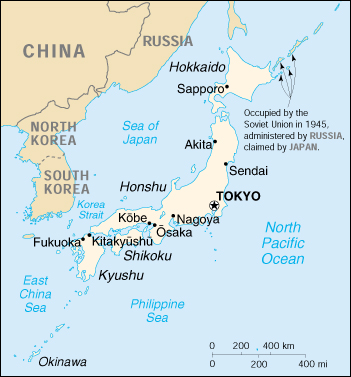
Background: While retaining its time-honored culture, Japan rapidly absorbed Western technology during the late 19th and early 20th centuries. After its devastating defeat in World War II, Japan recovered to become the second most powerful economy in the world and a staunch ally of the US. While the emperor retains his throne as a symbol of national unity, actual power rests in networks of powerful politicians, bureaucrats, and business executives. The economy experienced a major slowdown in the 1990s following three decades of unprecedented growth.
Government type: constitutional monarchy
Capital: Tokyo
Currency: yen
Geography of Japan
Location: Eastern Asia, island chain between the North Pacific Ocean and the Sea of Japan, east of the Korean Peninsula
Geographic coordinates: 36 00 N, 138 00 E
Area:
total: 377,835 sq. km
land: 374,744 sq. km
water: 3,091 sq. km
note: includes Bonin Islands (Ogasawara-gunto), Daito-shoto, Minami-jima, Okino-tori-shima, Ryukyu Islands (Nansei-shoto), and Volcano Islands (Kazan-retto)
Land boundaries: 0 km
Coastline: 29,751 km
Maritime claims:
exclusive economic zone: 200 nm
territorial sea: 12 nm; between 3 nm and 12 nm in the international straits – La Perouse or Soya, Tsugaru, Osumi, and Eastern and Western Channels of the Korea or Tsushima Strait
Climate: varies from tropical in south to cool temperate in north
Terrain: mostly rugged and mountainous
Elevation extremes:
lowest point: Hachiro-gata -4 m
highest point: Fujiyama 3,776 m
Natural resources: negligible mineral resources, fish
Land use:
arable land: 11%
permanent crops: 1%
permanent pastures: 2%
forests and woodland: 67%
other: 19% (1993 est.)
Irrigated land: 27,820 sq. km (1993 est.)
Natural hazards: many dormant and some active volcanoes; about 1,500 seismic occurrences (mostly tremors) every year; tsunamis
Environment – current issues: air pollution from power plant emissions results in acid rain; acidification of lakes and reservoirs degrading water quality and threatening aquatic life; Japan is one of the largest consumers of fish and tropical timber, contributing to the depletion of these resources in Asia and elsewhere.
Environment – international agreements:
party to: Antarctic-Environmental Protocol, Antarctic-Marine Living Resources, Antarctic Seals, Antarctic Treaty, Biodiversity, Climate Change, Desertification, Endangered Species, Environmental Modification, Hazardous Wastes, Law of the Sea, Marine Dumping, Nuclear Test Ban, Ozone Layer Protection, Ship Pollution, Tropical Timber 83, Tropical Timber 94, Wetlands, Whaling
signed, but not ratified: Climate Change-Kyoto Protocol
Geography – note: strategic location in northeast Asia
People of Japan
Japan’s population has experienced a phenomenal growth rate during the past 100 years as a result of scientific, industrial, and sociological changes, but this has recently slowed because of falling birth rates. High sanitary and health standards produce a long life expectancy.
Japan is an urban society with only about 7% of the labor force engaged in agriculture. Many farmers supplement their income with part-time jobs in nearby towns and cities. About 80 million of the urban population is heavily concentrated on the Pacific shore of Honshu and in northern Kyushu.
Metropolitan Tokyo with approximately 14 million; Yokohama with 3.3 million; Osaka 2.6 million; Nagoya 2.1 million; Kyoto 1.5 million; Sapporo 1.6 million; Kobe 1.4 million; and Kitakyushu, Kawasaki, and Fukuoka with 1.2 million each account for part of this population. Japan faces the same problems that confront urban industrialized societies throughout the world: overcrowded cities, congested highways, air pollution, and rising juvenile delinquency.
Shintoism and Buddhism are Japan’s two principle religions. Shintoism is founded on myths and legends emanating from the early animistic worship of natural phenomena. Since it was unconcerned with problems of afterlife which dominate Buddhist thought, and since Buddhism easily accommodated itself to local faiths, the two religions comfortably coexisted, and Shinto shrines and Buddhist monasteries often became administratively linked. Today many Japanese are adherents of both faiths.
Population: 127,417,244 (July 2005 est.)
Age structure:
0-14 years: 14.64%
15-64 years: 67.83%
65 years and over: 17.53%
Population growth rate: 0.17%
Birth rate: 10.04 births/1,000 population
Death rate: 8.34 deaths/1,000 population
Net migration rate: 0 migrant(s)/1,000 population
Infant mortality rate: 3.88 deaths/1,000 live births
Life expectancy at birth:
total population: 80.8 years
male: 77.62 years
female: 84.15 years
Total fertility rate: 1.41 children born/woman
Nationality:
noun: Japanese (singular and plural)
adjective: Japanese
Ethnic groups: Japanese 99.4%, Korean 0.6% (1999)
Religions: observe both Shinto and Buddhist 84%, other 16% (including Christian 0.7%)
Languages: Japanese
Literacy:
definition: age 15 and over can read and write
total population: 99% (1970 est.)
The mountainous islands of the Japanese Archipelago form a crescent off the eastern coast of Asia. They are separated from the mainland by the Sea of Japan, which historically served as a protective barrier. Japan’s insular nature, together with the compactness of its main territory and the cultural homogeneity of its people, enabled the nation to remain free of outside domination until its defeat in World War II. The country consists of four principal islands: Hokkaido, Honshu, Shikoku, and Kyushu; more than 3,000 adjacent islands and islets, including Oshima in the Nampo chain; and more than 200 other smaller islands, including those of the Amami, Okinawa, and Sakishima chains of the Ryukyu Islands. The national territory also includes the small Bonin Islands (called Ogasawara by the Japanese), Iwo Jima, and the Volcano Islands (Kazan Retto), stretching some 1,100 kilometers from the main islands. A territorial dispute with the Soviet Union, dating from the end of World War II, over the two southernmost of the Kuril Islands, Etorofu and Kunashiri, and the smaller Shikotan and Habomai Islands northeast of Hokkaido remained a sensitive spot in Japanese-Russian relations as the mid-1990s approached. Excluding disputed territory, the archipelago covers about 377,000 square kilometers. No point in Japan is more than 150 kilometers from the sea.
The four major islands are separated by narrow straits and form a natural entity. The Ryukyu Islands curve 970 kilometers southward from Kyushu.
The distance between Japan and the Korean Peninsula, the nearest point on the Asian continent, is about 200 kilometers at the Korea Strait. Japan has always been linked with the continent through trade routes, stretching in the north toward Siberia, in the west through the Tsushima Islands to the Korean Peninsula, and in the south to the ports on the south China coast.
The Japanese islands are the summits of mountain ridges uplifted near the outer edge of the continental shelf. About 75 percent of Japan’s area is mountainous, and scattered plains and intermontane basins (in which the population is concentrated) cover only about 25 percent. A long chain of mountains runs down the middle of the archipelago, dividing it into two halves, the “face,” fronting on the Pacific Ocean, and the “back,” toward the Sea of Japan. On the Pacific side are steep mountains 1,500 to 3,000 meters high, with deep valleys and gorges. Central Japan is marked by the convergence of the three mountain chains–the Hida, Kiso, and Akaishi mountains–that form the Japanese Alps (Nihon Arupusu), several of whose peaks are higher than 3,000 meters. The highest point in the Japanese Alps is Kitadake at 3,192 meters. The highest point in the country is Mount Fuji (Fujisan, also called Fujiyama in the West but not in Japan), a volcano dormant since 1707 that rises to 3,776 meters above sea level in Shizuoka Prefecture. On the Sea of Japan side are plateaus and low mountain districts, with altitudes of 500 to 1,500 meters.
None of the populated plains or mountain basins is extensive in area. The largest, the Kanto Plain, where Tokyo is situated, covers only 13,000 square kilometers. Other important plains are the Nobi Plain surrounding Nagoya, the Kinki Plain in the Osaka-Kyoto area, the Sendai Plain around the city of Sendai in northeastern Honshu, and the Ishikari Plain on Hokkaido. Many of these plains are along the coast, and their areas have been increased by reclamation throughout recorded history.
The small amount of habitable land prompted significant human modification of the terrain over many centuries. Land was reclaimed from the sea and from river deltas by building dikes and drainage, and rice paddies were built on terraces carved into mountainsides. The process continued in the modern period with extension of shorelines and building of artificial islands for industrial and port development, such as Port Island in Kobe and the new Kansai International Airport in Osaka Bay. Hills and even mountains have been razed to provide flat areas for housing.
Rivers are generally steep and swift, and few are suitable for navigation except in their lower reaches. Most rivers are fewer than 300 kilometers in length, but their rapid flow from the mountains provides a valuable, renewable resource: hydroelectric power generation. Japan’s hydroelectric power potential has been exploited almost to capacity. Seasonal variations in flow have led to extensive development of flood control measures. Most of the rivers are very short. The longest, the Shinano, which winds through Nagano Prefecture to Niigata Prefecture and flows into the Sea of Japan, is only 367 kilometers long. The largest freshwater lake is Lake Biwa, northeast of Kyoto.
Extensive coastal shipping, especially around the Inland Sea (Seto Naikai), compensates for the lack of navigable rivers. The Pacific coastline south of Tokyo is characterized by long, narrow, gradually shallowing inlets produced by sedimentation, which has created many natural harbors. The Pacific coastline north of Tokyo, the coast of Hokkaido, and the Sea of Japan coast are generally unindented, with few natural harbors.
Geographic Regions
The country’s forty-seven prefectures are grouped into eight regions frequently used as statistical units in government documents. The islands of Hokkaido, Shikoku, and Kyushu each form a region, and the main island of Honshu is divided into five regions.
Hokkaido
Hokkaido, about 83,500 square kilometers in area, constitutes more than 20 percent of Japan’s land area. Like the other main islands, Hokkaido is generally mountainous, but its mountains are lower than in other parts of Japan; many have leveled summits, and hills predominate. Valleys cut through the terrain, and communications are comparatively easy. Hokkaido was long looked upon as a remote frontier area and until the second half of the nineteenth century was left largely to the indigenous Ainu. The Ainu number fewer than 20,000, and they are being rapidly assimilated into the main Japanese population. Since the movement of modern technology and development into the area in the late nineteenth century, Hokkaido has been considered the major center of Japanese agriculture, forestry, fishing, and mining. Hokkaido, with about 90 percent of Japan’s pastureland, produces the same proportion of its dairy products. Manufacturing industry played a smaller role compared with the other regions.
Hokkaido’s environmental quality and rural character were altered by industrial and residential development in the 1980s, with developments such as the completion of the Seikan Tunnel linking Hokkaido and Honshu. Hokkaido is both an important agricultural center and a growing industrial area, with most industrial development near Sapporo, the prefectural capital.
Tohoku
The northeastern part of Honshu, called Tohoku (literally, “the northeast”), includes six prefectures. Tohoku, like most of Japan, is hilly or mountainous. Its initial historical settlement occurred between the seventh and ninth centuries A.D., well after Japanese civilization and culture had become firmly established in central and southwestern Japan. Although iron, steel, cement, chemical, pulp, and petroleum-refining industries began developing in the 1960s, Tohoku was traditionally considered the granary of Japan because it supplied Sendai and the Tokyo-Yokohama market with rice and other farm commodities. Tohoku provided 20 percent of the nation’s rice crop. The climate, however, is harsher than in other parts of Honshu and permits only one crop a year on paddy land.
The inland location of many of the region’s lowlands has led to a concentration of much of the population there. Coupled with coastlines that do not favor port development, this settlement pattern resulted in a much greater than usual dependence on land and railroad transportation. Low points in the central mountain range fortunately make communications between lowlands on either side of the range moderately easy. Tourism became a major industry in the Tohoku region, with points of interest including the islands of Matsushima Bay, Lake Towada, the Rikuchu Coastline National Park, and the Bandai-Asahi National Park.
Kanto
The Kanto (“east of the barrier”) region encompasses seven prefectures around Tokyo on the Kanto Plain. The plain itself, however, makes up only slightly more than 40 percent of the region. The rest consists of the hills and mountains that border it except on the seaward side. Once the heartland of feudal power, the Kanto became the center of modern development. Within the Tokyo-Yokohama metropolitan area, the Kanto houses not only Japan’s seat of government but also the largest group of universities and cultural institutions, the greatest population, and a large industrial zone. Although most of the Kanto Plain is used for residential, commercial, or industrial construction, it is still farmed. Rice is the principal crop, although the zone around Tokyo and Yokohama has been landscaped to grow garden produce for the metropolitan market.
The Kanto region is the most highly developed, urbanized, and industrialized part of Japan. Tokyo and Yokohama form a single industrial complex with a concentration of light and heavy industry along Tokyo Bay. Smaller cities, farther away from the coast, house substantial light industry. The average population density reached 1,192 persons per square kilometer in 1991.
Chubu
The Chubu, or central, region encompasses nine prefectures in the midland of Japan, west of the Kanto region. The region is the widest part of Honshu and is characterized by high, rugged mountains. The Japanese Alps divide the country into the sunnier Pacific side, known as the front of Japan, or Omote-Nihon, and the colder Sea of Japan side, or Ura-Nihon, the back of Japan. The region comprises three distinct districts: Hokuriku, a coastal strip on the Sea of Japan that is a major wet-rice producing area; Tosan, or the Central Highlands; and Tokai, or the eastern seaboard, a narrow corridor along the Pacific Coast.
Hokuriku lies west of the massive mountains that occupy the central Chubu region. The district has a very heavy snowfall and strong winds. Its turbulent rivers are the source of abundant hydroelectric power. Niigata Prefecture is the site of domestic gas and oil production. Industrial development is extensive, especially in the cities of Niigata and Toyama. Fukui and Kanazawa also have large manufacturing industries. Hokuriku developed largely independently of other regions, mainly because it remained relatively isolated from the major industrial and cultural centers on the Pacific Coast. Because port facilities are limited and road transport hampered by heavy winter snows, the district relied largely on railroad transportation.
The Tosan district is an area of complex and high rugged mountains–often called the roof of Japan–that include the Japanese Alps. The population is chiefly concentrated in six elevated basins connected by narrow valleys. Tosan was long a main silk-producing area, although output declined after World War II. Much of the labor formerly required in silk production was absorbed by the district’s diversified manufacturing industry, which included precision instruments, machinery, textiles, food processing, and other light manufacturing.
The Tokai district, bordering the Pacific Ocean, is a narrow corridor interrupted in places by mountains that descend into the sea. Since the Tokugawa period (1600-1867), this corridor has been important in linking Tokyo, Kyoto, and Osaka. One of old Japan’s most famous roads, the Tokaido, ran through it connecting Edo (Tokyo, since 1868) and Kyoto, the old imperial capital; in the twentieth century, it became the route of new super-express highways and high-speed railroad lines.
A number of small alluvial plains are found in the corridor section. A mild climate, favorable location relative to the great metropolitan complexes, and availability of fast transportation have made them truck-gardening centers for out-of-season vegetables. Upland areas of rolling hills are extensively given over to the growing of mandarin oranges and tea. The corridor also has a number of important small industrial centers. The western part of Tokai includes the Nobi Plain, where rice was grown by the seventh century A.D. Nagoya, facing Ise Bay, is a center for heavy industry, including iron and steel and machinery manufacturing.
Kinki
The Kinki region lies to the west of Tokai and consists of seven prefectures forming a comparatively narrow area of Honshu, stretching from the Sea of Japan on the north to the Pacific Ocean on the south. It includes Japan’s second largest industrialcommercial complex, centered on Osaka and Kobe, and the two former capital cities of Nara and Kyoto, seats of the imperial family from the early eighth century A.D. until the Meiji Restoration in 1868. The area is rich in imperial and cultural history and attracts many Japanese and foreign tourists.
The Osaka Plain is the site of Osaka, Kobe, and a number of intermediate-sized industrial cities, which together form the Hanshin commercial-industrial complex. Since the 1980s, the suburbs of Osaka have been given over to farming, including vegetables, dairy farming, poultry raising, and rice cultivation. These areas were progressively reduced as the cities expanded and residential areas, including numerous so-called “new cities,” were built, such as the developments north of Osaka resulting from the Osaka International Exposition (Expo ’70) world’s fair.
Chugoku
The Chugoku region, occupying the western end of Honshu, encompasses five prefectures. It is characterized by irregular rolling hills and limited plain areas and is divided into two distinct parts by mountains running east and west through its center. The northern, somewhat narrower, district is known as San’in, or “shady side of the mountain,” and the southern district is known as San’y , or “sunny side,” because of the marked differences in climate. The whole Inland Sea region, including San’yo, underwent rapid development in the late twentieth century. The city of Hiroshima, rebuilt after being destroyed by the atomic bomb in 1945, is an industrial metropolis of more than 1 million people. Overfishing and pollution reduced the productivity of the Inland Sea fishing grounds
Shikoku
The Shikoku region–comprising the entire island of Shikoku– covers about 18,800 square kilometers and consists of four prefectures. It is connected to Honshu by ferry and air and, since 1988, by the Seto- Ohashi bridge network. Until completion of the bridges, the region was isolated from the rest of Japan, and the freer movement between Honshu and Shikoku is expected to promote economic development on both sides of the bridges.
Mountains running east and west divide Shikoku into a narrow northern subregion, fronting on the Inland Sea, and a southern part facing the Pacific Ocean. Most of the population lives in the north, and all but one of the island’s few larger cites are located there. Industry is moderately well developed and includes the processing of ores from the important Besshi copper mine. Land is used intensively. Wide alluvial areas, especially in the eastern part of the zone, are planted with rice and subsequently are double cropped with winter wheat and barley. Fruit is grown throughout the northern area in great variety, including citrus fruits, persimmons, peaches, and grapes.
The larger southern area of Shikoku is mountainous and sparsely populated. The only significant lowland is a small alluvial plain at Kochi, a prefectural capital. The area’s mild winters stimulated some truck farming, specializing in growing out-of-season vegetables under plastic covering. Two crops of rice can be cultivated annually in the southern area. The pulp and paper industry took advantage of the abundant forests and hydroelectric power.
Kyushu
Kyushu, meaning “nine provinces” (from its ancient administrative structure), is the southernmost of the main islands and in modern times comprises seven prefectures. It was the stepping stone to Honshu for early migrants from the Korean Peninsula and a channel for the spread of ideas from the Asian mainland. Kyushu lies at the western end of the Inland Sea. Its northern extremity is only about 1.6 kilometers from Honshu, and the two islands are connected by the Kammon Bridge and by three tunnels, including one for the Japan Railways Group’s Shinkansen (bullet train). The region is divided not only geographically but also economically by the Kyushu Mountains, which run diagonally across the middle of the island. The north, including the Kitakyushu industrial region, became increasingly urbanized and industrialized after World War II, while the agricultural south became relatively poorer. The hilly northwestern part of the island has extensive coal deposits, the second largest in Japan, which formed the basis for a large iron and steel industry. An extensive lowland area in the northwest between Kumamoto and Saga is an important farming district.
The climate of Kyushu is generally warm and humid, and the cultivation of vegetables and fruits is supplemented by cattle raising. The cities of Kitakyushu and Sasebo are noted for iron and steel production, and Nagasaki is noted for manufacturing. Nagasaki is a city of historical and cultural importance, a center for Chinese and Western influences from the sixteenth century on, and the only port open to foreign ships during most of the Tokugawa period. Like Hiroshima, it also was rebuilt after being devastated by an atomic bomb attack in 1945.
Ryukyu Islands
The Ryukyu Islands include more than 200 islands and islets– some little more than coral outcrops–of which less than half are populated. They extend in a chain generally southwestward from the Tokara Strait, which separates them from the outlying islands of Kyushu, to within 120 kilometers of Taiwan. The Ryukyus are considered part of the Ryushu region but historically have been quite distinctively separate from the rest of the region.
The islands are the tops of mountain ranges along the outer edge of the continental shelf. They are generally hilly or mountainous, with active volcanos occurring mainly in the northern part of the archipelago. Okinawa is the largest and economically the most important of the Ryukyus. There is little industry, and the economy relies heavily on tourism. Northern Okinawa is quite rugged and forested, while the southern part consists of rolling hills. Although agriculture and fishing remained the occupations of most of the population in the Ryukyus, the region experienced considerable industrial expansion during the period of United States occupation from 1945 to 1972.
History of Japan
The origins of Japanese civilization are buried in legend, with the country’s first written records dating from the sixth to the eighth centuries A.D., after Japan had adopted the Chinese writing system. Early in the sixth century, Chinese Buddhism was introduced to Japan by way of Korea, and with it came many Chinese governmental and fiscal practices. A society of individual military rulers, each responsible for his own area, evolved into an imperial system codified in the Taiho-ryoritsu (Great Treasure Code) of 701. Imperial control was gradually spread throughout the main island of Honshu and eventually to all of Japan by military conquest. The leaders of these conquests were rewarded with large landholdings. By the tenth century, these military leaders had evolved into a warrior class–the bushi, or samurai–that supplanted the central authority of the emperor, and Japanese society evolved into a feudal economy in which the large landholdings of the samurai were supported by local peasants, artisans, and merchants. Beginning in the seventeenth century, the Tokugawa shoguns, like earlier military rulers under the same title, asserted control over a newly reunified Japan. They also closed the country to outside influences and developed the national premodern economy.
When Japan was reopened in the middle of the nineteenth century, the traditional political, military, and economic systems were no match for powerful foreign intruders, and the shogun’s government failed. It was replaced by a new oligarchy of strong regional leaders who brought about the Meiji Restoration–the ostensible restoration of imperial power–in 1868. The Meiji rulers carried out wholesale radical reforms. The government hired thousands of foreigners to teach modern science, mathematics, and foreign languages and sent a multitude of students and envoys to Europe and North America to learn the lessons that had bypassed them during the years of exclusion. They returned to combine foreign ideology and modern methods with Japanese traditions, devising a governmental and economic system that was totally new yet uniquely Japanese. The government also built factories and shipyards to help private businesses get started. These businesses developed rapidly into large conglomerates, some of which dominated the world of business in the early 1990s. Transportation and industry were modernized; the military was reorganized and equipped with up-to-date weapons; and under the 1889 constitution, Japan took the first steps toward representative government.
For the remainder of the nineteenth century and into the twentieth century, the economy grew at a moderate rate, although it remained heavily dependent on agriculture. After the development of a strong economic and industrial base at home, successful wars annexing Taiwan and Korea, and the growth of spheres of influence over a large part of the Chinese mainland, Japan began to exert its influence throughout the Asia-Pacific region. In the late 1920s, industry outstripped agriculture, and in the 1930s industry, little affected by the Great Depression plaguing the rest of the industrialized world, continued to grow. Using the strong Japanese economy to support their imperialistic designs, ultranationalist military officers succeeded in stifling the young democracy and took control of the government in the name of the emperor. With their power unchecked, the militarist government led the nation into a series of military conflicts that culminated in the almost total destruction of the nation during World War II.
World War II destroyed nearly half of Japan’s industry. Japan’s economy was completely disrupted, and the country was forced to rely on United States assistance and imports of essential food and raw material. Large-scale procurements by United States armed forces during the Korean War (1950-53) revived Japanese industry, and the country invested heavily in replacing the destroyed factories with modern, well-equipped factories. By the mid-1950s, modern plants staffed by a well-educated, disciplined work force had brought the Japanese economy back to pre-World War II levels. For the remainder of the 1950s, however, Japan endured chronic trade deficits. Unhampered by large military expenditures, the Japanese economy continued to grow at a rapid pace into the next decade. Japanese trade relations improved dramatically during the 1960s, attaining a favorable balance, and Japanese industry felt confident enough to compete in the international market in such heavy industrial products as automobiles, ships, and machine tools.
The Ministry of International Trade and Industry (MITI), formed in 1949, played a major role in the 1950s and 1960s in formulating and implementing Japan’s international trade policy, assisting the development of domestic industry and protecting it from foreign competition. MITI’s authority gradually decreased as private industry and other ministries took more responsibility on themselves. By the late 1980s, MITI’s control over international trade policy was greatly reduced. The Japan External Trade Organization (JETRO) was established by MITI in 1958 to promote Japan’s external trade. Over the years, JETRO’s role diversified; it went from promoting exports to fostering all aspects of Japan’s trade relations and enhancing understanding with trading partners.
In the immediate postwar period, the operations of Japanese financial institutions were severely restricted. In the 1970s, controls began to loosen, and these institutions rapidly expanded their international activities. By the late 1980s, they were major international players, making Tokyo a world financial center and opening branches abroad to foster foreign investments. During the late 1980s, Japan became the world’s largest creditor nation and was home to some of the world’s largest banking and financial institutions. Japanese securities firms played a major role in international finances and were members of major world stock exchanges. In 1988 the Tokyo Securities and Stock Exchange became the world’s largest, while the Osaka Stock Exchange ranked third behind Tokyo and the New York Stock Exchange. Beginning in 1986, the Tokyo exchange permitted foreign brokerage firms to be members. Japan also played an increasing role in international economic organizations and agreements, especially the Asian Development Bank and the General Agreement on Tariffs and Trade (GATT). Japan has a strong private enterprise economy, although public corporations played a very important role in the early postwar period. By the 1980s, however, their role was considerably decreased, and some of the largest were privatized. The thriving private enterprise sector was dominated by large corporations with affiliated smaller firms. Labor-management relations were generally harmonious, and labor productivity was high.
Japan promoted exports by developing world-class industries and providing incentives for firms to export. In the postwar period, export incentives mainly took the form of tax relief and government assistance to build export industries along with heavy import barriers. As Japanese industry regained its strength in the 1960s, the government gradually liberalized its trade policy, and tax incentives were eliminated. In the 1970s, a strong rise in the value of the yen under the new system of floating exchange rates and the oil price shocks of 1973 and 1979 brought large trade deficits. The situation spurred Japan to reduce its dependence on unreliable foreign petroleum by conservation and diversification of sources and to sharply increase its exports to offset the high cost of raw materials. In the 1980s, with the dramatic drop in the cost of raw materials, Japan developed a large trade surplus. Export policy shifted to export restraints on certain products that were causing the greatest tensions with trading partners, and Japan greatly increased its foreign investment. This trend continued through the 1980s.
Japan’s foreign aid program, begun in the 1960s in the form of World War II reparations to other Asian countries, grew rapidly during the 1980s. In the late 1980s, Japanese assistance consisted of bilateral grants and loans as well as support to multilateral aid organizations.
In the postwar period, Japan concentrated on rebuilding its economy, attempted to cultivate friendly ties with all nations, and relied on the United States for military security. By the 1970s, this foreign policy began to be called into question as Japan came into its own as a world economic power. In the 1980s, Japan became a leading industrial nation, the world’s largest creditor nation and largest donor of foreign aid, and a major actor in international financial institutions such as the World Bank and the International Monetary Fund. People at home and abroad expect Japan to play a diplomatic role proportionate to its economic power and its role in foreign assistance, trade, and investment. But popular sentiment in Japan and its Asian neighbors continues strongly to oppose Japan’s assuming the military role expected of a world power.
Because of their tragic experience with a military-controlled government before and during World War II, the Japanese people readily accepted the military restrictions written into the 1947 constitution at the insistence of occupation forces and still generally interpret Article 9 of the constitution as forbidding the SDF from being deployed outside of the country or possessing nuclear weapons. Japan still depends on the 1960 Treaty of Mutual Cooperation and Security with the United States, which mandates that the United States will come to its aid in the event of a large-scale invasion and which allows for United States provision of a nuclear umbrella. There is little popular sentiment for change in this arrangement.
The 1947 constitution, with its stipulation of a symbolic role for the emperor, guarantees of civil and human rights, and renunciation of war, remains the operative basis for Japanese government. By pragmatic collaboration with big business, small business, agriculture, and professional groups, the Liberal Democratic Party (LDP) dominated Japanese politics from the time it was formed as a coalition of smaller conservative groups in 1955 until it lost majority power in July 1993. Although LDP fortunes have risen and ebbed over the years since its establishment, opposition parties were unable to oust it from power. However, in the early 1990s the LDP became so divided that enough factions split away to weaken the LDP majority. Despite maintaining a plurality in the House of Delegates, the LDP was forced to join a series of short-term coalitions in order to maintain a voice in government.
The LDP formed a governing coalition with the Liberal Party and Komeito Party in 1999. Prime Minister Obuchi suffered a stroke in April 2000 and was replaced by Yoshiro Mori. After the Liberal Party left the coalition in April 2000, Prime Minister Mori welcomed a Liberal Party splinter group, the New Conservative Party, into the ruling coalition. The three-party coalition made up of the LDP, New Komeito, and the Conservative Party maintained its majority in the Diet following the June 2000 Lower House elections. After a turbulent year in office in which he saw his approval ratings plummet to the single digits, Prime Minister Mori agreed to hold early elections for the LDP presidency in order to improve his party’s chances in crucial July 2001 Upper House elections. Riding a wave of grassroots desire for change, maverick politician Junichiro Koizumi won an upset victory on April 24, 2001, over former Prime Minister Hashimoto and other party stalwarts on a platform of economic and political reform. Koizumi was elected as Japan’s 87th Prime Minister on April 26, 2001.
Historical Setting
“NOTHING SIMILAR MAY be found in foreign lands,” wrote Kitabatake Chikafusa when he described Japan in his fourteenthcentury Jinno sh t ki (Chronicle of the Direct Descent of the Divine Sovereigns). Although Japan’s culture developed late in Asian terms and was much influenced by China and later the West, its history, like its art and literature, is special among world civilizations. As some scholars have argued, these outside influences may have “corrupted” Japanese traditions, yet once absorbed they also enriched and strengthened the nation, forming part of a vibrant and unique culture.
Early in Japan’s history, society was controlled by a ruling elite of powerful clans. The most powerful emerged as a kingly line and later as the imperial family in Yamato (modern Nara Prefecture or possibly in northern Kyushu) in the third century A.D., claiming descent from the gods who created Japan. An imperial court and government, shaped by Chinese political and social institutions, was established. Often, powerful court families effected a hereditary regency, having established control over the emperor. The highly developed culture attained between the eighth and the twelfth centuries was followed by a long period of anarchy and civil war, and a feudal society developed in which military overlords ran the government on behalf of the emperor, his court, and the regent. Although the Yamato court continued control of the throne, in practice a succession of dynastic military regimes ruled the now-decentralized country. In the late sixteenth century, Japan began a process of reunification followed by a period of great stability and peace, in which contact with the outside world was limited and tightly controlled by the government.
Confronted by the West–inopportunely during the economically troubled late eighteenth and early nineteenth centuries–Japan emerged gradually as a modern, industrial power, exhibiting some democratic institutions by the end of World War I. Beginning in the mid-nineteenth century, phenomenal social upheaval, accompanied by political, military, and economic successes, led to an overabundance of nationalist pride and extremist solutions, and to even faster modernization. Representative government was finally replaced by increasingly authoritarian regimes, which propelled Japan into World War II. After the cataclysm of nuclear war, Japan rebuilt itself based on a new and earnest desire for peaceful development, becoming an economic superpower in the second half of the twentieth century.
NARA AND HEIAN PERIODS, A.D. 710-1185
Economic, Social, and Administrative Developments
Before the Taiho Code was established, the capital was customarily moved after the death of an emperor because of the ancient belief that a place of death was polluted. Reforms and bureaucratization of government led to the establishment of a permanent imperial capital at Heijokyo, or Nara, in A.D. 710. The capital at Nara, which gave its name to the new period (710-94), was styled after the grand Chinese Tang Dynasty (618-907) capital at Chang’an and was the first truly urban center in Japan. It soon had a population of 200,000, representing nearly 4 percent of the country’s population, and some 10,000 people worked in government jobs.
Economic and administrative activity increased during the Nara period. Roads linked Nara to provincial capitals, and taxes were collected more efficiently and routinely. Coins were minted, if not widely used. Outside the Nara area, however, there was little commercial activity, and in the provinces the old Shotoku land reform systems declined. By the mid-eighth century, shoen (landed estates), one of the most important economic institutions in medieval Japan, began to rise as a result of the search for a more manageable form of landholding. Local administration gradually became more self-sufficient, while the breakdown of the old land distribution system and the rise of taxes led to the loss or abandonment of land by many people who became the “wave people,” or ronin. Some of these formerly “public people” were privately employed by large landholders, and “public lands” increasingly reverted to the shoen.
Factional fighting at the imperial court continued throughout the Nara period. Imperial family members, leading court families, such as the Fujiwara, and Buddhist priests all contended for influence. In the late Nara period, financial burdens on the state increased, and the court began dismissing nonessential officials. In 792 universal conscription was abandoned, and district heads were allowed to establish private militia forces for local police work. Decentralization of authority became the rule despite the reforms of the Nara period. Eventually, to return control to imperial hands, the capital was moved in 784 to Nagaoka and in 794 to Heiankyo (Capital of Peace and Tranquillity), or Heian, about twenty-six kilometers north of Nara. By the late eleventh century, the city was popularly called Kyoto (Capital City), the name it has had every since.
Cultural Developments and the Establishment of Buddhism
Some of Japan’s literary monuments were written during the Nara period, including the Kojiki and Nihongi, the first national histories compiled in 712 and 720, respectively; the Man’yoshu (Collection of Ten Thousand Leaves), an anthology of poems; and the Kaifuso (Fond Recollections of Poetry), an anthology written in Chinese by Japanese emperors and princes. Another major cultural development of the era was the permanent establishment of Buddhism in Japan. Buddhism had been introduced in the sixth century but had a mixed reception until the Nara period, when it was heartily embraced by Emperor Shomu. Shomu and his Fujiwara consort were fervent Buddhists and actively promoted the spread of Buddhism, making it the “guardian of the state” and strengthening Japanese institutions through still further Chinese acculturation. During Shomu’s reign, the Todaiji (Great East Temple) was built, and within it was placed the Buddha Dainichi (Great Sun Buddha), a sixteen-meter-high, gilt-bronze statue. This Buddha was identified with the Sun Goddess, and from this point on, a gradual syncretism of Buddhism and Shinto ensued. Shomu declared himself the “Servant of the Three Treasures” of Buddhism: the Buddha, the law or teachings of Buddhism, and the Buddhist community.
Although these efforts stopped short of making Buddhism the state religion, Nara Buddhism heightened the status of the imperial family. Buddhist influence at court increased under the two reigns of Shomu’s daughter. As Empress Koken (r. 749-58) she brought many Buddhist priests into court. Koken abdicated in 758 on the advice of her cousin, Fujiwara Nakamaro. When the retired empress came to favor a Buddhist faith healer named Dokyo, Nakamaro rose up in arms in 764 but was quickly crushed. Koken charged the ruling emperor with colluding with Nakamaro and had him deposed. Koken reascended the throne as Empress Shotoku (r. 764-770). The empress commissioned the printing of 1 million prayer charms–the Hyakumanto dharani–many examples of which survive. The small scrolls, dating from 770, are among the earliest printed works in the world. Shotoku had the charms printed to placate the Buddhist clergy. She may even have wanted to make Dokyo emperor, but she died before she could act. Her actions shocked Nara society and led to the exclusion of women from imperial succession and the removal of Buddhist priests from positions of political authority.
Despite such machinations, Buddhism began to spread throughout Japan during the ensuing Heian period (794-1185), primarily through two major esoteric sects, Tendai (Heavenly Terrace) and Shingon (True Word). Tendai originated in China and is based on the Lotus Sutra, one of the most important sutras of Mahayana Buddhism. Shingon is an indigenous sect with close affiliations to original Indian, Tibetan, and Chinese Buddhist thought founded by Kukai (also called Kobo Daishi). Kukai greatly impressed the emperors who succeeded Emperor Kammu (782-806), and also generations of Japanese, not only with his holiness but also with his poetry, calligraphy, painting, and sculpture. Kammu himself was a notable patron of the otherworldly Tendai sect, which rose to great power over the ensuing centuries. A close relationship developed between the Tendai monastery complex on Mount Hiei and the imperial court in its new capital at the foot of the mountain. As a result, Tendai emphasized great reverence for the emperor and the nation.
The Fujiwara Regency
When Kammu moved the capital to Heian (Kyoto), which remained the imperial capital for the next 1,000 years, he did so not only to strengthen imperial authority but also to improve his seat of government geopolitically. Kyoto had good river access to the sea and could be reached by land routes from the eastern provinces. The early Heian period (794-967) continued Nara culture; the Heian capital was patterned on the Chinese capital at Chang’an, as was Nara, but on a larger scale. Despite the decline of the Taika-Taih reforms, imperial government was vigorous during the early Heian period. Indeed, Kammu’s avoidance of drastic reform decreased the intensity of political struggles, and he became recognized as one of Japan’s most forceful emperors.
Although Kammu had abandoned universal conscription in 792, he still waged major military offensives to subjugate the Emishi, possible descendants of the displaced Jomon, living in northern and eastern Japan. After making temporary gains in 794, in 797 Kammu appointed a new commander under the title seii taishogun (barbarian-subduing generalissimo; often referred to as shogun). By 801 the shogun had defeated the Emishi and had extended the imperial domains to the eastern end of Honshu. Imperial control over the provinces was tenuous at best, however. In the ninth and tenth centuries, much authority was lost to the great families, who disregarded the Chinese-style land and tax systems imposed by the government in Kyoto. Stability came to Heian Japan, but, even though succession was ensured for the imperial family through heredity, power again concentrated in the hands of one noble family, the Fujiwara.
Following Kammu’s death in 806 and a succession struggle among his sons, two new offices were established in an effort to adjust the Taika-Taiho administrative structure. Through the new Emperor’s Private Office, the emperor could issue administrative edicts more directly and with more self-assurance than before. The new Metropolitan Police Board replaced the largely ceremonial imperial guard units. While these two offices strengthened the emperor’s position temporarily, soon they and other Chinese-style structures were bypassed in the developing state. Chinese influence effectively ended with the last imperial-sanctioned mission to China in 838. Tang China was in a state of decline, and Chinese Buddhists were severely persecuted, undermining Japanese respect for Chinese institutions. Japan began to turn inward.
As the Soga had taken control of the throne in the sixth century, the Fujiwara by the ninth century had intermarried with the imperial family, and one of their members was the first head of the Emperor’s Private Office. Another Fujiwara became regent for his grandson, then a minor emperor, and yet another was appointed kanpaku (regent for an adult emperor). Toward the end of the ninth century, several emperors tried, but failed, to check the Fujiwara. For a time, however, during the reign of Emperor Daigo (897-930), the Fujiwara regency was suspended as he ruled directly.
Nevertheless, the Fujiwara were not demoted by Daigo but actually became stronger during his reign. Central control of Japan had continued to decline, and the Fujiwara, along with other great families and religious foundations, acquired ever larger shoen and greater wealth during the early tenth century. By the early Heian period, the shoen had obtained legal status, and the large religious establishments sought clear titles in perpetuity, waiver of taxes, and immunity from government inspection of the shoen they held. Those people who worked the land found it advantageous to transfer title to shoen holders in return for a share of the harvest. People and lands were increasingly beyond central control and taxation, a de facto return to conditions before the Taika Reform.
Within decades of Daigo’s death, the Fujiwara had absolute control over the court. By the year 1000, Fujiwara Michinaga was able to enthrone and dethrone emperors at will. Little authority was left for traditional officialdom, and government affairs were handled through the Fujiwara family’s private administration. The Fujiwara had become what historian George B. Sansom has called “hereditary dictators.”
Despite their usurpation of imperial authority, the Fujiwara presided over a period of cultural and artistic flowering at the imperial court and among the aristocracy. There was great interest in graceful poetry and vernacular literature. Japanese writing had long depended on Chinese ideograms (kanji), but these were now supplemented by kana, two types of phonetic Japanese script: katakana, a mnemonic device using parts of Chinese ideograms; and hiragana, a cursive form of katakana writing and an art form in itself. Hiragana gave written expression to the spoken word and, with it, to the rise in Japan’s famous vernacular literature, much of it written by court women who had not been trained in Chinese as had their male counterparts. Three late tenth-century and early eleventh-century women presented their views of life and romance at the Heian court in Kagero nikki (The Gossamer Years) by “the mother of Michitsuna,” Makura no soshi (The Pillow Book) by Sei Shonagon, and Genji monogatari (Tale of Genji)–the world’s first novel–by Murasaki Shikibu. Indigenous art also flourished under the Fujiwara after centuries of imitating Chinese forms. Vividly colored yamato-e (Japanese style) paintings of court life and stories about temples and shrines became common in the mid- and late Heian periods, setting patterns for Japanese art to this day.
As culture flourished, so did decentralization. Whereas the first phase of shoen development in the early Heian period had seen the opening of new lands and the granting of the use of lands to aristocrats and religious institutions, the second phase saw the growth of patrimonial “house governments,” as in the old clan system. (In fact, the form of the old clan system had remained largely intact within the great old centralized government.) New institutions were now needed in the face of social, economic, and political changes. The Taiho Code lapsed, its institutions relegated to ceremonial functions. Family administrations now became public institutions. As the most powerful family, the Fujiwara governed Japan and determined the general affairs of state, such as succession to the throne. Family and state affairs were thoroughly intermixed, a pattern followed among other families, monasteries, and even the imperial family. Land management became the primary occupation of the aristocracy, not so much because direct control by the imperial family or central government had declined but more from strong family solidarity and a lack of a sense of Japan as a single nation.
The Rise of the Military Class
Under the early courts, when military conscription had been centrally controlled, military affairs had been taken out of the hands of the provincial aristocracy. But as the system broke down after 792, local power holders again became the primary source of military strength. Shoen holders had access to manpower and, as they obtained improved military technology (such as new training methods, more powerful bows, armor, horses, and superior swords) and faced worsening local conditions in the ninth century, military service became part of shoen life. Not only the shoen but also civil and religious institutions formed private guard units to protect themselves. Gradually, the provincial upper class was transformed into a new military elite based on the ideals of the bushi (warrior) or samurai.
Bushi interests were diverse, cutting across old power structures to form new associations in the tenth century. Mutual interests, family connections, and kinship were consolidated in military groups that became part of family administration. In time, large regional military families formed around members of the court aristocracy who had become prominent provincial figures. These military families gained prestige from connections to the imperial court and court-granted military titles and access to manpower. The Fujiwara, Taira, and Minamoto were among the most prominent families supported by the new military class.
Decline in food production, growth of the population, and competition for resources among the great families all led to the gradual decline of Fujiwara power and gave rise to military disturbances in the mid-tenth and eleventh centuries. Members of the Fujiwara, Taira, and Minamoto families–all of whom had descended from the imperial family–attacked one another, claimed control over vast tracts of conquered land, set up rival regimes, and generally broke the peace of the Land of the Rising Sun.
The Fujiwara controlled the throne until the reign of Emperor Go-Sanjo (1068-73), the first emperor not born of a Fujiwara mother since the ninth century. Go-Sanjo, determined to restore imperial control through strong personal rule, implemented reforms to curb Fujiwara influence. He also established an office to compile and validate estate records with the aim of reasserting central control. Many shoen were not properly certified, and large landholders, like the Fujiwara, felt threatened with the loss of their lands. Go-Sanjo also established the Incho, or Office of the Cloistered Emperor, which was held by a succession of emperors who abdicated to devote themselves to behind-the-scenes governance, or insei (cloistered government).
The Incho filled the void left by the decline of Fujiwara power. Rather than being banished, the Fujiwara were mostly retained in their old positions of civil dictator and minister of the center while being bypassed in decision making. In time, many of the Fujiwara were replaced, mostly by members of the rising Minamoto family. While the Fujiwara fell into disputes among themselves and formed northern and southern factions, the insei system allowed the paternal line of the imperial family to gain influence over the throne. The period from 1086 to 1156 was the age of supremacy of the Incho and of the rise of the military class throughout the country. Military might rather than civil authority dominated the government.
A struggle for succession in the mid-twelfth century gave the Fujiwara an opportunity to regain their former power. Fujiwara Yorinaga sided with the retired emperor in a violent battle in 1158 against the heir apparent, who was supported by the Taira and Minamoto. In the end, the Fujiwara were destroyed, the old system of government supplanted, and the insei system left powerless as bushi took control of court affairs, marking a turning point in Japanese history. Within a year, the Taira and Minamoto clashed, and a twenty-year period of Taira ascendancy began. The Taira were seduced by court life and ignored problems in the provinces. Finally, Minamoto Yoritomo (1147-99) rose from his headquarters at Kamakura (in the Kanto region, southwest of modern Tokyo) to defeat the Taira, and with them the child emperor they controlled, in the Genpei War (1180-85).
KAMAKURA AND MUROMACHI PERIODS, 1185-1573
The Bakufu and the Hojo Regency
The Kamakura period (1185-1333) marks the transition to the Japanese “medieval” era, a nearly 700-year period in which the emperor, the court, and the traditional central government were left intact but were largely relegated to ceremonial functions. Civil, military, and judicial matters were controlled by the bushi class, the most powerful of whom was the de facto national ruler. The term feudalism is generally used to describe this period, being accepted by scholars as applicable to medieval Japan as well as to medieval Europe. Both had land-based economies, vestiges of a previously centralized state, and a concentration of advanced military technologies in the hands of a specialized fighting class. Lords required the loyal services of vassals, who were rewarded with fiefs of their own. The fief holders exercised local military rule and public power related to the holding of land. This period in Japan differed from the old shoen system in its pervasive military emphasis.
Once Minamoto Yoritomo had consolidated his power, he established a new government at his family home in Kamakura. He called his government a bakufu (tent government), but because he was given the title seii taishogun by the emperor, the government is often referred to in Western literature as the shogunate. Yoritomo followed the Fujiwara form of house government and had an administrative board, a board of retainers, and a board of inquiry. After confiscating Taira estates in central and western Japan, he had the imperial court appoint stewards for the estates and constables for the provinces. As shogun, Yoritomo was both the steward and the constable general. The Kamakura bakufu was not a national regime, however, and although it controlled large tracts of land, there was strong resistance to the stewards. The regime continued warfare against the Fujiwara in the north, but never brought either the north or the west under complete military control. The old court resided in Kyoto, continuing to hold the land over which it had jurisdiction, while newly organized military families were attracted to Kamakura.
Despite a strong beginning, Yoritomo failed to consolidate the leadership of his family on a lasting basis. Intrafamily contention had long existed within the Minamoto, although Yoritomo had eliminated most serious challengers to his authority. When he died suddenly in 1199, his son Yoriie became shogun and nominal head of the Minamoto, but Yoriie was unable to control the other eastern bushi families. By the early thirteenth century, a regency had been established for the shogun by his maternal grandparents– members of the Hojo family, a branch of the Taira that had allied itself with the Minamoto in 1180. Under the Hojo, the bakufu became powerless, and the shogun, often a member of the Fujiwara family or even an imperial prince, was merely a figurehead.
With the protector of the emperor a figurehead himself, strains emerged between Kyoto and Kamakura, and in 1221 a war–the Jokyu Incident–broke out between the cloistered emperor and the H j regent. The Hojo forces easily won the war, and the imperial court was brought under direct bakufu control. The shogun’s constables gained greater civil powers, and the court was obliged to seek Kamakura’s approval for all of its actions. Although deprived of political power, the court was allowed to retain extensive estates with which to sustain the imperial splendor the bakufu needed to help sanction its rule.
Several significant administrative achievements were made during the Hojo regency. In 1225 the Council of State was established, providing opportunities for other military lords to exercise judicial and legislative authority at Kamakura. The H j regent presided over the council, which was a successful form of collective leadership. The adoption of Japan’s first military code of law–the Joei Code–in 1232 reflected the profound transition from court to militarized society. While legal practices in Kyoto were still based on 500-year-old Confucian principles, the Joei Code was a highly legalistic document that stressed the duties of stewards and constables, provided means for settling land disputes, and established rules governing inheritances. It was clear and concise, stipulated punishments for violators of its conditions, and remained in effect for the next 635 years.
The Flourishing of Buddhism
In the time of disunity and violence, deepening pessimism increased the appeal of the search for salvation. Kamakura was the age of the great popularization of Buddhism. Two new sects, Jodo (Pure Land) and Zen (Meditation), dominated the period. The old Heian sects had been quite esoteric and appealed more to the intellectuals than to the masses. The Mount Hiei monasteries had become politically powerful but appealed primarily to those capable of systematic study of the sect’s teachings. This situation gave rise to the Jodo sect, based on unconditional faith and devotion and prayer to Amida Buddha. Zen rejected all temporal and scriptural authority, stressing moral character rather than intellectual attainments, an emphasis that appealed to the military class. Growing numbers of the military class turned to Zen masters, regarded as embodiments of truth.
Mongol Invasions
The repulsions of two Mongol invasions were momentous events in Japanese history. Japanese relations with China had been terminated in the mid-ninth century after the deterioration of late Tang China and the turning inward of the Heian court. Some commercial contacts were maintained with southern China in later centuries, but Japanese pirates made the open seas dangerous. At a time when the bakufu had little interest in foreign affairs and ignored communications from China and Koryo (as Korea was then known), news arrived in 1268 of a new Mongol regime in Beijing. Its leader, Khubilai Khan, demanded that the Japanese pay tribute to the new Yuan Dynasty (1279-1368) and threatened reprisals if they failed to do so. Unused to such threats, Kyoto raised the diplomatic counter of Japan’s divine origin, rejected the Mongol demands, dismissed the Korean messengers, and started defensive preparations. After further unsuccessful entreaties, the first Mongol invasion took place in 1274. More than 600 ships carried a combined Mongol, Chinese, and Korean force of 23,000 troops armed with catapults, combustible missiles, and bows and arrows. In fighting, these soldiers grouped in close cavalry formations against samurai, who were accustomed to one-on-one combat. Local Japanese forces at Hakata, on northern Kyushu, defended against the superior mainland force, which, after one day of fighting was decimated by the onslaught of a sudden typhoon. Khubilai realized that nature, not military incompetence, had been the cause of his forces’ failure so, in 1281, he launched a second invasion. Seven weeks of fighting took place in northwestern Kyushu before another typhoon struck, again destroying the Mongol fleet.
Although Shinto priests attributed the two defeats of the Mongols to a “divine wind” (kamikaze), a sign of heaven’s special protection of Japan, the invasion left a deep impression on the bakufu leaders. Long-standing fears of the Chinese threat to Japan were reinforced, and the Korean Peninsula became regarded as “an arrow pointed at the heart of Japan.” The Japanese victory, however, gave the bushi a sense of fighting superiority that remained with Japan’s soldiers until 1945. The victory also convinced the bushi of the value of the bakufu form of government.
The Mongol war had been a drain on the economy, and new taxes had to be levied to maintain defensive preparations for the future. The invasions also caused disaffection among those who expected recompense for their help in defeating the Mongols. There were no lands or other rewards to be given, however, and such disaffection, combined with overextension and the increasing defense costs, led to a decline of the Kamakura bakufu. Additionally, inheritances had divided family properties, and landowners increasingly had to turn to moneylenders for support. Roving bands of ronin further threatened the stability of the bakufu.
Civil War
The Hojo reacted to the ensuing chaos by trying to place more power among the various great family clans. To further weaken the Kyoto court, the bakufu decided to allow two contending imperial lines–known as the Southern Court or junior line and the Northern Court or senior line–to alternate on the throne. The method worked for several successions until a member of the Southern Court ascended to the throne as Emperor Go-Daigo (r. 1318- 39). Go-Daigo wanted to overthrow the bakufu, and he openly defied Kamakura by naming his own son his heir. In 1331 the bakufu exiled Go-Daigo, but loyalist forces rebelled. They were aided by Ashikaga Takauji (1305-58), a constable who turned against Kamakura when dispatched to put down Go-Daigo’s rebellion. At the same time, another eastern chieftain rebelled against the bakufu, which quickly disintegrated, and the Hojo were defeated.
In the swell of victory, Go-Daigo endeavored to restore imperial authority and tenth-century Confucian practices. This period of reform, known as the Kemmu Restoration (1333-36), aimed at strengthening the position of the emperor and reasserting the primacy of the court nobles over the bushi. The reality, however, was that the forces who had arisen against Kamakura had been set on defeating the Hojo, not on supporting the emperor. Ashikaga Takauji finally sided with the Northern Court in a civil war against the Southern Court represented by Go-Daigo. The long War Between the Courts lasted from 1336 to 1392. Early in the conflict, Go-Daigo was driven from Kyoto, and the Northern Court contender was installed by Ashikaga, who became the new shogun.
Ashikaga Bakufu
The ensuing period of Ashikaga rule (1336-1573) was called Muromachi for the district in which its headquarters were in Kyoto after 1378. What distinguished the Ashikaga bakufu from that of Kamakura was that, whereas Kamakura had existed in equilibrium with the Kyoto court, Ashikaga took over the remnants of the imperial government. Nevertheless, the Ashikaga bakufu was not as strong as the Kamakura had been and was greatly preoccupied by the civil war. Not until the rule of Ashikaga Yoshimitsu (as third shogun, 1368-94, and chancellor, 1394-1408) did a semblance of order emerge.
Yoshimitsu allowed the constables, who had had limited powers during the Kamakura period, to become strong regional rulers, later called daimyo (from dai, meaning great, and myoden, meanng named lands). In time, a balance of power evolved between the shogun and the daimyo; the three most prominent daimyo families rotated as deputies to the shogun at Kyoto. Yoshimitsu was finally successful in reunifying the Northern Court and the Southern Court in 1392, but, despite his promise of greater balance between the imperial lines, the Northern Court maintained control over the throne thereafter. The line of shoguns gradually weakened after Yoshimitsu and increasingly lost power to the daimyo and other regional strongmen. The shogun’s decisions about imperial succession became meaningless, and the daimyo backed their own candidates. In time, the Ashikaga family had its own succession problems, resulting finally in the Onin War (1467-77), which left Kyoto devastated and effectively ended the national authority of the bakufu. The power vacuum that ensued launched a century of anarchy.
Economic and Cultural Developments
Contact with Ming Dynasty (1368-1644) China was renewed during the Muromachi period after the Chinese sought support in suppressing Japanese pirates, or wako, who controlled the seas and pillaged coastal areas of China. Wanting to improve relations with China and to rid Japan of the wako threat, Yoshimitsu accepted a relationship with the Chinese that was to last for half a century. Japanese wood, sulfur, copper ore, swords, and folding fans were traded for Chinese silk, porcelain, books, and coins, in what the Chinese considered tribute but the Japanese saw as profitable trade.
During the time of the Ashikaga bakufu, a new national culture, called Muromachi culture, emerged from the bakufu headquarters in Kyoto to reach all levels of society. Zen Buddhism played a large role in spreading not only religious but also artistic influences, especially those derived from Chinese painting of the Chinese Song (960-1279), Yuan, and Ming dynasties. The proximity of the imperial court and the bakufu resulted in a commingling of imperial family members, courtiers, daimyo, samurai, and Zen priests. Art of all kinds–architecture, literature, No drama, comedy, poetry, the tea ceremony, landscape gardening, and flower arranging–all flourished during Muromachi times.
There also was renewed interest in Shinto, which had quietly coexisted with Buddhism during the centuries of the latter’s predominance. In fact, Shinto, which lacked its own scriptures and had few prayers, as a result of syncretic practices begun in the Nara period, had widely adopted Shingon Buddhist rituals. Between the eighth and fourteenth centuries, was nearly totally absorbed by Buddhism and became known as Ryobu Shinto (Dual Shinto). The Mongol invasions in the late thirteenth century, however, had evoked a national consciousness of the role of the kamikaze in defeating the enemy. Less than fifty years later (1339-43), Kitabatake Chikafusa (1293-1354), the chief commander of the Southern Court forces, wrote the Jinno sh t ki (Chronicle of the Direct Descent of the Divine Sovereigns). This chronicle emphasized the importance of maintaining the divine descent of the imperial line from Amaterasu to the current emperor, a condition that gave Japan a special national polity (kokutai). Besides reenforcing the concept of the emperor as a deity, the Jinno sh t ki provided a Shinto view of history, which stressed the divine nature of all Japanese and the country’s spiritual supremacy over China and India. As a result, a change gradually occurred in the balance between the dual Buddhist-Shinto religious practice. Between the fourteenth and seventeenth centuries, Shinto reemerged as the primary belief system, developed its own philosophy and scripture (based on Confucian and Buddhist canons), and became a powerful nationalistic force.
Provincial Wars and Foreign Contacts
The Onin War led to serious political fragmentation and obliteration of domains: a great struggle for land and power ensued among bushi chieftains until the mid-sixteenth century. Peasants rose against their landlords and samurai against their overlords as central control virtually ceased. The imperial house was left impoverished, and the bakufu was controlled by contending chieftains in Kyoto. The provincial domains that emerged after the Onin War were smaller and easier to control. Many new small daimyo arose from among the samurai who had overthrown their great overlords. Border defenses were improved, and wellfortified castle towns were built to protect the newly opened domains, for which land surveys were made, roads built, and mines opened. New house laws provided practical means of administration, stressing duties and rules of behavior. Emphasis was put on success in war, estate management, and finance. Threatening alliances were guarded against through strict marriage rules. Aristocratic society was overwhelmingly military in character. The rest of society was controlled in a system of vassalage. The shoen were obliterated, and court nobles and absentee landlords were dispossessed. The new daimyo directly controlled the land, keeping the peasantry in permanent serfdom in exchange for protection.
Most wars of the period were short and localized, although they occurred throughout Japan. By 1500 the entire country was engulfed in civil wars. Rather than disrupting the local economies, however, the frequent movement of armies stimulated the growth of transportation and communications, which in turn provided additional revenues from customs and tolls. To avoid such fees, commerce shifted to the central region, which no daimyo had been able to control, and to the Inland Sea. Economic developments and the desire to protect trade achievements brought about the establishment of merchant and artisan guilds.
By the end of the Muromachi period, the first Europeans had arrived. The Portuguese landed in southern Kyushu in 1543 and within two years were making regular port calls. The Spanish arrived in 1587, followed by the Dutch in 1609. The Japanese began to attempt studies of European civilization in depth, and new opportunities were presented for the economy, along with serious political challenges. European firearms, fabrics, glassware, clocks, tobacco, and other Western innovations were traded for Japanese gold and silver. Significant wealth was accumulated through trade, and lesser daimyo, especially in Kyushu, greatly increased their power. Provincial wars were made more deadly with the introduction of firearms, such as muskets and cannons, and greater use of infantry.
Christianity had an impact on Japan, largely through the efforts of the Jesuits, led first by Saint Francis Xavier (1506- 52), who arrived in Kagoshima in southern Kyushu in 1549. Both daimyo and merchants seeking better trade arrangements as well as peasants were among the converts. By 1560 Kyoto had become another major area of missionary activity in Japan. In 1568 the port of Nagasaki, in northwestern Kyushu, was established by a Christian daimyo and was turned over to Jesuit administration in 1579. By 1582 there were as many as 150,000 converts (2 percent of the population) and 200 churches. But bakufu tolerance for this alien influence diminished as the country became more unified and the openness of the period decreased. Proscriptions against Christianity began in 1587 and outright persecutions in 1597. Although foreign trade was still encouraged, it was closely regulated, and by 1640 the exclusion and suppression of Christianity had become national policy.
TOKUGAWA PERIOD, 1600-1867
Rule of Shogun and Daimyo
An evolution had taken place in the centuries from the time of the Kamakura bakufu, which existed in equilibrium with the imperial court, to the Tokugawa, when the bushi became the unchallenged rulers in what historian Edwin O. Reischauer called a “centralized feudal” form of government. Instrumental in the rise of the new bakufu was Tokugawa Ieyasu, the main beneficiary of the achievements of Nobunaga and Hideyoshi. Already powerful, Ieyasu profited by his transfer to the rich Kanto area. He maintained 2.5 million koku of land, had a new headquarters at Edo, a strategically situated castle town (the future Tokyo), and had an additional 2 million koku of land and thirtyeight vassals under his control. After Hideyoshi’s death, Ieyasu moved quickly to seize control from the Toyotomi family.
Ieyasu’s victory over the western daimyo at the Battle of Sekigahara (1600) gave him virtual control of all Japan. He rapidly abolished numerous enemy daimyo houses, reduced others, such as that of the Toyotomi, and redistributed the spoils of war to his family and allies. Ieyasu still failed to achieve complete control of the western daimyo, but his assumption of the title of shogun helped consolidate the alliance system. After further strengthening his power base, Ieyasu was confident enough to install his son Hidetada (1579-1632) as shogun and himself as retired shogun in 1605. The Toyotomi were still a significant threat, and Ieyasu devoted the next decade to their eradication. In 1615 the Toyotomi stronghold at Osaka was destroyed by the Tokugawa army.
The Tokugawa (or Edo) period brought 200 years of stability to Japan. The political system evolved into what historians call bakuhan, a combination of the terms bakufu and han (domains) to describe the government and society of the period. In the bakuhan, the shogun had national authority and the daimyo had regional authority, a new unity in the feudal structure, which had an increasingly large bureaucracy to administer the mixture of centralized and decentralized authorities. The Tokugawa became more powerful during their first century of rule: land redistribution gave them nearly 7 million koku, control of the most important cities, and a land assessment system reaping great revenues.
The feudal hierarchy was completed by the various classes of daimyo. Closest to the Tokugawa house were the shinpan, or “related houses.” They were twenty-three daimyo on the borders of Tokugawa lands, daimyo all directly related to Ieyasu. The shinpan held mostly honorary titles and advisory posts in the bakufu. The second class of the hierarchy were the fudai, or “house daimyo,” rewarded with lands close to the Tokugawa holdings for their faithful service. By the eighteenth century, 145 fudai controlled such smaller han, the greatest assessed at 250,000 koku. Members of the fudai class staffed most of the major bakufu offices. Ninety-seven han formed the third group, the tozama (outside vassals), former opponents or new allies. The tozama were located mostly on the peripheries of the archipelago and collectively controlled nearly 10 million koku of productive land. Because the tozama were least trusted of the daimyo, they were the most cautiously managed and generously treated, although they were excluded from central government positions.
The Tokugawa not only consolidated their control over a reunified Japan, they also had unprecedented power over the emperor, the court, all daimyo, and the religious orders. The emperor was held up as the ultimate source of political sanction for the shogun, who ostensibly was the vassal of the imperial family. The Tokugawa helped the imperial family recapture its old glory by rebuilding its palaces and granting it new lands. To ensure a close tie between the imperial clan and the Tokugawa family, Ieyasu’s granddaughter was made an imperial consort in 1619.
A code of laws was established to regulate the daimyo houses. The code encompassed private conduct, marriage, dress, and types of weapons and numbers of troops allowed; required alternateyear residence at Edo; prohibited the construction of ocean-going ships; proscribed Christianity; and stipulated that bakufu regulations were the national law. Although the daimyo were not taxed per se, they were regularly levied for contributions for military and logistical support and for such public works projects as castles, roads, bridges, and palaces. The various regulations and levies not only strengthened the Tokugawa but also depleted the wealth of the daimyo, thus weakening their threat to the central administration. The han, once military-centered domains, became mere local administrative units. The daimyo did have full administrative control over their territory and their complex systems of retainers, bureaucrats, and commoners. Loyalty was exacted from religious foundations, already greatly weakened by Nobunaga and Hideyoshi, through a variety of control mechanisms.
Seclusion and Social Control
Like Hideyoshi, Ieyasu encouraged foreign trade but also was suspicious of outsiders. He wanted to make Edo a major port, but once he learned that the Europeans favored ports in Kyushu and that China had rejected his plans for official trade, he moved to control existing trade and allowed only certain ports to handle specific kinds of commodities.
The “Christian problem” was, in effect, a problem controlling both the Christian daimyo in Kyushu and trade with the Europeans. By 1612 the shogun’s retainers and residents of Tokugawa lands had been ordered to foreswear Christianity. More restrictions came in 1616 (the restriction of foreign trade to Nagasaki and Hirado, an island northwest of Kyushu), 1622 (the execution of 120 missionaries and converts), 1624 (the expulsion of the Spanish), and 1629 (the execution of thousands of Christians). Finally, in 1635 an edict prohibited any Japanese from traveling outside Japan or, if someone left, from ever returning. In 1636 the Portuguese were restricted to Deshima, a man-made islet–and thus, not true Japanese soil–in Nagasaki’s harbor.
The Shimabara Rebellion of 1637-38, in which discontented Christian samurai and peasants rebelled against the bakufu– and Edo called in Dutch ships to bombard the rebel stronghold– marked the end of the Christian movement. Soon thereafter, the Portuguese were permanently expelled, members of the Portuguese diplomatic mission were executed, all subjects were ordered to register at a Buddhist or Shinto temple, and the Dutch and Chinese were restricted, respectively, to Deshima and to a special quarter in Nagasaki. Besides small trade of some outer daimyo with Korea and the Ryukyu Islands, to the southwest of Japan’s main islands, by 1641 foreign contacts were limited to Nagasaki.
Japanese society of the Tokugawa period was influenced by Confucian principles of social order. At the top of the hierarchy, but removed from political power, were the imperial court families at Kyoto. The real political power holders were the samurai, followed by the rest of society. In descending hierarchical order, they consisted of farmers, who were organized into villages, artisans, and merchants. Urban dwellers, often well-to-do merchants, were known as chonin (townspeople) and were confined to special districts. The individual had no legal rights in Tokugawa Japan. The family was the smallest legal entity, and the maintenance of family status and privileges was of great importance at all levels of society.
Economic Development
Economic development during the Tokugawa period included urbanization, more shipping of commodities, a significant expansion of domestic and, initially, foreign commerce, and a diffusion of trade and handicraft industries. By the mid-eighteenth century, Edo had a population of more than 1 million and Osaka and Kyoto each had more than 400,000 inhabitants. Many other castle towns grew as well. Osaka and Kyoto became busy trading and handicraft production centers, while Edo was the center for the supply of food and essential urban consumer goods. The construction trades flourished, along with banking facilities and merchant associations. Increasingly, han authorities oversaw the rising agricultural production and the spread of rural handicrafts.
Intellectual Trends
The flourishing of neo-Confucianism was the major intellectual development of the Tokugawa period. Confucian studies had long been kept active in Japan by Buddhist clerics, but during the Tokugawa period, Confucianism emerged from Buddhist religious control. This system of thought increased attention to a secular view of man and society. The ethical humanism, rationalism, and historical perspective of neo-Confucian doctrine appealed to the official class. By the mid-seventeenth century, neo-Confucianism was Japan’s dominant legal philosophy and contributed directly to the development of the kokugaku (national learning) school of thought.
Advanced studies and growing applications of neo-Confucianism contributed to the transition of the social and political order from feudal norms to class- and large-group-oriented practices. The rule of the people or Confucian man was gradually replaced by the rule of law. New laws were developed, and new administrative devices were instituted. A new theory of government and a new vision of society emerged as a means of justifying more comprehensive governance by the bakufu. Each person had a distinct place in society and was expected to work to fulfill his or her mission in life. The people were to be ruled with benevolence by those whose assigned duty it was to rule. Government was all-powerful but responsible and humane. Although the class system was influenced by neo-Confucianism, it was not identical to it. Whereas soldiers and clergy were at the bottom of the hierarchy in the Chinese model, in Japan some members of these classes constituted the ruling elite.
Members of the samurai class adhered to bushi traditions with a renewed interest in Japanese history and in cultivation of the ways of Confucian scholar-administrators, resulting in the development of the concept of bushido. Another special way of life– chonindo–also emerged. Chonindo (the way of the townspeople) was a distinct culture that arose in cities such as Osaka, Kyoto, and Edo. It encouraged aspiration to bushido qualities–diligence, honesty, honor, loyalty, and frugality–while blending Shinto, neo-Confucian, and Buddhist beliefs. Study of mathematics, astronomy, cartography, engineering, and medicine were also encouraged. Emphasis was placed on quality of workmanship, especially in the arts. For the first time, urban populations had the means and leisure time to support a new mass culture. Their search for enjoyment became known as ukiyo (the floating world), an ideal world of fashion and popular entertainment. Professional female entertainers (geisha), music, popular stories, Kabuki and bunraku (puppet) theater, poetry, a rich literature, and art, exemplified by beautiful woodblock prints (known as ukiyo-e), were all part of this flowering of culture. Literature also flourished with the talented examples of the playwright Chikamatsu Monzaemon (1653- 1724) and the poet, essayist, and travel writer Matsuo Basho (1644- 94).
Buddhism and Shinto were both still important in Tokugawa Japan. Buddhism, combined with neo-Confucianism, provided standards of social behavior. Although not as powerful politically as it had been in the past, Buddhism was espoused by the upper classes. Proscriptions against Christianity benefited Buddhism in 1640 when the bakufu ordered everyone to register at a temple. The rigid separation of Tokugawa society into han, villages, wards, and households helped reaffirm local Shinto attachments. Shinto provided spiritual support to the political order and was an important tie between the individual and the community. Shinto also helped preserve a sense of national identity.
Shinto eventually assumed an intellectual form as shaped by neo-Confucian rationalism and materialism. The kokugaku movement emerged from the interactions of these two beliefs systems. Kokugaku contributed to the emperor-centered nationalism of modern Japan and the revival of Shinto as a national creed in the eighteenth and nineteenth centuries. The Kojiki, Nihongi, and Man’yoshu were all studied anew in the search for the Japanese spirit. Some purists in the kokugaku movement even criticized the Confucian and Buddhist influences–in effect, foreign ones–for contaminating Japan’s ancient ways. Japan was the land of the kami and, as such, had a special destiny.
Knowledge of the West during the early Tokugawa periiod was restricted to a tiny school of thought known as Rangaku (Dutch Learning). Its adherents were mostly in Nagasaki, where the Dutch outpost was located on Deshima.
Decline of the Tokugawa
The Tokugawa did not eventually collapse simply because of intrinsic failures. Foreign intrusions helped to precipitate a complex political struggle between the bakufu and a coalition of its critics. The continuity of the anti-bakufu movement in the mid-nineteenth century would finally bring down the Tokugawa. From the outset, the Tokugawa attempted to restrict families’ accumulation of wealth and fostered a “back to the soil” policy, in which the farmer, the ultimate producer, was the ideal person in society. Despite these efforts to restrict wealth, and partly because of the extraordinary period of peace, the standard of living for urban and rural dwellers alike grew significantly during the Tokugawa period. Better means of crop production, transportation, housing, food, and entertainment were all available, as was more leisure time, at least for urban dwellers. The literacy rate was high for a preindustrial society, and cultural values were redefined and widely imparted throughout the samurai and chonin classes. Despite the reappearance of guilds, economic activities went well beyond the restrictive nature of the guilds, and commerce spread and a money economy developed. Although government heavily restricted the merchants and viewed them as unproductive and usurious members of society, the samurai, who gradually became separated from their rural ties, depended greatly on the merchants and artisans for consumer goods, artistic interests, and loans. In this way, a subtle subversion of the warrior class by the chonin took place.
A struggle arose in the face of political limitations that the shogun imposed on the entrepreneurial class. The government ideal of an agrarian society failed to square with the reality of commercial distribution. A huge government bureaucracy had evolved, which now stagnated because of its discrepancy with a new and evolving social order. Compounding the situation, the population increased significantly during the first half of the Tokugawa period. Although the magnitude and growth rates are uncertain, there were at least 26 million commoners and about 4 million members of samurai families and their attendants when the first nationwide census was taken in 1721. Drought, followed by crop shortages and starvation, resulted in twenty great famines between 1675 and 1837. Peasant unrest grew, and by the late eighteenth century, mass protests over taxes and food shortages had become commonplace. Newly landless families became tenant farmers, while the displaced rural poor moved into the cities. As the fortunes of previously well-to-do families declined, others moved in to accumulate land, and a new, wealthy farming class emerged. Those people who benefited were able to diversify production and to hire laborers, while others were left discontented. Many samurai fell on hard times and were forced into handicraft production and wage jobs for merchants.
Western intrusions were on the increase in the early nineteenth century. Russian warships and traders encroached on Karafuto (called Sakhalin under Russian and Soviet control) and on the Kuril Islands, the southernmost of which are considered by the Japanese as the northern islands of Hokkaido. A British warship entered Nagasaki Harbor searching for enemy Dutch ships in 1808, and other warships and whalers were seen in Japanese waters with increasing frequency in the 1810s and 1820s. Whalers and trading ships from the United States also arrived on Japan’s shores. Although the Japanese made some minor concessions and allowed some landings, they largely attempted to keep all foreigners out, sometimes using force. Rangaku became crucial not only in understanding the foreign “barbarians” but also in using the knowledge gained from the West to fend them off.
By the 1830s, there was a general sense of crisis. Famines and natural disasters hit hard, and unrest led to a peasant uprising against officials and merchants in Osaka in 1837. Although it lasted only a day, the uprising made a dramatic impression. Remedies came in the form of traditional solutions that sought to reform moral decay rather than address institutional problems. The shogun’s advisers pushed for a return to the martial spirit, more restrictions on foreign trade and contacts, suppression of Rangaku, censorship of literature, and elimination of “luxury” in the government and samurai class. Others sought the overthrow of the Tokugawa and espoused the political doctrine of sonno-joi (revere the emperor, expel the barbarians), which called for unity under imperial rule and opposed foreign intrusions. The bakufu persevered for the time being amidst growing concerns over Western successes in establishing colonial enclaves in China following the Opium War of 1839-42. More reforms were ordered, especially in the economic sector, to strengthen Japan against the Western threat.
Japan turned down a demand from the United States, which was greatly expanding its own presence in the Asia-Pacific region, to establish diplomatic relations when Commodore James Biddle appeared in Edo Bay with two warships in July 1846. However, when Commodore Matthew C. Perry’s four-ship squadron appeared in Edo Bay in July 1853, the bakufu was thrown into turmoil. The chairman of the senior councillors, Abe Masahiro (1819-57), was responsible for dealing with the Americans. Having no precedent to manage this threat to national security, Abe tried to balance the desires of the senior councillors to compromise with the foreigners, of the emperor who wanted to keep the foreigners out, and of the daimyo who wanted to go to war. Lacking consensus, Abe decided to compromise by accepting Perry’s demands for opening Japan to foreign trade while also making military preparations. In March 1854, the Treaty of Peace and Amity (or Treaty of Kanagawa) opened two ports to American ships seeking provisions, guaranteed good treatment to shipwrecked American sailors, and allowed a United States consul to take up residence in Shimoda, a seaport on the Izu Peninsula, southwest of Edo. A commercial treaty, opening still more areas to American trade, was forced on the bakufu five years later.
The resulting damage to the bakufu was significant. Debate over government policy was unusual and had engendered public criticism of the bakufu. In the hope of enlisting the support of new allies, Abe, to the consternation of the fudai, had consulted with the shinpan and tozama daimyo, further undermining the already weakened bakufu. In the Ansei Reform (1854-56), Abe then tried to strengthen the regime by ordering Dutch warships and armaments from the Netherlands and building new port defenses. In 1855 a naval training school with Dutch instructors was set up at Nagasaki, and a Western-style military school was established at Edo; by the next year, the government was translating Western books. Opposition to Abe increased within fudai circles, which opposed opening bakufu councils to tozama daimyo, and he was replaced in 1855 as chairman of the senior councillors by Hotta Masayoshi (1810-64).
At the head of the dissident faction was Tokugawa Nariaki, who had long embraced a militant loyalty to the emperor along with antiforeign sentiments, and who had been put in charge of national defense in 1854. The Mito school–based on neo-Confucian and Shinto principles–had as its goal the restoration of the imperial institution, the turning back of the West, and the founding of a world empire under the divine Yamato Dynasty.
In the final years of the Tokugawa, foreign contacts increased as more concessions were granted. The new treaty with the United States in 1859 allowed more ports to be opened to diplomatic representatives, unsupervised trade at four additional ports, and foreign residences in Osaka and Edo. It also embodied the concept of extraterritoriality (foreigners were subject to the laws of their own countries but not to Japanese law). Hotta lost the support of key daimyo, and when Tokugawa Nariaki opposed the new treaty, Hotta sought imperial sanction. The court officials, perceiving the weakness of the bakufu, rejected Hotta’s request and thus suddenly embroiled Kyoto and the emperor in Japan’s internal politics for the first time in many centuries. When the shogun died without an heir, Nariaki appealed to the court for support of his own son, Tokugawa Yoshinobu (or Keiki), for shogun, a candidate favored by the shinpan and tozama daimyo. The fudai won the power struggle, however, installing Tokugawa Yoshitomi, arresting Nariaki and Keiki, executing Yoshida Shoin (1830-59, a leading sonno-joi intellectual who had opposed the American treaty and plotted a revolution against the bakufu), and signing treaties with the United States and five other nations, thus ending more than 200 years of exclusion.
The strong measures the bakufu took to reassert its dominance were not enough. Revering the emperor as a symbol of unity, extremists wrought violence and death against the bakufu and han authorities and foreigners. Foreign naval retaliation led to still another concessionary commercial treaty in 1865, but Yoshitomi was unable to enforce the Western treaties. A bakufu army was defeated when it was sent to crush dissent in Satsuma and Choshu han in 1866. Finally, in 1867, the emperor died and was succeeded by his minor son Mutsuhito; Keiki reluctantly became head of the Tokugawa house and shogun. He tried to reorganize the government under the emperor while preserving the shogun’s leadership role. Fearing the growing power of the Satsuma and Choshu daimyo, other daimyo called for returning the shogun’s political power to the emperor and a council of daimyo chaired by the former Tokugawa shogun. Keiki accepted the plan in late 1867 and resigned, announcing an “imperial restoration.” The Satsuma, Choshu, and other han leaders and radical courtiers, however, rebelled, seized the imperial palace, and announced their own restoration on January 3, 1868. The bakufu was abolished, Keiki was reduced to the ranks of the common daimyo, and the Tokugawa army gave up without a fight (although other Tokugawa forces fought until November 1868, and bakufu naval forces continued to hold out for another six months).
BETWEEN THE WARS, 1920-36
Two-Party System
The two-party political system that had been developing in Japan since the turn of the century finally came of age after World War I. This period has sometimes been called that of “Taish Democracy,” after the reign title of the emperor. In 1918 Hara Takashi (1856-1921), a protégé of Saionji and a major influence in the prewar Seiyokai cabinets, had become the first commoner to serve as prime minister. He took advantage of long-standing relationships he had throughout the government, won the support of the surviving genro and the House of Peers, and brought into his cabinet as army minister Tanaka Giichi (1864-1929), who had a greater appreciation of favorable civil-military relations than his predecessors. Nevertheless, major problems confronted Hara: inflation, the need to adjust the Japanese economy to postwar circumstances, the influx of foreign ideas, and an emerging labor movement. Prewar solutions were applied by the cabinet to these postwar problems, and little was done to reform the government. Hara worked to ensure a Seiyokai majority through time-tested methods, such as new election laws and electoral redistricting, and embarked on major government-funded public works programs.
The public grew disillusioned with the growing national debt and the new election laws, which retained the old minimum tax qualifications for voters. Calls were raised for universal suffrage and the dismantling of the old political party network. Students, university professors, and journalists, bolstered by labor unions and inspired by a variety of democratic, socialist, communist, anarchist, and other Western schools of thought, mounted large but orderly public demonstrations in favor of universal male suffrage in 1919 and 1920. New elections brought still another Seiyokai majority, but barely so. In the political milieu of the day, there was a proliferation of new parties, including socialist and communist parties.
In the midst of this political ferment, Hara was assassinated by a disenchanted railroad worker in 1921. Hara was followed by a succession of nonparty prime ministers and coalition cabinets. Fear of a broader electorate, left-wing power, and the growing social change engendered by the influx of Western popular culture together led to the passage of the Peace Preservation Law (1925), which forbade any change in the political structure or the abolition of private property.
Unstable coalitions and divisiveness in the Diet led the Kenseikai (Constitutional Government Association) and the Seiy Honto (True Seiyokai) to merge as the Rikken Minseito (Constitutional Democratic Party) in 1927. The Rikken Minseito platform was committed to the parliamentary system, democratic politics, and world peace. Thereafter, until 1932, the Seiyokai and the Rikken Minseito alternated in power.
Despite the political realignments and hope for more orderly government, domestic economic crises plagued whichever party held power. Fiscal austerity programs and appeals for public support of such conservative government policies as the Peace Preservation Law–including reminders of the moral obligation to make sacrifices for the emperor and the state–were attempted as solutions. Although the world depression of the late 1920s and early 1930s had minimal effects on Japan–indeed, Japanese exports grew substantially during this period–there was a sense of rising discontent that was heightened with the assassination of Rikken Minseito prime minister Hamaguchi Osachi (1870-1931) in 1931.
The events flowing from the Meiji Restoration in 1868 had seen not only the fulfillment of many domestic and foreign economic and political objectives–without Japan’s first suffering the colonial fate of other Asian nations–but also a new intellectual ferment, in a time when there was interest worldwide in socialism and an urban proletariat was developing. Universal male suffrage, social welfare, workers’ rights, and nonviolent protest were ideals of the early leftist movement. Government suppression of leftist activities, however, led to more radical leftist action and even more suppression, resulting in the dissolution of the Japan Socialist Party (Nihon Shakaito), only a year after its 1906 founding, and in the general failure of the socialist movement.
The victory of the Bolsheviks in Russia in 1917 and their hopes for a world revolution led to the establishment of the Comintern (a contraction of Communist International, the organization founded in Moscow in 1919 to coordinate the world communist movement). The Comintern realized the importance of Japan in achieving successful revolution in East Asia and actively worked to form the Japan Communist Party (Nihon Kyosanto), which was founded in July 1922. The announced goals of the Japan Communist Party in 1923 were an end to feudalism, abolition of the monarchy, recognition of the Soviet Union, and withdrawal of Japanese troops from Siberia, Sakhalin, China, Korea, and Taiwan. A brutal suppression of the party followed. Radicals responded with an assassination attempt on Prince Regent Hirohito. The 1925 Peace Preservation Law was a direct response to the “dangerous thoughts” perpetrated by communist elements in Japan.
The liberalization of election laws, also in 1925, benefited communist candidates even though the Japan Communist Party itself was banned. A new Peace Preservation Law in 1928, however, further impeded communist efforts by banning the parties they had infiltrated. The police apparatus of the day was ubiquitous and quite thorough in attempting to control the socialist movement. By 1926 the Japan Communist Party had been forced underground, by the summer of 1929 the party leadership had been virtually destroyed, and by 1933 the party had largely disintegrated.
Diplomacy
Emerging Chinese nationalism, the victory of the communists in Russia, and the growing presence of the United States in East Asia all worked against Japan’s postwar foreign policy interests. The four-year Siberian expedition and activities in China, combined with big domestic spending programs, had depleted Japan’s wartime earnings. Only through more competitive business practices, supported by further economic development and industrial modernization, all accommodated by the growth of the zaibatsu, could Japan hope to become predominant in Asia. The United States, long a source of many imported goods and loans needed for development, was seen as becoming a major impediment to this goal because of its policies of containing Japanese imperialism.
An international turning point in military diplomacy was the Washington Conference of 1921-22, which produced a series of agreements that effected a new order in the Pacific region. Japan’s economic problems made a naval buildup nearly impossible and, realizing the need to compete with the United States on an economic rather than a military basis, rapprochement became inevitable. Japan adopted a more neutral attitude toward the civil war in China, dropped efforts to expand its hegemony into China proper, and joined the United States, Britain, and France in encouraging Chinese self-development.
In the Four Power Treaty on Insular Possessions (December 13, 1921), Japan, the United States, Britain, and France agreed to recognize the status quo in the Pacific, and Japan and Britain agreed to terminate formally their Treaty of Alliance. The Five Power Naval Disarmament Treaty (February 6, 1922) established an international capital ship ratio (5, 5, 3, 1.75, and 1.75, respectively, for the United States, Britain, Japan, France, and Italy) and limited the size and armaments of capital ships already built or under construction. In a move that gave the Japanese Imperial Navy greater freedom in the Pacific, Washington and London agreed not to build any new military bases between Singapore and Hawaii.
The goal of the Nine Power Treaty (February 6, 1922), signed by Belgium, China, the Netherlands, and Portugal, along with the original five powers, was the prevention of war in the Pacific. The signatories agreed to respect China’s independence and integrity, not to interfere in Chinese attempts to establish a stable government, to refrain from seeking special privileges in China or threatening the positions of other nations there, to support a policy of equal opportunity for commerce and industry of all nations in China, and to reexamine extraterritoriality and tariff autonomy policies. Japan also agreed to withdraw its troops from Shandong, relinquishing all but purely economic rights there, and to evacuate its troops from Siberia.
In 1928 Japan joined fourteen other nations in signing the Kellogg-Briand Pact, which denounced “recourse to war for the solution of international controversies.” Thus, when Japan invaded Manchuria only three years later, its pretext was the defense of its nationals and economic interests there. The London Naval Conference in 1930 came at a time of economic recession in Japan, and the Japanese government was amenable to further, cost-saving naval reductions. Although Prime Minister Hamaguchi Osachi had civilian support, he bypassed the Naval General Staff and approved the signing of the London Naval Treaty. Hamaguchi’s success was pyrrhic: ultranationalists called the treaty a national surrender, and navy and army officials girded themselves for defense of their budgets. Hamaguchi himself died from wounds suffered in an assassination attempt in November 1930, and the treaty, with its complex formula for ship tonnage and numbers aimed at restricting the naval arms race, had loopholes that made it ineffective by 1938.
The Rise of the Militarists
Ultranationalism was characteristic of right-wing politicians and conservative military men since the inception of the Meiji Restoration, contributing greatly to the prowar politics of the 1870s. Disenchanted former samurai had established patriotic societies and intelligence-gathering organizations, such as the Gen’yosha (Black Ocean Society, founded in 1881) and its later offshoot, the Kokuryukai (Black Dragon Society, or Amur River Society, founded in 1901). These groups became active in domestic and foreign politics, helped foment prowar sentiments, and supported ultranationalist causes through the end of World War II. After Japan’s victories over China and Russia, the ultranationalists concentrated on domestic issues and perceived domestic threats, such as socialism and communism.
After World War I and the intellectual ferment of the period, nationalist societies became numerous but had a minority voice during the era of two-party democratic politics. Diverse and angry groups called for nationalization of all wealth above a fixed minimal amount and for armed overseas expansion. The emperor was highly revered by these groups, and when Hirohito was enthroned in 1927, initiating the Showa period (Bright Harmony, 1926-89), there were calls for a “Showa Restoration” and a revival of Shinto. Emperor-centered neo-Shintoism, or State Shinto, which had long been developing, came to fruition in the 1930s and 1940s. It glorified the emperor and traditional Japanese virtues to the exclusion of Western influences, which were perceived as greedy, individualistic, bourgeois, and assertive. The ideals of the Japanese family-state and self-sacrifice in service of the nation were given a missionary interpretation and were thought by their ultranationalist proponents to be applicable to the modern world.
The 1930s were a decade of fear in Japan, characterized by the resurgence of right-wing patriotism, the weakening of democratic forces, domestic terrorist violence (including an assassination attempt on the emperor in 1932), and stepped-up military aggression abroad. A prelude to this state of affairs was Tanaka Giichi’s term as prime minister from 1927 to 1929. Twice he sent troops to China to obstruct Chiang Kai-shek’s unification campaign. In June 1928, adventurist officers of the Guandong Army, the Imperial Japanese Army unit stationed in Manchuria, embarked an unauthorized initiatives to protect Japanese interests, including the assassination of a former ally, Manchurian warlord Zhang Zuolin. The perpetrators hoped the Chinese would be prompted to take military action, forcing the Guandong Army to retaliate. The Japanese high command and the Chinese, however, both refused to mobilize. The incident turned out to be a striking example of unchecked terrorism. Even though press censorship kept the Japanese public from knowing about these events, they led to the downfall of Tanaka and set the stage for a similar plot, the Manchurian Incident, in 1931.
A secret society founded by army officers seeking to establish a military dictatorship–the Sakurakai (Cherry Society, the cherry blossom being emblematic of self-sacrifice)–plotted to attack the Diet and political party headquarters, assassinate the prime minister, and declare martial law under a “Showa Restoration” government led by the army minister. Although the army canceled its coup plans (to have been carried out in March 1931), no reprisals were taken and terrorist activity was again tacitly condoned.
The Manchurian Incident of September 1931 did not fail, and it set the stage for the eventual military takeover of the Japanese government. Guandong Army conspirators blew up a few meters of South Manchurian Railway Company track near Mukden (now Shenyang), blamed it on Chinese saboteurs, and used the event as an excuse to seize Mukden. One month later, in Tokyo, military figures plotted the October Incident, which was aimed at setting up a national socialist state. The plot failed, but again the news was suppressed and the military perpetrators were not punished. Japanese forces attacked Shanghai in January 1932 on the pretext of Chinese resistance in Manchuria. Finding stiff Chinese resistance in Shanghai, the Japanese waged a three-month undeclared war there before a truce was reached in March 1932. Several days later, Manchukuo was established. Manchukuo was a Japanese puppet state headed by the last Chinese emperor, Puyi, as chief executive and later emperor. The civilian government in Tokyo was powerless to prevent these military happenings. Instead of being condemned, the Guandong Army’s actions enjoyed popular support back home. International reactions were extremely negative, however. Japan withdrew from the League of Nations, and the United States became increasingly hostile.
The Japanese system of party government finally met its demise with the May 15th Incident in 1932, when a group of junior naval officers and army cadets assassinated Prime Minister Inukai Tsuyoshi (1855-1932). Although the assassins were put on trial and sentenced to fifteen years’ imprisonment, they were seen popularly as having acted out of patriotism. Inukai’s successors, military men chosen by Saionji, the last surviving genro, recognized Manchukuo and generally approved the army’s actions in securing Manchuria as an industrial base, an area for Japanese emigration, and a staging ground for war with the Soviet Union. Various army factions contended for power amid increasing suppression of dissent and more assassinations. In the February 26th Incident of 1936, about 1,500 troops went on a rampage of assassination against the current and former prime ministers and other cabinet members, and even Saionji and members of the imperial court. The revolt was put down by other military units, and its leaders were executed after secret trials. Despite public dismay over these events and the discredit they brought to numerous military figures, Japan’s civilian leadership capitulated to the army’s demands in the hope of ending domestic violence. Increases were seen in defense budgets, naval construction (Japan announced it would no longer accede to the London Naval Treaty), and patriotic indoctrination as Japan moved toward a wartime footing.
In November 1936, the Anti-Comintern Pact, an agreement to exchange information and collaborate in preventing communist activities, was signed by Japan and Germany (Italy joined a year later). War was launched against China after the Marco Polo Bridge Incident of July 7, 1937, in which an allegedly unplanned clash took place near Beiping (as Beijing was then called) between Chinese and Japanese troops and quickly escalated into full-scale warfare. The Second Sino-Japanese War (1937-45) ensued, and relations with the United States, Britain, and the Soviet Union deteriorated. The increased military activities in China–and the Japanese idea of establishing “Mengukuo” in Inner Mongolia and the Mongolian People’s Republic–soon led to a major clash over rival Mongolia-Manchukuo border claims. When Japanese troops invaded eastern Mongolia, a ground and air battle with a joint Soviet- Mongolian army took place between May and September 1939 at the Battle of Halhin Gol. The Japanese were severely defeated, sustaining as many as 80,000 casualties, and thereafter Japan concentrated its war efforts on its southward drive in China and Southeast Asia, a strategy that helped propel Japan ever closer to war with the United States and Britain and their allies.
Under the prime ministership of Konoe Fumimaro (1891-1945)–the last head of the famous Fujiwara house–the government was streamlined and given absolute power over the nation’s assets. In 1940, the 2,600th anniversary of the founding of Japan, according to tradition, Konoe’s cabinet called for the establishment of a “Greater East Asia Coprosperity Sphere,” a concept building on Konoe’s 1938 call for a “New Order in Greater East Asia,” encompassing Japan, Manchukuo, China, and Southeast Asia. The Greater East Asia Coprosperity Sphere was to integrate Asia politically and economically–under Japanese leadership–against Western domination and was developed in recognition of the changing geopolitical situation emerging in 1940. (In 1942 the Greater East Asia Ministry was established, and in 1943 the Greater East Asia Conference was held in Tokyo.) Also in 1940, political parties were ordered to dissolve, and the Imperial Rule Assistance Association, comprising members of all former parties, was established to transmit government orders throughout society. In September 1940, Japan joined the Axis alliance with Germany and Italy when it signed the Tripartite Pact, a military agreement to redivide the world that was directed primarily against the United States.
There had been a long-standing and deep-seated antagonism between Japan and the United States since the first decade of the twentieth century. Each perceived the other as a military threat, and trade rivalry was carried on in earnest. The Japanese greatly resented the racial discrimination perpetuated by United States immigration laws, and the Americans became increasingly wary of Japan’s interference in the self-determination of other peoples. Japan’s military expansionism and quest for national self- sufficiency eventually led the United States in 1940 to embargo war supplies, abrogate a long-standing commercial treaty, and put greater restrictions on the export of critical commodities. These American tactics, rather than forcing Japan to a standstill, made Japan more desperate. After signing the Japanese-Soviet Neutrality Pact in April 1941, and while still actively making war plans against the United States, Japan participated in diplomatic negotiations with Washington aimed at achieving a peaceful settlement. Washington was concerned about Japan’s role in the Tripartite Pact and demanded the withdrawal of Japanese troops from China and Southeast Asia. Japan countered that it would not use force unless “a country not yet involved in the European war” (that is, the United States) attacked Germany or Italy. Further, Japan demanded that the United States and Britain not interfere with a Japanese settlement in China (a pro-Japanese puppet government had been set up in Nanjing in 1940). Because certain Japanese military leaders were working at cross-purposes with officials seeking a peaceful settlement (including Konoe, other civilians, and some military figures), talks were deadlocked. On October 15, 1941, army minister Tojo Hideki (1884-1948) declared the negotiations ended. Konoe resigned and was replaced by Tojo. After the final United States rejection of Japan’s terms of negotiation, on December 1, 1941, the Imperial Conference (an ad hoc meeting convened–and then only rarely–in the presence of the emperor) ratified the decision to embark on a war of “self-defense and self-preservation” and to attack the United States naval base at Pearl Harbor.
WORLD WAR II AND THE OCCUPATION, 1941-52
After initial naval and battlefield successes and a tremendous overextension of its resources in the war (known to Japan as the Greater East Asia War, to the United States as the Pacific War) against a quickly mobilizing United States and Allied war effort, Japan was unable to sustain “Greater East Asia”. As early as 1943, Konoe led a peace movement, and Tojo was forced from office in July 1944. His successors sought peace mediation (Sweden and the Soviet Union were approached for help in such a process), but the enemy offered only unconditional surrender. After the detonation of atomic bombs over Hiroshima and Nagasaki on August 6 and 8, 1945, respectively, the emperor asked that the Japanese people bring peace to Japan by “enduring the unendurable and suffering what is insufferable” by surrendering to the Allied powers. The documents of surrender were signed on board the U.S.S. Missouri in Tokyo Bay on September 2, 1945. The terms of surrender included the occupation of Japan by Allied military forces, assurances that Japan would never again go to war, restriction of Japanese sovereignty to the four main islands “and such minor islands as may be determined,” and surrender of Japan’s colonial holdings.
A period of demilitarization and democratization followed in Japan (1945-47). Under the direction of General Douglas MacArthur, the Supreme Commander for the Allied Powers (SCAP), Japan’s army and navy ministries were abolished, munitions and military equipment were destroyed, and war industries were converted to civilian uses. War crimes trials found 4,200 Japanese officials guilty; 700 were executed, and 186,000 other public figures were purged. State Shinto was disestablished, and on January 1, 1946, Emperor Hirohito repudiated his divinity. MacArthur pushed the government to amend the 1889 Meiji Constitution, and on May 3, 1947, the new Japanese constitution (often called the “MacArthur Constitution”) came into force. Constitutional reforms were accompanied by economic reforms, including agricultural land redistribution, reestablishment of trade unions, and severe proscriptions on zaibatsu.
The relatively rapid stabilization of Japan led to a relaxation of SCAP purges and press censorship. Quick economic recovery was encouraged, restrictions on former zaibatsu members eventually were lifted, and foreign trade was allowed. Finally, in September 1951 fifty-one nations met in San Francisco to reach a peace accord with Japan. China, India, and the Soviet Union participated in the conference but did not sign the treaty, formally known as the Treaty of Peace. Japan renounced its claims to Korea, Taiwan, Penghu, the Kuril Islands, southern Sakhalin, islands it had gained by League of Nations mandate, South China Sea islands, and Antarctic territory, while agreeing to settle disputes peacefully according to the United Nations Charter. Japan’s rights to defend itself and to enter into collective security arrangements were acknowledged. The 1952 ratification of the Japan-United States Mutual Security Assistance Pact also ensured a strong defense for Japan and a large postwar role in Asia for the United States.
TOWARD A NEW CENTURY, 1953-87
Political Developments
Political parties had begun to revive almost immediately after the occupation began. Left-wing organizations, such as the Japan Socialist Party and the Japan Communist Party, quickly reestablished themselves, as did various conservative parties. The old Seiyokai and Rikken Minseito came back as, respectively, the Liberal Party (Nihon Jiyuto) and the Japan Progressive Party (Nihon Shimpoto). The first postwar elections were held in 1946 (women were given the franchise for the first time), and the Liberal Party’s vice president, Yoshida Shigeru (1878-1967), became prime minister. For the 1947 elections, anti-Yoshida forces left the Liberal Party and joined forces with the Progressive Party to establish the new Democratic Party (Minshuto). This divisiveness in conservative ranks gave a plurality to the Japan Socialist Party, which was allowed to form a cabinet, which lasted less than a year. Thereafter, the socialist party steadily declined in its electoral successes. After a short period of Democratic Party administration, Yoshida returned in late 1948 and continued to serve as prime minister until 1954.
Even before Japan regained full sovereignty, the government had rehabilitated nearly 80,000 people who had been purged, many of whom returned to their former political and government positions. A debate over limitations on military spending and the sovereignty of the emperor ensued, contributing to the great reduction in the Liberal Party’s majority in the first postoccupation elections (October 1952). After several reorganizations of the armed forces, in 1954 the Self-Defense Forces were established under a civilian director. Cold War realities and the hot war in nearby Korea also contributed significantly to the United States-influenced economic redevelopment, the suppression of communism, and the discouragement of organized labor in Japan during this period.
Continual fragmentation of parties and a succession of minority governments led conservative forces to merge the Liberal Party (Jiyuto) with the Japan Democratic Party (Nihon Minshuto), an offshoot of the earlier Democratic Party, to form the Liberal Democratic Party (Jiyu-Minshuto; LDP) in November 1955. This party continuously held power from 1955 through 1993, when it was replaced by a new minority government. LDP leadership was drawn from the elite who had seen Japan through the defeat and occupation; it attracted former bureaucrats, local politicians, businessmen, journalists, other professionals, farmers, and university graduates. In October 1955, socialist groups reunited under the Japan Socialist Party, which emerged as the second most powerful political force. It was followed closely in popularity by the Komeito (Clean Government Party), founded in 1964 as the political arm of the Soka Gakkai (Value Creation Society), a lay organization of the Buddhist sect Nichiren Shoshu. The Komeito emphasized traditional Japanese beliefs and attracted urban laborers, former rural residents, and many women. Like the Japan Socialist Party, it favored the gradual modification and dissolution of the JapanUnited States Mutual Security Assistance Pact.
Foreign Affairs
Japan’s biggest postwar political crisis took place in 1960 over the revision of the Japan-United States Mutual Security Assistance Pact. As the new Treaty of Mutual Cooperation and Security was concluded, which renewed the United States role as military protector of Japan, massive street protests and political upheaval occurred, and the cabinet resigned a month after the Diet’s ratification of the treaty. Thereafter, political turmoil subsided. Japanese views of the United States, after years of mass protests over nuclear armaments and the mutual defense pact, improved by 1972, with the reversion of United States-occupied Okinawa to Japanese sovereignty and the winding down of the Second Indochina War (1954-75).
Japan had reestablished relations with the Republic of China after World War II, and cordial relations were maintained with the nationalist government when it was exiled to Taiwan, a policy that won Japan the enmity of the People’s Republic of China, which was established in 1949. After the general warming of relations between China and Western countries, especially the United States, which shocked Japan with its sudden rapprochement with Beijing in 1971, Tokyo established relations with Beijing in 1972. Close cooperation in the economic sphere followed.
Japan’s relations with the Soviet Union continued to be problematic long after the war. The main object of dispute was the Soviet occupation of what Japan calls its Northern Territories, the two most southerly islands in the Kurils (Etorofu and Kunashiri) and Shikotan and the Habomai Islands (northeast of Hokkaido), which were seized by the Soviet Union in the closing days of World War II.
Economic Achievements and the Liberal Democratic Party
Throughout the postwar period, Japan’s economy continued to boom, with results far outstripping expectations. Japan rapidly caught up with the West in foreign trade, gross national product, and general quality of life. These achievements were underscored by the 1964 Tokyo Olympic Games and the Osaka International Exposition (Expo ’70) world’s fair in 1970.
The high economic growth and political tranquillity of the midto late 1960s were tempered by the quadrupling of oil prices by the Organization of the Petroleum Exporting Countries (OPEC) in 1973. Almost completely dependent on imports for petroleum, Japan experienced its first recession since World War II.
Despite its wealth and central position in the world economy, Japan has had little or no influence in global politics for much of the postwar period. Under the prime ministership of Tanaka Kakuei (1972-74), Japan took a stronger but still low-key stance by steadily increasing its defense spending and easing trade frictions with the United States. Tanaka’s administration was also characterized by high-level talks with United States, Soviet, and Chinese leaders, if with mixed results. His visits to Indonesia and Thailand prompted riots, a manifestation of long-standing antiJapanese sentiments. Tanaka was forced to resign in 1974 because of his alleged connection to financial scandals and, in the face of charges of involvement in the Lockheed bribery scandal, he was arrested and jailed briefly in 1976.
By the late 1970s, the Komeito and the Democratic Socialist Party had come to accept the Treaty of Mutual Cooperation and Security, and the Democratic Socialist Party even came to support a small defense buildup. The Japan Socialist Party, too, was forced to abandon its once strict antimilitary stance. The United States kept up pressure on Japan to increase its defense spending above 1 percent of its GNP, engendering much debate in the Diet, with most opposition coming not from minority parties or public opinion but from budget-conscious officials in the Ministry of Finance.
The fractious politics of the LDP hindered consensus in the Diet in the late 1970s. The sudden death of Prime Minister Ohira Masayoshi just before the June 1980 elections, however, brought out a sympathy vote for the party and gave the new prime minister, Suzuki Zenko, a working majority. Suzuki was soon swept up in a controversy over the publication of a textbook that appeared to many of Japan’s former enemies as a whitewash of Japanese aggression in World War II. This incident, and serious fiscal problems, caused the Suzuki cabinet, composed of numerous LDP factions, to fall.
Nakasone Yasuhiro, a conservative backed by the still-powerful Tanaka and Suzuki factions who once served as director general of the Defense Agency, became prime minister in November 1982. Several cordial visits between Nakasone and United States president Ronald Reagan were aimed at improving relations between their countries. Nakasone’s more strident position on Japanese defense issues made him popular with some United States officials but not, generally, in Japan or among Asian neighbors. Although his characterization of Japan as an “unsinkable aircraft carrier,” his noting the “common destiny” of Japan and the United States, and his calling for revisions to Article 9 of the Constitution (which renounced war as the sovereign right of the nation), among other prorearmament statements, produced negative reactions at home and abroad, a gradual acceptance emerged of the Self-Defense Forces and the mutual security treaty with the United States in the mid-1980s.
Another serious problem was Japan’s growing trade surplus, which reached record heights during Nakasone’s first term. The United States pressured Japan to remedy the imbalance, demanding that Tokyo raise the value of the yen and open its markets further to facilitate more imports from the United States. Because the Japanese government aids and protects its key industries, it was accused of creating an unfair competitive advantage. Tokyo agreed to try to resolve these problems but generally defended its industrial policies and made concessions on its trade restrictions very reluctantly.
In November 1984, Nakasone was chosen for a second term as LDP president. His cabinet received an unusually high rating, a 50 percent favorable response in polling during his first term, while opposition parties reached a new low in popular support. As he moved into his second term, Nakasone thus held a strong position in the Diet and the nation. Despite being found guilty of bribery in 1983, Tanaka in the early to mid-1980s remained a power behind the scenes through his control of the party’s informal apparatus, and he continued as an influential adviser to the more internationally minded Nakasone. The end of Nakasone’s tenure as prime minister in October 1987 (his second two-year term had been extended for one year) was a momentous point in modern Japanese history. Just fifteen months before Nakasone’s retirement, the LDP unexpectedly had won its largest majority ever in the House of Representatives by securing 304 out of the 512 seats. Despite the solid conservative majority, the government was faced with growing crises. Land prices were rapidly increasing, inflation increased at the highest rate since 1975, unemployment reached a record high at 3.2 percent, bankruptcies were rife, and there was political rancor over LDP-proposed tax reform. In the summer of 1987, economic indicators showed signs of recovery, but on October 20, 1987, the same day Nakasone officially named his successor, Takeshita Noboru, the Tokyo Stock Market crashed. Japan’s economy and its political system had reached a watershed in their postwar development that would continue to play out into the 1990s.
Japan Economy
Economy – overview: Government-industry cooperation, a strong work ethic, mastery of high technology, and a comparatively small defense allocation (1% of GDP) have helped Japan advance with extraordinary rapidity to the rank of second most technologically powerful economy in the world after the US and third largest economy in the world after the US and China. One notable characteristic of the economy is the working together of manufacturers, suppliers, and distributors in closely-knit groups called keiretsu. A second basic feature has been the guarantee of lifetime employment for a substantial portion of the urban labor force. Both features are now eroding. Industry, the most important sector of the economy, is heavily dependent on imported raw materials and fuels. The much smaller agricultural sector is highly subsidized and protected, with crop yields among the highest in the world. Usually self-sufficient in rice, Japan must import about 50% of its requirements of other grain and fodder crops. Japan maintains one of the world’s largest fishing fleets and accounts for nearly 15% of the global catch. For three decades overall real economic growth had been spectacular: a 10% average in the 1960s, a 5% average in the 1970s, and a 4% average in the 1980s. Growth slowed markedly in the 1990s largely because of the aftereffects of overinvestment during the late 1980s and contractionary domestic policies intended to wring speculative excesses from the stock and real estate markets. Government efforts to revive economic growth have met little success and were further hampered in late 2000 by the slowing of the US and Asian economies. The crowding of habitable land area and the aging of the population are two major long-run problems. Robotics constitutes a key long-term economic strength, with Japan possessing 410,000 of the world’s 720,000 “working robots”.
GDP: purchasing power parity – $3.15 trillion (2000 est.)
GDP – real growth rate: 0.3% (1999 est.), 1.3% (2000 est.)
GDP – per capita: purchasing power parity – $24,900 (2000 est.)
GDP – composition by sector:
agriculture: 2%
industry: 35%
services: 63% (1999 est.)
Household income or consumption by percentage share:
lowest 10%: 4.8%
highest 10%: 21.7% (1993)
Inflation rate (consumer prices): -0.8% (1999 est.), -0.7% (2000 est.)
Labor force: 67.7 million (December 2000)
Labor force – by occupation: services 65%, industry 30%, agriculture 5%
Unemployment rate: 4.7% (1999 est.), 4.7% (2000)
Budget:
revenues: $441 billion
expenditures: $718 billion, including capital expenditures (public works only) of about $84 billion (FY01/02 est.)
Industries: among world’s largest and technologically advanced producers of motor vehicles, electronic equipment, machine tools, steel and nonferrous metals, ships, chemicals; textiles, processed foods.
Industrial production growth rate: -0.1% (1999 est.), 5.3% (2000 est.)
Electricity – production: 1.018 trillion kWh (1999)
Electricity – production by source:
fossil fuel: 58.91%
hydro: 8.35%
nuclear: 30.31%
other: 2.43% (1999)
Electricity – consumption: 947.038 billion kWh (1999)
Electricity – exports: 0 kWh (1999)
Electricity – imports: 0 kWh (1999)
Agriculture – products: rice, sugar beets, vegetables, fruit; pork, poultry, dairy products, eggs; fish
Exports: $413 billion (f.o.b., 1999 est.), $450 billion (f.o.b., 2000)
Exports – commodities: motor vehicles, semiconductors, office machinery, chemicals
Exports – partners: US 30%, Taiwan 7%, South Korea 6.4%, China 6.2%, Hong Kong 5.6% (2000 est.)
Imports: $306 billion (c.i.f., 1999 est.), $355 billion (c.i.f., 2000)
Imports – commodities: fuels, foodstuffs, chemicals, textiles, office machinery
Imports – partners: US 19%, China 14.5%, South Korea 5.4%, Taiwan 4.8%, Indonesia 4.3%, Australia 3.9% (2000 est.)
Economic aid – donor: ODA, $9.1 billion (1999)
Currency: yen (JPY)
Map of Japan