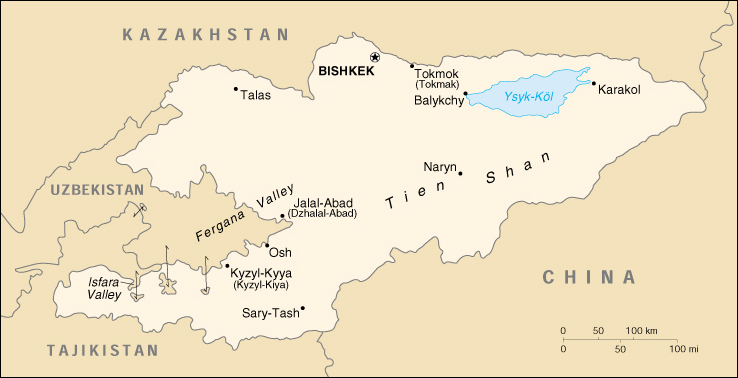
Background: A Central Asian country of incredible natural beauty and proud nomadic traditions, Kyrgyzstan was annexed by Russia in 1864; it achieved independence from the Soviet Union in 1991. Current concerns include: privatization of state-owned enterprises, expansion of democracy and political freedoms, inter-ethnic relations, and terrorism.
Government type: republic
Capital: Bishkek
Currency: 1 Kyrgyzstani som (KGS) = 100 tyiyn
Geography of Kyrgyzstan
Location: Central Asia, west of China
Geographic coordinates: 41 00 N, 75 00 E
Area:
total: 198,500 sq km
land: 191,300 sq km
water: 7,200 sq km
Land boundaries:
total: 3,878 km
border countries: China 858 km, Kazakhstan 1,051 km, Tajikistan 870 km, Uzbekistan 1,099 km
Coastline: 0 km (landlocked)
Climate: dry continental to polar in high Tien Shan; subtropical in southwest (Fergana Valley); temperate in northern foothill zone
Terrain: peaks of Tien Shan and associated valleys and basins encompass entire nation
Elevation extremes:
lowest point: Kara-Darya 132 m
highest point: Jengish Chokusu (Pik Pobedy) 7,439 m
Natural resources: abundant hydropower; significant deposits of gold and rare earth metals; locally exploitable coal, oil, and natural gas; other deposits of nepheline, mercury, bismuth, lead, and zinc
Land use:
arable land: 7%
permanent crops: 0%
permanent pastures: 44%
forests and woodland: 4%
other: 45% (1993 est.)
note: Kyrgyzstan has the world’s largest natural growth walnut forest
Irrigated land: 9,000 sq km (1993 est.)
Environment – current issues: water pollution; many people get their water directly from contaminated streams and wells; as a result, water-borne diseases are prevalent; increasing soil salinity from faulty irrigation practices.
Environment – international agreements:
party to: Air Pollution, Biodiversity, Climate Change, Desertification, Hazardous Wastes, Ozone Layer Protection
signed, but not ratified: none of the selected agreements
Geography – note: landlocked; entirely mountainous, dominated by the Tien Shan range; many tall peaks, glaciers, and high-altitude lakes
People of Kyrgyzstan
The earliest descendents of the Kyrgyz people, who are believed to be of mixed Mongol, Turkic, and Kypchak descent, probably settled until the 10th century around what is now the Tyva region of the Russian Federation. With the rise of the Mongol Empire in the 13th century, the Kyrgyz migrated south. They did not emerge as a distinct ethnic group until the 15th century. Various Turkic peoples ruled them until 1685, when they came under the control of the Mongol Oirots. Islam is the predominant religion in the region, and most of the Kyrgyz are Sunni Muslims of the Hanafi school.
Population: 5,146,281 (July 2005 est.)
Age structure:
0-14 years: 35.03%
15-64 years: 58.83%
65 years and over: 6.14%
Population growth rate: 1.44%
Birth rate: 26.18 births/1,000 population
Death rate: 9.13 deaths/1,000 population
Net migration rate: -2.66 migrant(s)/1,000 population
Infant mortality rate: 76.5 deaths/1,000 live births
Life expectancy at birth:
total population: 63.46 years
male: 59.2 years
female: 67.94 years
Total fertility rate: 3.19 children born/woman
Nationality:
noun: Kyrgyzstani(s)
adjective: Kyrgyzstani
Ethnic groups: Kirghiz 52.4%, Russian 18%, Uzbek 12.9%, Ukrainian 2.5%, German 2.4%, other 11.8%
Religions: Muslim 75%, Russian Orthodox 20%, other 5%
Languages: Kirghiz (Kyrgyz) – official language, Russian – official language
note: in May 2000, the Kyrgyzstani legislature made Russian an official language, equal in status to Kirghiz
Literacy:
definition: age 15 and over can read and write
total population: 97%
male: 99%
female: 96% (1989 est.)
History of Kyrgyzstan
ELEVATED TO THE STATUS of a union republic by Joseph V. Stalin in 1936, the Kyrgyz Soviet Socialist Republic was until 1990 one of the poorest, quietest, and most conservative of all the Soviet republics. It was the Kyrgyz Republic that celebrated the election of a sheepherder as president of its parliamentary executive committee, the Presidium, in 1987. Three years later, however, that quiescence ended, and Kyrgyzstan’s history as a separate nation began.
Kyrgyzstan began the new phase of its existence by declaring independence in August 1991. At that point, it possessed a combination of useful resources and threatening deficiencies. Geographic location fits in both categories; landlocked deep inside the Asian continent, Kyrgyzstan has minimal natural transportation routes available to serve its economic development, and its isolation has been an obstacle in the campaign to gain international attention. On the other hand, Kyrgyzstan also is isolated from most of the Asian trouble spots (excepting Tajikistan), making national security a relatively low priority. The natural resources that Kyrgyzstan possesses–primarily gold, other minerals, and abundant hydroelectric power–have not been managed well enough to make them an asset in pulling the republic up from the severe economic shock of leaving the secure, if limiting, domain of the Soviet Union.
In the mid-1990s, the most ambitious economic and political reform program in Central Asia caused more frustration than satisfaction among Kyrgyzstan’s citizens, largely because the republic inherited neither an economic infrastructure nor a political tradition upon which to base the rapid transitions envisioned by President Askar Akayev’s first idealistic blueprints. Although some elements of reform (privatization, for example) went into place quickly, the absence of others (credit from a commercial banking system, for example) brought the overall system to a halt, causing high unemployment and frustration. By 1995, democratic reform seemed a victim of that frustration, as Akayev increasingly sought to use personal executive power in promoting his policies for economic growth, a pattern that became typical in the Central Asian countries’ first years of independence.
Since independence Kyrgyzstan has made impressive strides in some regards such as creating genuinely free news media and fostering an active political opposition. At the same time, the grim realities of the country’s economic position, which exacerbate the clan- and family-based political tensions that have always remained beneath the surface of national life, leave long-term political and economic prospects clouded at best. Kyrgyzstan has no desire to return to Russian control, yet economic necessity has forced the government to look to Moscow for needed financial support and trade.
Kyrgyzstan Economy
The economy of Kyrgyzstan was severely affected by the collapse of the Soviet trading block. In 1990, some 98% of Kyrgyz exports went to other parts of the Soviet Union. Thus, the nation’s economic performance in the early 1990s was worse than any other former Soviet republic except war-torn Armenia, Azerbaijan, and Tajikistan. While economic performance has improved in the last few years, difficulties remain in securing adequate fiscal revenues and providing an adequate social safety net.
The principal sector of the economy in Kyrgyzstan is agriculture, which contributes about one-third of the GDP and more than one-third of employment. The republic possesses a mountainous terrain, which accommodates livestock rearing, the largest sector within agriculture. The main crops are cotton, hemp, tobacco, vegetables, and fruit. By the early 1990s, the private sector provided between one-third and one-half of some harvests. Wool, leather, and silk also are major products, and much of the industrial sector is devoted to agroprocessing, the most attractive proposition for foreign investors.
The position of the country geographically works to its disadvantage. The region is prone to harsh climatic conditions and is in an earthquake zone. In 1992 there were earthquakes and mudslides, and in 1998 two mudslides also occurred in southern Kyrgyzstan
With respect to Kyrgyzstan’s potential for mining and energy extraction, the Republic is rich in mineral resources but has negligible petroleum and natural gas reserves. Among its reserves are substantial deposits of coal, gold, uranium, antimony, and other rare metals. The main barrier to development has been the inaccessibility of many of the potential resources. The government has actively cultivated foreign cooperation in processing and extracting gold while building up the nation’s own reserves in the process. OPIC has recently been involved in the establishment of two joint ventures in Kyrgyzstan with Western gold companies.
Kyrgyzstan’s plentiful water resources and mountainous terrain have enabled it to export hydroelectric energy. However, Kyrgyzstan imports petroleum and gas. There are plans to construct a petroleum refinery in Kyrgyzstan. The metallurgy industry is among the most important in Kyrgyzstan, and the government is hopeful of attracting foreign investment in the field.
Kyrgyzstan’s principle exports, which go overwhelmingly to other Commonwealth of Independent States (CIS) countries, are nonferrous metals and minerals, woolen goods and other agricultural products, electric energy, and certain engineering goods. In turn, the Republic relies on other former Soviet states for petroleum and natural gas, ferrous metals, chemicals, most machinery, wood and paper products, some foods, and most construction materials.
The Kyrgyzstan Government has reduced expenditures, ended most price subsidies, and introduced a value added tax. Overall, the government appears committed to transferring to a free market economic system by stabilizing the economy and implementing reforms, which will encourage long-term growth. These reforms have led to Kyrgyzstan’s accession to the WTO on December 20, 1998.
GDP: purchasing power parity – $12.6 billion (2000 est.)
GDP – real growth rate: 5.7% (2000 est.)
GDP – per capita: purchasing power parity – $2,700 (2000 est.)
GDP – composition by sector:
agriculture: 45%
industry: 20%
services: 35% (1999 est.)
Household income or consumption by percentage share:
lowest 10%: 2.7%
highest 10%: 31.7% (1997)
Inflation rate (consumer prices): 18.7% (2000 est.)
Labor force: 1.7 million
Labor force – by occupation: agriculture and forestry 55%, industry 15%, services 30% (1999 est.)
Unemployment rate: 6% (1998 est.)
Budget:
revenues: $207.4 million
expenditures: $238.7 million (1999 est.)
Industries: small machinery, textiles, food processing, cement, shoes, sawn logs, refrigerators, furniture, electric motors, gold, rare earth metals
Industrial production growth rate: 7% (2000 est.)
Electricity – production: 12.981 billion kWh (1999)
Electricity – production by source:
fossil fuel: 6.67%
hydro: 93.33%
nuclear: 0%
other: 0% (1999)
Agriculture – products: tobacco, cotton, potatoes, vegetables, grapes, fruits and berries; sheep, goats, cattle, wool
Exports: $482 million (f.o.b., 2000 est.)
Exports – commodities: cotton, wool, meat, tobacco; gold, mercury, uranium, hydropower; machinery; shoes
Exports – partners: Germany 33%, Russia 16%, Kazakhstan 10%, Uzbekistan 10%, China 6% (1999)
Imports: $579 million (f.o.b., 2000 est.)
Imports – commodities: oil and gas, machinery and equipment, foodstuffs
Imports – partners: Russia 18%, Kazakhstan 12%, US 9%, Germany 8%, Uzbekistan 8%, China (1999)
Debt – external: $1.4 billion (2000 est.)
Economic aid – recipient: $329.4 million (1995)
Currency: Kyrgyzstani som (KGS)
Map of Kyrgyzstan