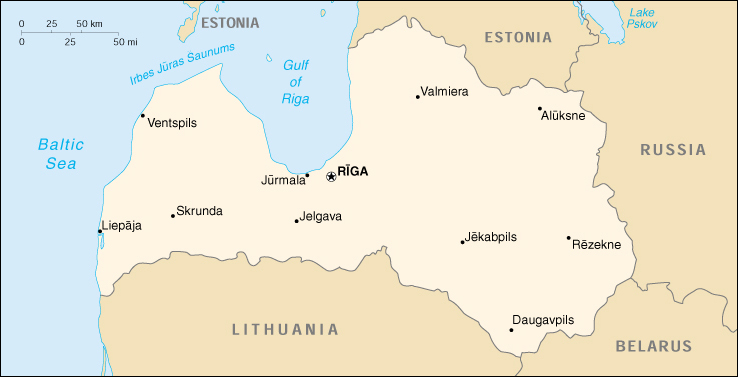
Background: After a brief period of independence between the two World Wars, Latvia was annexed by the USSR in 1940. It reestablished its independence in 1991 following the breakup of the Soviet Union. Although the last Russian troops left in 1994, the status of the Russian minority (some 30% of the population) remains of concern to Moscow. Latvia continues to revamp its economy for eventual integration into various Western European political and economic institutions.
Government type: parliamentary democracy
Capital: Riga
Currency: 1 Latvian lat (LVL) = 100 santims
Geography of Latvia
Location: Eastern Europe, bordering the Baltic Sea, between Estonia and Lithuania
Geographic coordinates: 57 00 N, 25 00 E
Area:
total: 64,589 sq km
land: 64,589 sq km
water: 0 sq km
Land boundaries:
total: 1,150 km
border countries: Belarus 141 km, Estonia 339 km, Lithuania 453 km, Russia 217 km
Coastline: 531 km
Maritime claims:
continental shelf: 200-m depth or to the depth of exploitation
exclusive economic zone: 200 nm
territorial sea: 12 nm
Climate: maritime; wet, moderate winters
Terrain: low plain
Elevation extremes:
lowest point: Baltic Sea 0 m
highest point: Gaizinkalns 312 m
Natural resources: minimal; amber, peat, limestone, dolomite, hydropower, arable land
Land use:
arable land: 27%
permanent crops: 0%
permanent pastures: 13%
forests and woodland: 46%
other: 14% (1993 est.)
Irrigated land: 160 sq km (1993 est.)
Environment – current issues: air and water pollution because of a lack of waste conversion equipment; Gulf of Riga and Daugava River heavily polluted; contamination of soil and groundwater with chemicals and petroleum products at military bases
Environment – international agreements:
party to: Air Pollution, Biodiversity, Climate Change, Endangered Species, Hazardous Wastes, Ozone Layer Protection, Ship Pollution, Wetlands
signed, but not ratified: Air Pollution-Persistent Organic Pollutants, Climate Change-Kyoto Protocol
Geography – note: most of the country is composed of fertile, low-lying plains, with some hills in the east.
People of Latvia
Latvians occasionally refer to themselves by the ancient name of “Latviji,” which may have originated from a “Latve” river that presumably flowed through what is now eastern Latvia. A small Finno-Ugric tribe known as the Livs settled among the Latvians and modulated the name to “Latvis,” meaning “forest-clearers,” which is how medieval German settlers also referred to these peoples. The German colonizers changed this name to “Lette” and called their initially small colony “Livland.” The Latin form, “Livonia,” gradually referred to the whole of modern-day Latvia as well as southern Estonia, which had fallen under German dominion. Latvians and Lithuanians are the only directly surviving members of the Baltic peoples and languages of the Indo-European family.
Latvians look like and consider themselves Nordics, evidenced through the strong cultural and religious influences gained over centuries during Germanic and Scandinavian colonization and settlement. Eastern Latvia (Latgale), however, retains a strong Polish and Russian cultural and linguistic influence. This highly literate society places strong emphasis upon education, which is free and compulsory until age 16. Most Latvians belong to the Evangelical Lutheran Church, a sizable minority are Russian Orthodox, and Eastern Latvia is predominantly Roman Catholic.
Historically, Latvia always has had a fairly large Russian, Jewish, German and Polish minority, but postwar emigration, deportations and Soviet Russification policies from 1939-89 dropped the percentage of ethnic Latvians in Latvia from 73% to 52%. In an attempt to preserve the Latvian language and avoid ethnic Latvians becoming a minority in their own country, Latvia’s strict language law and draft citizenship law have caused many non-citizen resident Russians concern over their ability to assimilate, despite Latvian legal guarantees of universal human and civil rights regardless of citizenship.
Written with the Latin alphabet, Latvian is the language of the Latvian people and the official language of the country. It is an inflective language with several analytical forms, three dialects, and German syntactical influence. The oldest known examples of written Latvian are from a 1585 catechism. The Soviets imposed the official use of Russian, so most Latvians speak Russian as a second or first language while the resident Slavic populace generally speaks Russian as a first language.
Population: 2,290,237 (July 2005 est.)
Age structure:
0-14 years: 16.55%
15-64 years: 68.15%
65 years and over: 15.3%
Population growth rate: -0.81%
Birth rate: 8.03 births/1,000 population
Death rate: 14.8 deaths/1,000 population
Net migration rate: -1.27 migrant(s)/1,000 population
Infant mortality rate: 15.34 deaths/1,000 live births
Life expectancy at birth:
total population: 68.7 years
male: 62.8 years
female: 74.9 years
Total fertility rate: 1.15 children born/woman
Nationality:
noun: Latvian(s)
adjective: Latvian
Ethnic groups: Latvian 56.5%, Russian 30.4%, Byelorussian 4.3%, Ukrainian 2.8%, Polish 2.6%, other 3.4%
Religions: Lutheran, Roman Catholic, Russian Orthodox
Languages: Lettish (official), Lithuanian, Russian, other
Literacy:
definition: age 15 and over can read and write
total population: 100%
male: 100%
female: 99% (1989 est.)
History of Latvia
Early History
Latvians have resided in their present geographical area for more than 2,000 years. Their closest ethnic relatives are the ancient Prussians, the Galinds, the Jatvings, and the Lithuanians. Only the Lithuanians have avoided extinction. All the other peoples were conquered or assimilated by their neighbors, demonstrating one of the realities of history–the ebb and flow of the creation and disappearance of nations. This aspect of history has been taken to heart by Latvians, who regularly use their experience of extinction as a tocsin of potential danger to the survival of their own group. Ironically, Latvians themselves have been in the position of having assimilated another group. The first settlers in the territory of Latvia were Livonians, or “Libiesi.” Whereas the Latvians originated from the Indo-European family, the Livonians were akin to the Estonians and the Finns and formed a part of the Finno-Ugric complex of nations. The Livonians were once heavily concentrated in the northern part of Latvia’s present-day provinces of Kurzeme and Vidzeme, but today only about 100 individuals retain their ancient language. Livonians have also contributed to the development of a prominent Latvian dialect.
Until about 1300, the Latvian people lived within half a dozen or so independent and culturally distinct kingdoms.This lack of unity hastened their conquest by German-led crusaders, who brought with them more efficient weaponry, war experience, and technology, including stone and mortar fortifications. During the next 600 years, various parts of the territory of Latvia were taken over by a succession of foreign regimes, including those of Denmark, Prussia, the Polish-Lithuanian Commonwealth, Sweden, and Russia. In this maelstrom of changing rulers, the descendants of the German conquerors were able to maintain their autonomy and their title to feudal estates by adapting to new circumstances and by offering loyalty to whoever was the dominant power. These Baltic barons formed the bulk of the upper classes and set the tone of the Baltic establishment. Although their dominance over the Latvian serfs has often been justifiably criticized, their profound impact on Latvian cultural and social development can be observed even to this day.
Besides the Baltic barons and other Germans, the greatest impact on the formation of the Latvian nation came from Russia, the giant neighbor that began the conquest of Latvia in 1710 under Peter I (the Great) (r. 1682-1725) and completed the process eighty-five years later. For more than 200 years, Latvians had a unique mixture of elites. The German nobility was dominant in economic, cultural, social, and local political life, and the Russian bureaucracy was in charge of higher politics and administration. Some Latvians aspiring to higher status tried to emulate the Germans, but other Latvians thought that salvation was to be found with the Russians. Indeed, a large part of the Latvian intelligentsia was inspired by alumni of the higher educational institutes of St. Petersburg. Several prominent intellectual leaders agitated for the migration of Latvians to the interior of Russia, where free land was available. Some Latvians adopted the Orthodox faith, Russia’s predominant religion.
During the second half of the nineteenth century, Latvians experienced a resurgence of national consciousness. There was an intense development of Latvian culture and a new stress on the need for protecting this culture against the inroads of both Germanization and Russification. A new Latvian-oriented elite appeared and began to press for a larger input by Latvians in the determination of their own local affairs. This period is known as the first Latvian awakening.
The favorable geographical position of Latvia alongside the Baltic Sea and on the outer frontier of a vast, mostly landlocked Russian Empire provided the impetus for an extremely rapid economic development of the region. The most rapid growth occurred between 1880 and World War I. Riga became the third largest port in the Russian Empire; in 1913 its port had a larger trade turnover than St. Petersburg’s. Many huge factories were constructed, attracting great masses of new workers from the Latvian countryside and from the interior of Russia.
Working-class discontent and the spread of Marxism created a volatile situation in Latvia. This radicalism was exacerbated by the shooting of seventy peaceful demonstrators in Riga in January 1905. Massive strikes by workers and the uprising of peasants with the attendant burning of feudal manor houses resulted in a very vindictive reaction by authorities, who shot some 3,000 people and sent many into exile in Siberia. Others managed to flee abroad. In 1905 almost all segments of Latvian society were united in their anger against the Russian authorities and the German barons.
This legacy of 1905, together with the disruption of World War I, when half the Latvian population was forced to evacuate ahead of the invading Germans, created propitious conditions for the growth of Marxism and especially its radical variant, Bolshevism. Of the votes for the All-Russian Constitutional Assembly from Latvians in the Russian-controlled northeastern part of Latvia, the Bolsheviks received a majority (71.9 percent). By contrast, in the entire empire less than a quarter voted for the Bolsheviks.
This infatuation with Bolshevism suffered a severe jolt, and support plummeted dramatically, during the half-year of Bolshevik rule of Latvia, which ended in May 1919. Nevertheless, a significant contingent of Latvian Red Riflemen fled to Russia, where they formed an important part of the leadership and infrastructure of the Red Army. Many Latvians also became prominent in the top hierarchy of the first Soviet political police, known as the Cheka, and the Russian Communist Party (Bolshevik). Their days of glory were cut short by the mass executions initiated by Joseph V. Stalin in the 1930s.
Independence, 1918-40
Latvian independence was proclaimed on November 18, 1918, but its real advent came only in 1920 after the cessation of hostilities between pro- and anti-Bolshevik forces and the withdrawal of all foreign armies from Latvian territory. The peace treaty signed with Soviet Russia on August 11, 1920, was a critical step. As stated in Article 2 of this treaty, “Russia unreservedly recognizes the independence and sovereignty of the Latvian State and voluntarily and forever renounces all sovereign rights over the Latvian people and territory.” Latvia became a member of the League of Nations in 1921.
Latvia’s ensuing period of independence lasted for twenty years and has become embedded in the Latvian consciousness as a golden era of progress and achievement, now referred to as the second awakening. The period of independence was characterized by both economic viability and political instability. The Latvian currency, the lats, became relatively stable. Farming and exports flourished. Inflation was low. Welfare provisions were generous. Foreign debt was minimal. One of the more important indexes of economic achievement was the volume of gold–10.6 tons–that the Latvian government placed for safekeeping in the United States, Britain, France, and Switzerland. This period is also important in understanding a significant thread of present-day Latvian political culture. The state intervened as a direct economic actor in many areas, including heavy industry, building materials, electricity, tobacco, brewing, confectionery, textiles, insurance, and food processing. The government also made a conscious attempt to provide stability and, even more important, to help expand Latvian control of the economy.
Until 1934 Latvia had a system of democracy similar to that in Weimar Germany (1919-33). The use of proportional elections and the absence of any dominant party encouraged participation by more than forty different political parties. The 1931 parliament (Saeima) had representatives from twenty-seven parties. It is not surprising, then, that Latvia had eighteen different parliamentary governments with new combinations of coalition partners in fewer than fourteen years. The evident political instability and the threat of a coup d’état from both the left and the right encouraged Karlis Ulmanis, a centrist, to take the reins of power into his own hands in May 1934. Ulmanis had been one of the founders of independent Latvia and had also been prime minister several times. His acknowledged experience and the public’s general disgust with politicking assured little protest against the “setting aside” of Latvia’s constitution.
Ulmanis was a populist ruler who did not countenance opposition. He banned all parties and many press organs. It is important to note, however, that not a single person was executed during this period, although several hundred activists from the left and right were incarcerated for brief periods of time. Ulmanis tried to maintain a neutral stance between the Soviet Union and Nazi Germany, but his best efforts failed when these two totalitarian systems connived to carve out spheres of dominance in the heart of Europe.
Ulmanis was deported by the Soviet authorities and died in captivity in Russia in 1942, but his legacy remains alive in Latvia. Today, Ulmanis is a powerful symbol of selfless dedication to Latvia, and his memory is honored even by organizations with high concentrations of former communists. These groups realize that the once-vilified dictator has tremendous appeal among Latvians, especially in rural areas, and that their association with Ulmanis can provide long-term political dividends. At the same time, the historical experience of such a dictatorship, even if beneficial in some respects, has been used in debates as a warning against a repetition of dictatorial rule.
The fate of Latvia and the other Baltic republics was sealed on August 23, 1939, when the foreign ministers of the Soviet Union and Nazi Germany, Vyacheslav Molotov and Joachim von Ribbentrop, respectively, signed a secret protocol giving Estonia and Latvia to the Soviet Union and Lithuania to Germany. Within five weeks, however, Lithuania was added to the Soviet roster of potential possessions in exchange for other territories and sizable sums of gold.
The Nazi-Soviet Nonaggression Pact (also known as the Molotov-Ribbentrop Pact) was not acknowledged by the Soviet Union until it was forced to do so, fifty years later, by the Baltic delegation to the Congress of People’s Deputies in Moscow in 1989. The pact was seen by Latvian and other Baltic independence supporters as the Achilles’ heel of the carefully constructed myth by Moscow propagandists of how the Baltic countries had joyfully embraced the Soviet Union and had voted to become new Soviet republics. Indeed, the Latvian dissident group known as Helsinki ’86 had organized demonstrations on August 23, 1987, to underscore the secret pact’s existence. These demonstrations had reverberated throughout the world and had put Soviet leader Mikhail S. Gorbachev’s regime on the defensive.
For the Baltic countries, the half-century following the 1939 pact was a particularly tragic time. During that period, hundreds of thousands of people perished, and much effort was expended to obliterate the memory of independence.
On October 5, 1939, soon after the Nazi-Soviet Nonagression Pact was signed, the Soviet Union coerced Latvia into signing the Pact of Defense and Mutual Assistance. It then forced Latvia to accept occupation by 30,000 Soviet troops. Similar treaties were imposed on Estonia and Lithuania, whose forces also were vastly outnumbered by Soviet forces. (The Baltic states’ northern neighbor, Finland, refused to accept such a demand, however, and, after it was attacked on November 30, 1939, valiantly fought the Red Army in what became known as the Winter War. The Soviet Union was expelled from the League of Nations for this unprovoked attack on Finland.)
Stalin made his next move in the Baltics when world attention was riveted on the imminent surrender of France to the Nazis in June 1940. An ultimatum was sent to each one of the Baltic countries demanding replacement of their existing governments by those capable of ensuring the proper fulfillment of the previously signed pacts of mutual assistance. Moscow also demanded the free entry of unlimited troops to secure strategic centers. With no hope of external support, all three countries capitulated to these demands.
The Soviet Period
The new Soviet troops moved into Latvia, together with a special emissary, Andrey Vyshinskiy, who was entrusted with the details of mobilizing enthusiastic mass support for the Sovietization of Latvia. Vyshinskiy had learned political choreography well when he staged the infamous Moscow show trials against the theoretician Nikolay I. Bukharin and other enemies of Stalin.
A so-called “people’s government” was assembled, and elections were held to help legitimate the changes in the eyes of the world. Only the communist slate of candidates was allowed on the ballot, and the improbable result of 97.6 percent in favor–with a more than 90 percent turnout–was never found to be credible by any of the Western governments. For the purposes of Soviet strategy and mythmaking, however, they sufficed. On July 21, 1940, the newly elected delegates proclaimed the Latvian Soviet Socialist Republic and voted to petition the Soviet Union to allow Latvia to join as a constituent republic. Not surprisingly, their wishes were granted. The process of Sovietizing Latvia was interrupted, however, when Stalin’s ally and co-conspirator attacked the Soviet Union on June 22, 1941. One week before the Nazi attack, the Soviet regime had arrested and deported to Siberia, in sealed cattle cars, about 15,000 of the former Latvian elite, as well as suspected anticommunists, including 5,154 women and 3,225 children. In all, during the first year of occupation, Latvia lost 35,000 people to deportations or executions. Most deportees died in Siberia.
The equally brutal Nazi occupation lasted until May 8, 1945. Latvia’s Jews and Gypsies were particularly subjected to mass annihilation, and only a small number of each group survived this holocaust. The Nazis had no intention of liberating Latvia or providing renewed independence. Even the bulk of nationalized property was not returned. They did, however, draft young men into the armed forces–an illegal move in occupied territories, according to international law. These young people fought against the Red Army in two divisions, suffering high casualties.
With the advance of the Red Army into Latvia, about 200,000 Latvian refugees fled in panic to the West. Many lost their lives in the Baltic Sea, and others were bombed, together with their horse-drawn wagons. A sizable group was captured and turned back to await punishment for their “disloyalty.” About 150,000 refugees from Latvia settled in the West, where many of them continued a half-century-long struggle against the occupation of their homeland.
The reestablishment of Soviet control in the mid-1940s was not welcomed. Many Latvians joined the guerrilla movement, which fought the occupying power for close to a decade. To break this resistance and also to force peasants into collective farms, new deportations to Siberia, involving more than 40,000 people (10,590 of them children under sixteen years of age), were completed on March 25, 1949. This date was to become a focal point of demonstrations in 1988.
The leading positions in postwar Latvia’s political, economic, and cultural life were filled by Russians or Russified Latvians, known as latovichi , who had spent much or all of their lives in the Soviet Union. Political power was concentrated in the Communist Party of Latvia (CPL), which numbered no more than 5,000 in 1945. The rapid growth of industry attracted migrant workers, primarily from Russia, further facilitating the processes of Russification and Sovietization. Net immigration from 1951 to 1989 has been estimated at more than 400,000.
After Stalin’s death in 1953, conditions for greater local autonomy improved. In Latvia, beginning in 1957, a group of national communists under the leadership of Eduards Berklavs, deputy premier of the Latvian Council of Ministers, began a serious program of Latvianization. He and his supporters passed regulations restricting immigration, requested that party and government functionaries know the Latvian language, and planned to limit the growth of industry requiring large inputs of labor. Increased funding was planned for local requirements, such as agricultural machines, urban and rural housing, schools, hospitals, and social centers, rather than for Moscow-planned “truly grandiose projects.”
These programs were not well received in Moscow, and a purge of about 2,000 national communists was initiated in July 1959. Many of the most gifted individuals in Latvia lost their positions and had to endure continuous harassment.
Berklavs himself was exiled from Latvia and expelled from the CPL. Later, upon returning to Latvia, he was one of the leaders of the Latvian underground opposition and coauthored a 1974 letter with seventeen Latvian communists, detailing the pace of Russification in Latvia. In 1988 Berklavs became one of the key founders of the Latvian National Independence Movement (Latvijas Nacionala neatkaribas kustiba–LNNK), and as an elected deputy in the Latvian parliament he vigorously defended Latvian interests.
After the purge of the national communists, Latvia experienced a particularly vindictive and staunchly pro-Moscow leadership. Under the iron fist of hard-liner Arvids Pelse (CPL first secretary, 1959-66), who later became a member of the Political Bureau (Politburo) of the Central Committee of the Communist Party of the Soviet Union (CPSU), Latvia suffered many restrictions and petty harassments in all fields of national culture and social development. Sovietization and Russification programs were of an intensity and dimension not found in either Estonia or Lithuania. Pelse was replaced by Augusts Voss (CPL first secretary, 1966-84), who was equally insensitive to Latvian demands. With the advent of a new period of glasnost and national awakening, Voss was transferred to Moscow to preside over the Supreme Soviet’s Council of Nationalities and was replaced by Boris Pugo, a former chief of Latvia’s Committee for State Security (Komitet gosudarstvennoy bezopasnosti–KGB). Pugo, who served as CPL first secretary until 1988, subsequently gained prominence as a partici-pant in the abortive Soviet coup of August 1991.
The Pursuit of Independence, 1987-91
The national awakening came about in large measure as a result of Gorbachev’s loosening of the reins of repression and his public stress on truth and freedom of expression. When open demonstrations started in 1987, Latvians were no longer lacking in social cohesion. The purpose of these “calendar” demonstrations was to publicly commemorate the events of June 13-14, 1941 (the mass deportations of Latvians to the Soviet Union); August 23, 1939 (the signing of the Nazi-Soviet Nonaggression Pact); and November 18, 1918 (the proclamation of Latvian independence). During the several years leading up to the first demonstrations by Helsinki ’86 on June 14, 1987, several groups had labored with missionary zeal to inspire Latvians to work for a number of social and political causes.
One group that organized in 1976 committed itself to the revival of folk culture and, in spite of harassment, succeeded in rekindling interest in Latvian traditions and in awakening pride in being Latvian. Parallel to the folk culture group, another movement focused on the repair of old churches and monuments and the protection of the environment. The founder of this movement, the Environmental Protection Club (EPC), acknowledged that its primary goal was to raise the consciousness of the general public. Indeed, the EPC became the organization within which many individuals opposed to various aspects of Sovietization and Russification could unite. Under the seemingly nonpolitical umbrella of the EPC, they could organize far more radical bodies, such as the Latvian National Independence Movement.
A dynamic group of young theologians within Latvia’s moribund Evangelical Lutheran Church also began a campaign to reactivate their congregations and the structure of the church itself. The Rebirth and Renewal (Atdzimsana un Atjaunosana) group did not have many members, but its activism and confrontation with communist party officials and policies energized people within the growing religious communities as well as in the wider society. Indeed, several individuals from this group served as catalysts for the creation of the Popular Front of Latvia (Latvijas Tautas Fronte–LTF).
The mobilization of a larger constituency of Latvians occurred as a result of the successful campaign to stop the construction of a hydroelectric dam on the Daugava River in 1987. The initiator of this campaign, journalist Dainis Ivans, was later elected the first president of the LTF.
The “calendar” demonstrations, led by Helsinki ’86 during 1987, electrified the Latvian population. Most people expected the authorities to mete out swift and ruthless retribution. When they did not, even more people joined in. In 1988 this grassroots protest was joined by the Latvian intelligentsia, whose demands for decentralization and democratization were forcefully articulated at the June 1-2 plenum of the Latvian Writers Union. Several months later, the idea of a popular front was brought to fruition, with a formal first congress organized on October 8-9, 1988.
The LTF had more than 100,000 dues-paying members and chapters in almost every locality in Latvia. These members slowly took the initiative in politics and became a de facto second government, pushing the Latvian Supreme Soviet to adopt a declaration of sovereignty and economic independence in July 1989. They also helped elect a majority of their approved candidates for the all-union Congress of People’s Deputies in the spring of 1989; for the municipal local elections in December of that year; and for the critical parliamentary elections of March-April 1990. Slightly more than two-thirds of the delegates in the new parliament, now known as the Supreme Council, voted in favor of a transition to a democratic and independent Latvia on May 4, 1990. This process was marred by several instances of Soviet aggression, most notably in January 1991, when five people were killed during an attack on the Latvian Ministry of Interior in Riga by units of the Soviet Ministry of Internal Affairs Special Forces Detachment (Otryad militsii osobogo naznacheniya–OMON), commonly known as the Black Berets. The transition turned out to be much briefer than anyone could have expected, however, because of the failed Soviet coup of August 1991. Latvia declared independence on August 21, 1991. Soon thereafter, the Soviet Union recognized Latvia’s independence, and once again Latvia was able to join the world community of nations.
Latvia Economy
For centuries under Hanseatic and German influence and then during its inter-war independence, Latvia used its geographic location as an important East-West commercial and trading center.
Industry served local markets, while timber, paper and agricultural products supplied Latvia’s main exports. Conversely, the years of Russian and Soviet occupation tended to integrate Latvia’s economy to serve those empires’ large internal industrial needs. Comprising 40.1% of the populace, non-ethnic Latvians control almost 80% of the economy.
Since reestablishing its independence, Latvia has proceeded with market-oriented reforms, albeit at a measured pace. Its freely traded currency, the lat, was introduced in 1993 and has held steady, or appreciated, against major world currencies. Inflation has been reduced to a monthly rate of one percent or less. After contracting substantially between 1991-93, the eonomy steadied in late 1994, led by recovery in light industry and a boom in commerce and finance. A prolonged banking crisis and scandal involving what had been Latvia’s largest commercial bank set the economy back in mid-1995 and 1996, causing budget deficits well beyond the 2% target recommended by the IMF. Nevertheless, Latvia’s 1997 budget is balanced.
Replacement of the centrally planned system imposed during the Soviet period with a structure based on free-market principles has been occurring spontaneously from below much more than through consistently applied structural adjustment. Official statistics tend to understate the booming private sector, suggesting that the Latvian people and their economy are doing much better than is reflected statistically. Two-thirds of employment and 60% of GDP is now in the private sector. Recovery in light industry and Riga’s emergence as a regional financial and commercial center have offset shrinkage of the state-owned industrial sector and agriculture. The official unemployment figure has held steady in the 7%-8% range.
Privatization in Latvia is almost complete. Virtually all of the previously state-owned small and medium companies have been successfully privatized, leaving only the politically sensitive large state utilities. Despite a bad image based on loosely controlled privatization efforts in the early days, as well as the difficulties of privatizing the utilities, Latvian privatization efforts have led t the development of a dynamic and prosperous private sector, which accounted for nearly 68% of GDP in 2000. In addition, recent developments indicate that Latvia is likely to fulfill its commitment to the IMF to sell its majority interest in the Latvian Shipping Company, and the remaining state shares in Ventspils Nafta and Latvijas Gaze by mid-2001. The main goal of the Latvian Privatization Agency was and is to created healthy companies.
Foreign investment in Latvia is still modest compared with the levels in north-central Europe. A law expanding the scope for selling land, including to foreigners, was passed in 1997. Eager to join Western economic institutions like the World Trade Organization, OECD, and the European Union, Latvia signed a Europe Agreement with the EU in 1995–with a 4-year transition period.
GDP: purchasing power parity – $17.3 billion (2000 est.)
GDP – real growth rate: 5.5% (2000 est.)
GDP – per capita: purchasing power parity – $7,200 (2000 est.)
GDP – composition by sector:
agriculture: 5%
industry: 33%
services: 62% (1999)
Household income or consumption by percentage share:
lowest 10%: 2.9%
highest 10%: 25.9% (1998)
Inflation rate (consumer prices): 2.7% (2000)
Labor force: 1.4 million (2000 est.)
Labor force – by occupation: agriculture 10%, industry 25%, services 65% (2000 est.)
Unemployment rate: 7.8% (2000 est.)
Budget:
revenues: $1.33 billion
expenditures: $1.27 billion (1998 est.)
Industries: buses, vans, street and railroad cars, synthetic fibers, agricultural machinery, fertilizers, washing machines, radios, electronics, pharmaceuticals, processed foods, textiles; dependent on imports for energy, raw materials, and intermediate products
Industrial production growth rate: 6.3% (2000 est.)
Electricity – production: 3.996 billion kWh (1999)
Electricity – production by source:
fossil fuel: 31.78%
hydro: 68.22%
nuclear: 0%
other: 0% (1999)
Agriculture – products: grain, sugar beets, potatoes, vegetables; beef, milk, eggs; fish
Exports: $2.1 billion (f.o.b., 2000)
Exports – commodities: wood and wood products, machinery and equipment, metals, textiles, foodstuffs
Exports – partners: Germany 16%, United Kingdom 11%, Sweden 11%, Russia 7% (1999)
Imports: $3.2 billion (f.o.b., 2000)
Imports – commodities: machinery and equipment, chemicals, fuels
Imports – partners: Russia 15%, Germany 10%, Finland 9%, Sweden 7% (1999)
Debt – external: $800 million (2000 est.)
Economic aid – recipient: $96.2 million (1995)
Currency: Latvian lat (LVL)
Map of Latvia