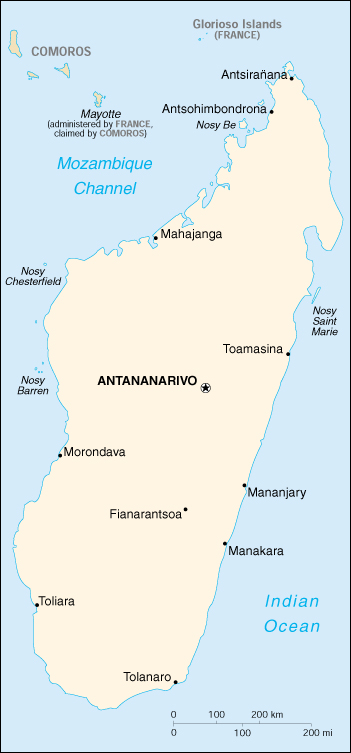
Background: Formerly an independent kingdom, Madagascar became a French colony in 1886, but regained its independence in 1960. During 1992-93, free presidential and National Assembly elections were held, ending 17 years of single-party rule. In 1997 in the second presidential race, Didier RATSIRAKA, the leader during the 1970s and 1980s, was returned to the presidency.
Government type: republic
Capital: Antananarivo
Currency: 1 Malagasy franc (FMG) = 100 centimes
Geography of Madagascar
Location: Southern Africa, island in the Indian Ocean, east of Mozambique
Geographic coordinates: 20 00 S, 47 00 E
Area:
total: 587,040 sq km
land: 581,540 sq km
water: 5,500 sq km
Land boundaries: 0 km
Coastline: 4,828 km
Maritime claims:
contiguous zone: 24 nm
continental shelf: 200 nm or 100 nm from the 2,500-m deep isobath
exclusive economic zone: 200 nm
territorial sea: 12 nm
Climate: tropical along coast, temperate inland, arid in south
Terrain: narrow coastal plain, high plateau and mountains in center
Elevation extremes:
lowest point: Indian Ocean 0 m
highest point: Maromokotro 2,876 m
Natural resources: graphite, chromite, coal, bauxite, salt, quartz, tar sands, semiprecious stones, mica, fish, hydropower
Land use:
arable land: 4%
permanent crops: 1%
permanent pastures: 41%
forests and woodland: 40%
other: 14% (1993 est.)
Irrigated land: 10,870 sq km (1993 est.)
Natural hazards: periodic cyclones
Environment – current issues: soil erosion results from deforestation and overgrazing; desertification; surface water contaminated with raw sewage and other organic wastes; several species of flora and fauna unique to the island are endangered.
Environment – international agreements:
party to: Biodiversity, Climate Change, Desertification, Endangered Species, Hazardous Wastes, Marine Life Conservation, Nuclear Test Ban, Ozone Layer Protection, Wetlands
signed, but not ratified: Law of the Sea
Geography – note: world’s fourth-largest island; strategic location along Mozambique Channel
People of Madagascar
Madagascar’s population is predominantly of mixed Asian and African origin. Recent research suggests that the island was uninhabited until Indonesian seafarers arrived in roughly the first century A.D., probably by way of southern India and East Africa, where they acquired African wives and slaves. Subsequent migrations from both the Pacific and Africa further consolidated this original mixture, and 18 separate tribal groups emerged. Asian features are most predominant in the central highlands people, the Merina (3 million) and the Betsileo (2 million); the coastal people are of African origin.
The largest coastal groups are the Betsimisaraka (1.5 million) and the Tsimihety and Sakalava (700,000 each).
The Malagasy language is of Malayo-Polynesian origin and is generally spoken throughout the island. French also is spoken among the educated population of this former French colony.
Most people practice traditional religions, which tend to emphasize links between the living and the dead. They believe that the dead join their ancestors in the ranks of divinity and that ancestors are intensely concerned with the fate of their living descendants. This spiritual communion is celebrated by the Merina and Betsileo reburial practice of famadihana, or “turning over the dead.” In this ritual, relatives’ remains are removed from the family tomb, rewrapped in new silk shrouds, and returned to the tomb following festive ceremonies in their honor.
About 41% of the Malagasy are Christian, divided almost evenly between Roman Catholic and Protestant. Many incorporate the cult of the dead with their religious beliefs and bless their dead at church before proceeding with the traditional burial rites. They also may invite a pastor to attend a famadihana.
Population: 18,040,341 (July 2005 est.)
Age structure:
0-14 years: 45.02%
15-64 years: 51.77%
65 years and over: 3.21%
Population growth rate: 3.02%
Birth rate: 42.66 births/1,000 population
Death rate: 12.42 deaths/1,000 population
Net migration rate: 0 migrant(s)/1,000 population
Infant mortality rate: 83.58 deaths/1,000 live births
Life expectancy at birth:
total population: 55.35 years
male: 53.08 years
female: 57.68 years
Total fertility rate: 5.8 children born/woman
Nationality:
noun: Malagasy (singular and plural)
adjective: Malagasy
Ethnic groups: Malayo-Indonesian (Merina and related Betsileo), Cotiers (mixed African, Malayo-Indonesian, and Arab ancestry – Betsimisaraka, Tsimihety, Antaisaka, Sakalava), French, Indian, Creole, Comoran.
Religions: indigenous beliefs 52%, Christian 41%, Muslim 7%
Languages: French (official), Malagasy (official)
Literacy:
definition: age 15 and over can read and write
total population: 80%
male: 88%
female: 73% (1990 est.)
History of Madagascar
A VAST REGION, the Indian Ocean encompasses an area of about 73.4 million square kilometers, or roughly 14 percent of the earth’s surface. The region has been defined variously, depending on whether the Antarctic Sea is included. Commonly, the Indian Ocean is thought to stretch from East Africa (or specifically from the southern tip of Africa at Cape Agulhas where it meets the Atlantic) to Tasmania (where it meets the Pacific), and from Asia to Antarctica.
Historically, the region has played a prominent commercial role in East-West trade since early times. For the colonial powers, particularly the United Kingdom and France, in the seventeenth, eighteenth, and the nineteenth century until the construction of the Suez Canal in 1869, the islands of the Indian Ocean provided trading posts and refueling locations en route to their colonies in the East. More recently, the Indian Ocean was a focal point of East-West tension because it served as a route through which much oil from the Persian Gulf states passed in shipment to markets elsewhere.
By the mid-1990s, as a result of the breakup of the Soviet Union and the growing participation in international affairs of a number of Indian Ocean littoral states, such as India and South Africa, the balance of power and external influences in the region had altered markedly. In addition, the island nations that constitute the subject of this volume–Madagascar, Mauritius, Comoros, Seychelles, and Maldives–have experienced a growth in democratic institutions and economic development that has changed their relationships to outside powers. For example, the island states have tended to follow a nonaligned policy in their foreign relations and, reflecting their lack of defense capabilities, have sought to promote the Indian Ocean Zone of Peace, in which they include littoral states.
Despite their unique aspects, these island nations have certain features in common. For example, all have been colonies or protectorates of either the United Kingdom or France. All have gained their independence since 1965 (1960 in the case of Madagascar) and have been inclined (with the possible exception of Comoros) to institute rule based on the dominance of executive leadership, specifically based on the personality of one man. This has been true even though in several instances such rule may be under the guise of socialism. Those islands that adopted socialism are now moving toward greater privatization and a free-market system.
Traditionally, agriculture has been the economic basis of all these nations despite the limited land area available for this pursuit. As of the early 1990s, however, the nations were seeking to diversify their economies, stressing fisheries development, tourism, the establishment of export processing zones (EPZs) where raw materials are processed and textiles manufactured, and industrial development, or the creation of international commercial centers. Of these island states, only Madagascar has significant mineral and energy resources, although offshore exploration is taking place near several of the islands.
These island countries consist of multiethnic societies, often with several religious faiths, but some are more homogeneous than others. Notwithstanding this ethnic diversity, in a number of the countries human rights have tended to be limited, particularly with respect to the rights of women, workers, and opposition elements. As democratic institutions are strengthened and public opinion makes itself felt, most of the states are making progress in this regard.
MADAGASCAR
The written history of Madagascar began in the seventh century A.D., when Arabs established trading posts along the northwest coast. European contact began in the 1500s, when Portuguese sea captain Diego Dias sighted the island after his ship became separated from a fleet bound for India. In the late 17th century, the French established trading posts along the east coast. From about 1774 to 1824, it was a favorite haunt for pirates, including Americans, one of whom brought Malagasy rice to South Carolina.
Beginning in the 1790s, Merina rulers succeeded in establishing hegemony over the major part of the island, including the coast. In 1817, the Merina ruler and the British governor of Mauritius concluded a treaty abolishing the slave trade, which had been important in Madagascar’s economy. In return, the island received British military and financial assistance. British influence remained strong for several decades, during which the Merina court was converted to Presbyterianism, Congregationalism, and Anglicanism.
The British accepted the imposition of a French protectorate over Madagascar in 1885 in return for eventual control over Zanzibar (now part of Tanzania) and as part of an overall definition of spheres of influence in the area. Absolute French control over Madagascar was established by military force in 1895-96, and the Merina monarchy was abolished.
Malagasy troops fought in France, Morocco, and Syria during World War I. After France fell to the Germans, Madagascar was administered first by the Vichy government and then in 1942 by the British, whose troops occupied the strategic island to preclude its seizure by the Japanese. The Free French received the island from the United Kingdom in 1943.
In 1947, with French prestige at low ebb, a nationalist uprising was suppressed only after several months of bitter fighting. The French subsequently established reformed institutions in 1956 under the Loi Cadre (Overseas Reform Act), and Madagascar moved peacefully toward independence. The Malagasy Republic was proclaimed on October 14, 1958, as an autonomous state within the French Community. A period of provisional government ended with the adoption of a constitution in 1959 and full independence on June 26, 1960.
Madagascar Economy
In 2000, Madagascar embarked on the preparation of a Poverty Reduction Strategy Paper (PRSP) under the Heavily Indebted Poor countries (HIPC) Initiative. The boards of the IMF and of the World Bank concurred in December 2000 that the country is eligible under the HIPC Initiative, and Madagascar has reached the decision point for debt relief. On March 1, 2001, the IMF Board granted the country $103 million for 2001-03 under the Poverty Reduction and Growth Facility (PRGR). Resources freed up from HIPC will be directed toward improving access to health, education, rural roads, water, and direct support to communities. In addition, on March 7, 2001, the Paris Club approved a debt cancellation of $161 million. On February 28, 2001, the African Development Bank (ADB) approved under the HIPC a debt cancellation of $71.46 million and granted in June 2001 an additional credit of $20 million to fight against AIDS and poverty.
Partly as a result of these credits but also as a result of previous reforms, average GDP growth exceeded the population growth rate of 2.8% in 1997 (3.5%), 1998 (3.9%), 1999 (4.7%) and 2000 (4.8%). Madagascar’s appeal to investors stems from its competitive, trainable work force. More than 200 investors, particularly garment manufacturers, have organized under the country’s Export Processing Zone (EPZ) system since it was established in 1989. The absence of quota limits on textile imports to the European market under the Lome Convention has helped stimulate this growth. In addition, there is evidence that Madagascar’s recent eligibility for AGOA is significantly increasing Malagasy exports and foreign investment.
In the short and medium terms, considerable economic growth can arise from greater efficiency in the allocation and use of resources. Since the mid-1980s, Madagascar has run sizeable balance-of-payment deficits. The current account deficit as a percentage of GDP averaged in excess of 6% during the last 6 years and registered nearly 4% in 1999. Madagascar’s debt ratio, which had reached 46% in 1996, is estimated at 15.4% in 2000. Within an overall framework of poverty reduction, the HIPC Initiative would enable the country to reduce its debt service ratio to 5.5% in 2003, and remain at around 5% throughout the projection period 2000-19.
An optimistic high-growth scenario is predicated on recovery of private investor interest and a continuing drop in inflation. From more than 60 % in 1994, the inflation rate dropped to 6.4% in 1998, before rising again to 14.4% in 1999 and 8.7% in 2000. The government hopes to bring this down to 5.8% by the end of 2001. In 2000, real GDP growth reached 4.8% and was forecast to accelerate to 6% in 2001. Tax revenues increased to more than 11% of GDP in 2000 and in 2001, the government forecasts a rate approaching 12%.
GDP: purchasing power parity – $12.3 billion (2000 est.)
GDP – real growth rate: 4.8% (2000 est.)
GDP – per capita: purchasing power parity – $800 (2000 est.)
GDP – composition by sector:
agriculture: 30%
industry: 14%
services: 56% (1999 est.)
Household income or consumption by percentage share:
lowest 10%: 1.9%
highest 10%: 36.7% (1993)
Inflation rate (consumer prices): 8.7% (2000 est.)
Labor force: 7 million (1999)
Budget:
revenues: $553 million
expenditures: $735 million (1998 est.)
Industries: meat processing, soap, breweries, tanneries, sugar, textiles, glassware, cement, automobile assembly plant, paper, petroleum, tourism
Industrial production growth rate: 3% (2000 est.)
Electricity – production: 810 million kWh (1999)
Electricity – production by source:
fossil fuel: 37.04%
hydro: 62.96%
nuclear: 0%
other: 0% (1999)
Electricity – consumption: 753.3 million kWh (1999)
Agriculture – products: coffee, vanilla, sugarcane, cloves, cocoa, rice, cassava (tapioca), beans, bananas, peanuts; livestock products
Exports: $600 million (f.o.b., 1998 est.)
Exports – commodities: coffee, vanilla, shellfish, sugar; cotton cloth, chromite, petroleum products
Exports – partners: France 41%, US 19%, Germany 13%, UK 8%, Japan 6% (1999)
Imports: $881 million (c.i.f., 1998 est.)
Imports – commodities: intermediate manufactures, capital goods, petroleum, consumer goods, food
Imports – partners: France 34%, Hong Kong 6%, China 6%, Japan 5%, Singapore 4% (1999)
Debt – external: $4.4 billion (1999)
Economic aid – recipient: $838 million (1997)
Currency: Malagasy franc (MGF)
Map of Madagascar