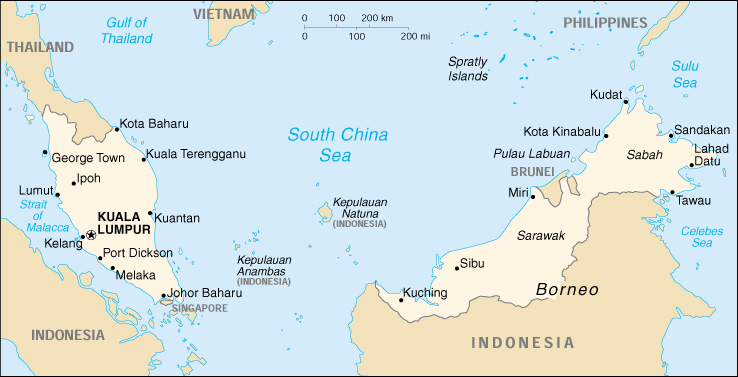
Background: Malaysia was created in 1963 through the merging of Malaya (independent in 1957) and the former British Singapore, both of which formed West Malaysia, and Sabah and Sarawak in north Borneo, which composed East Malaysia. The first three years of independence were marred by hostilities with Indonesia. Singapore separated from the union in 1965.
Government type: constitutional monarchy
note: Malaya (what is now Peninsular Malaysia) formed 31 August 1957; Federation of Malaysia (Malaya, Sabah, Sarawak, and Singapore) formed 9 July 1963 (Singapore left the federation on 9 August 1965); nominally headed by the paramount ruler and a bicameral Parliament consisting of a nonelected upper house and an elected lower house; Peninsular Malaysian states – hereditary rulers in all but Melaka, Penang, Sabah, and Sarawak, where governors are appointed by the Malaysian Government; powers of state governments are limited by the federal constitution; under terms of the federation, Sabah and Sarawak retain certain constitutional prerogatives (e.g., the right to maintain their own immigration controls); Sabah – holds 20 seats in House of Representatives, with foreign affairs, defense, internal security, and other powers delegated to federal government; Sarawak – holds 28 seats in House of Representatives, with foreign affairs, defense, internal security, and other powers delegated to federal government.
Capital: Kuala Lumpur
Currency: 1 ringgit (M$) = 100 sen
Geography of Malaysia
Location: Southeastern Asia, peninsula and northern one-third of the island of Borneo, bordering Indonesia and the South China Sea, south of Vietnam
Geographic coordinates: 2 30 N, 112 30 E
Area:
total: 329,750 sq km
land: 328,550 sq km
water: 1,200 sq km
Land boundaries:
total: 2,669 km
border countries: Brunei 381 km, Indonesia 1,782 km, Thailand 506 km
Coastline: 4,675 km (Peninsular Malaysia 2,068 km, East Malaysia 2,607 km)
Maritime claims:
continental shelf: 200-m depth or to the depth of exploitation; specified boundary in the South China Sea
exclusive economic zone: 200 nm
territorial sea: 12 nm
Climate: tropical; annual southwest (April to October) and northeast (October to February) monsoons
Terrain: coastal plains rising to hills and mountains
Elevation extremes:
lowest point: Indian Ocean 0 m
highest point: Gunung Kinabalu 4,100 m
Natural resources: tin, petroleum, timber, copper, iron ore, natural gas, bauxite
Land use:
arable land: 3%
permanent crops: 12%
permanent pastures: 0%
forests and woodland: 68%
other: 17% (1993 est.)
Irrigated land: 2,941 sq km (1998 est.)
Natural hazards: flooding, landslides
Environment – current issues: air pollution from industrial and vehicular emissions; water pollution from raw sewage; deforestation; smoke/haze from Indonesian forest fires.
Environment – international agreements:
party to: Biodiversity, Climate Change, Desertification, Endangered Species, Hazardous Wastes, Law of the Sea, Marine Life Conservation, Nuclear Test Ban, Ozone Layer Protection, Ship Pollution, Tropical Timber 83, Tropical Timber 94, Wetlands
signed, but not ratified: Climate Change-Kyoto Protocol
Geography – note: strategic location along Strait of Malacca and southern South China Sea
People of Malaysia
Malaysia’s population of 22.2 million continues to grow at a rate of 2.4% per annum; about 33% of the population is under the age of 15. Malaysia’s population comprises many ethnic groups, with the politically dominant Malays comprising a plurality. By constitutional definition, all Malays are Muslim. About a quarter of the population is Chinese who have historically played an important role in trade and business.
Malaysians of Indian descent comprise about 7% of the population and include Hindus, Muslims, Buddhists, and Christians. About 85% of the Indian community is Tamil.
Non-Malay indigenous groups make up more than half of the Borneo state of Sarawak’s population and about 66% of the Borneo state of Sabah’s population. They are divided into dozens of ethnic groups, but they share some general patterns of living and culture. Until the 20th century, most practiced traditional beliefs, but many have become Christian or Muslim. The “other” category includes Malaysians of, inter alia, European and Middle Eastern descent. Population distribution is uneven, with some 15 million residents concentrated in the lowlands of Peninsular Malaysia, an area slightly smaller than the State of Michigan.
Population: 23,953,136 (July 2005 est.)
Age structure:
0-14 years: 34.5%
15-64 years: 61.35%
65 years and over: 4.15%
Population growth rate: 1.96%
Birth rate: 24.75 births/1,000 population
Death rate: 5.2 deaths/1,000 population
Net migration rate: 0 migrant(s)/1,000 population
note: does not reflect net flow of an unknown number of illegal immigrants from other countries in the region
Infant mortality rate: 20.31 deaths/1,000 live births
Life expectancy at birth:
total population: 71.11 years
male: 68.48 years
female: 73.92 years
Total fertility rate: 3.24 children born/woman
Nationality:
noun: Malaysian(s)
adjective: Malaysian
Ethnic groups: Malay and other indigenous 58%, Chinese 27%, Indian 8%, others 7% (2000)
Religions: Islam, Buddhism, Daoism, Hinduism, Christianity, Sikhism; note – in addition, Shamanism is practiced in East Malaysia
Languages: Bahasa Melayu (official), English, Chinese dialects (Cantonese, Mandarin, Hokkien, Hakka, Hainan, Foochow), Tamil, Telugu, Malayalam, Panjabi, Thai; note – in addition, in East Malaysia several indigenous languages are spoken, the largest of which are Iban and Kadazan.
Literacy:
definition: age 15 and over can read and write
total population: 83.5%
male: 89.1%
female: 78.1% (1995 est.)
History of Malaysia
In the first century AD, two far-flung but related events helped stimulate Malaysia’s emergence in international trade in the ancient world. At that time, India had two principal sources of gold and other metals: the Roman Empire and China. The overland route from China was cut by marauding Huns, and at about the same time, the Roman Emperor Vespasian cut off shipments of gold to India. As a result, India sent large and seaworthy ships, with crews reported to have numbered in the hundreds, to Southeast Asia, including the Malayan Peninsula, to seek alternative sources. In the centuries that followed, rich Malaysian tin deposits assumed great significance in Indian Ocean trade, and the region prospered. As maritime trade among Middle Eastern, Indian, and Chinese ports flourished, the peninsula benefited from its location as well as from development of its diverse resources, including tropical woods and spices. Malay ships became prominent in that trade, and Malay ports served as transshipment centers. Indian trade brought Indian culture, economy, religion, and politics, with historic results for what is now Malaysia.
The early Buddhist Malay kingdom of Srivijaya, based at what is now Palembang, Sumatra, dominated much of the Malay Peninsula from the 9th to the 13th centuries AD. The powerful Hindu kingdom of Majapahit, based on Java, gained control of the Malay Peninsula in the 14th century. Conversion of the Malays to Islam, beginning in the early 14th century, accelerated with the rise of the state of Malacca under the rule of a Muslim prince in the 15th century. Malacca was a major regional entrepot, where Chinese, Arab, Malay, and Indian merchants traded precious goods. Drawn by this rich trade, a Portuguese fleet conquered Malacca in 1511, marking the beginning of European expansion in Southeast Asia. The Dutch ousted the Portuguese from Malacca in 1641 and, in 1795, were themselves replaced by the British, who had occupied Penang in 1786.
In 1826, the British settlements of Malacca, Penang, and Singapore were combined to form the Colony of the Straits Settlements. From these strong points, in the 19th and early 20th centuries, the British established protectorates over the Malay sultanates on the peninsula. Four of these states were consolidated in 1895 as the Federated Malay States.
During British control, a well-ordered system of public administration was established, public services were extended, and largescale rubber and tin production was developed. This control was interrupted by the Japanese invasion and occupation from 1942 to 1945 during World War II.
Popular sentiment for independence swelled during and after the war and, in 1957, the Federation of Malaysia, established from the British-ruled territories of Peninsula Malaysia in 1948, negotiated independence from the United Kingdom under the leadership of Tunku Abdul Rahman, who became the first prime minister. The British colonies of Singapore, Sarawak, and Sabah (called North Borneo) joined the Federation to form Malaysia on September 16, 1963.
Singapore withdrew from the Federation on August 9, 1965, and became an independent republic. Neighboring Indonesia objected to the formation of Malaysia and pursued a program of economic, political, diplomatic, and military “confrontation” against the new country, which ended only after the fall of Indonesia’s President Sukarno in 1966.
Following World War II, local communists, nearly all Chinese, launched a long, bitter insurgency, prompting the imposition of a state of emergency in 1948 (later lifted in 1960). Small bands of guerrillas remained in bases along the rugged border with southern Thailand, occasionally entering northern Malaysia. These guerrillas finally signed a peace accord with the Malaysian Government in December 1989. A separate smallscale communist insurgency that began in the mid-1960s in Sarawak also ended with the signing of a peace accord in October 1990.
Malaysia Economy
ontracted by 7.4% in 1998. The economy grew 6.1% in 1999 and a strong 8.3% in 2000, led by rapid growth in exports, particularly of electronics and electrical products, to the United States, Malaysia’s principal trade and investment partner. When the U.S. economy began to slow in late 2000, Malaysian exports declined, and the Malaysian economy slowed dramatically. Though the government introduced two fiscal stimulus packages in 2001, equal to U.S.$1.9 billion, most analysts predict growth of under 1% for the year. Since September 1998, the Malaysian ringgit has been pegged at an exchange rate of RM3.8/U.S.$1.0.
Malaysia successfully developed from a commodity-based economy to one focused on manufacturing. Today the Government of Malaysia seeks to make the leap to a knowledge-based economy. At independence, Malaysia inherited an economy dominated by two commodities–rubber and tin. In the 40 years thereafter, Malaysia’s economic record had been one of Asia’s best. From the early 1980s through the mid-1990s, the economy experienced a period of broad diversification and sustained rapid growth averaging almost 8% annually. New foreign and domestic investment played a significant role in the transformation of Malaysia’s economy. Manufacturing grew from 13.9% of GDP in 1970 to 33% in 2000, while agriculture and mining, which together had accounted for 42.7% of GDP in 1970, dropped to 8.4% and 6.9%, respectively, in 1999. Malaysia is one of the world’s largest exporters of semiconductor devices–electrical goods, and appliances, and the government has ambitious plans to make Malaysia a leading producer, and developer, of high-tech products, including software.
The Government of Malaysia has taken an active role in guiding the nation’s economic development. Malaysia’s New Economic Policy (NEP), first established in 1971, sought to eradicate poverty and end the identification of economic function with ethnicity. In particular, it was designed to enhance the economic standing of ethnic Malays and other indigenous peoples (collectively known as “bumiputeras” in Bahasa Malaysia). Rapid growth through the mid-1990s made it possible to expand the share of the economy for bumiputeras without reducing the economic attainment of other groups. One controversial NEP goal was to alter the pattern of ownership of corporate equity in Malaysia, with the government providing funds to purchase foreign-owned shareholdings on behalf of the bumiputera population. In June 1991, after the NEP expired, the government unveiled its National Development Policy, which contained many of the NEP’s goals, although without specific equity targets and timetables. In April 2001, the government released a new plan, the “National Vision Policy,” to guide development over the period 2001-10. The National Vision Policy targets education for budget increases and seeks to refocus the economy toward higher-technology production.GDP: purchasing power parity – $223.7 billion (2000 est.)
GDP – real growth rate: 6.1% (1999 est.), 8.3% (2000 est.)
GDP – per capita: purchasing power parity – $10,300 (2000 est.)
GDP – composition by sector:
agriculture: 14%
industry: 44%
services: 42% (2000)
Population below poverty line: 6.8% (1997 est.)
Household income or consumption by percentage share:
lowest 10%: 1.4%
highest 10%: 20.4% (1997 est.)
Inflation rate (consumer prices): 2.8% (1999), 1.7% (2000)
Labor force: 9.6 million (2000 est.)
Labor force – by occupation: local trade and tourism 28%, manufacturing 27%, agriculture, forestry, and fisheries 16%, services 10%, government 10%, construction 9% (2000 est.)
Unemployment rate: 3% (1999 est.), 2.8% (2000 est.)
Budget:
revenues: $16.4 billion
expenditures: $17.8 billion, including capital expenditures of $43 billion (2000 est.)
Industries: Peninsular Malaysia – rubber and oil palm processing and manufacturing, light manufacturing industry, electronics, tin mining and smelting, logging and processing timber; Sabah – logging, petroleum production; Sarawak – agriculture processing, petroleum production and refining, logging.
Industrial production growth rate: 8.5% (1999 est.), 12.1% (2000 est.)
Electricity – production: 59.044 billion kWh (1999)
Electricity – production by source:
fossil fuel: 91.61%
hydro: 8.39%
nuclear: 0%
other: 0% (1999)
Electricity – consumption: 54.872 billion kWh (1999)
Electricity – exports: 50 million kWh (1999)
Electricity – imports: 11 million kWh (1999)
Agriculture – products: Peninsular Malaysia – rubber, palm oil, cocoa, rice; Sabah – subsistence crops, rubber, timber, coconuts, rice; Sarawak – rubber, pepper; timber
Exports: $83.5 billion (1999 est.), $97.9 billion (2000 est.)
Exports – commodities: electronic equipment, petroleum and liquefied natural gas, chemicals, palm oil, wood and wood products, rubber, textiles.
Exports – partners: US 21%, Singapore 18%, Japan 13%, Hong Kong 5%, Netherlands 4%, Taiwan 4%, Thailand 3% (2000 est.)
Imports: $61.5 billion (1999 est.), $82.6 billion (2000 est.)
Imports – commodities: machinery and transport equipment, chemicals, food, fuel and lubricants
Imports – partners: Japan 21%, US 17%, Singapore 14%, Taiwan 6%, South Korea 5%, Thailand 4%, China 4% (2000 est.)
Debt – external: $43.6 billion (1999 est.), $41.8 billion (2000 est.)
Currency: ringgit (MYR)
Map of Malaysia