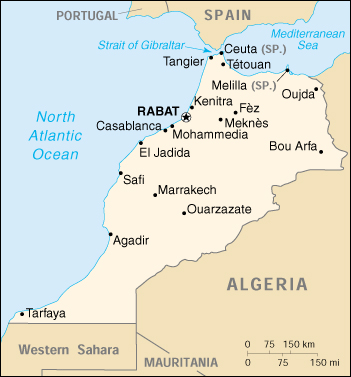
Background: Morocco’s long struggle for independence from France ended in 1956. The internationalized city of Tangier was turned over to the new country that same year. Morocco virtually annexed Western Sahara during the late 1970s, but final resolution on the status of the territory remains unresolved. Gradual political reforms in the 1990s resulted in the establishment of a bicameral legislature in 1997.
Government type: constitutional monarchy
Capital: Rabat
Currency: 1 Moroccan dirham (DH) = 100 centimes
Geography of Morocco
Location: Northern Africa, bordering the North Atlantic Ocean and the Mediterranean Sea, between Algeria and Western Sahara
Geographic coordinates: 32 00 N, 5 00 W
Area:
total: 446,550 sq km
land: 446,300 sq km
water: 250 sq km
Land boundaries:
total: 2,017.9 km
border countries: Algeria 1,559 km, Western Sahara 443 km, Spain (Ceuta) 6.3 km, Spain (Melilla) 9.6 km
Coastline: 1,835 km
Maritime claims:
contiguous zone: 24 nm
continental shelf: 200-m depth or to the depth of exploitation
exclusive economic zone: 200 nm
territorial sea: 12 nm
Climate: Mediterranean, becoming more extreme in the interior
Terrain: northern coast and interior are mountainous with large areas of bordering plateaus, intermontane valleys, and rich coastal plains
Elevation extremes:
lowest point: Sebkha Tah -55 m
highest point: Jebel Toubkal 4,165 m
Natural resources: phosphates, iron ore, manganese, lead, zinc, fish, salt
Land use:
arable land: 21%
permanent crops: 1%
permanent pastures: 47%
forests and woodland: 20%
other: 11% (1993 est.)
Irrigated land: 12,580 sq km (1993 est.)
Natural hazards: northern mountains geologically unstable and subject to earthquakes; periodic droughts.
Environment – current issues: land degradation/desertification (soil erosion resulting from farming of marginal areas, overgrazing, destruction of vegetation); water supplies contaminated by raw sewage; siltation of reservoirs; oil pollution of coastal waters.
Environment – international agreements:
party to: Biodiversity, Climate Change, Desertification, Endangered Species, Hazardous Wastes, Marine Dumping, Nuclear Test Ban, Ozone Layer Protection, Ship Pollution, Wetlands, Whaling
signed, but not ratified: Environmental Modification, Law of the Sea
Geography – note: strategic location along Strait of Gibraltar
People of Morocco
Most Moroccans are Sunni Muslims of Arab, Berber, or mixed Arab-Berber stock. The Arabs invaded Morocco in the 7th and 11th centuries and established their culture there. Morocco’s Jewish minority numbers about 7,000. Most of the100,000 foreign residents are French or Spanish; many are teachers or technicians.
Arabic is Morocco’s official language (it is the “classical” Arabic of the Qur’an, literature and news media). The country’s distinctive Arabic dialect is the most widely spoken language in Morocco. Approximately 10 million Moroccans, mostly in rural areas, speak Berber–which exists in Morocco in three different dialects (Tarifit, Tashlehit, and Tamazight)–either as a first language or bilingually with the spoken Arabic dialect. French, which remains Morocco’s unofficial third language, is taught universally and still serves as Morocco’s primary language of commerce and economics; it also is widely used in education and government. Many Moroccans in the northern part of the country speak Spanish. English, while still far behind French and Spanish in terms of number of speakers, is rapidly becoming the foreign language of choice among educated youth. As a result of national education reforms entering into force in late 2002, English will be taught in all public schools from the fourth year on.
Most people live west of the Atlas Mountains, a range that insulates the country from the Sahara Desert. Casablanca is the center of commerce and industry and the leading port; Rabat is the seat of government; Tangier is the gateway to Morocco from Spain and also a major port; “Arab” Fez is the cultural and religious center; and “Berber” Marrakech is a major tourist center.
Education in Morocco is free and compulsory through primary school (age 15). Nevertheless, many children–particularly girls in rural areas–still do not attend school. The country’s illiteracy rate has been stuck at around 50% for some years but reaches as high as 90% among girls in rural regions.
Population: 32,725,847 (July 2005 est.)
Age structure:
0-14 years: 34.39%
15-64 years: 60.93%
65 years and over: 4.68%
Population growth rate: 1.71%
Birth rate: 24.16 births/1,000 population
Death rate: 5.94 deaths/1,000 population
Net migration rate: -1.15 migrant(s)/1,000 population
Infant mortality rate: 48.11 deaths/1,000 live births
Life expectancy at birth:
total population: 69.43 years
male: 67.2 years
female: 71.76 years
Total fertility rate: 3.05 children born/woman
Nationality:
noun: Moroccan(s)
adjective: Moroccan
Ethnic groups: Arab-Berber 99.1%, other 0.7%, Jewish 0.2%
Religions: Muslim 98.7%, Christian 1.1%, Jewish 0.2%
Languages: Arabic (official), Berber dialects, French often the language of business, government, and diplomacy
Literacy:
definition: age 15 and over can read and write
total population: 43.7%
male: 56.6%
female: 31% (1995 est.)
History of Morocco
Morocco’s strategic location has shaped its history. Beginning with the Phoenicians, many foreigners were drawn to this area. Romans, Vandals, Visigoths, and Byzantine Greeks successively ruled the area. Arab forces began occupying Morocco in the seventh century A.D., bringing their civilization and Islam. The Alaouite dynasty, which has ruled Morocco since 1649, claims descent from the Prophet Muhammad.
Morocco’s location and resources led to early competition among European powers in Africa, beginning with successful Portuguese efforts to control the Atlantic coast in the 15th century. France showed a strong interest in Morocco as early as 1830. Following recognition by the United Kingdom in 1904 of France’s “sphere of influence” in Morocco, the Algeciras Conference (1906) formalized France’s “special position” and entrusted policing of Morocco to France and Spain jointly. The Treaty of Fez (1912) made Morocco a protectorate of France. By the same treaty, Spain assumed the role of protecting power over the northern and southern (Saharan) zones.
Nationalist political parties, which subsequently arose under the French protectorate, based their arguments for Moroccan independence on such World War II declarations as the Atlantic Charter (a joint U.S.-British statement that set forth, among other things, the right of all people to choose the form of government under which they live). A manifesto of the Istiqlal (Independence) Party in 1944 was one of the earliest public demands for independence. That party subsequently provided most of the leadership for the nationalist movement.
France’s exile of the highly respected Sultan Mohammed V in 1953 and his replacement by the unpopular Mohammed Ben Aarafa, whose reign was perceived as illegitimate, sparked active opposition to the French protectorate. France allowed Mohammed V to return in 1955, and the negotiations that led to Moroccan independence began the following year.
The Kingdom of Morocco recovered its political independence from France on March 2, 1956. Through agreements with Spain in 1956 and 1958, Moroccan control over certain Spanish-ruled areas was restored. The internationalized city of Tangier was reintegrated with the signing of the Tangier Protocol on October 29, 1956. The Spanish enclave of Ifni in the south became part of Morocco in 1969. Spain, however, retains control over the small enclaves of Ceuta and Melilla in the north.
Morocco Economy
Macroeconomic stability coupled with relatively slow economic growth characterize the Moroccan economy over the past several years. The present Youssoufi government has introduced a number of important economic reforms over the past several years. The economy, however, remains overly dependent on the agriculture sector. Morocco’s primary economic challenge is to accelerate growth in order to reduce high levels of unemployment.
Through a foreign exchange rate anchor and well-managed monetary policy, Morocco has held inflation rates to industrial country levels over the past decade. Inflation in 2000 and 2001 were below 2%. Despite criticism among exporters that the dirham has become badly overvalued, the current account deficit remains modest. Foreign exchange reserves are strong, with more than $7 billion in reserves at the end of 2001. The combination of strong foreign exchange reserves and active external debt management gives Morocco the capacity to service its debt. Current external debt stands at about $19 billion.
Economic growth, however, has been erratic and relatively slow, partially as a result of an overreliance on the agriculture sector. Agriculture production is extremely susceptible to rainfall levels and ranges from 13% to 20% of GDP. Given that almost 50% of Morocco’s population depends directly on agriculture production, droughts have a severe knock-on effect to the economy. Two successive years of drought led to a 0.7% decline in real GDP in 1999 and stagnation in 2000. Better rains during the 2000-01 growing season led to an estimated 6% growth rate in 2001. Over the long term, Morocco will have to diversify its economy away from agriculture to develop a more stable economic basis for growth.
The current government has introduced a series of structural reforms in recent years. The most promising reforms have been in the liberalization of the telecommunications sector. This process started with the sale of a second GSM license in 1999. In 2001, the process continued with the privatization of 35% of the state operator Maroc Telecom. Morocco has announced plans to sell two fixed licenses in 2002. Morocco also has liberalized rules for oil and gas exploration and has granted concessions for many public services in major cities. The tender process in Morocco is becoming increasingly transparent. Many believe, however, that the process of economic reform must be accelerated in order to reduce urban unemployment below the current rates above 20%.
GDP: purchasing power parity – $105 billion (2000 est.)
GDP – real growth rate: 0.8% (2000 est.)
GDP – per capita: purchasing power parity – $3,500 (2000 est.)
GDP – composition by sector:
agriculture: 15%
industry: 33%
services: 52% (1999 est.)
Household income or consumption by percentage share:
lowest 10%: 2.6%
highest 10%: 30.9% (1998-99)
Inflation rate (consumer prices): 2% (2000 est.)
Labor force: 11 million (1997 est.)
Labor force – by occupation: agriculture 50%, services 35%, industry 15% (1999 est.)
Unemployment rate: 23% (1999 est.)
Budget:
revenues: $9.6 billion
expenditures: $8.6 billion, including capital expenditures of $2.1 billion (2001 est.)
Industries: phosphate rock mining and processing, food processing, leather goods, textiles, construction, tourism
Industrial production growth rate: 0.5% (1999 est.)
Electricity – production: 13.695 billion kWh (1999)
Electricity – production by source:
fossil fuel: 89.19%
hydro: 10.81%
nuclear: 0%
other: 0% (1999)
Electricity – consumption: 13.441 billion kWh (1999)
Agriculture – products: barley, wheat, citrus, wine, vegetables, olives; livestock
Exports: $7.6 billion (f.o.b., 2000 est.)
Exports – commodities: phosphates and fertilizers, food and beverages, minerals
Exports – partners: France 35%, Spain 9%, UK 8%, Germany 7%, US 5% (1999)
Imports: $12.2 billion (f.o.b., 1999 est.)
Imports – commodities: semi processed goods, machinery and equipment, food and beverages, consumer goods, fuel
Imports – partners: France 32%, Spain 12%, Italy 7%, Germany 6%, UK 6% (1999)
Debt – external: $18.4 billion (2000 est.)
Economic aid – recipient: $565.6 million (1995)
Currency: Moroccan dirham (MAD)
Map of Morocco