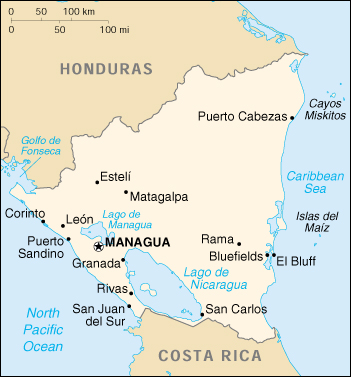
Facts About Nicaragua
Background: Settled as a colony of Spain in the 1520s, Nicaragua gained its independence in 1821. Violent opposition to governmental manipulation and corruption spread to all classes by 1978 and resulted in a short-lived civil war that brought the Marxist Sandinista guerrillas to power in 1979. Nicaraguan aid to leftist rebels in El Salvador caused the US to sponsor anti-Sandinista contra guerrillas through much of the 1980s. Free elections in 1990 and again in 1996 saw the Sandinistas defeated. The country has slowly rebuilt its economy during the 1990s, but was hard hit by Hurricane Mitch in 1998.
Government type: republic
Capital: Managua
Currency: 1 gold cordoba (C$) = 100 centavos
Geography of Nicaragua
Location: Middle America, bordering both the Caribbean Sea and the North Pacific Ocean, between Costa Rica and Honduras
Geographic coordinates: 13 00 N, 85 00 W
Area:
total: 129,494 sq km
land: 120,254 sq km
water: 9,240 sq km
Land boundaries:
total: 1,231 km
border countries: Costa Rica 309 km, Honduras 922 km
Coastline: 910 km
Maritime claims:
contiguous zone: 25-nm security zone
continental shelf: natural prolongation
territorial sea: 200 nm
Climate: tropical in lowlands, cooler in highlands
Terrain: extensive Atlantic coastal plains rising to central interior mountains; narrow Pacific coastal plain interrupted by volcanoes
Elevation extremes:
lowest point: Pacific Ocean 0 m
highest point: Mogoton 2,438 m
Natural resources: gold, silver, copper, tungsten, lead, zinc, timber, fish
Land use:
arable land: 9%
permanent crops: 1%
permanent pastures: 46%
forests and woodland: 27%
other: 17% (1993 est.)
Irrigated land: 880 sq km (1993 est.)
Natural hazards: destructive earthquakes, volcanoes, landslides, and occasionally severe hurricanes
Environment – current issues: deforestation; soil erosion; water pollution; Hurricane Mitch damage
Environment – international agreements:
party to: Biodiversity, Climate Change, Climate Change-Kyoto Protocol, Desertification, Endangered Species, Hazardous Wastes, Law of the Sea, Nuclear Test Ban, Ozone Layer Protection, Ship Pollution, Wetlands
signed, but not ratified: Environmental Modification
Geography – note: largest country in Central America; contains the largest freshwater body in Central America, Lago de Nicaragua.
People of Nicaragua
Most Nicaraguans have both European and Indian ancestry, and the culture of the country reflects the Ibero-European and Indian heritage of its people. Only the Indians of the eastern half of the country remain ethnically distinct and retain tribal customs and languages. A large black minority, of Jamaican origin, is concentrated on the Caribbean coast. In the mid-1980s, the central government divided the eastern half of the country–the former department of Zelaya–into two autonomous regions and granted the people of the region limited self-rule.
The 1995 constitutional reform guaranteed the integrity of the regions’ several unique cultures and gave the inhabitants a say in the use of the area’s natural resources. Roman Catholicism is the major religion, but Evangelical Protestant groups have grown recently, and there are strong Anglican and Moravian communities on the Caribbean coast. Most Nicaraguans live in the Pacific lowlands and the adjacent interior highlands. The population is 54% urban.
Population: 5,465,100 (July 2005 est.)
Age structure:
0-14 years: 38.98%
15-64 years: 58.08%
65 years and over: 2.94%
Population growth rate: 2.15%
Birth rate: 27.64 births/1,000 population
Death rate: 4.82 deaths/1,000 population
Net migration rate: -1.33 migrant(s)/1,000 population
Infant mortality rate: 33.66 deaths/1,000 live births
Life expectancy at birth:
total population: 69.05 years
male: 67.1 years
female: 71.11 years
Total fertility rate: 3.18children born/woman
Nationality:
noun: Nicaraguan(s)
adjective: Nicaraguan
Ethnic groups: mestizo (mixed Amerindian and white) 69%, white 17%, black 9%, Amerindian 5%
Religions: Roman Catholic 85%, Protestant
Languages: Spanish (official)
note: English and indigenous languages on Atlantic coast
Literacy:
definition: age 15 and over can read and write
total population: 65.7%
male: 64.6%
female: 66.6% (1995 est.)
History Of Nicaragua
NICARAGUA IS A COUNTRY OVERWHELMED by its history. Since colonial times, Nicaragua has suffered from political instability, civil war, poverty, foreign intervention, and natural disasters. Successive governments have been unable to bring political stability or significant economic growth to the country. Personal and foreign special interests have generally prevailed over national interests, and repeated foreign intervention in Nicaraguan political and economic affairs has resulted in nationalistic reactions and a legacy of suspicion of foreign governments and their motives.
From precolonial times through the present, the broad central mountain range that splits the country in two has also divided it into two culturally distinct areas. Before the arrival of the Spanish, western Nicaragua was populated by indigenous peoples related to the Maya and Aztec in the north; eastern Nicaragua’s earliest inhabitants were believed to have migrated to the region from South America. The fertile volcanic soils and more salubrious climate in the west attracted Spanish settlers throughout the colonial period. As a result, most of Nicaragua’s present-day population lives in the western part of the country. The eastern Caribbean coastal area with its sultry climate and nonfertile soils attracted only a handful of English settlers and pirates and some blacks (many of whom were runaway slaves) from the West Indies.
Europeans first saw what is now Nicaragua when Christopher Columbus sailed south along the Caribbean coast on his fourth voyage to the Americas in late 1502 and claimed the entire area for Spain. Several land expeditions were launched in the 1520s to subdue the indigenous population, but in general the Spanish were more interested in exploiting the vast riches of Mexico and Peru than in settling Central America. The population of the area dropped precipitously in the sixteenth century. Incoming Spanish settlers were few, and the indigenous population was all but wiped out by exposure to new diseases, with the remainder forcibly sent to Peru to work the silver mines. Administratively during this period, the region became a backwater province of the Audiencia of Guatemala.
The seventeenth century proved no more auspicious than the previous century. Although the population of Nicaragua grew somewhat because of the introduction of livestock, the province’s economy was devastated by trade restrictions imposed by Spain, by natural disasters, and by foreign attacks. The local government neglected agricultural production, preferring to import food. The economy of Nicaragua also suffered because of the massive destruction caused by three powerful earthquakes during the period. During the second half of the century, Nicaragua was subjected to bloody incursions from English, French, and Dutch pirates. In 1668 and 1670, these buccaneers captured and destroyed the city of Granada, center of the province’s agricultural wealth. Control of the eastern half of the country eluded the Spanish, and the English declared eastern Nicaragua to be a protectorate of the English crown.
The eighteenth century saw the beginnings of economic growth based on agriculture but also the birth of a pernicious political rivalry that was to plague the country for two centuries. By the 1750s, a powerful elite was well established in the cities of León and Granada. The landowners in León concentrated on cattle raising and the export of animal products, and Granada became the center of regional agricultural trade. Although these local elites agreed on promoting Nicaragua as the site for a transisthmian canal linking the Caribbean Sea and Pacific Ocean, they differed violently on the trade policies of the province (free-trade or protectionist). During the colonial period, these two cities fought for political control over the province. After independence, the rivalry only intensified, often breaking into open warfare. The hatred between the two factions, the liberals, or free-traders, in León and the conservatives, or protectionists, in Granada, became so institutionalized that the factions often forgot the original philosophical difference that had spawned their rivalry. The violent conflict between liberals and conservatives was one of the most important and destructive aspects of Nicaraguan history, an aspect that would last until well into the twentieth century. Politicians frequently chose party loyalty over national interest, and the nation was often the loser in interparty strife.
Establishment of an independent Nicaragua came in several stages. The first step occurred when the Audiencia of Guatemala declared its independence from Spain in 1821 and became part of the Mexican Empire. Separatist feelings throughout the isthmus grew, and the United Provinces of Central America declared their independence from Mexico in 1823. Under a weak federal government, each province of the new nation created its own independent internal administration. Efforts to centralize power led to civil war between 1826 and 1829. The federation finally dissolved in 1837, and Nicaragua’s independence was formally declared on April 30, 1838.
The mid-1800s were marked by unstable national governments and a rivalry between the United States and Britain to bring Nicaragua under their spheres of influence. The goal of both foreign powers was control of a transisthmian transit route, either overland or via a new Caribbean-to-Pacific canal. Continued domestic turmoil in the 1850s provided the opportunity for William Walker, a soldier of fortune from the United States, to take over Nicaragua. The struggle to expel Walker was long and costly, ultimately involving intervention from all of Nicaragua’s neighbors, the British Navy, and an invasion by the United States marines. The Walker affair left a bitter legacy in Nicaragua and was the first example of what was to become a common occurrence in the country: a penchant for Nicaraguan politicians to call on the United States to settle domestic disputes and an eagerness by the United States to respond by military intervention.
Nicaragua’s thirty-five-year period of relative calm under conservative administrations was broken in 1893 by liberal José Santos Zelaya. Zelaya’s rule proved to be one of the most controversial periods in Nicaraguan history. Zelaya, a ruthless dictator who managed to stay in power for sixteen years despite strong foreign and domestic opposition, was responsible for the creation of a professional army and the growth of strong nationalist feelings. Zelaya opened the country to foreign investment, expanded coffee production, and boosted banana exports. His government promoted internal development and modernized Nicaragua’s infrastructure. During his tenure, new roads and seaport facilities were constructed, railroad lines were extended, and many government buildings and schools were built. Opposition from conservatives eventually erupted into a revolt that, with the support of United States marines, drove Zelaya from power in 1909.
Zelaya’s fall ushered in another era of political instability and foreign intervention. The United States, flush with its new colonies in the Caribbean won after the Spanish-American War (1898), entered a new era of interventionism in the Caribbean and Central America. The United States marines who helped topple Zelaya remained in Nicaragua to support subsequent conservative governments. United States banks lent money to Nicaragua on the condition that these banks would retain complete control of Nicaraguan customs and all revenue from the railroads and steamships. By the end of World War I, United States military presence and supervision of the economy had turned Nicaragua into a near United States protectorate.
As isolationist sentiment grew in the United States in the 1920s, there were increased calls in the United States for removal of the marines from Nicaragua. United States officials decided that an honorable way to withdraw forces was to create a national Nicaraguan constabulary, the National Guard, to maintain order after the marines withdrew. The National Guard was formed in June 1925, and the last United States marines withdrew in August.
The worst predictions regarding Nicaragua’s future after the departure of United States marines soon came to pass. The Nicaraguan government dissolved into chaos, and liberal- conservative fighting erupted anew. The United States, fearing a full-scale civil war would result in a leftist victory, as had been the case after the Mexican Revolution (1911-17), sent the marines back to Managua in January 1927. This time, however, the rapid buildup of United States forces led only to increased mayhem. The fighting did not stop until massive United States power and the growing strength of the National Guard forced most combatants to sign a truce. Out of this latest struggle would emerge two of the most influential Nicaraguans of the twentieth century, Augusto César Sandino and Anastasio Somoza García.
Sandino was the only major player who refused to abide by the truce. Initially a combatant for the liberals in the fighting, he turned his forces against the United States marines and the National Guard, which he considered merely a tool of the United States, after the implementation of the peace accord. Sandino led a force of several hundred who engaged in classic guerrilla warfare in remote rural areas. Never a serious threat to the national government, Sandino’s forces nevertheless proved a drain on the economy and a constant gadfly and embarrassment to the National Guard. Sandino’s hit-and-run tactics were also the excuse that allowed 2,000 United States marines to remain in Nicaragua.
Once again, domestic events in the United States had powerful repercussions in Nicaragua. The deepening Great Depression, outrage in the United States over the growing number of names on marine casualty lists, and a desire to improve relations with Latin America in the face of a growing threat from Japan and Germany resulted in president Herbert Hoover’s withdrawing all marines from Nicaragua in the waning days of his administration in January 1933.
The National Guard and its new director, Somoza García, immediately moved to fill the power vacuum left by the departure of the United States. Recognizing the potential power of a strong army in a weak nation, Somoza García rapidly began consolidating power within the National Guard and soon was acting independently of his uncle, President Juan Bautista Sacasa, who was nominal head of the guard. In January 1934, upon leaving the president’s house where he had been conducting peace negotiations, Sandino was assassinated by National Guard associates, who had acted without approval of the president. As Somoza García’s power over the National Guard strengthened, his control of national affairs became more evident. Finally, in June 1936, Somoza García forced his uncle to resign as president and instructed the Nicaraguan Congress name him as his uncle’s replacement. A Somoza dynasty that would last for more than four decades was hence founded.
For the next twenty years, Somoza García was dictator of Nicaragua, always in control of the National Guard and ruling either directly as president or indirectly through a hand-picked and compliant family associate who held the post of president. A weak opposition was tolerated but only to give a democratic facade to the regime. Real opposition was met with incarceration, torture, exile, or assassination. A clever politician, Somoza García maintained power by changing roles to gain the support of one or another influential group in Nicaragua, while keeping the support of the United States. He, for example, expressed sympathy with fascism in the late 1930s in order to win support from the business sector and the upper classes. However, he was an ardent supporter of the Allies in World War II and was rewarded with large amounts of United States military aid. In the late 1940s and early 1950s, domestically he supported labor (generally on the left politically), while keeping a fervent anticommunist stance in international forums.
Control over the country also meant almost complete control over its economy. The 1940s and 1950s were boom times for the Nicaraguan economy as coffee prices soared, but most of the country’s profit went into the pockets of Somoza García and his cronies. (Somoza García is reported to have quipped, “Bucks for my friends, bullets for my enemies.”) They bought or expropriated farms, mining interests, and companies until by the late 1940s, Somoza García was the nation’s largest landowner. He owned most of the country’s cattle ranches and coffee plantations and, as well, owned or controlled all banks, the national railroad, the national airlines, a cement factory, textile plants, several large electric power companies, and extensive rental property in the cities. Somoza García’s policies made him many enemies, including a disgruntled citizen, who assassinated him in September 1956.
Somoza García had changed the presidential succession so that it devolved on the director of the National Guard, a post held by his older son, Luis Somoza Debayle. Luis Somoza Debayle immediately assumed the post of president, and his younger brother, Anastasio Somoza Debayle, took over as director of the National Guard. The brothers’ different personalities soon became apparent. Although both had been trained to take over as president in turn, the older Somoza brother appeared to favor a slight liberalization of his father’s repressive style of governing. The younger brother, in contrast, lacked his father’s political skills and increasingly commanded the National Guard through brute force. Because of the older brother’s poor health, Anastasio Somoza Debayle assumed more and more power.
The formal transfer of power came in 1967, shortly before Luis Somoza Debayle suffered a fatal heart attack. Decades of pent-up grievances against corruption and repression had created opposition to the Somozas, however. Having none of his father’s ability to finesse the opposition, the new president, Anastasio Somoza Debayle, reacted to any criticism by increasing political repression. Instead of being trumped as in the past, opposition forces now seemed only to be strengthened by Anastasio Somoza Debayle’s repressive tactics. For the next dozen years, a cycle of active opposition to Anastasio Somoza Debayle’s regime and the regime’s ever more ruthless response threatened to destroy Nicaragua’s economy and society.
As the 1970s progressed, all sectors of Nicaraguan society joined the opposition to Anastasio Somoza Debayle’s regime. The turning point for many was the December 1972 earthquake that destroyed Managua. National Guard members joined in looting the city after the tremor, and it was later revealed that most of the international aid after the earthquake enriched the Somoza family instead of reaching the victims. As a result, almost all political figures drifted over to the opposition. The president was nominally identified with the liberals and therefore was opposed by the conservatives from the beginning of his rise to power. Anastasio Somoza Debayle’s loyalty to family, cronies, and the National Guard over party, however, gradually alienated former fellow liberals. The country’s rapid economic decline after the earthquake lost him the support of labor, the middle class, and Nicaragua’s elite. The left and student groups had long been vocal opponents of the regime. The Roman Catholic Church and elements of the press, especially the influential La Prensa, also became outspoken in their condemnation of the government’s repressive actions.
The group that was eventually to take the lead in opposing Anastasio Somoza Debayle, the Sandinista National Liberation Front (Frente Sandinista de Liberación Nacional–FSLN), was formed in 1962. Taking its name and much of its ideology from Sandino, the FSLN grew from a group of university students to a small Marxist revolutionary organization operating in rural areas. Fueled by growing disenchantment with the dictator and foreign help, the FSLN was militarily challenging the National Guard throughout the country by the late 1970s. Despite the collapse of the economy and the loss of all domestic and international support, the tenacity of Anastasio Somoza Debayle and the National Guard made it increasingly apparent that a change in Nicaragua would come through revolution instead of peaceful reform.
After two years of violent struggle, Anastasio Somoza Debayle finally fled Nicaragua, and on July 20, 1979, the FSLN and other members of the revolutionary force entered Managua. A new five- member junta assumed power, pledging political pluralism, a mixed economic system, and a nonaligned foreign policy. The new government inherited a country in ruins; an estimated 50,000 Nicaraguans were dead, 120,000 exiled, and 600,000 homeless. Despite the destruction, most Nicaraguans supported the new regime because they saw the Sandinista victory as an opportunity to end the repression and economic inequalities of the almost universally hated Somoza regime.
As leaders in the military struggle and the best-organized and most powerful group in postrevolutionary Nicaragua, the Sandinistas rapidly began consolidating their political power. The constitution was abrogated, and the Congress was replaced by an appointed Council of State, dominated by Sandinista members. The two influential non-Sandinista members of the ruling junta resigned, and by 1983 it was clear that Daniel José Ortega Saavedra, a long-time member of the FSLN, controlled the junta. The National Guard was abolished and replaced by the new Sandinista People’s Army (Ejército Popular Sandinista–EPS), headed by Humberto Ortega Saavedra. Mass popular groups were formed to represent labor, peasants, and women.
Domestic and international support for the new Sandinista government was not universal, however. The ethnic minorities from the Caribbean coast, neglected by national governments since colonial times, rejected Sandinista efforts to incorporate them into the national mainstream and demanded autonomy. Worried that Nicaragua would become “another Cuba,” the United States government launched a campaign to isolate the Sandinista government in 1981. Later that year, the Reagan administration (1981-89) authorized support for groups trying to overthrow the Sandinistas. Using camps in southern Honduras as a staging area, the United States supported groups of disgruntled former members of the National Guard. This effort became known as the Nicaraguan Resistance; members of the group were later called the Contras.
As the Contra war intensified, the Sandinistas’ tolerance of political pluralism waned, and the government imposed emergency laws to ban criticism and organization of political opposition. Social programs also suffered as a result of the war because the Sandinista regime was forced to increase military spending until half of its budget went for defense. Agricultural production also sharply declined as refugees fled areas of conflict.
Throughout the 1980s, as the Contra war expanded, the economy continued to deteriorate, in part because of a devastating embargo on Nicaraguan goods imposed by the United States in early 1985. In 1987, in the aftermath of the Iran-Contra affair, the United States Congress, however, stopped all military support to the Contras. The result of the cutoff was a military stalemate; the Contras were unable to keep on fighting without United States support, and the Sandinista government could not afford to continue waging an unpopular war that had already devastated the economy. The Contras and the Sandinistas had few options other than to negotiate.
International negotiations among the Central American countries in the late 1980s laid the groundwork for a peace settlement. Elections, originally scheduled for the fall of 1990, were moved to February 1991. President Ortega also agreed to guarantee fair participation for opposition parties and to allow international observers to monitor the entire electoral process.
The Sandinistas felt confident of their success at the polls despite deteriorating socioeconomic conditions. On June 6, 1989, fourteen parties, united only in their opposition to the Sandinistas, formed a coalition called the National Opposition Union (Unión Nacional Opositora–UNO), whose support was drawn from a broad base, including conservative and liberal parties. Despite its determination to vote the Sandinistas out of power, however, the UNO coalition remained a weak opposition lacking a cohesive program.
Despite some violent incidents, the electoral campaign took place in relative peace. In an effort to divert attention from the critical economic situation, the Sandinista campaign appealed to nationalism, depicting UNO followers as pro-Somoza, instruments of United States foreign policy, and enemies of the Nicaraguan revolution. The UNO coalition under Violeta Barrios de Chamorro directed a campaign centered around the failing economy and promises of peace. Many Nicaraguans expected the country’s economic crisis to deepen and the Contra conflict to continue if the Sandinistas remained in power. Chamorro promised to end the unpopular military draft, bring about democratic reconciliation, and promote economic growth. The UNO coalition won a surprising victory on February 25, 1990. Exhausted by war and poverty, the Nicaraguan people opted for change.
The new administration inherited a country in ruins. Agriculture remained the country’s primary economic resource, but production of the two main crops, coffee and cotton, had dropped during the 1980s. Manufacturing, always a small part of the economy, had practically ceased by 1990. The transportation and telecommunication networks, found almost exclusively in the western half of the country and inadequate even during the Somoza era, were damaged by nearly two decades of fighting. Blackouts were frequent because the electric power system was often the target of sabotage during the Contra war and because the country frequently was unable to pay for petroleum, all of which was imported, to generate electricity. The entire banking system was bankrupt, and more than half the labor force was unemployed or underemployed. A per capita gross domestic product of less than US$500 gave Nicaragua the dubious distinction of being one of the poorest nations in the Western Hemisphere. Perhaps the only bright spot in the economic morass was that the collapse of the economy stopped the ecological destruction of the rich forest lands in eastern Nicaragua.
Social conditions largely parallelled the poor state of the economy. Although in their early years in power, the Sandinistas put great effort into improving the health and education systems and the literacy rate, diversion of half of the national budget to the military during the second half of their administration largely wiped out the significant gains made in their first few years. Even using spartan standards for what is adequate for survival, official government statistics in 1992 classified two- thirds of Nicaraguans as poor. Only slightly more than half of primary-school age children attended school. Most rural inhabitants (45 percent of the population) and many urban dwellers (55 percent out of a total of nearly 4 million people) lacked access to health care.
The ethnic divide adds to the country’s social problems. Nicaragua continues to be ethnically divided in two: the west is relatively homogeneous, Spanish-speaking, culturally Hispanic and racially mestizo; the east is a multiracial, multicultural and mostly English-speaking region. Although the people are nominally Roman Catholic, various Protestant denominations have made significant inroads in recent years, particularly in the east.
In addition to its overwhelming economic and social challenges, the new Chamorro administration faced immediate political problems. Almost from the day it took power, the Chamorro government was a stepchild. Even though Chamorro personified the Nicaraguan people’s aspiration for peace, neither the UNO nor the FSLN recognized the government as the legitimate representative of its political, social, and economic aspirations for Nicaragua. The strong constitutional powers of the executive branch theoretically should have given the president adequate control over the political and economic systems, but the transition agreements left the Sandinistas in control of the military and police.
President Chamorro’s first four years in power were marked by social, political, and economic instability. The economy continued deteriorating. Although the demobilization of the Contras concluded in June 1990, violence continued in rural areas, especially in the country’s northern departments. Rearmed members of the Nicaraguan Resistance, now known as Recontras, argued that the Chamorro government did not comply with commitments made during the demobilization process. In the spring of 1991, an estimated 2,000 Recontras rearmed and resumed guerrilla operations in the northern part of the country. They charged the Chamorro government with not fulfilling its promises of land and economic assistance to the Contras as they disarmed and demobilized. The reorganization of the police and the army, as well as the removal of Humberto Ortega as army chief, was necessary, according to the Recontras, for their disbandment.
After the Recontras staged uprisings in support of their demands, demobilized Sandinista soldiers, calling themselves Recompas, took up arms during late August 1991 to fight against anti-Sandinista forces and protect the accomplishments of the Sandinista revolution, which they perceived as being threatened by the UNO government. Recompas clashed with Recontras and government forces and demanded compliance with the commitments made to them during the peace process. Government and army intervention persuaded the two groups to halt the fighting. Ironically, the Recontras and Recompas discovered that they had common grievances and joined forces in a new group called the Revueltos. To achieve political conciliation, the government launched a plan for reconciliation. The government initiative failed, however, to disarm the civilian population. In the spring of 1992, the Revueltos had an estimated 2,000-member force operating in northern Nicaragua.
At the end of 1992, continued confrontation between the Chamorro government and the UNO coalition also threatened the country’s democratic institutions. A conflict over politics developed among UNO representatives in the National Assembly. The UNO group in the assembly split into two groups: a larger conservative wing, headed by Alfredo César Aguirre, that demanded a complete rupture with the Sandinistas and began to oppose the president; and a smaller, more moderate group, headed by Antonio Lacayo Oyanguren, that insisted on cooperation with the FSLN as a prerequisite for national reconciliation and continued to support the president’s policies. The group headed by César was backed by conservatives in the United States Senate, who threatened to freeze United States aid to Nicaragua in an effort to persuade the Chamorro administration to oppose the Sandinistas more strongly.
The political crisis grew during the summer of 1992, when César launched a political offensive against Lacayo in an effort to implicate Lacayo in fraud and embezzlement of government funds. César also directed attacks on Humberto Ortega and high- ranking police officials. Conflict in the National Assembly heightened when eight UNO deputies broke ranks and began voting with the Sandinistas. This new UNO/Sandinista bloc represented a majority within the legislature, and César, backed by most of the remaining UNO coalition, took over the National Assembly in what many considered a political coup. The Sandinista faction boycotted César’s actions by walking out of the National Assembly.
The UNO bloc in the National Assembly headed by César demanded Humberto Ortega’s removal from the army and Chamorro’s ouster from the presidency. It also demanded property legislation to abolish the Piñata–the FSLN legislation giving the Sandinistas titles to considerable state property put into effect immediately following the 1990 elections. At the same time, the United States Congress froze US$116 million in economic aid to Nicaragua pending restructuring of the police. In an effort to unfreeze the United States economic package, the Chamorro administration negotiated the removal of top Sandinista police leaders, including its chief, René Vivas Lugo. The Nicaraguan president appealed to the courts, which in turn ruled that all legislation passed by the César faction of UNO was unconstitutional. On December 29, 1992, President Chamorro used her executive powers to authorize a military takeover of the congressional building and the removal of César as president of the National Assembly. The following day, police occupied the National Assembly building and seized all of its assets and documents. The government appointed a provisional administration to run legislative affairs until new authorities were elected on January 9, 1993.
The takeover of the assembly, which César called a coup, marked the end of UNO support for President Chamorro. Ten of the fourteen political parties that in 1990 formed the UNO coalition now openly opposed the Chamorro administration, accusing it of “co-governing” with the Sandinistas. The supporters of Chamorro from the old UNO coalition formed a progovernment center bloc called the Center Group (Grupo de Centro-GC). The FSLN delegation, along with deputies from the GC, elected Gustavo Tablada Zelaya, from the former Communist Party, as president of the National Assembly. The vice presidency of the legislature went to a Sandinista, Reinaldo Antonio Tefel.
After four years of government under Violeta Barrios de Chamorro, Nicaragua faces difficult times on its road to economic recovery and national reconstruction. Its government must cope with insufficient economic aid to carry out economic reforms, lagging growth in investments, intense partisan struggle, and an increasingly frustrated populace. The internal political situation is exacerbated by the need for compromise with the Sandinistas, who themselves suffered a crisis of identity and credibility after their loss in the 1990 elections.
The role of the armed forces remains the center of debate among political forces. Criticized by its neighbors and by the United States because it was deemed to large to be a purely defensive force, the army has gone through a major reduction in force, going from 97,000 troops in 1989 to 15,200 in 1993. However, despite repeated promises by the president that the army chief would be replaced and control be transferred from the Sandinistas to the national government, Humberto Ortega still commanded the Nicaraguan army in mid-1994.
In mid-1994, Nicaragua is still far from enjoying the social and political peace necessary to attract foreign investment and achieve economic growth. The Chamorro administration, as well as the Sandinista leadership and the UNO coalition are caught between their respective ideals and the need for a pragmatic political reconciliation. Popular dissatisfaction with the democratic process prevails. Despite its internal conflicts, however, the FSLN remains the strongest and best organized political force in Nicaragua and is the only party with the organizational skills and political experience to carry out a government program. As the country prepares for the 1996 elections, conditions similar to those faced in 1990–social instability, political polarization, and economic uncertainty– leave Nicaragua with few means for overcoming its political and socioeconomic crisis.
Nicaragua Economy
Nicaragua began free market reforms in 1991 after 12 years of economic free-fall under the Sandinista regime. Despite some setbacks, it has made dramatic progress: privatizing more than 350 state enterprises, reducing inflation from 13,500% to 8%, and cutting the foreign debt in half. The economy began expanding in 1994 and grew 2.5% in 2001, with overall GDP reaching $2.44 million in 2001. In 2001, the global recession, combined with a series of bank failures, low coffee prices, and a drought, caused the economy to retract.
Nicaragua remains the second-poorest nation in the hemisphere with a per capita GDP of less than $500–below where it stood before the Sandinista takeover in 1979. Unemployment is officially around 11%, and another 36% are underemployed. Nicaragua suffers from persistent trade and budget deficits and a high debt-service burden, leaving it highly dependent on foreign assistance–as much as 25% of GDP in 2001.
One of the key engines of economic growth has been production for export. Exports were 640 million in 2001. Although traditional products such as coffee, meat, and sugar continued to lead the list of Nicaraguan exports, the fastest growth is now in nontraditional exports: maquila goods (apparel); gold; seafood; and new agricultural products such as peanuts, sesame, melons, and onions. Nicaragua also depends heavily on remittances from Nicaraguans living abroad.
Nicaragua is primarily an agricultural country, but construction, mining, fisheries, and general commerce also have been expanding during the last few years. Foreign private capital inflows topped $300 million in 1999 but, due to economic and political uncertainty, fell to less than $100 million in 2001. Rapid expansion of the tourist industry has made it the nation’s third-largest source of foreign exchange. Some 60,000 Americans visit Nicaragua yearly–primarily business people, tourists, and those visiting relatives. An estimated 5,300 U.S. citizens reside in the country. The U.S. embassy’s consular section provides a full range of consular services–from passport replacement and veteran’s assistance to prison visitation and repatriation assistance.
Nicaragua faces a number of challenges in stimulating rapid economic growth. Long-term success at attracting investment, creating jobs, and reducing poverty depend on its ability to comply with an International Monetary Fund (IMF) program, resolve the thousands of Sandinista-era property confiscation cases, and open its economy to foreign trade. This process was boosted in late 2000 when Nicaragua reached the decision point under the Heavily Indebted Poor Countries (HIPC) debt relief initiative. However, HIPC benefits will be delayed because Nicaragua subsequently fell “off track” from its IMF program. The country also has been grappling with a string of bank failures that began in August 2000. Moreover, Nicaragua continues to lose international reserves due to its growing fiscal deficits.
GDP: purchasing power parity – $13.1 billion (2000 est.)
GDP – real growth rate: 5% (2000 est.)
GDP – per capita: purchasing power parity – $2,700 (2000 est.)
GDP – composition by sector:
agriculture: 31.6%
industry: 22.8%
services: 45.6% (1999)
Household income or consumption by percentage share:
lowest 10%: 1.6%
highest 10%: 39.8% (1993)
Inflation rate (consumer prices): 11% (2000 est.)
Labor force: 1.7 million (1999)
Labor force – by occupation: services 43%, agriculture 42%, industry 15% (1999 est.)
Unemployment rate: 10.5% (1999 est.); considerable underemployment
Budget:
revenues: $734 million
expenditures: $836 million (1999 est.)
Industries: food processing, chemicals, machinery and metal products, textiles, clothing, petroleum refining and distribution, beverages, footwear, wood
Industrial production growth rate: 4.4% (2000 est.)
Electricity – production: 2.349 billion kWh (1999)
Electricity – production by source:
fossil fuel: 67.26%
hydro: 17.71%
nuclear: 0%
other: 15.03% (1999)
Electricity – consumption: 2.265 billion kWh (1999)
Agriculture – products: coffee, bananas, sugarcane, cotton, rice, corn, tobacco, sesame, soya, beans; beef, veal, pork, poultry, dairy products
Exports: $631 million (f.o.b., 2000 est.)
Exports – commodities: coffee, shrimp and lobster, cotton, tobacco, beef, sugar, bananas; gold
Exports – partners: United States 37.7%, El Salvador 12.5%, Germany 9.8%, Costa Rica 5.1%, Spain 2.5%, France 2.1% (1999)
Imports: $1.6 billion (f.o.b., 2000 est.)
Imports – commodities: machinery and equipment, raw materials, petroleum products, consumer goods
Imports – partners: United States 34.5%, Costa Rica 11.4%, Guatemala 7.3%, Panama 6.9%, Venezuela 5.9%, El Salvador 5.5% (1999)
Debt – external: $6.4 billion (2000 est.)
Economic aid – recipient: pledges of $1.4 billion in new aid in 1999
Currency: gold cordoba (NIO)
Map Of Nicaragua