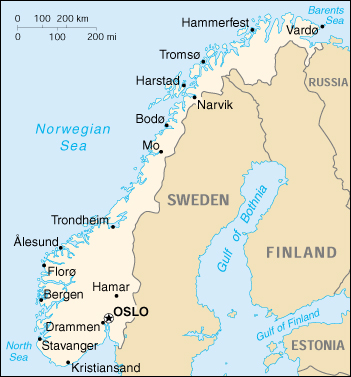
Facts About Norway
Background: Despite its neutrality, Norway was not able to avoid occupation by Germany in World War II. In 1949, neutrality was abandoned and Norway became a member of NATO. Discovery of oil and gas in adjacent waters in the late 1960s boosted Norway’s economic fortunes. The current focus is on containing spending on the extensive welfare system and planning for the time when petroleum reserves are depleted. In referenda held in 1972 and 1994, Norway rejected joining the EU.
Government type: constitutional monarchy
Capital: Oslo
Currency: 1 Norwegian krone (NKr) = 100 oere
Geography of Norway
Location: Northern Europe, bordering the North Sea and the North Atlantic Ocean, west of Sweden
Geographic coordinates: 62 00 N, 10 00 E
Area:
total: 324,220 sq km
land: 307,860 sq km
water: 16,360 sq km
Land boundaries:
total: 2,515 km
border countries: Finland 729 km, Sweden 1,619 km, Russia 167 km
Coastline: 21,925 km (includes mainland 3,419 km, large islands 2,413 km, long fjords, numerous small islands, and minor indentations 16,093 km)
Maritime claims:
contiguous zone: 10 nm
continental shelf: 200 nm
exclusive economic zone: 200 nm
territorial sea: 4 nm
Climate: temperate along coast, modified by North Atlantic Current; colder interior; rainy year-round on west coast
Terrain: glaciated; mostly high plateaus and rugged mountains broken by fertile valleys; small, scattered plains; coastline deeply indented by fjords; arctic tundra in north
Elevation extremes:
lowest point: Norwegian Sea 0 m
highest point: Galdhopiggeh 2,469 m
Natural resources: petroleum, copper, natural gas, pyrites, nickel, iron ore, zinc, lead, fish, timber, hydropower
Land use:
arable land: 3%
permanent crops: 0%
permanent pastures: 0%
forests and woodland: 27%
other: 70% (1993 est.)
Irrigated land: 970 sq km (1993 est.)
Natural hazards: rockslides, avalanches
Environment – current issues: water pollution; acid rain damaging forests and adversely affecting lakes, threatening fish stocks; air pollution from vehicle emissions
Environment – international agreements:
party to: Air Pollution, Air Pollution-Nitrogen Oxides, Air Pollution-Persistent Organic Pollutants, Air Pollution-Sulphur 85, Air Pollution-Sulphur 94, Air Pollution-Volatile Organic Compounds, Antarctic-Environmental Protocol, Antarctic-Marine Living Resources, Antarctic Seals, Antarctic Treaty, Biodiversity, Climate Change, Desertification, Endangered Species, Environmental Modification, Hazardous Wastes, Law of the Sea, Marine Dumping, Nuclear Test Ban, Ozone Layer Protection, Ship Pollution, Tropical Timber 83, Tropical Timber 94, Wetlands, Whaling
signed, but not ratified: Air Pollution-Volatile Organic Compounds, Climate Change-Kyoto Protocol
Geography – note: about two-thirds mountains; some 50,000 islands off its much indented coastline; strategic location adjacent to sea lanes and air routes in North Atlantic; one of most rugged and longest coastlines in world; Norway is the only NATO member having a land boundary with Russia.
People of Norway
Ethnically, Norwegians are predominantly Germanic, although in the far north there are communities of Sami (Lapps) who came to the area more than 10,000 years ago, probably from central Asia. In recent years, Norway has become home to increasing numbers of immigrants, foreign workers, and asylum-seekers from various parts of the world. Immigrants now total nearly 150,000; some have obtained Norwegian citizenship.
Although the Evangelical Lutheran Church is the state church, Norway has complete religious freedom. Education is free through the university level and is compulsory from ages 7 to 16. At least 12 months of military service and training are required of every eligible male. Norway’s health system includes free hospital care, physician’s compensation, cash benefits during illness and pregnancy, and other medical and dental plans. There is a public pension system.
Norway is in the top rank of nations in the number of books printed per capita, even though Norwegian is one of the world’s smallest language groups. Norway’s most famous writer is the dramatist Henrik Ibsen. Artists Edvard Munch and Christian Krogh were Ibsen’s contemporaries. Munch drew part of his inspiration from Europe and in turn exercised a strong influence on later European expressionists. Sculptor Gustav Vigeland has a permanent exhibition in the Vigeland Sculpture Park in Oslo. Musical development in Norway since Edvard Grieg has followed either native folk themes or, more recently, international trends.
Population: 4,593,041 (July 2005 est.)
Age structure:
0-14 years: 19.99%
15-64 years: 64.91%
65 years and over: 15.1%
Population growth rate: 0.49%
Birth rate: 12.6 births/1,000 population
Death rate: 9.83 deaths/1,000 population
Net migration rate: 2.11 migrant(s)/1,000 population
Infant mortality rate: 3.94 deaths/1,000 live births
Life expectancy at birth:
total population: 78.79 years
male: 75.87 years
female: 81.92 years
Total fertility rate: 1.81 children born/woman
Nationality:
noun: Norwegian(s)
adjective: Norwegian
Ethnic groups: Norwegian (Nordic, Alpine, Baltic), Sami 20,000
Religions: Evangelical Lutheran 86% (state church), other Protestant and Roman Catholic 3%, other 1%, none and unknown 10% (1997)
Languages: Norwegian (official)
note: small Lapp- and Finnish-speaking minorities
Literacy:
definition: age 15 and over can read and write
total population: 100%
Norway Economy
Economy – overview: The Norwegian economy is a prosperous bastion of welfare capitalism, featuring a combination of free market activity and government intervention. The government controls key areas, such as the vital petroleum sector (through large-scale state enterprises). The country is richly endowed with natural resources – petroleum, hydropower, fish, forests, and minerals – and is highly dependent on its oil production and international oil prices; in 1999, oil and gas accounted for 35% of exports. Only Saudi Arabia exports more oil than Norway. Oslo opted to stay out of the EU during a referendum in November 1994. Growth picked up in 2000 to 2.7%, compared to the meager 0.8% of 1999, but may fall back in 2001. The government moved ahead with privatization in 2000, even proposing the sale of up to one-third of the 100% state-owned oil company Statoil. Despite their high per capita income and generous welfare benefits, Norwegians worry about that time in the next two decades when the oil and gas begin to run out. Accordingly, Norway has been saving its oil-boosted budget surpluses in a Government Petroleum Fund, which is invested abroad and now is valued at more than $43 billion.
GDP: purchasing power parity – $111.3 billion (1999 est.)
GDP – real growth rate: 0.8% (1999 est.), 2.7% (2000 est.)
GDP – per capita: purchasing power parity – $27,700 (2000 est.)
GDP – composition by sector:
agriculture: 2%
industry: 25%
services: 73% (1999)
Household income or consumption by percentage share:
lowest 10%: 4.1%
highest 10%: 21.8% (1995)
Inflation rate (consumer prices): 2.8% (1999 est.), 2.9% (2000 est.)
Labor force: 2.4 million (2000 est.)
Labor force – by occupation: services 74%, industry 22%, agriculture, forestry, and fishing 4% (1995)
Unemployment rate: 2.9% (1999 est.), 3% (2000 est.)
Budget:
revenues: $71.7 billion
expenditures: $57.6 billion (2000 est.)
Industries: petroleum and gas, food processing, shipbuilding, pulp and paper products, metals, chemicals, timber, mining, textiles, fishing
Industrial production growth rate: 0.7% (1999 est.), 3% (2000 est.)
Electricity – production: 121.084 billion kWh (1999)
Electricity – production by source:
fossil fuel: 0.63%
hydro: 99.11%
nuclear: 0%
other: 0.26% (1999)
Electricity – consumption: 110.795 billion kWh (1999)
Electricity – exports: 8.28 billion kWh (1999)
Electricity – imports: 6.467 billion kWh (1999)
Agriculture – products: barley, other grains, potatoes; beef, milk; fish
Exports: $47.3 billion (f.o.b., 1999 est.), $59.2 billion (f.o.b., 2000 est.)
Exports – commodities: petroleum and petroleum products, machinery and equipment, metals, chemicals, ships, fish
Exports – partners: EU 73% (UK 17%, Germany 11%, Netherlands 10%, Sweden 9%), US 5% (1999)
Imports: $38.6 billion (f.o.b., 1999 est.), $35.2 billion (f.o.b., 2000 est.)
Imports – commodities: machinery and equipment, chemicals, metals, foodstuffs
Imports – partners: EU 66% (Sweden 15%, Germany 12%, UK 9%, Denmark 7%), US 10%, Japan (1999)
Debt – external: $0 (Norway is a net external creditor)
Economic aid – donor: ODA, $1.4 billion (1998)
Currency: Norwegian krone (NOK)
Map Of Norway