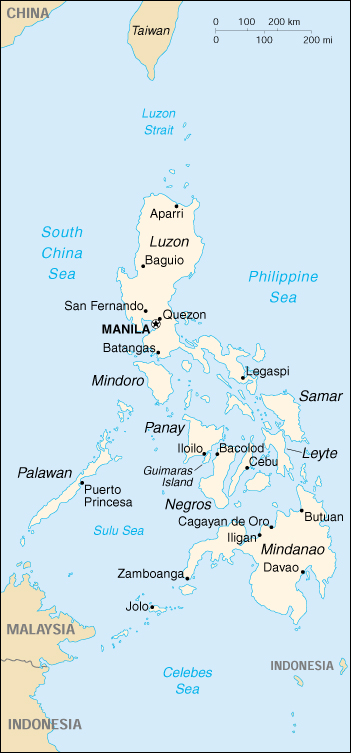
Facts About Philippines
Background: The Philippines were ceded by Spain to the US in 1898 following the Spanish-American War. They attained their independence in 1946 after being occupied by the Japanese in World War II. The 21-year rule of Ferdinand MARCOS ended in 1986 when a widespread popular rebellion forced him into exile. In 1992, the US closed down its last military bases on the islands. The Philippines has had two electoral presidential transitions since Marcos’ removal by “people power.” In January 2001, the Supreme Court declared Joseph ESTRADA unable to rule in view of mass resignations from his government and administered the oath of office to Vice President Gloria MACAPAGAL-ARROYO as his constitutional successor. The government continues to struggle with ongoing Muslim insurgencies in the south.
Government type: republic
Capital: Manila
Currency: 1 Philippine peso (P) = 100 centavos
Geography of the Philippines
Location: Southeastern Asia, archipelago between the Philippine Sea and the South China Sea, east of Vietnam
Geographic coordinates: 13 00 N, 122 00 E
Area:
total: 300,000 sq km
land: 298,170 sq km
water: 1,830 sq km
Land boundaries: 0 km
Coastline: 36,289 km
Maritime claims: measured from claimed archipelagic baselines
continental shelf: to depth of exploitation
exclusive economic zone: 200 nm
territorial sea: irregular polygon extending up to 100 nm from coastline as defined by 1898 treaty; since late 1970s has also claimed polygonal-shaped area in South China Sea up to 285 nm in breadth
Climate: tropical marine; northeast monsoon (November to April); southwest monsoon (May to October)
Terrain: mostly mountains with narrow to extensive coastal lowlands
Elevation extremes:
lowest point: Philippine Sea 0 m
highest point: Mount Apo 2,954 m
Natural resources: timber, petroleum, nickel, cobalt, silver, gold, salt, copper
Land use:
arable land: 19%
permanent crops: 12%
permanent pastures: 4%
forests and woodland: 46%
other: 19% (1993 est.)
Irrigated land: 15,800 sq km (1993 est.)
Natural hazards: astride typhoon belt, usually affected by 15 and struck by five to six cyclonic storms per year; landslides; active volcanoes; destructive earthquakes; tsunamis
Environment – current issues: uncontrolled deforestation in watershed areas; soil erosion; air and water pollution in Manila; increasing pollution of coastal mangrove swamps which are important fish breeding grounds.
Environment – international agreements:
party to: Biodiversity, Climate Change, Desertification, Endangered Species, Hazardous Wastes, Law of the Sea, Marine Dumping, Nuclear Test Ban, Ozone Layer Protection, Tropical Timber 83, Tropical Timber 94, Wetlands
signed, but not ratified: Climate Change-Kyoto Protocol
Geography – note: favorably located in relation to many of Southeast Asia’s main water bodies: the South China Sea, Philippine Sea, Sulu Sea, Celebes Sea, and Luzon Strait.
People of the Philippines
The majority of Philippine people are of Malay stock, descendants of Indonesians and Malays who migrated to the islands long before the Christian era. The most significant ethnic minority group is the Chinese, who have played an important role in commerce since the ninth century, when they first came to the islands to trade. As a result of intermarriage, many Filipinos have some Chinese and Spanish ancestry. Americans and Spaniards constitute the next largest alien minorities in the country.
About 90% of the people are Christian; most were converted and Westernized to varying degrees during nearly 400 years of Spanish and American rule. The major non-Hispanicized groups are the Muslim population, concentrated in the Sulu Archipelago and in central and western Mindanao, and the mountain groups of northern Luzon. Small forest tribes live in the more remote areas of Mindanao.
About 87 native languages and dialects are spoken, all belonging to the Malay-Polynesian linguistic family. Of these, eight are the first languages of more than 85% of the population. The three principal indigenous languages are Cebuano, spoken in the Visayas; Tagalog, predominant in the area around Manila; and Ilocano, spoken in northern Luzon. Since 1939, in an effort to develop national unity, the government has promoted the use of the national language, Pilipino, which is based on Tagalog. Pilipino is taught in all schools and is gaining acceptance, particularly as a second language.
English, the most important nonnative language, is used as a second language by many, including nearly all professionals, academics, and government workers. Only a few Filipino families retain Spanish usage.
Despite this multiplicity of languages, the Philippines has one of the highest literacy rates in the East Asian and Pacific area. About 90% of the population 10 years of age and older are literate.
Population: 87,857,473 (July 2005 est.)
Age structure:
0-14 years: 36.87%
15-64 years: 59.45%
65 years and over: 3.68%
Population growth rate: 2.03%
Birth rate: 27.37 births/1,000 population
Death rate: 6.04 deaths/1,000 population
Net migration rate: -1.01 migrant(s)/1,000 population
Infant mortality rate: 28.7 deaths/1,000 live births
Life expectancy at birth:
total population: 67.8 years
male: 64.96 years
female: 70.79 years
Total fertility rate: 3.42 children born/woman
Nationality:
noun: Filipino(s)
adjective: Philippine
Ethnic groups: Christian Malay 91.5%, Muslim Malay 4%, Chinese 1.5%, other 3%
Religions: Roman Catholic 83%, Protestant 9%, Muslim 5%, Buddhist and other 3%
Languages: Pilipino (official, based on Tagalog), English (official)
Literacy:
definition: age 15 and over can read and write
total population: 94.6%
male: 95%
female: 94.3% (1995 est.)
History Of Philippines
ON AUGUST 21, 1983, Benigno Aquino, leader of the Philippines democratic opposition, was assassinated as he left the airplane that had brought him back home after three years’ exile in the United States. The explanation of the killing by the government of President Ferdinand E. Marcos, placing responsibility on a lone communist gunman, who himself was shot by government troops, aroused skepticism and was even rejected by a governmentappointed commission. It was evident to a majority of Filipinos that Aquino had been killed by the armed forces and that ultimate responsibility lay, if not with Ferdinand Marcos, with his powerful wife Imelda Romualdez Marcos and her close ally, General Fabian Ver. The killing exposed the Marcoses to massive popular indignation, even more than the communist and Muslim insurgencies in the countryside, economic distress, corruption of political institutions, and the incompetence and brutality of the military. Aquino’s widow, Corazon Cojuangco Aquino, became a powerful symbol of democratic resurgence. Following a February 7, 1986, presidential election hopelessly compromised by regimeperpetuated abuses, she was brought to power by a popular movement that encompassed practically every major social group. Her struggle against Marcos was more than a political campaign and assumed the proportions of a moral crusade, backed by the Roman Catholic Church.
Ferdinand Marcos had been elected president in 1965 and won a second term in 1969. But, largely in order to perpetuate his regime, he felt constrained to impose martial law in September 1972. Long-established democratic institutions were shut down or coopted by the Marcos dictatorship. While the economies of neighboring states, such as Malaysia, Thailand, and Indonesia, flourished, or at least adequately weathered uncertainties during the late 1970s and early 1980s, the Philippine economy stagnated. The Aquino assassination caused any remaining confidence in business to evaporate. For ordinary Filipinos, this situation meant high inflation, unemployment, and declines in already low living standards.
The Marcos era from 1965 to 1986 and the ensuing democratic resurgence under Corazon Aquino revealed both the strengths and weaknesses of the nation’s democratic institutions. A Spanish colony since the sixteenth century, the Philippines became a United States possession after the 1898 Spanish-American War, although local patriots wanted to establish an independent republic and fought a bitter guerrilla war against the new colonizers. Representative institutions were established in the first decade of United States rule in order to prepare the people for eventual independence. Particularly when compared with other Western colonies in Asia, progress in this direction was rapid. On November 15, 1935, the self-governing Commonwealth of the Philippines was established. Despite a harsh Japanese occupation during World War II, which inflicted tremendous suffering on the population, independence was achieved, on schedule, on July 4, 1946.
The independent Philippines had firmly established democratic institutions: a two-party system, an independent judiciary, a free press, and regularly scheduled national and local elections. Although there were electoral abuses, the candidates and the citizenry abided by the results. But social values emphasized the importance of personal relations over the rule of law, and the political system and economy since early American colonial days had been dominated by a small landholding elite that opposed meaningful social change, including land reform. The rural and urban poor lacked political power. Many joined communist insurgencies. By the early 1980s, a nation rich in natural resources had extreme poverty in some regions, such as the sugargrowing island of Negros, and gaps between rich and poor were wider than in most of the other developing countries of Southeast Asia and East Asia.
When Marcos declared martial law in September 1972, he promised to eliminate poverty and injustice and create a “New Society.” Instead, he destroyed democratic institutions that would have acted as a brake on abuses of power by him, his wife, and their close associates. Corazon Aquino assumed power on February 25, 1986, amidst an atmosphere of hope and enthusiasm. But the obstacles she faced–communist insurgency, years of economic mismanagement, and an indigenous ethic that persistently emphasized group loyalties and patron-client relationships over the national welfare–were formidable.
Philippines Economy
Economy – overview: In 1998 the Philippine economy – a mixture of agriculture, light industry, and supporting services – deteriorated as a result of spillover from the Asian financial crisis and poor weather conditions. Growth fell to about -0.5% in 1998 from 5% in 1997, but recovered to about 3% in 1999 and 3.6% in 2000. The government has promised to continue its economic reforms to help the Philippines match the pace of development in the newly industrialized countries of East Asia. The strategy includes improving infrastructure, overhauling the tax system to bolster government revenues, moving toward further deregulation and privatization of the economy, and increasing trade integration with the region.
GDP: purchasing power parity – $310 billion (2000 est.)
GDP – real growth rate: 2.9% (1999 est.), 3.6% (2000 est.)
GDP – per capita: purchasing power parity – $3,800 (2000 est.)
GDP – composition by sector:
agriculture: 20%
industry: 32%
services: 48% (1997 est.)
Population below poverty line: 32% (1997 est.)
Household income or consumption by percentage share:
lowest 10%: 1.5%
highest 10%: 39.3% (1998)
Inflation rate (consumer prices): 6.8% (1999), 5% (2000 est.)
Labor force: 48.1 million (2000 est.)
Labor force – by occupation: agriculture 39.8%, government and social services 19.4%, services 17.7%, manufacturing 9.8%, construction 5.8%, other 7.5% (1998 est.)
Unemployment rate: 10% (2000)
Budget:
revenues: $14.5 billion
expenditures: $12.6 billion (1998 est.)
Industries: textiles, pharmaceuticals, chemicals, wood products, food processing, electronics assembly, petroleum refining, fishing
Industrial production growth rate: 4% (2000 est.)
Electricity – production: 40.745 billion kWh (1999)
Electricity – production by source:
fossil fuel: 61.03%
hydro: 18.68%
nuclear: 0%
other: 20.29% (1999)
Electricity – consumption: 37.893 billion kWh (1999)
Electricity – exports: 0 kWh (1999)
Electricity – imports: 0 kWh (1999)
Agriculture – products: rice, coconuts, corn, sugarcane, bananas, pineapples, mangoes; pork, eggs, beef; fish
Exports: $34.8 billion (f.o.b., 1999 est.), $38 billion (f.o.b., 2000 est.)
Exports – commodities: electronic equipment, machinery and transport equipment, garments, coconut products
Exports – partners: US 34%, EU 20%, Japan 14%, Netherlands 8%, Singapore 6%, UK 6%, Hong Kong 4% (1998)
Imports: $30.7 billion (f.o.b., 1999 est.), $35 billion (f.o.b., 2000 est.)
Imports – commodities: raw materials and intermediate goods, capital goods, consumer goods, fuels
Imports – partners: US 22%, Japan 20%, South Korea 8%, Singapore 6%, Taiwan 5%, Hong Kong 4% (1998 est.)
Debt – external: $52 billion (1999)
Economic aid – recipient: ODA, $1.1 billion (1998)
Currency: Philippine peso (PHP)
Map of Philippines