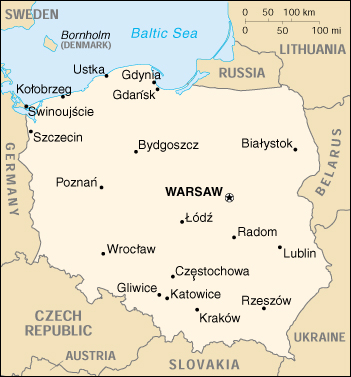
Facts About Poland
Background: Poland gained its independence in 1918 only to be overrun by Germany and the Soviet Union in World War II. It became a Soviet satellite country following the war, but one that was comparatively tolerant and progressive. Labor turmoil in 1980 led to the formation of the independent trade union “Solidarity” that over time became a political force and by 1990 had swept parliamentary elections and the presidency. A “shock therapy” program during the early 1990s enabled the country to transform its economy into one of the most robust in Central Europe, boosting hopes for acceptance to the EU. Poland joined the NATO alliance in 1999.
Government type: republic
Capital: Warsaw
Currency: 1 zloty (Zl) = 100 groszy
Geography of Poland
Location: Central Europe, east of Germany
Geographic coordinates: 52 00 N, 20 00 E
Area:
total: 312,685 sq km
land: 304,465 sq km
water: 8,220 sq km
Land boundaries:
total: 2,888 km
border countries: Belarus 605 km, Czech Republic 658 km, Germany 456 km, Lithuania 91 km, Russia (Kaliningrad Oblast) 206 km, Slovakia 444 km, Ukraine 428 km
Coastline: 491 km
Maritime claims:
exclusive economic zone: defined by international treaties
territorial sea: 12 nm
Climate: temperate with cold, cloudy, moderately severe winters with frequent precipitation; mild summers with frequent showers and thundershowers
Terrain: mostly flat plain; mountains along southern border
Elevation extremes:
lowest point: Raczki Elblaskie -2 m
highest point: Rysy 2,499 m
Natural resources: coal, sulfur, copper, natural gas, silver, lead, salt, arable land
Land use:
arable land: 47%
permanent crops: 1%
permanent pastures: 13%
forests and woodland: 29%
other: 10% (1993 est.)
Irrigated land: 1,000 sq km (1993 est.)
Environment – current issues: situation has improved since 1989 due to decline in heavy industry and increased environmental concern by postcommunist governments; air pollution nonetheless remains serious because of sulfur dioxide emissions from coal-fired power plants, and the resulting acid rain has caused forest damage; water pollution from industrial and municipal sources is also a problem, as is disposal of hazardous wastes.
Environment – international agreements:
party to: Air Pollution, Antarctic-Environmental Protocol, Antarctic-Marine Living Resources, Antarctic Seals, Antarctic Treaty, Biodiversity, Climate Change, Endangered Species, Environmental Modification, Hazardous Wastes, Law of the Sea, Marine Dumping, Nuclear Test Ban, Ozone Layer Protection, Ship Pollution, Wetlands
signed, but not ratified: Air Pollution-Nitrogen Oxides, Air Pollution-Persistent Organic Pollutants, Air Pollution-Sulphur 94, Climate Change-Kyoto Protocol
Geography – note: historically, an area of conflict because of flat terrain and the lack of natural barriers on the North European Plain
People of Poland
Poland today is ethnically almost homogeneous (98% Polish), in contrast with the World War II period, when there were significant ethnic minorities 4.5 million Ukrainians, 3 million Jews, 1 million Belorussians, and 800,000 Germans. The majority of the Jews were murdered during the German occupation in World War II, and many others emigrated in the succeeding years.
Most Germans left Poland at the end of the war, while many Ukrainians and Belorussians lived in territories incorporated into the then-U.S.S.R. Small Ukrainian, Belorussian, Slovakian, and Lithuanian minorities reside along the borders, and a German minority is concentrated near the southwest city of Opole.
Population: 38,635,144 (July 2005 est.)
Age structure:
0-14 years: 18.39%
15-64 years: 69.17%
65 years and over: 12.44%
Population growth rate: -0.03%
Birth rate: 10.2 births/1,000 population
Death rate: 9.98 deaths/1,000 population
Net migration rate: -0.49 migrant(s)/1,000 population
Infant mortality rate: 9.39 deaths/1,000 live births
Life expectancy at birth:
total population: 73.42 years
male: 69.26 years
female: 77.82 years
Total fertility rate: 1.37 children born/woman
Nationality:
noun: Pole(s)
adjective: Polish
Ethnic groups: Polish 97.6%, German 1.3%, Ukrainian 0.6%, Byelorussian 0.5% (1990 est.)
Religions: Roman Catholic 95% (about 75% practicing), Eastern Orthodox, Protestant, and other 5%
Languages: Polish
Literacy:
definition: age 15 and over can read and write
total population: 99%
male: 99%
female: 98% (1978 est.)
History Of Poland
THE POLES POSSESS one of the richest and most venerable historical traditions of all European peoples. Convention fixes the origins of Poland as a nation near the middle of the tenth century, contemporaneous with the Carolingians, Vikings, and Saracens, and a full hundred years before the Norman conquest of Britain in 1066. Throughout the subsequent centuries, the Poles managed despite great obstacles to build and maintain an unbroken cultural heritage. The same cannot be said of Polish statehood, which was notoriously precarious and episodic. Periods of independence and prosperity alternated with phases of foreign domination and disaster. Especially in more recent centuries, frequent adversity subjected the Poles to hardships scarcely equaled in European history.
Many foreign observers perceive Poland as a perennial victim of history, whose survival through perseverance and a dogged sense of national identity has left a mixed legacy of indomitable courage and intolerance toward outsiders. To Poles, their history includes brighter recollections of Poland as a highly cultured kingdom, uniquely indulgent of ethnic and religious diversity and precociously supportive of human liberty and the fundamental values of Western civilization. The contrast between these images reflects the extremes of fortune experienced by Poland. The two visions of history combine in uneasy coexistence in the Polish consciousness. One striking feature of Polish culture is its fascination with the national past; the unusual variety and intensity of that past defy tidy conclusions and produce energetic debate among Poles themselves on the meaning of their history.
A NEW ERA BEGAN for the nation of Poland in 1989, when the last communist regime ended unexpectedly and the Poles began to explore the potentials and pitfalls of true independence. That exploration process, which was accompanied by a firm commitment to democratic government, proved more chaotic and ambiguous than most Poles expected; it meant recovering long-dormant political and social traditions and reshaping them to meet Poland’s needs as a capitalist member of post-Soviet Europe. It also meant inventing a political structure to accommodate the numerous interest groups that emerged from behind the communist monolith.
The cultural heritage of Poland, and the sense of nationhood that accompanies that heritage, evolved in a continuous process that began before the year A.D. 1000. Over the same period, the nation’s history was a long series of dramatic shifts that included changes of dynasties, drastic realignment of frontiers, foreign invasion and occupation, and repeated partition by more powerful neighbors. Especially in the era that followed the collapse of Poland’s 400-year federation with neighboring Lithuania at the end of the eighteenth century, the political and physical geography of Europe played a key role in Poland’s fate. For the next two centuries, Poland was surrounded and often dominated by powerful expansionist Austrian, German, and Russian states. Poland’s flat topography and central location invited invasion and made it strategically important during the many wars among European powers.
In the most recent phase of foreign domination, the post- World War II period between 1945 and 1989, Poland lay at the center of Soviet-dominated economic and military alliances, Comecon and the Warsaw Pact, respectively. Socially, Poles suffered totalitarian repression of independent groups of all kinds, state-prescribed monolithic education doctrine, strict censorship, and repeated attempts to stifle their religious self-expression. Economically, Poland’s subjugation resulted in a Soviet-style centralized planning system that produced early industrial growth but then stagnated in spite of repeated government restructuring programs. Comecon also isolated Poland’s foreign trade from market competition throughout the communist era.
Politically, economic inertia and repression by communist regimes stimulated major incidents of nationwide social unrest that forced several changes of government between 1956 and 1981. Certain state controls were also relaxed during that period. The last and most enduring expression of social discontent was initiated by the Solidarity labor movement in 1980. Although officially illegal from 1981 to 1989, Solidarity was the symbolic spearhead of Poland’s national revival and the foundation of the democratization movement that unexpectedly ousted communist rule in 1989.
In 1989 Poland was in the vanguard of political upheaval that swept communism from most of Eastern Europe and set the members of the Soviet-dominated Warsaw Pact on the course of drastic political and economic reform. In important ways, however, Poland had remained beyond the control of the communist political system that swallowed up Eastern Europe, even when that system was at its most formidable in the 1950s. As Poland’s government bureaucracy, army, and internal security system assumed the classic forms of centralized totalitarianism, Polish society adjusted to official regimentation by establishing pragmatic alternative channels for economic and spiritual sustenance. The most visible and structured social institution of all, the Roman Catholic Church, actually increased in stature in the communist era. Most Poles responded to foreign domination by intensifying the unique linkage between their religion and their sense of secular nationality. Especially in the 1980s, the activism and stature of the church and labor groups prepared the ground for Poland to reassert the national independence that it had enjoyed only briefly in the previous 200 years.
The last communist government was voted out of office in mid- 1989. In the reform period that followed, the groups that had mounted unified opposition to communist rule during the 1980s dispersed to pursue their own special interests in Poland’s newly democratized political atmosphere. This dispersal lent a chaotic quality to the making of government policy on the country’s most pressing problems: instituting rapid privatization of the key enterprises in Poland’s formerly state-run economy; providing adequate social services during the severe dislocations of the privatization process; resuming economic growth while dealing with the desperately polluted environment inherited from communist industrial policy; and establishing a new set of foreign commercial and political connections to support Poland’s new market economy and maximize national security. In 1992 experts agreed that, given Poland’s strong sense of nationhood and dynamic entrepreneurial culture, the main obstacle to solving those problems was the acute fragmentation of its political system. In the second half of 1992, the new government of Prime Minister Hanna Suchocka began an energetic drive to refocus attention on issues of national concern and to regain the public trust that had eroded since the initial postcommunist optimism of 1990.
At the stage when Poland emerged from Soviet dominance, it had a homogeneous ethnic culture. The near-unanimity of commitment to the Polish nation minimized the eruptions of nationalistic rivalry that plagued the postcommunist transitions of Czechoslovakia, Romania, the former components of the Soviet Union, and, most disastrously, Yugoslavia. In 1993 Poland was the only country in Eastern Europe whose borders were universally accepted, that faced no danger of disintegration, and that had no territorial claims on its neighbors. A monolithic ethnic structure was quite new to Poland, however: its cities had a long history as richly diverse cultural centers that tolerated religious and intellectual beliefs deemed heretical in other parts of Europe. Before 1939 the three largest ethnic minorities, the Ukrainians, Jews, and Germans, made up more than 25 percent of Poland’s population.
World War II was the most recent and conclusive influence on Poland’s ethnic structure. A large proportion of the prewar German and Ukrainian minorities were removed by forcible resettlement or the postwar redrawing of Poland’s frontiers. Most of Poland’s Jewish population (the largest in Europe in 1939) was exterminated in Nazi death camps; many of the surviving Jews emigrated after the war. Although the nation that emerged from those changes faced less ethnic unrest (the Ukrainians had been a particularly bothersome minority in the interwar years), many older Poles recalled that ethnic and cultural diversity had contributed much to the fabric of Polish life before 1939.
The Roman Catholic Church commanded the loyalty of Poles in such a way that communist dogma never penetrated much below the surface of Polish social or spiritual life. This status made the church the most powerful opponent of communist regimes in Poland throughout the postwar period. Most notably in the 1970s and 1980s, popular loyalty to the church forced communist governments to compromise in major church-state confrontations. Church support was vital to the initial success of the Solidarity movement in 1980 and to the movement’s eventual accession to power in 1989.
In the political and social culture that emerged from totalitarianism in 1989, the church occupied an extremely influential and controversial position. After 1989, the church sought to preserve and extend the social leadership role it had played as an opposition force. Accordingly, it pushed legislation outlawing abortion, making religious education mandatory in public schools, and permitting active church participation in political elections. Politicians and the public were split between preserving the separation of church and state, which was a fundamental of the Western constitutional democracy to which Poland aspired, and preserving the thorough penetration of Polish secular life by religion-based ethics. Debate on the relation of church to state was especially heated in the prolonged framing of a new Polish constitution, a process that showed no sign of ending in early 1993.
Because the Soviet-modeled constitution of 1952 remained in force, with amendments, in 1992, all political factions considered a new constitution absolutely necessary as a foundation for Western-style commercial and human rights legislation. As in the other East European countries, governance in postwar Poland had been dominated by the national communist party, in this case the Polish United Workers’ Party (Polska Zjednoczona Partia Robotnicza–PZPR). The party channeled policy decisions through a nominally democratic rubber-stamp political system that included a single-chamber parliament, the Sejm, and an executive Council of Ministers. After 1952 Poland had no president; the functions of chief of state were conducted by a Council of State elected by the Sejm. After 1989 those institutions proved inadequate for the return of democratic governance, however.
The Round Table Agreement of 1989, forged by the government of Wojciech Jaruzelski and by opposition forces led by Solidarity and the church, created a new presidency with formidable parliamentary curbs to limit the power of the communist Jaruzelski, who was expected to continue as head of state. The Senate was also restored as a second house of Poland’s parliament, the National Assembly. Then the opposition unexpectedly won the national elections of 1989, and the total rebuilding of the Polish state began. Under those circumstances, the institution of the presidency was not powerful enough to push needed reforms through parliament. Lech Walesa, a strong personality committed to rapid reform, was chosen president by direct election in 1990. He faced twin frustrations: a government structure that constitutionally withheld most of Poland’s executive powers from the president and a parliament fragmented among the numerous political parties that emerged when communist dominance ended. That fragmentation also blocked passage of a full constitution in the first three postcommunist years. The Little Constitution, ratified in October 1992, was a pragmatic compromise that defined the roles of the president and parliament and quieted the power struggles that had flared in early 1992 between head of state Walesa and Prime Minister (head of government) Jan Olszewski. More important, previously irreconcilable factions of the Sejm finally compromised on a political system that would promote economic reform, which all sides recognized as Poland’s top priority.
The Little Constitution helped reduce the confusion and near paralysis that had afflicted the central government since early 1990. The most controversial aspect of the document was the role assigned the president and the president’s relationship to the Sejm, the lower house of parliament. Because the Little Constitution deleted the previous description of the Sejm as the supreme organ of state authority, many deputies feared that the president would now dominate the government. The new document empowered the president to submit a candidate for prime minister to the Sejm and to approve the prime minister’s choices to fill cabinet positions. The president would also approve all important military and national security appointments and play a key role in selecting the most powerful ministers, those of defense, foreign affairs, and internal affairs. Thus, in contrast to the previous system, whose divided responsibility for naming a government had brought the gridlock of 1992, all roles were clearly delineated.
On August 1, 1992, a majority of 241 approved the Little Constitution in the Sejm. The issues resolved by the Little Constitution had been debated hotly and inconclusively many times before. Especially significant was the concept of the government’s “special powers,” which Walesa had advocated to avoid the legislative morass of Poland’s multiparty parliament in building the legal framework for economic reform. Special powers meant that the government (cabinet) could now issue decrees with the force of law, provided the cabinet had the support of an absolute majority of the Sejm. The Sejm still decided, however, which policy areas were subject to such circumvention of the legislative process. According to the Little Constitution, areas protected from the force of decree were elections at all levels, constitutional amendments, the state budget, and civil and political liberties.
In early 1993, Prime Minister Hanna Suchocka requested expansion of the government’s decree power to specifically include management of the economy, local government reform, public services, and adaptation of Polish laws to the standards of the European Community (EC)–areas considered vital to accelerate urgently pending economic decisions. According to her proposal, numerous safeguards would prevent the Council of Ministers from inappropriate action under the new law.
Because the Sejm retained substantial powers and met continuously, Walesa complained of the tyranny of the “Sejmocracy.” Although the role of the presidency was better defined after mid-1992, the role of Walesa himself remained unclear. He continued strong advocacy of rapid capitalization of the economy, but in 1992 his traditional constituency, the workers in large factories, increasingly resisted painful transition steps such as wage controls and the closing of inefficient state-owned enterprises. Walesa failed to gain control of the national security policy-making apparatus in 1993, when the Sejm blocked legislation empowering the National Security Council that he had appointed.
In the first months of 1993, Walesa’s position was destabilized by charges that his closest aide had collaborated with the communist secret police. This new phase in the campaign of Jaroslaw Kaczynski, Walesa’s former chief of staff, to topple Walesa, aroused new questions about the deeds of present government officials in the communist era. It also endangered the unprecedented harmony that existed between Walesa and the Suchocka government in early 1993.
As an institution, the Sejm’s performance in 1992 was mixed. Some sixty laws were passed, and numerous commissions met constantly. But most of the completed legislation covered rather narrow topics. Urgent and fundamental issues such as privatization, electoral law, the role of the prosecutor general, and financial and penal law, were tabled, and the Sejm often was preoccupied with trivial disputes. Passage of the Little Constitution was considered a remarkable achievement, but emotional issues such as separation of church and state made passage of a full constitution unlikely in the foreseeable future. Finally, the political qualifications of the average Sejm deputy were quite limited. Of the 460 members, sixteen were economists, twenty-two were lawyers, and few had significant political experience. This background had particular impact on the quality of legislation because in 1992 more bills were proposed by deputies than by the Council of Ministers.
The coalition government of Prime Minister Suchocka, who took office in the summer of 1992, brought together seven parties with diverse programs. By that time, Solidarity, the political linchpin of the anticommunist drive and the soil from which many of the ruling parties had sprung, had disappeared as a unifying force. The branches that emerged reflected two major lines of thought from the old Solidarity. The Suchocka coalition united most of the major parties on the right side of Poland’s political spectrum. Within that grouping, the traditionalist right advocated continuing enough state intervention from the old communist system to protect social programs for the disadvantaged; at the same time, it backed strong state regulation in religious and moral issues such as abortion. The leader of this subcoalition was the strongly Catholic Christian National Union. The “liberal” group, led by Suchocka’s Democratic Union, advocated rapid introduction of a free-market system (with relatively little state protection from its inevitable social stresses), tighter monetary policy to stabilize the currency, and much less government intervention in personal freedom issues such as abortion and education. In the second half of 1992, the latter group was able to dominate economic issues by compromising on issues such as increasing church influence over policy on abortion, religious education, government control of broadcast programming, and the new constitution’s position on separation of church and state.
In a national survey at the end of 1992, 80 percent of Poles expressed trust in Suchocka, a rating that had risen steadily through her first months in office. But, in a series of key parliamentary votes in early 1993, elements of her coalition defected, somewhat weakening her hold on power. Experts predicted that a confidence vote on the 1993 budget, due in midyear, would determine whether Suchocka stayed in power, but her position was not considered in immediate danger. Meanwhile, calls for a new presidential election multiplied as Walesa’s political base eroded. Although his term would not be up until 1995, voices from both right and left suggested Suchocka and others as alternative candidates.
Suchocka was the first postcommunist Polish head of government with experience in foreign affairs. Under her government, Poland continued its strong efforts to solidify foreign relations with neighbors and, most urgently, with Western Europe. Poland’s minister of foreign affairs, Krzystof Skubiszewski, remained in office through several changes of government and lent continuity to primary foreign policies such as fostering good relations with powerful neighbors Germany and the Soviet Union/Russia and moving Poland into the prosperous and secure sphere of Western Europe.
In 1990 Poland followed a two-track policy toward the Soviet Union. It maintained relations with central Soviet institutions while cultivating new relations with the Soviet republics. When the Soviet Union crumbled in 1991, Poland extended the latter policy by recognizing the newly independent post-Soviet states and seeking formal bilateral treaties with them. Thus, declarations of friendship and cooperation were signed with “new” neighbors Ukraine and Belarus in 1990 and 1991, respectively. In 1992 Polish trade and communications links increased with those countries in a fragmented, localized fashion. Poland also joined the Baltic Council, which theoretically linked it in a cooperative structure with the former Baltic republics of the Soviet Union.
Polish policy toward Russia had the short-term goal of expediting removal of the Russian troops that had been on Polish soil since World War II. Thus early support for the independence of the non-Russian Soviet republics was stated carefully to avoid antagonizing Russia. In mid-1992 Russia accepted a troop withdrawal agreement that achieved complete combat troop removal in October 1992; all Russian troops were to leave by the end of 1993. Meanwhile, both nations saw the treaty of friendship and good-neighborly relations signed in May 1992 as beginning a new era of general bilateral cooperation.
The city of Kaliningrad was the capital of a small piece of Russian territory bordering northeast Poland and the Baltic Sea and isolated from the rest of Russia when Belarus, Lithuania, and Ukraine became independent in 1991. By 1992 the city had become a significant issue for Poland because of its continued role as a large Russian military base and its potential as a transportation and trading hub for the entire region. Although Poland and Russia held high-level talks on opening borders, regulating trade, and initiating joint transportation projects along their only common border, no other notable accords were reached in 1992.
In late 1992, Poland proposed new international standards for European border contacts, with the goal of easing multinational policies on issues such as the environment, regional development, communications, and transportation. By the end of 1993, two Euroregions had been established: the Nysa Euroregion at the junction of Poland, Germany, and the Czech Republic, and the Pomeranian Euroregion, including far northeast Germany and far northwest Poland. The latter was viewed as a way of attracting support from the EC regional fund. Polish nationalist groups attacked proposals for such regions, however, as threats to the ethnic identity and the territorial integrity of the Polish state. In the fall of 1992, Poland signed a convention of the Council of Europe on cross-border cooperation. In early 1993, however, the Sejm rejected the government’s proposal for Polish participation in a Carpathians Euroregion that also would include Ukraine, Hungary, and Slovakia.
In 1992 a new spate of European refugees moved northward and westward from war-torn territories of the former Yugoslavia and the countries of the former Soviet Union. Germany, the destination of choice for Muslim Slavs and other displaced groups, sought to return to Poland some of those who had entered Germany through Poland. Because Germany had acted without reaching agreement with Poland, and because Poland could not afford an influx of refugees, intense debates resulted over Poland’s proper role and the economic and ethnic consequences of opening the borders.
After 1989 Poland entered two regional cooperation groupings of postcommunist East European states. The first was the Central European Initiative (CEI), which originally included Austria, Czechoslovakia, Hungary, Italy, and Yugoslavia. After the breakup of Yugoslavia in 1991, however, Poland distanced itself from the organization to avoid taking sides in the explosive Yugoslav political disputes that followed. In early 1993, however, Poland participated in many multinational working groups within the CEI and still considered the grouping potentially helpful in gaining entry into Western Europe.
A second grouping, the so-called Visegrád Triangle that included Hungary and the Czech and Slovak Federative Republic, was a promising economic and human-rights coalition aimed at moving its members faster into the institutions of Western Europe. The structure of that grouping was jeopardized, however, by the split of the Czech Republic and Slovakia at the start of 1993. In early 1993, Poland took a conciliatory role between the Czechs and Slovaks and between the Hungarians and Slovaks, whose relations had been strained for several years by ethnic and environmental disputes. In March 1993, after many postponements, the former triangle members (now known as the Visegrád Four or the Visegrád Group) established a free-trade zone that would eliminate customs duties among them by the year 2001. The agreement, whose timetable matched that already established between triangle and EC countries, signaled a shift in the triangle’s attention from gaining EC membership to improving trade conditions within their group.
In 1993 Poles continued to feel anxiety about German reunification and the prospect of rapprochement between Poland’s traditional threats, Germany and Russia. A strong opposing argument, however, held that fragmentation of the Soviet Union and the weakening of postcommunist Russia had significantly reduced the danger of domination from either East or West and that, on the contrary, Poland now had unique opportunities to establish advantageous relations with both sides. The latter assumptions formed the basis of Poland’s policy toward Germany and Russia early in 1993.
In 1993 the national economy remained the most important issue to most Poles, but much of the country’s economic policy remained unsettled. In 1990 the first postcommunist government had introduced the Balcerowicz Plan to introduce rapid market- oriented reforms in the national economy. (The first reform step, cessation of agricultural and food subsidies, occurred in mid- 1989.) The general goals of the Balcerowicz Plan were macroeconomic stabilization, liberalization of prices from state control, deregulation of economic activity, privatization, and drastic industrial restructuring. In tandem with those steps would be ending wage indexation, taxation of excessive wage increases, and devaluation of Poland’s unit of currency, the zloty. The plan initially eliminated shortages, curbed inflation, and prompted international financial institutions to pledge loans and encourage investment. But in 1990 and 1991, stabilization also drove unemployment far higher than expected while reducing real wages and productivity. The national budget deficit grew alarmingly because of Poland’s negative trade balance and the inability of the state to collect taxes from large state enterprises. During the next two years, the contradictory short-term results of the Balcerowicz Plan fueled passionate economic debates.
In the first half of 1992, the government of Jan Olszewski attempted to soften the effects of the shock therapy. Olszewski’s policy change was motivated by falling income, rising unemployment, higher prices, lower worker productivity, and a general feeling in Polish society that a market economy might not be worth the sacrifice needed to attain it. The worldwide recession that began in 1990 was a further disadvantage for economic recovery. Society’s skepticism toward postcommunist reform was fueled by drastic budget cuts in education, health services, housing, and cultural activities. The idealistic egalitarianism of the old system, which many Poles cherished long after the end of communism, was sharply deflated by the rise of a small but visible wealthy class at a time when most Poles were struggling to maintain a minimal standard of living.
Olszewski’s plan would have restored state spending for welfare, agricultural subsidies, and price supports, among other items. At the same time, it would have increased the national deficit, raised inflation, and destabilized the currency. This process in turn would jeopardize loan agreements with the International Monetary Fund and other Western sources considered vital in the economic transition period. By the middle of 1992, those disadvantages had caused Olszewski to reverse the retrenchment experiment; his failure to carry through promised improvements contributed to rejection of his government.
Although the political chaos of early 1992 brought national economic policy making to a virtual halt, the Polish economy had begun a noticeable upturn by midyear. Price increases were the smallest since 1988, inflation showed signs of being under control, worker productivity increased about 12 percent, and the stabilization of unemployment at around 13 percent exceeded the most optimistic government predictions. The budget deficit, center of great controversy in the Olszewski government, was controlled enough in the first half of 1992 to fulfill IMF loan requirements.
The Suchocka government was able to stabilize somewhat the economic policy-making apparatus, which had been paralyzed by three changes in the positions of prime minister and finance minister between 1990 and 1992. In the first half of 1992, controversies in the crucial ministries of ownership transformation and foreign economic relations had further complicated economic planning.
Indicators at the end of 1992 confirmed some of the optimistic midyear figures: inflation for the year was 45 percent, unemployment 13.5 percent, and decline in production zero. In the last category, Poland’s performance surpassed Bulgaria, the Czech and Slovak Federative Republic, Hungary, and Romania; Poland’s inflation and unemployment figures were either better than or not far behind those of its former Comecon partners. Poland’s end-of-1992 budget deficit, however, was about 50 percent higher than the midyear forecast. The size of the deficit ignited new acrimonious government conflict over budget cuts. In February 1993, after nearly three months of debate and Walesa’s threat to dissolve parliament, the Sejm passed a stringent budget that promised additional short-term reductions in the living standards of many Poles.
In 1992 much of Poland’s economic progress stemmed from growth in private sector productivity rather than from systematic government reform of the old system. Private firms were mostly small-scale and had minimal foreign-trade connections, but they generally adapted to recession conditions much better than state- owned enterprises. Thus between 1990 and 1992, employment in the private sector doubled, and by the end of 1992 well over half of Poland’s workers held jobs in that sector. In foreign trade, the private sector provided 20 percent of sales, an increase of 3 percent over 1991. The magnitude of that statistic exerted great influence on the restructuring of industry and the development of capital markets in the early 1990s.
A second important factor in the upturn was 12.5 percent growth in hard-currency exports between 1991 and 1992. This trend included both Western and former Comecon trading partners, with the Czech and Slovak Federative Republic and Hungary (the partners in the Visegrád Triangle) registering the largest increases in the latter category. Poland’s trade with EC countries rose much faster, however. EC trade reached a new high by the end of 1991, giving Poland the highest percentage of total exports (55.6 percent) to the EC among former Comecon countries. Experts considered this trend positive because it signaled the prosperity of firms able to survive in a Western market environment.
Germany retained its usual place as Poland’s top overall trading partner. The combined countries of the former Soviet Union occupied second place overall, mainly because of large increases in sales of Polish agricultural and chemical products to those countries. Imports from most postcommunist European countries to Poland declined in 1992, however.
The permanence of the 1992 economic upturn was a matter of dispute at year’s end because similar trends had proved illusory in 1990 and 1991. But falling inflation rates and a trade surplus now gave the government the opportunity to loosen restrictions on capital flow without again losing control of inflation. Also, the negative one-time effect of ending Poland’s favorable trade status within Comecon had been absorbed fully by late 1992, and the unprecedented size of the private sector promised greater overall stability.
On the negative side, in the second half of 1992 strikes in major industries threatened to derail wage control policy and raise inflation while hampering productivity. But, by that time, the growing role of private enterprise and the service sector had blunted the traditional political impact of blue-collar labor actions. Although Suchocka’s stringent economic policy continued to threaten workers in large enterprises through the end of 1992, labor failed to present a united front on the issue. Many strikes ended without inflationary pay raises, and by early 1993 worker discontent seemed to pose a diminished threat to government stability.
At the end of 1992, the financial structure of large state enterprises remained a severe obstacle to economic reform because those firms still supplied a major part of Poland’s output and employment. Through mid-1992 the banking system had continued forgiving large debts incurred by such enterprises, a practice that automatically restricted credit available to finance new private enterprises. Many state enterprises had avoided bankruptcy (preserving their inefficient practices as part of the Polish economy) by making loans to each other, threreby creating a network of indebtedness outside the accountability of the national bank system. In mid-1992 the total state firm debt was an estimated US$24 billion, with 45 percent of state firms contributing to that figure.
In late 1992, the Suchocka government proposed a “pact on state firms” that would attack both the inefficient structure and the worker unrest in Poland’s state firms. The basis of the proposal was a government grant of greater unemployment security and liberalized wage policy in return for active worker support of a range of privatization plans for their enterprises. The pact also would install Poland’s first organized debt relief plan to allow both debtor and creditor organizations to regain financial health. The pact received considerable criticism. Many Poles feared that such a compromise would give trade unions too much power over government economic policy. And debt relief depended upon generous infusion of foreign capital into the national banking system, hence contributing to further indebtedness to the West. Under the 1990 agreement with the Paris Club of seventeen Western creditors, Poland’s total indebtedness was US$30 billion, with provisions for additional relief. At the end of 1992, the Polish government reached an agreement with the IMF for a loan of US$600 million that was expected to initiate a new series of negotiations with other Western lenders. But all agreements depended on Poland’s demonstrating fiscal restraint by controlling its national budget deficit. That goal meant further cuts in pensions and welfare support and continued wage controls, policies that would affect most Poles in 1993.
The rate of privatization remained the single most important aspect of Polish economic policy. Between 1989 and the end of 1992, the most frequent form of privatization was liquidation, an interim solution that shifted ownership within the firm but retained state ownership. It predominated because outside private investment funds remained very scarce. Of at least 1,200 firms in liquidation in late 1992, more than half had declared bankruptcy.
The sale of shares to a joint-stock company was the predominant method of privatizing large state companies in the early 1990s. That process, which began with interim partnership with the State Treasury, went very slowly after that stage. Shares in state-owned firms were offered increasingly rarely on the Warsaw Stock Exchange, and only seven of 348 existing State Treasury partnerships were sold between January and August 1992. Overall, only twenty-five large or medium-sized companies had been sold to foreign owners on this plan.
The Ministry of Ownership Transformation, established to determine the type of disposal or restructuring required by Polish firms, faced political forces that prevented a comprehensive approach to transition. In late 1992, parliament was still sharply divided over issues such as foreign ownership and distribution of property rights, making liquidation the only generally accepted privatization formula. Long-term plans called for the Ministry of Ownership Transformation to begin a mass privatization program in 1994 that would move 400 state companies at one time into private ownership. Equity in the companies would be transferred into twenty national investment funds, shares of which would be available to all adult Poles according to a complex distribution scheme.
The predominance of debtor firms in Poland’s major heavy industries made their restructuring a high priority in 1993. Among mines and steel mills, only a handful of firms showed a profit in 1992, and twenty of twenty-eight firms in the armaments industry were in the red. At the end of 1992, the power industry had amassed US$1 billion of credits from large enterprises, mainly shipyards, mines, and steel mills. The power industry had no leverage to collect its debts because energy supply could not be curtailed without hampering industrial output.
In late 1992, Polish mines were regrouped and their financial status examined, and plans were set for drastic shrinkage of the metallurgical industry, which was also a relic of communist inefficiency. Shipbuilding firms, expecting an upturn in their flagging international business in 1993, were spared major overhaul, but the armaments industry faced a depleted market and the prospect of retooling for some type of peacetime production. Such conversion promised a longterm “disarmament dividend,” but it also required substantial short-term investment that had not materialized by early 1993. The insecurity of the post-Soviet arms market led to a series of illegal or quasi-legal arms sales by major Polish manufacturers.
Replacing or securing Russian fuel supplies was a major goal of industrial planners, who were dismayed by the disorganized state of the Russian fuel industry. Although two-thirds of Poland’s natural gas came from Russia in 1993, two years after the end of Comecon the two countries still had not solidified terms of delivery or the standing of previous debts. Two factors made oil and natural gas vital to the Polish economy. Coal was recognized as a primary cause of Poland’s environmental and health problems, especially because most coal-burning power plants lacked pollution controls. And Poland had ceased construction of its two nuclear power plants in 1990. Polish prospects for supplementing foreign fuel supplies were boosted in 1992 by discovery of large offshore Baltic oil deposits, however. Early estimates projected their output as 500, tons per year, compared with the 11.4 million tons of crude oil imported by Poland in 1990. Poland also sought agreements that would ensure regular fuel supplies from Russia and Ukraine, where political uncertainty had made export policy unreliable after the end of Comecon.
As Poles adjusted to the open exchange of ideas in the postcommunist era, certain issues of social policy became quite divisive. Central to this process was the Roman Catholic Church, to which about 98 percent of Poles professed allegiance in early 1993, and which had gained enormous prestige in the communist era. After ultimately winning the struggle to protect Polish spiritual life from the effects of communist dogma, the church immediately took a powerful role in determining social policy in the transition period. In doing so, the church successfully reapplied the linkage of religious and secular ethics that had become traditional in the communist era. Between 1989 and 1993, the promotion of “Christian values” became a routine element in the agendas of political and social groups, and by 1993 the meetings of nearly all political parties began with Holy Mass.
Significant numbers of Roman Catholic Poles, however, defended the idea of a “neutral state” that would set secular policy independent of ideological or religious tenets. Between 1990 and 1993, tension grew as the church sought to influence key items of legislation: religious instruction in public schools, abortion rights, government control of the broadcast media, and a new constitutional formulation of the relationship of church and state. Although mandatory religious instruction was reintroduced into public schools in 1991, public resentment toward the change escalated noticeably in 1992.
A majority of Poles also disagreed with their church’s position that abortion was a crime and that the liberal communist-era abortion laws must be reversed completely. Although abortions in Poland already had decreased drastically in the early 1990s, parliamentary debates over illegalizing abortion were quite bitter in late 1992 and early 1993. Abortion rights advocates mounted a substantial drive for a national referendum on the issue, in the expectation that Polish public opinion would support their position. But Prime Minister Suchocka used her now substantial influence to block a referendum, calling it a bad precedent that might erode the government’s recently acquired legitimacy.
In January 1993, the Sejm passed a bill outlawing abortion under most conditions. The Senate, where radicals considered the Sejm bill too lenient, forged with the Sejm a compromise provision that made abortion officially illegal except under life-threatening conditions. That version was passed into law in February 1993. At the same time, many Roman Catholic Poles who disapproved of dogmatic social positions and feared establishment of a theocratic state demanded internal liberalization, and some church authorities were alarmed by their institution’s sharp drop in public trust in the postcommunist years. Open public criticism was a new phenomenon for the church, which in the communist period enjoyed strong public support when threatened by state authorities. In 1993, however, the conventional hierarchy of the Polish Episcopate still possessed unprecedented political power and resisted strongly any policy-making democratization that would threaten its influence. Although the episcopate moderated its official positions on some social questions, individual priests used their pulpits to advocate radical change.
In 1992 Poland continued to feel the environmental and health consequences of previous communist policies. A 1993 report characterized 13 million Poles as living in regions of environmental danger, and disorders associated with environmental pollution–especially respiratory and circulatory problems– continued far above the European average. The report also noted bad living conditions, poor eating habits, smoking, excessive alcohol consumption, drug abuse, and poor personal hygiene as factors contributing to poor national health. National health care coverage remained in an uneven, poorly funded transitional stage between the full state-sponsored program of the old regime and a privatized system of yet unknown structure.
By 1993 Poland had environmental programs for protection of the atmosphere and forests and for water management. Funding, however, was a major problem. A high percentage of fines assessed against polluting industries went unpaid, especially in the industrial Katowice District. The Ecofund, an arrangement by which part of debts forgiven by Western banks would be channeled into environmental programs, received little funding in its early stages in 1993. And environmental agencies remained cautious about strangling vital industries, especially in the power generation sector, by levying excessive fines.
Poland’s rate of population growth was among the highest in Europe throughout the postwar period. It reached a postwar low in 1992, however, because of lower birth rates and the continuing decline in average life expectancy. Poland was expected to retain its place at the top of European growth rates, however, when the larger next generation of women reached childbearing age in the 1990s.
By early 1993, Poland had moved ahead of its East European neighbors in several economic measurements. Major economic indicators suggested that the worst fallout of Poland’s “shock therapy” might be past; growth in exports and major expansion of the private enterprise sector were reasons for economic optimism. But the overall privatization rate still lagged behind government plans, and Polish workers remained alienated or skeptical of reforms that seemed to produce only lower employment and lower standards of living. The domestic price for more international aid and debt forgiveness, considered vital to pump capital into the economy, included additional painful stringency measures to satisfy international lenders. The main question was whether recognizable recovery could occur before the public abandoned its commitment to capitalist reform.
In politics, Hanna Suchocka emerged as a strong leader respected by most of the Polish public, even as the members of her fragile coalition fought bitterly over social issues such as abortion. As Suchocka’s fortunes improved, however, the image of President Lech Walesa declined. In 1992 the pragmatic Little Constitution had clarified the main lines of government power, but agreement among political factions on a full constitution remained impossible in early 1993. Aside from the calming influence of Suchocka, Polish politics remained confrontational and coalitions tenuous. For that reason, the potential for solid, long-term political and economic reform was unclear; in spite of positive economic signs, Polish society reacted to the turmoil of postcommunist transition with increased restlessness as it approached the fourth anniversary of the end of communist rule.
June 1, 1993
In the months following preparation of this manuscript, significant events occurred in the process of political and economic reform in postcommunist Poland. The upturn of economic productivity that began at the end of 1992 continued through 1993 and brought Poland recognition as the best example of postcommunist progress toward a market economy among the nations that had been in the Soviet sphere. Despite economic improvement, however, the government of Hanna Suchocka, the fourth prime minister of Poland since the fall of the Jaruzelski regime in 1989, was rejected decisively in the parliamentary election of September 19, 1993. Through the remainder of 1993, a new governing coalition negotiated toward workable approaches to the programs already in progress.
By midsummer the simmering test of wills between President Walesa and the Sejm had erupted in a parliamentary no-confidence vote toppling the Suchocka government, which Walesa had supported strongly. Ironically, the initial no-confidence vote was proposed by Solidarity deputies as a bargaining ploy to gain wage increases for public employees. With no agreement on a successor to Suchocka, Walesa dissolved parliament and called for a new election.
An important result of the ensuing election was rejection of the political elite that had dominated the political scene since 1989. In fact, all parties favoring rapid transition to a full- scale market economy met defeat in 1993. Also defeated were the most radical advocates of a return to the state central planning of the communist era. The representation thresholds in the election law of May 1993 were the main cause of this upheaval. The law succeeded in reducing fragmentation, because only six parties or coalitions gained one or more seats in the National Assembly. The main beneficiaries of the change were the Alliance of the Democratic Left (Sojusz Lewicy Demokratycznej–SLD), direct heir to the PZPR, and the Polish Peasant Party (Polskie Stronnictwo Ludowe–PSL), which had been a figurehead opposition party in the communist era.
The election also reduced the influence of the two most prominent political figures in Poland, Suchocka and Walesa, both of whom had pushed market reform at a rate judged by some as harmful to employment and social stability. Walesa, not due to stand for reelection until 1995, was expected to lose considerable influence on policy making because of declining support for the Solidarity-based parties. His newly restructured pro-reform coalition was second to Suchocka’s Democratic Union (Unia Demokratyczna–UD) among opposition groups pressing for reform in the new Sejm. Walesa was also damaged by renewed allegations of connections with the communist-era internal security agencies. Suchocka, who had weathered major crises and gained unexpected personal popularity in 1993, easily retained her seat in the Sejm.
After the election, the shape of the Polish government and the fate of economic reform remained unclear for some time. Despite its historical connections with communist regimes, by 1993 the constituency of the SLD had changed markedly, and the party’s triumph did not threaten a return to centralized state planning. The SLD now included substantial support from private entrepreneurs, together with part of the structure remaining from the communist days. New diversity and unforeseen growth complicated formation of a ruling-party platform, but a majority of the SLD favored continuing most of the Suchocka program. The PSL continued to represent mostly agricultural interests, many of which contradicted SLD’s more urban economic priorities. Under pressure from Walesa, the two groups agreed to compromise their differences on financial policy, privatization, agricultural policy, trade, and other key issues to form a new government.
The SLD and the PSL formed a loose, pragmatic, majority coalition that backed Waldemar Pawlak of the PSL as prime minister and SLD members as heads of key economic ministries and speaker of the Sejm. The new Polish cabinet did not take shape until late October 1993. Although Pawlak technically headed the Council of Ministers, Walesa and SLD leader Aleksandr Kwasniewski both used their positions to control parts of Pawlak’s cabinet. At the end of 1993, this arrangement promised a new struggle for power involving personalities as much as policy. The last months of the year included debate about which policies of the previous government should be retained, which modified, and which rejected. Domestic policies under dispute included the rate and emphasis of privatization activity; improvement of tax revenues and application of taxes more fairly to minimize the suffering of the transition process; subsidies for Polish exporters to enhance competitiveness in West European agricultural markets; and the need for a more autonomous, streamlined system of local and regional government, including reestablishment of the powiat (county) level of local government.
Also unresolved between Walesa and the Sejm was official authority for national security policy making. In November 1993, the National Defense Committee (renamed the National Security Council by the Little Constitution but unchanged in membership or unofficial nomenclature since that time) resolved to cede its authority to a restructured National Security Council. The Sejm refused to pass legislation for the change, however, because Walesa would then control the agency whose national security decisions were binding on the Sejm.
The election of September 1993 sent signals in other directions as well. After receiving strong criticism for its activism in the 1991 election, the Polish Catholic Church limited itself to quietly advocating a conservative coalition in the 1993 election. When the right-of-center parties most closely identified with church positions gained no seats in the new parliament, the strong showing of the SLD brought warnings from church officials about Poland’s leftward swing. Experts predicted that the moral issues that church-affiliated parties had pushed in the previous parliament would receive much less attention in 1994.
In the first two months of its operation, parliament impressed most observors as more competent and less given to procedural wrangling than its predecessor. In November 1993, the National Assembly established a new constitutional committee charged with drafting the full constitution that had eluded previous legislation. A six-month period was fixed for the committee to create its own text and consider other constitutional bills submitted by the major political parties or by Walesa.
In 1993 Poland also suffered increased ethnic tensions in Silesia. In the 1991 treaty of friendship and cooperation with Germany, Poland had recognized several hundred thousand citizens of Poland as ethnic Germans with separate cultural identities and political rights. Nevertheless, in 1993 the new freedoms of the postcommunist era continued to breed expression of animosity from parts of the Silesian German population toward the Poles. Encouraged by ultranationalist groups in Germany, an expanded Germanization movement included replacing Polish place-names in Silesia with the German form applied by the Nazis during their occupation of Poland.
According to a report on the state of the nation by outgoing Prime Minister Suchocka, in late 1993 economic indicators were more favorable than at any previous point since 1989. At that time, about 60 percent of the work force and half of the gross domestic product was in the private sector, and an estimated 1.1 million new jobs had appeared in that sector since 1990. Projected GDP growth for 1994 was 4 to 4.5 percent, the highest estimate in all of Europe. Still, 2.8 million Poles, over 15 percent of the work force, were unemployed at the end of 1993. Economic growth was hindered by scarce credit, which stemmed from low bank reserves and a frequent failure to repay loans. The cost of social welfare continued to be high in 1993, and no change was forecast. In late 1993, some 6.5 million pensioners were supported by the social security payments of about 13 million working Poles. Meanwhile, the new government increased retirement pensions for 1994 by an average of 40 percent.
The 1994 budget, which the cabinet passed and presented to parliament at the the end of December 1993, featured a deficit of about US$4.1 billion. On the one hand, although this amount was less than the 5 percent of GDP stipulated for credit approval by international lenders, it was criticized for failing to set a long-term budgetary structure while it substantially increased state debt. On the other hand, the final figure was reached under protest from several of the larger ministries, which demanded a bigger share. Major funding increases were to go to the Ministry of National Defense (for purchase of domestically produced equipment), to agricultural subsidies, to the Ministry of Justice (to hire more judges, among other purposes), and to the Ministry of Internal Affairs for improved public security. The main revenue sources were to be value-added and personal income taxes and excise duties.
Although Poland maintained its diversified foreign-trade policy through the end of 1993, it met obstacles in expanding partnerships. Trade with former partners to the East, notably Russia and Ukraine, remained meager. To the West, a combination of general recession and protective trade barriers discouraged Polish initiatives and created resentment among Polish exporters. As an alternative, the Pawlak government sought improved trade with the five-member nations of the European Free Trade Agreement (EFTA) in 1994. Under these circumstances, a final trade deficit of at least US$2 billion was forecast for 1993, and domestic producers called for limitation of consumer goods imports in 1994 to improve the trade balance. Meanwhile, the new government took up negotiations with the London Club, to whose European member banks Poland owed over US$12 billion at the end of 1993, to gain more favorable repayment terms and protect Poland’s image as a responsible borrower. Prime Minister Pawlak identified foreign and internal debt among the most urgent problems that Poland would face in 1994.
Political unrest in Russia in the fall of 1993 and the very strong showing of militant nationalists in the Russian elections of December 1993 increased Polish worries about Russia’s long- term intentions toward the lost empire of Eastern Europe. In response to pressure from the members of the Visegrád Group (known as the Visegrád Triangle before the split of Czechoslovakia) for immediate full membership in the North Atlantic Treaty Organization, that organization offered a compromise, gradual admission procedure. The program, dubbed the Partnership for Peace, would set up a system of joint military planning, maneuvers, and eventual operations of NATO forces and forces of the Visegrád Group and the other East European nations. The proposal did not promise full membership, nor did it guarantee specifically the security of the new democracies in the region, however. The proposal did require participating nations to divert additional defense funds to joint activities.
Poland’s official response was a warning that, although Russian military domination was not an immediate threat, nationalist forces within the East European countries could push those countries back to anti-Western positions if the people viewed overtures to the West as unproductive. Thus the insecurities of the Cold War could resume if NATO did not make immediate security guarantees and integrate those nations speedily into the European Union (formerly the European Community). When the other members of the Visegrád Group accepted the partnership readily, however, Walesa reluctantly accepted the arrangement at a meeting with President William J. Clinton in Prague in January 1994.
Elsewhere, in December 1993 Poland concluded a treaty with Ukraine setting procedures for solving border issues. And the sensitive issue of rights for Lithuania’s Polish minority calmed somewhat in the second half of 1993; negotiations with Lithuania, the only neighbor with whom Poland had achieved no major treaty in the postcommunist era, thus offered hope for a 1994 treaty of friendship and cooperation.
Although no direct military threat existed at the end of 1993, internal conditions remained a vital concern to Poland’s national security. Although the outburst of crime that had accompanied the fall of communism in 1990 had stabilized, banditry, financial scandals, and organized crime continued to rise. Improvements in the equipment and methods of police and internal security agencies (including better communications technology and stricter licensing and regulation of commercial activities) promised a long-range reduction in street crime and white-collar crime.
Among the chief obstacles facing Poland in 1994 were the following: the threat of labor unrest caused by continued unemployment and low wages; continued resistance to reform from former communists entrenched in influential policy-making positions; doubts among potential Western investors about Poland’s long-term economic and political health; continued ambiguity in Russian policy toward Eastern Europe; and the collapse of Eastern markets combined with protectionist tendencies among trade partners in the West. Although skeptics saw the economic success of 1993 as a short-term anomaly, the ever-expanding private sector remained a vigorous support for the entire economic system. The efficiency of the political system, depending at the end of 1993 on a tenuous parliamentary alliance of two quite diverse parties and an unproven prime minister, remained the chief unknown factor as 1994 began.
January 14, 1994
Glenn E. Curtis
Poland Economy
The Polish economy grew rapidly in the mid-1990s, but growth has slowed considerably in recent years. The gross domestic product (GDP) grew 4.0% in 2000, but was expected to increase only by about 1.0% in both 2001 and 2002. Slowing growth has boosted unemployment, which stood at 17.4% at the end of 2001. Tight monetary policy and slow growth have helped temper inflation, which was down to 5.5% in 2001. Likewise, Poland’s current account deficit, which grew rapidly in the late 1990’s, fell to 4.0% of GDP in 2001. The budget deficit remains a source of concern: the slowing economy drove up the deficit to an estimated 5% of GDP in 2001.
Throughout the 1990s the United States and other Western countries supported the growth of a free enterprise economy by reducing Poland’s foreign debt burden, providing economic aid, and lowering trade barriers. Poland graduated from USAID assistance in 2000. Poland is currently negotiating entry into the European Union with a target date of 2004.
Agriculture
Agriculture employs 28.4% of the work force but contributes only 3.4% to the gross domestic product (GDP), reflecting relatively low productivity. Unlike the industrial sector, Poland’s agricultural sector remained largely in private hands during the decades of communist rule. Most of the former state farms are now leased to farmer tenants. Lack of credit is hampering efforts to sell former state farmland. Currently, Poland’s 2 million private farms occupy 90% of all farmland and account for roughly the same percentage of total agricultural production. These farms are small–8 hectares (ha) on average–and often fragmented. Farms with an area exceeding 15 ha accounted for only 9% of the total number of farms but cover 45% of total agricultural area. Over half of all farming households in Poland produce only for their own needs with little, if any, commercial sales.
Poland is a net exporter of confectionery, processed fruit and vegetables, meat, and dairy products. Processors often rely on imports to supplement domestic supplies of wheat, feed grains, vegetable oil, and protein meals, which are generally insufficient to meet domestic demand. However, Poland is the leading producer in Europe of potatoes and rye and is one of the world’s largest producers of sugarbeets. Poland also is a significant producer of rapeseed, grains, hogs, and cattle. Attempts to increase domestic feed grain production are hampered by the short growing season, poor soil, and the small size of farms.
Pressure to restructure the agriculture sector is intensifying as Poland prepares to accede to the European Union, which is unwilling to subsidize the vast number of subsistence farms that do not produce for the market. The changes in agriculture are likely to strain Poland’s social fabric, tearing at the heart of the traditional, family-based small farm as the younger generation drifts toward the cities.
Industry
Before World War II, Poland’s industrial base was concentrated in the coal, textile, chemical, machinery, iron, and steel sectors. Today it extends to fertilizers, petrochemicals, machine tools, electrical machinery, electronics, and shipbuilding.
Poland’s industrial base suffered greatly during World War II, and many resources were directed toward reconstruction. The communist economic system imposed in the late 1940s created large and unwieldy economic structures operated under a tight central command. In part because of this systemic rigidity, the economy performed poorly even in comparison with other economies in central Europe.
In 1990, the Mazowiecki government began a comprehensive reform program to replace the centralized command economy with a market-oriented system. While the results overall have been impressive, many large state-owned industrial enterprises, particularly the railroad and the mining, steel, and defense sectors, have remained resistant to the change and downsizing required to survive in an open market economy.
Economic Reform Program
The economic reforms introduced in 1990 removed price controls, eliminated most subsidies to industry, opened markets to international competition, and imposed strict budgetary and monetary discipline. Poland was the first former centrally planned economy in central Europe to end its recession and return to growth in the early 1990s. Since 1992, the Polish economy has enjoyed an accelerated recovery, although growth has recently slowed. The private sector now accounts for over two-thirds of GDP.
As a result of Poland’s growth and investment-friendly climate, the country has received over $50 billion in direct foreign investment since 1990. However, the government continues to play a strong role in the economy, as seen in excessive red tape and the high level of politicization in many business decisions. Investors complain that state regulation is not transparent or predictable; the economy suffers from a lack of competition in many sectors, notably telecommunications. In early 2002, the government announced a new set of economic reforms, designed in many ways to complete the process launched in 1990. The package acknowledges the need to improve Poland’s investment climate, particularly the conditions for small and medium-sized enterprises, and better prepare the economy to compete as an EU member. The government also aims to improve Poland’s public finances to prepare for eventual adoption of the euro.
Foreign Trade
With the collapse of the ruble-based COMECON trading bloc in 1990, Poland scrambled to reorient its trade. As early as 1996, 70% of its trade was with EU members, and neighboring Germany today is Poland’s dominant trading partner. While membership in the EU is Poland’s primary goal, it has fostered regional integration and trade through the Central European Free Trade Agreement (CEFTA), which includes Hungary, the Czech and Slovak Republics, and Slovenia.
Most of Poland’s imports are capital goods needed for industrial retooling and for manufacturing inputs, rather than imports for consumption. Therefore, a deficit is expected and should even be regarded as positive at this point. Poland, a member of the World Trade Organization, has been steadily lowering tariffs in line with its WTO and EU commitments. Most products from EU countries now enter Poland duty-free; while Poland will apply the EU’s common external tariff to goods from other countries (including the U.S.) upon EU entry, it continues to maintain higher tariffs in advance of accession. The Polish government has agreed to lower tariffs on selected U.S. products to address this differential. Most Polish exports to the U.S. receive tariff benefits under the Generalized System of Preferences (GSP) program.
GDP: purchasing power parity – $327.5 billion (2000 est.)
GDP – real growth rate: 3.8% (1999 est.), 4.8% (2000 est.)
GDP – per capita: purchasing power parity – $8,500 (2000 est.)
GDP – composition by sector:
agriculture: 3.8%
industry: 36.6%
services: 59.6% (1999)
Population below poverty line: 18.4% (2000 est.)
Household income or consumption by percentage share:
lowest 10%: 3%
highest 10%: 26.3% (1996)
Inflation rate (consumer prices): 8.4% (1999 est.), 10.2% (2000 est.)
Labor force: 15.3 million 17.2 million (1999 est.)
Labor force – by occupation: industry 25%, agriculture 25%, services 50% (1999 est.)
Unemployment rate: 11% (1999 est.)
Budget:
revenues: $31.6 billion
expenditures: $34.8 billion (1999 est.)
Industries: machine building, iron and steel, coal mining, chemicals, shipbuilding, food processing, glass, beverages, textiles
Industrial production growth rate: 4.3% (1999)
Electricity – production: 134.351 billion kWh (1999)
Electricity – production by source:
fossil fuel: 96.43%
hydro: 3.16%
nuclear: 0%
other: 0.41% (1999)
Electricity – consumption: 120.007 billion kWh (1999)
Electricity – exports: 8.43 billion kWh (1999)
Electricity – imports: 3.491 billion kWh (1999)
Agriculture – products: potatoes, fruits, vegetables, wheat; poultry, eggs, pork
Exports: $27.8 billion (f.o.b., 1999), $28.4 billion (f.o.b., 2000)
Exports – commodities: machinery and transport equipment 30.2%, intermediate manufactured goods 25.5%, miscellaneous manufactured goods 20.9%, food and live animals 8.5% (1999)
Exports – partners: Germany 36.1%, Italy 6.5%, Netherlands 5.3%, France 4.8%, UK 4.0%, Czech Republic 3.8% (1999)
Imports: $40.8 billion (f.o.b., 1999), $42.7 billion (f.o.b., 2000)
Imports – commodities: machinery and transport equipment 38.2%, intermediate manufactured goods 20.8%, chemicals 14.3%, miscellaneous manufactured goods 9.5% (1999)
Imports – partners: Germany 25.2%, Italy 9.4%, France 6.8%, Russia 5.8%, UK 4.6%, Netherlands 3.7% (1999)
Debt – external: $57 billion (2000)
Currency: zloty (PLN)
Map Of Poland