Facts Of Romania
Background: Soviet occupation following World War II led to the formation of a communist “peoples republic” in 1947 and the abdication of the king. The decades-long rule of President Nicolae CEAUSESCU became increasingly draconian through the 1980s. He was overthrown and executed in late 1989. Former communists dominated the government until 1996 when they were swept from power. Much economic restructuring remains to be carried out before Romania can achieve its hope of joining the EU.
Government type: republic
Capital: Bucharest
Currency: 1 leu (ROL) = 100 bani
Geography of Romania
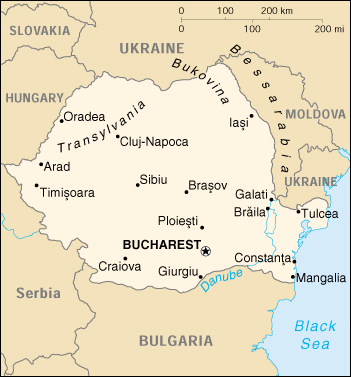
Location: Southeastern Europe, bordering the Black Sea, between Bulgaria and Ukraine
Geographic coordinates: 46 00 N, 25 00 E
Area:
total: 237,500 sq km
land: 230,340 sq km
water: 7,160 sq km
Land boundaries:
total: 2,508 km
border countries: Bulgaria 608 km, Hungary 443 km, Moldova 450 km, Serbia and Montenegro 476 km (all with Serbia), Ukraine (north) 362 km, Ukraine (east) 169 km
Coastline: 225 km
Maritime claims:
contiguous zone: 24 nm
continental shelf: 200-m depth or to the depth of exploitation
exclusive economic zone: 200 nm
territorial sea: 12 nm
Climate: temperate; cold, cloudy winters with frequent snow and fog; sunny summers with frequent showers and thunderstorms
Terrain: central Transylvanian Basin is separated from the Plain of Moldavia on the east by the Carpathian Mountains and separated from the Walachian Plain on the south by the Transylvanian Alps
Elevation extremes:
lowest point: Black Sea 0 m
highest point: Moldoveanu 2,544 m
Natural resources: petroleum (reserves declining), timber, natural gas, coal, iron ore, salt, arable land, hydro power
Land use:
arable land: 41%
permanent crops: 3%
permanent pastures: 21%
forests and woodland: 29%
other: 6% (1993 est.)
Irrigated land: 31,020 sq km (1993 est.)
Natural hazards: earthquakes most severe in south and southwest; geologic structure and climate promote landslides.
Environment – current issues: soil erosion and degradation; water pollution; air pollution in south from industrial effluents; contamination of Danube delta wetlands.
Environment – international agreements:
party to: Air Pollution, Antarctic Treaty, Biodiversity, Climate Change, Desertification, Endangered Species, Environmental Modification, Hazardous Wastes, Law of the Sea, Nuclear Test Ban, Ozone Layer Protection, Ship Pollution, Wetlands
signed, but not ratified: Air Pollution-Persistent Organic Pollutants, Antarctic-Environmental Protocol, Climate Change-Kyoto Protocol
Geography – note: controls most easily traversable land route between the Balkans, Moldova, and Ukraine
People of Romania
About 89% of the people are ethnic Romanians, a group that–in contrast to its Slav or Hungarian neighbors–traces itself to Latin-speaking Romans, who in the second and third centuries A.D. conquered and settled among the ancient Dacians, a Thracian people. As a result, the Romanian language, although containing elements of Slavic, Turkish, and other languages, is a romance language related to French and Italian.
Primarily a rural, agricultural population, the medieval Wallachians and Moldavians maintained their language and culture despite centuries of rule by foreign princes. Once independent, the population of the unified Romanian state took their modern name to emphasize their connection with the ancient Romans.
Hungarians and Gypsies are the principal minorities, with a declining German population and smaller numbers of Serbs, Croats, Ukrainians, Greeks, Turks, Armenians, Great Russians, and others. Minority populations are greatest in Transylvania and the Banat, areas in the north and west, which belonged to the Austro-Hungarian Empire until World War I. Even before union with Romania, ethnic Romanians comprised the overall majority in Transylvania. However, ethnic Hungarians and Germans were the dominant urban population until relatively recently, and still are the majority in a few districts.
Before World War II, minorities represented more than 28% of the total population. During the war that percentage was halved, largely by the loss of the border areas of Bessarabia and northern Bukovina (to the former Soviet Union — now Moldova and Ukraine) and southern Dobrudja (to Bulgaria), as well as by the postwar flight or deportation of ethnic Germans.
Though Romanian troops participated in the destruction of the Jewish communities of Bessarabia and Bukovina, most Jews from Romania properly survived the Holocaust. Mass emigration, mostly to Israel, has reduced the surviving Jewish community from over 300,000 to less than 15,000. In recent years, more than two-thirds of the ethnic Germans in Romania have emigrated to Germany.
Religious affiliation tends to follow ethnic lines, with most ethnic Romanians identifying with the Romanian Orthodox Church. The Greek Catholic or Uniate church, reunified with the Orthodox Church by fiat in 1948, was restored after the 1989 revolution. The 1992 census indicates that 1% of the population is Greek Catholic, as opposed to about 10% prior to 1948. Roman Catholics, largely ethnic Hungarians and Germans, constitute about 5% of the population; Calvinists, Baptists, Pentecostals, and Lutherans make up another 5%. There are smaller numbers of Unitarians, Muslims, and other religions.
Romania’s rich cultural traditions have been nourished by many sources, some of which predate the Roman occupation. The traditional folk arts, including dance, wood carving, ceramics, weaving and embroidery of costumes and household decorations, and fascinating folk music, still flourish in many parts of the country. Despite strong Austrian, German, and especially French influence, many of Romania’s great artists, such as the painter Nicolae Grigorescu, the poet Mihai Eminescu, the composer George Enescu, and the sculptor Constantin Brancusi, drew their inspiration from Romanian folk traditions.
The country’s many Orthodox monasteries, as well as the Transylvanian Catholic and Evangelical Churches, some of which date back to the 13th century, are repositories of artistic treasures. The famous painted monasteries of Bukovina make an important contribution to European architecture.
Poetry and the theater play an important role in contemporary Romanian life. Classic Romanian plays, such as those of Ion Luca Caragiale, as well as works by modern or avant-garde Romanian and international playwrights, find sophisticated and enthusiastic audiences in the many theaters of the capital and of the smaller cities.
Population: 22,329,977 (July 2005 est.)
Age structure:
0-14 years: 17.95%
15-64 years: 68.51%
65 years and over: 13.54%
Population growth rate: -0.21%
Birth rate: 10.8 births/1,000 population
Death rate: 12.28 deaths/1,000 population
Net migration rate: -0.6 migrant(s)/1,000 population
Infant mortality rate: 19.36 deaths/1,000 live births
Life expectancy at birth:
total population: 70.16 years
male: 66.36 years
female: 74.19 years
Total fertility rate: 1.35 children born/woman
Nationality:
noun: Romanian(s)
adjective: Romanian
Ethnic groups: Romanian 89.5%, Hungarian 7.1%, Roma 1.8%, German 0.5%, Ukrainian 0.3%, other 0.8% (1992)
Religions: Romanian Orthodox 70%, Roman Catholic 3%, Uniate Catholic 3%, Protestant 6%, unaffiliated 18%
Languages: Romanian, Hungarian, German
Literacy:
definition: age 15 and over can read and write
total population: 97%
male: 98%
female: 95% (1992 est.)
People of Romania
About 89% of the people are ethnic Romanians, a group that–in contrast to its Slav or Hungarian neighbors–traces itself to Latin-speaking Romans, who in the second and third centuries A.D. conquered and settled among the ancient Dacians, a Thracian people. As a result, the Romanian language, although containing elements of Slavic, Turkish, and other languages, is a romance language related to French and Italian.
Primarily a rural, agricultural population, the medieval Wallachians and Moldavians maintained their language and culture despite centuries of rule by foreign princes. Once independent, the population of the unified Romanian state took their modern name to emphasize their connection with the ancient Romans.
Hungarians and Gypsies are the principal minorities, with a declining German population and smaller numbers of Serbs, Croats, Ukrainians, Greeks, Turks, Armenians, Great Russians, and others. Minority populations are greatest in Transylvania and the Banat, areas in the north and west, which belonged to the Austro-Hungarian Empire until World War I. Even before union with Romania, ethnic Romanians comprised the overall majority in Transylvania. However, ethnic Hungarians and Germans were the dominant urban population until relatively recently, and still are the majority in a few districts.
Before World War II, minorities represented more than 28% of the total population. During the war that percentage was halved, largely by the loss of the border areas of Bessarabia and northern Bukovina (to the former Soviet Union — now Moldova and Ukraine) and southern Dobrudja (to Bulgaria), as well as by the postwar flight or deportation of ethnic Germans.
Though Romanian troops participated in the destruction of the Jewish communities of Bessarabia and Bukovina, most Jews from Romania properly survived the Holocaust. Mass emigration, mostly to Israel, has reduced the surviving Jewish community from over 300,000 to less than 15,000. In recent years, more than two-thirds of the ethnic Germans in Romania have emigrated to Germany.
Religious affiliation tends to follow ethnic lines, with most ethnic Romanians identifying with the Romanian Orthodox Church. The Greek Catholic or Uniate church, reunified with the Orthodox Church by fiat in 1948, was restored after the 1989 revolution. The 1992 census indicates that 1% of the population is Greek Catholic, as opposed to about 10% prior to 1948. Roman Catholics, largely ethnic Hungarians and Germans, constitute about 5% of the population; Calvinists, Baptists, Pentecostals, and Lutherans make up another 5%. There are smaller numbers of Unitarians, Muslims, and other religions.
Romania’s rich cultural traditions have been nourished by many sources, some of which predate the Roman occupation. The traditional folk arts, including dance, wood carving, ceramics, weaving and embroidery of costumes and household decorations, and fascinating folk music, still flourish in many parts of the country. Despite strong Austrian, German, and especially French influence, many of Romania’s great artists, such as the painter Nicolae Grigorescu, the poet Mihai Eminescu, the composer George Enescu, and the sculptor Constantin Brancusi, drew their inspiration from Romanian folk traditions.
The country’s many Orthodox monasteries, as well as the Transylvanian Catholic and Evangelical Churches, some of which date back to the 13th century, are repositories of artistic treasures. The famous painted monasteries of Bukovina make an important contribution to European architecture.
Poetry and the theater play an important role in contemporary Romanian life. Classic Romanian plays, such as those of Ion Luca Caragiale, as well as works by modern or avant-garde Romanian and international playwrights, find sophisticated and enthusiastic audiences in the many theaters of the capital and of the smaller cities.
Population: 22,329,977 (July 2005 est.)
Age structure:
0-14 years: 17.95%
15-64 years: 68.51%
65 years and over: 13.54%
Population growth rate: -0.21%
Birth rate: 10.8 births/1,000 population
Death rate: 12.28 deaths/1,000 population
Net migration rate: -0.6 migrant(s)/1,000 population
Infant mortality rate: 19.36 deaths/1,000 live births
Life expectancy at birth:
total population: 70.16 years
male: 66.36 years
female: 74.19 years
Total fertility rate: 1.35 children born/woman
Nationality:
noun: Romanian(s)
adjective: Romanian
Ethnic groups: Romanian 89.5%, Hungarian 7.1%, Roma 1.8%, German 0.5%, Ukrainian 0.3%, other 0.8% (1992)
Religions: Romanian Orthodox 70%, Roman Catholic 3%, Uniate Catholic 3%, Protestant 6%, unaffiliated 18%
Languages: Romanian, Hungarian, German
Literacy:
definition: age 15 and over can read and write
total population: 97%
male: 98%
female: 95% (1992 est.)
THE ROMANIAN PEOPLE’S REPUBLIC, later renamed the Socialist Republic of Romania, came into being in 1948 when the country’s communist party, under Gheorghe Gheorghiu-Dej, consolidated its power and promulgated a Soviet-style constitution. Romania, in spite of its fierce prewar anticommunism and long antipathy toward tsarist Russia and the Soviet Union, became one of the first East European states to suffer a Soviet-sponsored communist takeover after World War II. For nearly a decade after the war, Romania obediently followed Moscow’s lead, but in the late 1950s Gheorghiu-Dej defied a Soviet attempt to make his country a “breadbasket” for the East bloc and insisted on continuing his country’s rapid industrial expansion. The Romanian leader also developed an independent foreign policy and launched a campaign promoting Romanian nationalism. Nicolae Ceausescu succeeded Gheorghiu-Dej in 1965 and continued his mentor’s policies. Ceausescu, however, appended to them an extravagant cult of personality that once promoted him as Romania’s “secular god” and heir to the wisdom of Romanian rulers from ages past.
Romanians descend from the Dacians, an ancient people who fell under Rome’s dominance in the first century A.D., intermarried with Roman colonists, and adopted elements of Roman culture, including a Vulgar Latin that evolved into today’s Romanian. Barbarian tribes forced the Romans out of Dacia in 271. In the eleventh century the Magyars, the ancestors of today’s Hungarians, settled the mountainous heart of ancient Dacia, Transylvania. Hungarian historians claim that Transylvania was almost uninhabited when the Magyars arrived; Romanians, however, assert that their ancestors remained in Transylvania after Rome’s exodus and that Romanians constitute the region’s aboriginal inhabitants. This disagreement was the germ of a conflict that poisoned relations between Romanians and Hungarians throughout the twentieth century.
History of Romania
For thousands of years, Romania suffered from an unfortunate location astride the invasion routes of migrating hordes and the frontiers of ambitious empires that plundered its wealth and enslaved its people. For centuries Transylvania, with its repressed Romanian majority, was a semi-autonomous part of Hungary. Romanians fleeing Transylvania founded the independent principalities of Walachia and Moldavia in the thirteenth and fourteenth centuries. The Ottoman Empire dominated all three regions from the sixteenth to the late seventeenth century, when Austria’s Habsburgs gained full control of Transylvania. Walachia and Moldavia came under Russian protection soon afterward and remained under Russian influence until the Crimean War (1853-56) ended the protectorate. In 1859 Walachia and Moldavia merged to form Romania, and in 1881 its prince renounced Turkish suzerainty and Romania became a kingdom. Austria reunited Transylvania and Hungary in 1867, but the union lasted only until the end of World War I, when Romania acquired Transylvania. World War II brought dismemberment of Greater Romania, and the country sided with Germany hoping to regain its lost territories. In 1943 the Red Army crushed Romanian forces before Stalingrad, and in 1944 Romania’s King Michael overthrew the country’s radical right-wing premier and signed an armistice with the Soviet Union. Moscow forced Michael to appoint a communist sympathizer to lead the government in 1945, and three years later Romania found itself under strict communist control.
Romanian Economy
Economy – overview: Romania, one of the poorest countries in Central and Eastern Europe, began the transition from communism in 1989 with a largely obsolete industrial base and a pattern of output unsuited to the country’s needs. Over the past decade economic restructuring has lagged behind most other countries in the region. Consequently, living standards have continued to fall – real wages are down over 40%. Corruption too has worsened. The EU ranks Romania last among enlargement candidates, and the European Bank for Reconstruction and Development (EBRD) rates Romania’s transition progress the region’s worst. The country emerged in 2000 from a punishing three-year recession thanks to strong demand in EU export markets. A new government elected in November 2000 promises to promote economic reform. Bucharest hopes to receive financial and technical assistance from international financial institutions and Western governments; negotiations over a new IMF standby agreement are to begin early in 2001. If reform stalls, Romania’s ability to borrow from both public and private sources could quickly dry up, leading to another financial crisis.
GDP: purchasing power parity – $87.4 billion (1999 est.), $132.5 billion (2000 est.)
GDP – real growth rate: -4.8% (1999 est.), 2.2% (2000 est.)
GDP – per capita: purchasing power parity – $3,900 (1999 est.), $5,900 (2000 est.)
GDP – composition by sector:
agriculture: 13.9%
industry: 32.6%
services: 53.5% (2000)
Household income or consumption by percentage share:
lowest 10%: 3.8%
highest 10%: 20.2% (1992)
Inflation rate (consumer prices): 45.7% (2000 est.)
Labor force: 9.9 million (1999 est.)
Labor force – by occupation: agriculture 40%, industry 25%, services 35% (1998)
Unemployment rate: 11.5% (1999)
Budget:
revenues: $11.7 billion
expenditures: $12.4 billion (1999 est.)
Industries: textiles and footwear, light machinery and auto assembly, mining, timber, construction materials, metallurgy, chemicals, food processing, petroleum refining
Industrial production growth rate: 8% (2000)
Electricity – production: 49.036 billion kWh (1999)
Electricity – production by source:
fossil fuel: 53.99%
hydro: 36.18%
nuclear: 9.81%
other: 0.02% (1999)
Electricity – consumption: 44.768 billion kWh (1999)
Agriculture – products: wheat, corn, sugar beets, sunflower seed, potatoes, grapes; eggs, sheep
Exports: $11.2 billion (f.o.b., 2000 est.)
Exports – commodities: textiles and footwear 26%, metals and metal products 15%, machinery and equipment 11%, minerals and fuels 6% (1999)
Exports – partners: Italy 23%, Germany 18%, France 6%, Turkey 5%, US (1999)
Imports: $11.9 billion (f.o.b., 2000 est.)
Imports – commodities: machinery and equipment 23%, fuels and minerals 12%, chemicals 9%, textile and products 19% (1999)
Imports – partners: Italy 20%, Germany 19%, France 7%, Russia 6% (1999)
Debt – external: $9.3 billion (2000 est.)
Currency: 1 leu (ROL) = 100 bani
Map Of Romania