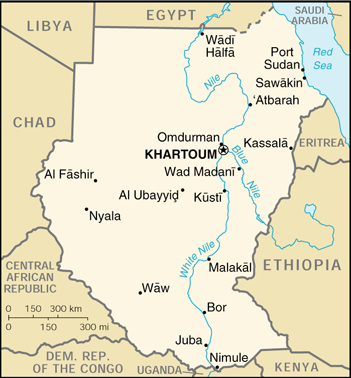
Facts About Sudan
Background: Military dictatorships promulgating an Islamic government have mostly run the country since independence from the UK in 1956. Over the past two decades, a civil war pitting black Christians and animists in the south against the Arab-Muslims of the north has cost at least 1.5 million lives in war- and famine-related deaths, as well as the displacement of millions of others.
Government type: transitional – ruling military junta took power in 1989; government is dominated by members of Sudan’s National Islamic Front (NIF), a fundamentalist political organization, which uses the National Congress Party (NCP) as its legal front.
Capital: Khartoum
Currency: 1 Sudanese dinar (SDD) = 100 piastres; note – in July 1999 the Sudanese Central Bank made the formal declaration that all dealings with the Sudanese pound should stop
Geography of Sudan
Location: Northern Africa, bordering the Red Sea, between Egypt and Eritrea
Geographic coordinates: 15 00 N, 30 00 E
Area:
total: 2,505,810 sq km
land: 2.376 million sq km
water: 129,810 sq km
Land boundaries:
total: 7,687 km
border countries: Central African Republic 1,165 km, Chad 1,360 km, Democratic Republic of the Congo 628 km, Egypt 1,273 km, Eritrea 605 km, Ethiopia 1,606 km, Kenya 232 km, Libya 383 km, Uganda 435 km
Coastline: 853 km
Maritime claims:
contiguous zone: 18 nm
continental shelf: 200-m depth or to the depth of exploitation
territorial sea: 12 nm
Climate: tropical in south; arid desert in north; rainy season (April to October)
Terrain: generally flat, featureless plain; mountains in east and west
Elevation extremes:
lowest point: Red Sea 0 m
highest point: Kinyeti 3,187 m
Natural resources: petroleum; small reserves of iron ore, copper, chromium ore, zinc, tungsten, mica, silver, gold, hydropower
Land use:
arable land: 5%
permanent crops: 0%
permanent pastures: 46%
forests and woodland: 19%
other: 30% (1993 est.)
Irrigated land: 19,460 sq km (1993 est.)
Natural hazards: dust storms
Environment – current issues: inadequate supplies of potable water; wildlife populations threatened by excessive hunting; soil erosion; desertification
Environment – international agreements:
party to: Biodiversity, Climate Change, Desertification, Endangered Species, Law of the Sea, Nuclear Test Ban, Ozone Layer Protection
signed, but not ratified: none of the selected agreements
Geography – note: largest country in Africa; dominated by the Nile and its tributaries
People of Sudan
The population of metropolitan Khartoum (including Khartoum, Omdurman, and Khartoum North) is growing rapidly and ranges from 6-7 million, including around 2 million displaced persons from the southern war zone as well as western and eastern drought-affected areas.
Sudan has two distinct major cultures–Arab and Black African–with hundreds of ethnic and tribal divisions and language groups, which makes effective collaboration among them a major problem.
The northern states cover most of the Sudan and include most of the urban centers. Most of the 22 million Sudanese who live in this region are Arabic speaking Muslims, though the majority also use a traditional non-Arabic mother tongue (i.e., Nubian, Beja, Fur, Nuban, Ingessana, etc.) Among these are several distinct tribal groups; the Kababish of northern Kordofan, a camel-raising people; the Ja’alin and Shaigiyya groups of settled tribes along the rivers; the seminomadic Baggara or Kordofan and Darfur; the Hamitic Beja in the Red Sea area and Nubians of the northern Nile areas, some of whom have been resettled on the Atbara River; and the Negroid Nuba of southern Kordofan and Fur in the western reaches of the country.
The southern region has a population of around 6 million and a predominantly rural, subsistence economy. This region has been negatively affected by war for all but 10 years of the independence period (1956), resulting in serious neglect, lack of infrastructure development, and major destruction and displacement. More than 2 million people have died, and more than 4 million are internally displaced or become refugees as a result of the civil war and war-related impacts. Here the Sudanese practice mainly indigenous traditional beliefs, although Christian missionaries have converted some. The south also contains many tribal groups and uses many more languages than in the north. The Dinka (pop. est. more than 1 million) is the largest of the many Black African tribes of the Sudan. Along with the Shilluk and the Nuer, they are among the Nilotic tribes. The Azande, Bor, and Jo Luo are “Sudanic” tribes in the west, and the Acholi and Lotuhu live in the extreme south, extending into Uganda.
Population: 40,187,486 (July 2005 est.)
Age structure:
0-14 years: 45%
15-64 years: 53%
65 years and over: 2%
Population growth rate: 2.84%
Birth rate: 38.58 births/1,000 population
Death rate: 10.28 deaths/1,000 population
Net migration rate: 0.05 migrant(s)/1,000 population
Infant mortality rate: 70.21 deaths/1,000 live births
Life expectancy at birth:
total population: 56.55 years
male: 55.49 years
female: 57.66 years
Total fertility rate: 5.47 children born/woman
Nationality:
noun: Sudanese (singular and plural)
adjective: Sudanese
Ethnic groups: black 52%, Arab 39%, Beja 6%, foreigners 2%, other 1%
Religions: Sunni Muslim 70% (in north), indigenous beliefs 25%, Christian 5% (mostly in south and Khartoum)
Languages: Arabic (official), Nubian, Ta Bedawie, diverse dialects of Nilotic, Nilo-Hamitic, Sudanic languages, English
note: program of Arabization in process
Literacy:
definition: age 15 and over can read and write
total population: 46.1%
male: 57.7%
female: 34.6% (1995 est.)
History of Sudan
SUDAN, LIKE MANY AFRICAN COUNTRIES, consists of numerous ethnic groups. Unlike most states, however, Sudan has two distinct divisions: the north, which is largely Arab and Muslim, and the south, which consists predominantly of black Nilotic peoples, some of whom are members of indigenous faiths and others who are Christians. British policy during the Anglo-Egyptian condominium (1899-1955) intensified the rift because Britain established separate administrations for the two areas and forbade northerners to enter the south. In the 1990s, many southerners continued to fear being ruled by northerners, who lacked familiarity with their beliefs and ethnic traditions and sought to impose northern institutions on them.
Given its proximity to Egypt and the centrality of the Nile River that both countries share, it is not surprising that historically Egypt has influenced Sudan significantly especially the northern part of the country. Ancient Cush, located in present-day northern Sudan, was strongly influenced by Egypt for about 1,000 years beginning ca. 2700 B.C. Although the Hyksos kings of Egypt temporarily broke off contact, Cush subsequently was incorporated into Egypt’s New Kingdom as a province about 1570 B.C. and remained under Egyptian control until about 1100 B.C. In a move that reversed the pattern of Egyptian dominance, a Cushite king conquered Upper Egypt in 730 B.C.; in 590 B.C., however, the Cushite capital was sacked by the Egyptians and the court moved farther south along the Nile to Meroe.
By the sixth century A.D., Meroe had broken up into three kingdoms collectively referred to as Nubia. The people of Nubia adopted Christianity and were ministered to largely by Egyptian clergy. The kingdoms reached their peak in the ninth and tenth centuries. Prior to the coming of Islam, the people had contact with the Arabs primarily in the form of trade. Sudan became known as a source of ivory, gold, gems, aromatic gum, and cattle, all products that were transported to markets in Egypt and Arabia. Following the Muslim conquest of the area, in 1276 the Mamluk rulers of Egypt gave Nubia to a Muslim overlord. The Nubians themselves converted to Islam only gradually; a majority of them remained Christian until the fifteenth or sixteenth century. During the sixteenth century, the Muslim religious brotherhoods spread through northern Nubia, and the Ottoman Empire exerted its jurisdiction through military leaders whose rule endured for three centuries.
In 1820 Muhammad Ali, who ruled Egypt on behalf of the Ottomans, sent 4,000 troops to Sudan to clear the area of Mamluks. The invasion resulted in Ottoman-Egyptian rule of Sudan from 1821 to 1885; the rule was accompanied by the introduction of secular courts and a large bureaucracy. The 1880s saw the rise of the Mahdist movement, consisting of disciples of Muhammad Ahmad ibn as Sayyid Abd Allah, a Sudanese who proclaimed himself the Mahdi or “guided one,” and launched a jihad against the Ottoman rulers. Britain perceived the Mahdists as a threat to stability in the region and sent first Charles George Gordon and then Herbert Kitchener to Sudan to assert British control. The British conquest led to the establishment of the Anglo-Egyptian condominium and, initially, to military rule of Sudan, followed by civilian administration. Britain largely ignored southern Sudan until after World War I, leaving Western missionary societies to establish schools and medical facilities in the area.
After World War I, Sudanese nationalism, which favored either independence or union with Egypt, gathered popular support. Recognizing the inevitable, Britain signed a self-determination agreement with Sudan in 1952, followed by the Anglo-Egyptian accord in 1953 that set up a three-year transition period to self-government. Sudan proclaimed its independence January 1, 1956. The country had two short-lived civilian coalition governments before a coup in November 1958 brought in a military regime under Ibrahim Abbud and a collective body known as the Supreme Council of the Armed Forces. Abbud’s government sought to arabize the south and in 1964 expelled all western missionaries. Northern repression of the south led to open civil war in the mid-1960s and the rise of various southern resistance groups, the most powerful of which was the Anya Nya guerrillas, who sought autonomy. Civilian rule returned to Sudan between 1964 and 1969, and political parties reappeared. In the 1965 elections, Muhammad Ahmad Mahjub became prime minister, succeeded in June 1966 by Sadiq al Mahdi, a descendant of the Mahdi. In the 1968 elections, no party had a clear majority, and a coalition government took office under Mahjub as prime minister.
In May 1969, the Free Officers’ Movement led by Jaafar an Nimeiri staged a coup and established the Revolutionary Command Council (RCC). In July 1971, a short-lived procommunist military coup occurred, but Nimeiri quickly regained control, was elected to a six-year term as president, and abolished the RCC. Meanwhile in the south, Joseph Lagu, a Christian, had united several opposition elements under the Southern Sudan Liberation Movement. In March 1972, the southern resistance movement concluded an agreement with the Nimeiri regime at Addis Ababa, and a cease- fire followed. A Constituent Assembly was created in August 1972 to draft a constitution at a time when the growing opposition to military rule was reflected in strikes and student unrest. Despite this dissent, Nimeiri was reelected for another six-year term in 1977.
During the early stages of his new term, Nimeiri worked toward reconciliation with the south. As the south became stronger, however, he considered it a threat to his regime; and in June 1983, after abolishing the Southern Regional Assembly, he redivided the southern region into its three historic provinces. The Sudanese People’s Liberation Movement (SPLM) and the Sudanese People’s Liberation Army (SPLA), founded in 1983, opposed this division. They intensified their opposition following the imposition of Muslim sharia law throughout the country. In early 1985, while Nimeiri was returning from a visit to the United States, a general strike occurred that the government could not quell, followed by a successful military coup led by Lieutenant General Abd ar Rahman Siwar adh Dhahab. A Transitional Military Council was created, but the government proved incapable of establishing a national political consensus or of dealing with the deteriorating economic situation and the famine threatening southern and western Sudan. In March 1986, in the Koka Dam Declaration, the government and the SPLM called for a Sudan free from “discrimination and disparity” and the repeal of the sharia.
Sadiq al Mahdi formed what proved to be a weak coalition government following the April 1986 elections. An agreement with the SPLM was signed by Sadiq al Mahdi’s coalition partners at Addis Ababa in November 1988; the agreement called for a cease- fire and freezing the application of the sharia. Sadiq al Mahdi’s failure to end the civil war in the south or improve the economic and famine situations led to the overthrow of the government at the end of June 1989 by Colonel Umar Hassan Ahmad al Bashir.
Sudan’s economic straits reflected its position as Africa’s largest nation geographically, but one possessed of large areas of desert and semidesert east and west of the Nile and in the south the world’s largest swamp, As Sudd, which led to tropical rain forests in the southernmost area. As a result, although the Nile itself with its tributaries–the Blue Nile and the White Nile, which joined at Khartoum–constituted a vital communications link for the country and a source of water for agriculture, the cultivable area of Sudan was somewhat limited. Moreover, in years of drought the agriculturally productive sector declines appreciably, causing the likelihood of severe famine.
In accordance with the focal role played by the Nile, about one-third of Sudan’s 1990 estimated population of 25 million lived around Khartoum and in Al Awsat State. The latter included the rich agricultural region of Al Jazirah, south of Khartoum between the Blue Nile and the White Nile. Although only one-fifth of the population lived in urban areas, two-thirds of the total population resided within 300 kilometers of Khartoum. About 600 ethnic groups speaking around 400 languages were represented. Arabic was the official language of the country, with English spoken widely in the south. Ethnic statistics for the 1990s were lacking, but in 1983 Arabs constituted about two-fifths of the total population, representing the majority in the north where the next largest group was the Nile Nubians. Much of the remainder of Sudan’s population consisted of non-Muslim Nilotic peoples living in southern Sudan or in the hilly areas west of the Blue Nile or near the Ethiopian border. Among the largest of these ethnic groups were the Dinka and the Nuer, followed by the Shilluk. Many of these groups migrated with their herds, seeking areas of rainfall, and therefore it was difficult to establish their numbers accurately.
In the early 1990s, agriculture and livestock raising provided the major sources of livelihood for about four-fifths of the population. Wherever possible, Nile waters were used for irrigation, and the government has sponsored a number of irrigation projects. Commercial crops such as cotton, peanuts, sugarcane, sorghum, and sesame were grown, and gum arabic was obtained from trees. Most of these products along with livestock destined primarily for Saudi Arabia also represented Sudan’s major exports.
Manufacturing concentrated on food-processing enterprises and textiles, as well as some import substitution industries such as cement, chemicals, and fertilizers. Industry, however, contributed less than one-tenth to gross domestic product in the early 1990s, in comparison with agriculture’s more than three-tenths contribution. Sudan was among the world’s poorest countries according to the World Bank, with an annual per capita income of US$310 in FY 1991.
Several factors accounted for the relative economic insignificance of the industrial sector. Historically, during the colonial period, Britain had discouraged industrialization, preferring to keep Sudan as a source of raw materials and a market for British manufactured goods. Following independence, a paucity of development programs as well as better employment opportunities in the Persian Gulf states have contributed to a shortage of skilled workers. In the early 1990s, Sudan also had limited energy sources–only small amounts of petroleum in the south between Kurdufan State and Bahr al Ghazal State and a few dams producing hydroelectric power. In addition, transportation facilities; were limited; there existed only a sketchy network of railroads and roads, many of the latter being impassable in the rainy season. Inland waterways could also be difficult to use because of low water, cataracts, or swamps. The lack of a good transportation network hindered not only the marketing of produce and consumer goods but also the processing of such minerals as gold, chrome, asbestos, gypsum, mica, and uranium. The lack of capital accumulation also limited financial resources and necessitated funding by the government, which itself had inadequate revenues. Some northern Sudanese hoped that the rise of Islamic banks might result in more capital being invested in private industrial development, especially after the World Bank refused to extend further loans to the country.
Sudan’s problems with the World Bank occurred initially in 1984. The World Bank cited Sudan’s large external debt–in June 1992 the debt was about US$15.3 billion, of which approximately two-thirds represented payment arrears–and its failure to take steps to restructure its economy as reasons for denying credit. The large debt resulted primarily from the nationalization of major sectors of the economy in the 1970s and the use of funds borrowed from abroad to finance enterprises with low productivity. The government needed to use its revenues to meet the losses of these enterprises. In addition, the civil war, the prolonged drought, widespread malnutrition, famine, and the hundreds of thousands of refugees further sapped the economy.
Not until June 1990 did the government act to reform the economy by instituting a three-year (FY 1991-93) National Economic Salvation Program. The program aimed to reduce the budget deficit, privatize nationalized enterprises, heighten the role of the private sector, and remove controls on prices, profits, and exports. In October 1991, other steps toward economic reform included devaluing the official exchange rate from LSd4.5 to LSd15 to the United States dollar and reducing subsidies on sugar and petroleum products. In February 1992, in a further liberalization of the economy, all price controls were removed and official exchange rates devalued to LSd90 to the United States dollar. Officials hoped that these measures would not cause the inflation rate, which was about 115 percent per year as of March 1992, to worsen. In a further move designed to curb inflation, Sudan instituted a new currency, the dinar, worth ten Sudanese pounds, in May 1992.
Although the World Bank refused to authorize new loans for Sudan, in July 1991 the Bank granted Sudan US$16 million for the Emergency Drought Recovery Project. In addition, in the spring of 1992 Sudan received an agricultural credit of US$42 million from the African Development Bank and some bilateral aid from Iran and Libya. Like the World Bank, the United States and the European Community had suspended loans to Sudan but had provided some humanitarian assistance; the value of United States humanitarian aid in 1991 was estimated to exceed US$150 million. Nevertheless, the drought, the famine, and the massive influx into the north of refugees from the south as a result of the civil war caused the country’s already precarious economy to deteriorate further and complicated the government’s ability to rule.
Since the military coup of June 30, 1989, the constitution had been suspended, political parties banned, and the legislative assembly dissolved. For practical purposes, in mid-1992 Bashir made political decisions in his capacity as president or head of state, prime minister, commander in chief, and chairman of the legislative body created by the 1989 coup, the Revolutionary Command Council for National Salvation (RCC-NS). The RCC-NS consisted of fifteen members who had carried out the coup along with Bashir. Several members had ties to the National Islamic Front (NIF), the political arm of the Muslim Brotherhood, an Islamist (sometimes seen as fundamentalist) activist group.
Although political parties were illegal under the Bashir government, the NIF represented the equivalent of a party. The nature of the relationship between Bashir and the NIF was not clear. Some well informed Western observers considered Bashir to be a tool of the NIF in spreading its Islamist programs and its strong advocacy of the imposition of the sharia. Other observers believed that Bashir was using the NIF for his own purposes. The leading figure in the NIF was Hassan Abd Allah at Turabi, an Oxford-educated Muslim religious scholar and lawyer, who strongly advocated the spread of Islamism in the Muslim world. As Turabi was ending his tour of the United States and Ottawa in late May in the spring of 1992, he was attacked in Canada by a Sudanese opponent of the NIF and was seriously injured. Whereas by late July Turabi had resumed meetings with government and Islamic officials and speeches to Muslim groups in Khartoum and in London, the effects of his impaired health on the NIF, the RCC- NS, and the political scene were uncertain in mid-August.
In addition to their legislative functions, members of the RCC-NS shared with Bashir and members of the Council of Ministers functions traditionally associated with the executive branch, such as heading government ministries. The Council of Ministers included civilians as well as military officers and in practice was subordinate to the RCC-NS. In April 1991, probably in response to growing criticism of its authoritarian rule, the RCC- NS convened a constitutional conference. However, major opposition groups boycotted the conference. As on previous occasions, the principal intractable problem proved to be the inability of Muslims and non-Muslims to agree on the role of Islamic law as the basis of the legal system at both the national and local levels.
Another vexing problem historically was the relationship of regional and local governmental bodies to the national government. The Nimeiri regime had created a pyramidal structure with councils at various levels. The councils were theoretically elective, but in practice the only legal party at the time, the Sudan Socialist Union, dominated them. In February 1991, the RCC- NS introduced a federal structure, creating nine states that resembled the nine provinces of Sudan’s colonial and early independence years. The states were subdivided into provinces and local government areas, with officials at all levels appointed by the RCC-NS. Although the governors of the three southern states were southerners, power lay in the hands of the deputy governors who were Muslim members of the NIF and who controlled finance, trade, and cooperatives. Below them the most important ministerial posts in the southern states also were held by Muslims, including the post of minister of education, culture, youth, guidance, and information.
In a further step, in mid-February 1992, Bashir announced the formation of an appointed 300-member Transitional National Assembly to include all RCC-NS members, federal cabinet ministers, and state governors. Bashir also indicated in March that beginning in May popular conferences based on religious values would be held in the north and in “secure areas” of the south to elect chairmen and members of such conferences. The election process would create a “general mobilization of all political institutions.” Although the agendas for conferences over the succeeding ten-year period would be based on national issues set by the head of state and local issues raised by the governors, the government touted the process as one that would “fulfill the revolution’s promise to hand over full power to the people.” The proposed conference committees were somewhat reminiscent of the popular committees established by the Popular Defence Act of October 1989. Initially, these popular committees had the function of overseeing rationing, but their mandated was broadened to include powers such as arresting enemies of the state.
The control exerted by the RCC-NS over various parts of the country varied. For example, western Sudan, especially Darfur, enjoyed considerable autonomy, which at times approached anarchy, as a result of the various armed ethnic groups and the refugee population that existed within it. The situation was even more confused in the south, where until 1991 the government had controlled the major centers and the SPLM occupied the smaller towns and rural areas. The government launched a military campaign in 1991-92 that succeeded in recapturing many military posts that had served as SPLM and SPLA strongholds. The government’s success resulted in part from the acquisition of substantial military equipment financed by Iran, including weapons and aircraft bought from China. Another reason for the successes of the government forces was the split that occurred in August 1991 within the SPLA between Garang’s Torit faction (mainly Dinka from southern Al Istiwai) and the Nasir group (mainly Nuer and other non-Dinka from northern Al Istiwai). The two groups launched military attacks against each other, thereby not only destroying their common front against the government but also killing numerous civilians. The Nasir group had defected from the main SPLA body and tried unsuccessfully to overthrow John Garang over human rights violations, Garang’s authoritarian leadership style, and his favoritism toward his ethnic group, the Dinka. Abortive peace talks with representatives of both groups as well as the government were held in Abuja, Nigeria, in May and early June 1992. (In December 1989 former United States president Jimmy Carter had attempted without success to mediate peace talks between the government and the SPLA.) The Torit faction sought a secular state and an end to the sharia; the Nasir group wanted self-determination or independence for southern Sudan. During the talks, both groups agreed to push for self-determination, but when the government rejected this proposal, they decided instead to discuss Nigeria’s power-sharing plan.
A major basis of southern dissidence was strong opposition to the imposition of the sharia–the SPLA had vowed not to lay down its arms until the sharia was abrogated. The other source of concern was the fear of northern pressures to arabize the education system (the Bashir regime had declared Arabic the language of instruction in the south in early 1992), government offices, and society in general. These fears had led to the civil war, which, with a respite between 1972 and 1983, had been ongoing since 1955.
The Bashir government’s need for assistance in pursuing the war in the south determined to a large degree Sudan’s foreign policy in the 1990s. Bashir recognized that the measures taken in the south, which outside observers termed human rights abuses, had alienated the West. Historically, the West had been the source of major financial support for Sudan. Furthermore, Sudan’s siding with Iraq in the 1991 Persian Gulf War had antagonized Saudi Arabia and Kuwait, principal donors for Sudan’s military and economic needs in the preceding several decades.
Bashir therefore turned to Iran, especially for military aid, and, to a lesser extent, to Libya. Iranian president Ali Akbar Hashemi Rafsanjani visited Sudan in December 1991, accompanied by several cabinet ministers. The visit led to an Iranian promise of military and economic assistance. Details of the reported aid varied, but in July 1992, in addition to the provision of 1 million tons of oil annually for military and civil consumption, aid was thought to include the financing of Sudanese weapons and aircraft purchases from China in the amount of at least US$300 million. Some accounts alleged that 3,000 Iranian soldiers had also arrived in January 1992 to engage in the war in the south and that Iran had been granted use of Port Sudan facilities and permission to establish a communications monitoring station in the area; these reports were not verified as of mid-August 1992, however.
The only other country with which Sudan had close relations in the early 1990s was Libya. Following an economic agreement the two countries signed in July 1990, head of state Muammar al Qadhafi paid an official visit to Khartoum in October. Bashir paid a return visit to Libya in November 1991. Libyan officials arrived in Khartoum for talks on unity, primarily economic unity, in January 1992.
While the government was cultivating relations with Iran and Libya, the SPLM and SPLA were seeking other sources of aid in Africa. They had lost their major source of support when the government of Mengistu Haile Mariam in Ethiopia was overthrown in May 1991. The SPLM and SPLA subsequently sought help from Kenya, Uganda, and several other African countries, thereby creating tensions between those nations and the Bashir regime. Furthermore, Sudan’s relations with Egypt had soured in 1991 as a result of the Bashir government’s failure to support Egypt’s position in the Persian Gulf War. One manifestation of the deteriorating relations occurred in April 1992 when Sudan became involved in a border confrontation with Egypt. The disagreement resulted from an oil concession Sudan had granted to a subsidiary of Canada’s International Petroleum Corporation for exploration of a 38,400-square-kilometer area onshore and offshore near Halaib on the Red Sea coast, an area also claimed by Egypt.
In the matter of determining Sudan’s foreign policy as well as domestic policy, the military had played a major role since independence. Initially, the military was seen as being free from specific ethnic or religious identification and thus in a position to accomplish what civilians could not, namely to resolve economic problems and to bring peace to the south. Such hopes proved futile, however. The growing civil war in the south from 1955-72 and again from 1983 to the present, as well as the rising strength of the SPLA and the SPLM posed tremendous problems for the military and for the internal security forces. The civil war was extremely costly; according to one Sudanese government estimate, it cost approximately US$1 million per day. Furthermore, it disrupted the economy–Bashir stated in February 1992 that the loss of oil revenues alone since 1986 amounted to more than US$6 billion. In addition, based on United States Department of State estimates in late 1991, war had displaced as many as 4.5 million Sudanese.
To counter the SPLA, the government armed various non-Arab southern ethnic groups as militias as early as 1985. In addition, in October 1989 the Bashir government created a new paramilitary body, the Popular Defence Forces (PDF) to promote the Islamist aims of the government and the NIF. Although the Bashir regime prominently featured the PDF’s participation in the 1991-92 campaign in the south, informed observers believed their role lacked military significance.
In view of the ongoing civil war, internal security was a major concern of the Bashir regime, which reportedly had been the object of coup attempts in 1990, 1991, and 1992. In this regard, the government faced problems on several fronts. There was the outright dissidence or rebellion of several southern ethnic groups. There was also the creation in January 1991 of an opposition abroad in the form of a government in exile. This body, called the National Democratic Alliance, was headed by Lieutenant General Fathi Ahmad Ali, formerly commander of the armed forces under Sadiq al Mahdi. There also was increasing opposition in the north on the part of those who favored a secular state, including professional persons, trade union leaders, and other modernizers. Such persons opposed the application of Islamic hudud punishments, the growing restrictions on the activities and dress of women, and the increasing authoritarianism of the government as reflected, for example, in the repression of criticism through censorship, imprisonment, and death sentences. On a wider scale, members of the public in the north staged protests in February 1992 against the price increases on staples after price supports were removed.
As a result of the repressive measures taken by the government and the actions of armed government militias in the south as well as retaliatory measures of the SPLA forces, the human rights group Africa Watch estimated that at least 500,000 civilian deaths had occurred between 1986 and the end of 1989. The overall number of deaths between 1983 and mid-1992 was far greater, an outcome not only of the civil war, but also of the famine and drought in the late 1980s and early 1990s. In late 1989, the government, which has considered famine relief efforts a political football, ended its cooperation with relief efforts from abroad because it feared such measures were strengthening southern resistance. The pressure of world public opinion, however, obliged Sudan to allow relief efforts to resume in 1990.
The United Nations (UN) World Food Programme (WFP) had initiated Operation Lifeline Sudan (OLS) in March 1989, which had delivered more than 110,000 tons of food aid to southern Sudan before it was obliged by renewed hostilities to close down operations in October 1989. OLS II was launched in late March 1990, via the UN and the International Committee of the Red Cross, to bring in food flights via Kenya and Uganda. In the spring of 1990, WFP indicated it was helping 4.2 million people in Sudan: 1.8 million refugees in Khartoum; 1.4 million people in rural areas of the south; 600,000 who had sought refuge in southern towns; and 400,000 in the “transition zone” in Darfur and Kurdufan, between the north and the south.
In addition to these sources of suffering, the government, beginning in the 1980s, had undertaken campaigns to destroy the Dinka and the Fur and Zaghawa ethnic groups in Darfur. As of 1991 the Bashir regime was also using armed militias to undertake depopulation campaigns against the Nuba in southern Kurdufan. Moreover, the government had to deal with the return in 1991 of Sudanese citizens who had been working in Iraq and Kuwait; according to estimates of the International Labour Organisation, such persons numbered at least 150,000. Finally, during late November 1991 and early 1992, the government forcibly uprooted more than 400,000 non-Arab southern squatters, who had created shanty towns in the outskirts of Khartoum, and transported them to the desert about fifty kilometers away, creating an international outcry.
In summary, in August 1992 the Bashir government found itself in a very difficult position. Although the country’s economic problems had begun to be addressed, the economic situation remained critical. At the peace negotiations in Abuja, slight progress had been made toward ending the civil war in the south, but the central concerns about imposition of the sharia and arabization had not been resolved. Moreover, the regime appeared to be facing growing dissension, not only in the south but from elements in the north as well. These considerations raised serious questions about the stability of the Bashir government.
August 14, 1992
Helen Chapin Metz
Sudan Economy
Economy – overview: Sudan is buffeted by civil war, chronic instability, adverse weather, weak world agricultural prices, a drop in remittances from abroad, and counterproductive economic policies. The private sector’s main areas of activity are agriculture (which employs 80% of the work force), trading, and light industry which is mostly processing of agricultural goods. Most of the 1990s were characterized by sluggish economic growth as the IMF suspended lending, declared Sudan a non-cooperative state, and threatened to expel Sudan from the IMF. Starting in 1997, Sudan began implementing IMF macroeconomic reforms which have successfully stabilized inflation at 10% or less. Sudan continues to have limited international credit resources as over 75% of Sudan’s debt of $24.9 billion is in arrears and Khartoum’s continued prosecution of the civil war works to isolate Sudan. In 1999, Sudan began exporting oil and in 1999-2000 had recorded its first trade surpluses. Current oil production stands at 185,000 barrels per day, of which about 70% is exported and the rest refined for domestic consumption. Despite its many infrastructure problems, Sudan’s increased oil production, the return of regular rainfall, and recent investments in irrigation schemes should allow the country to achieve economic growth of 6% in 2001.
GDP: purchasing power parity – $35.7 billion (2000 est.)
GDP – real growth rate: 3% (1999 est.), 7% (2000 est.)
GDP – per capita: purchasing power parity – $1,000 (2000 est.)
GDP – composition by sector:
agriculture: 41%
industry: 17%
services: 42% (1997 est.)
Inflation rate (consumer prices): 20% (1999 est.)
Labor force: 11 million (1996 est.)
note: labor shortages for almost all categories of skilled employment (1983 est.)
Labor force – by occupation: agriculture 80%, industry and commerce 10%, government 6%, unemployed 4%
Unemployment rate: 30% (FY92/93 est.)
Budget:
revenues: $1.2 billion
expenditures: $1.3 billion
Industries: cotton ginning, textiles, cement, edible oils, sugar, soap distilling, shoes, petroleum refining
Industrial production growth rate: 5% (1996 est.)
Electricity – production: 1.815 billion kWh (1998)
Electricity – production by source:
fossil fuel: 44.9%
hydro: 55.1%
nuclear: 0%
other: 0% (1998)
Electricity – consumption: 1.688 billion kWh (1998)
Agriculture – products: cotton, groundnuts (peanuts), sorghum, millet, wheat, gum arabic, sesame; sheep
Exports: $580 million (f.o.b., 1999 est.)
Exports – commodities: cotton, sesame, livestock, groundnuts, oil, gum arabic
Exports – partners: Saudi Arabia 24%, Italy 10%, Germany 5%, Egypt 5%, France 3%, Japan 3%, China 1% (1998)
Imports: $1.4 billion (c.i.f., 1999 est.)
Imports – commodities: foodstuffs, petroleum products, manufactured goods, machinery and transport equipment, medicines and chemicals, textiles
Imports – partners: China 27%, France 14%, United Kingdom 10%, Germany 7%, Japan 4%, Netherlands 3%, Canada 1% (1998)
Debt – external: $24 billion (1999 est.)
Economic aid – recipient: $187 million (1997)
Currency: Sudanese dinar (SDD); note – in July 1999 the Sudanese Central Bank made the formal declaration that all dealings with the Sudanese pound should stop.
Map of Sudan