Facts About Tuvalu
Background: In 1974, ethnic differences within the British colony of the Gilbert and Ellice Islands caused the Polynesians of the Ellice Islands to vote for separation from the Micronesians of the Gilbert Islands. The following year, the Ellice Islands became the separate British colony of Tuvalu. Independence was granted in 1978. In 2000, Tuvalu negotiated a contract leasing its Internet domain name “.tv” for $50 million in royalties over the next dozen years.
Government type: constitutional monarchy with a parliamentary democracy; began debating republic status in 1992
Capital: Funafuti
Currency: 1 Tuvaluan dollar ($T) or 1 Australian dollar ($A) = 100 cents
Geography of Tuvalu
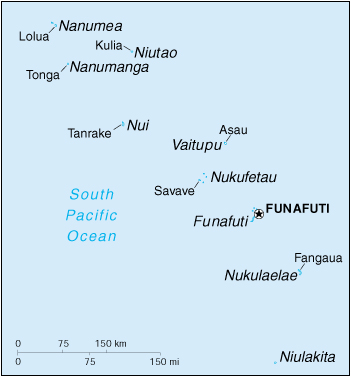
Location: Oceania, island group consisting of nine coral atolls in the South Pacific Ocean, about one-half of the way from Hawaii to Australia
Geographic coordinates: 8 00 S, 178 00 E
Area:
total: 26 sq km
land: 26 sq km
water: 0 sq km
Land boundaries: 0 km
Coastline: 24 km
Maritime claims:
contiguous zone: 24 nm
exclusive economic zone: 200 nm
territorial sea: 12 nm
Climate: tropical; moderated by easterly trade winds (March to November); westerly gales and heavy rain (November to March)
Terrain: very low-lying and narrow coral atolls
Elevation extremes:
lowest point: Pacific Ocean 0 m
highest point: unnamed location 5 m
Natural resources: fish
Land use:
arable land: 0%
permanent crops: 0%
permanent pastures: 0%
forests and woodland: 0%
other: 100% (1993 est.)
Natural hazards: severe tropical storms are usually rare, but, in 1997, there were three cyclones; low-level of islands make them very sensitive to sea-level rise
Environment – current issues: since there are no streams or rivers and groundwater is not potable, most water needs must be met by catchment systems with storage facilities (the Japanese Government has built one desalination plant and plans to build one other); beachhead erosion because of the use of sand for building materials; excessive clearance of forest undergrowth for use as fuel; damage to coral reefs from the spread of the Crown of Thorns starfish; Tuvalu is very concerned about global increases in greenhouse gas emissions and their effect on rising sea levels, which threaten the country’s underground water table.
Environment – international agreements:
party to: Climate Change, Climate Change-Kyoto Protocol, Desertification, Ozone Layer Protection, Ship Pollution
signed, but not ratified: Biodiversity, Law of the Sea
Geography – note: one of the smallest and most remote countries on Earth; five of the coral atolls enclose sizable lagoons, but the other four are just pinnacles.
People of Tuvalu
Population: 11,636 (July 2005 est.)
Age structure:
0-14 years: 34%
15-64 years: 61%
65 years and over: 5%
Population growth rate: 1.41%
Birth rate: 21.78 births/1,000 population
Death rate: 7.66 deaths/1,000 population
Net migration rate: 0 migrant(s)/1,000 population
Infant mortality rate: 23.3 deaths/1,000 live births
Life expectancy at birth:
total population: 66.32 years
male: 64.21 years
female: 68.53 years
Total fertility rate: 3.11 children born/woman
Nationality:
noun: Tuvaluan(s)
adjective: Tuvaluan
Ethnic groups: Polynesian 96%
Religions: Church of Tuvalu (Congregationalist) 97%, Seventh-Day Adventist 1.4%, Baha’i 1%, other 0.6%
Languages: Tuvaluan, English
Tuvalu Economy
Economy – overview: Tuvalu consists of a densely populated, scattered group of nine coral atolls with poor soil. The country has no known mineral resources and few exports. Subsistence farming and fishing are the primary economic activities. Government revenues largely come from the sale of stamps and coins and worker remittances. About 1,000 Tuvaluans work in Nauru in the phosphate mining industry. Nauru has begun repatriating Tuvaluans, however, as phosphate resources decline. Substantial income is received annually from an international trust fund established in 1987 by Australia, NZ, and the UK and supported also by Japan and South Korea. Thanks to wise investments and conservative withdrawals, this Fund has grown from an initial $17 million to over $35 million in 1999. The US government is also a major revenue source for Tuvalu, with 1999 payments from a 1988 treaty on fisheries at about $9 million, a total which is expected to rise annually. In an effort to reduce its dependence on foreign aid, the government is pursuing public sector reforms, including privatization of some government functions and personnel cuts of up to 7%. In 1998, Tuvalu began deriving revenue from use of its area code for “900” lines and in 2000, from the lease of its “.tv” Internet domain name. Royalties from these new technology sources could raise GDP three or more times over the next decade. In 1999, with merchandise exports falling and financing reaching less than 5% of imports, continued reliance was placed on fishing and telecommunications license fees, remittances from overseas workers, official transfers, and investment income from overseas assets to cover the trade deficit.
GDP: purchasing power parity – $11.6 million (1999 est.)
GDP – real growth rate: 3% (1999 est.)
GDP – per capita: purchasing power parity – $1,100 (1999 est.)
Inflation rate (consumer prices): 3.9% (average 1985-93)
Labor force – by occupation: people make a living mainly through exploitation of the sea, reefs, and atolls and from wages sent home by those working abroad (mostly workers in the phosphate industry and sailors)
Budget:
revenues: $4.3 million
expenditures: $4.3 million (1989 est.)
Industries: fishing, tourism, copra
Electricity – production: 3 million kWh (1995)
Electricity – consumption: 3 million kWh (1995)
Agriculture – products: coconuts; fish
Exports: $165,000 (f.o.b., 1989)
Exports – commodities: copra
Exports – partners: Fiji, Australia, NZ
Imports: $4.4 million (c.i.f., 1989)
Imports – commodities: food, animals, mineral fuels, machinery, manufactured goods
Imports – partners: Fiji, Australia, NZ
Economic aid – recipient: $7.9 million (1995); note – substantial annual support from an international trust fund
Currency: 1 Tuvaluan dollar ($T) or 1 Australian dollar ($A) = 100 cents
Map of Tuvalu