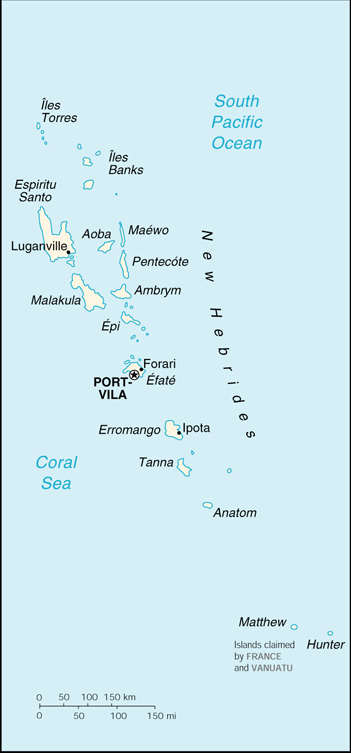
Facts About Vanuatu
Background: The British and French who settled the New Hebrides in the 19th century, agreed in 1906 to an Anglo-French Condominium, which administered the islands until independence in 1980.
Government type: republic
Capital: Port-Vila
Currency: 1 vatu (VT) = 100 centimes
Geography of Vanuatu
Location: Oceania, group of islands in the South Pacific Ocean, about three-quarters of the way from Hawaii to Australia
Geographic coordinates: 16 00 S, 167 00 E
Area:
total: 14,760 sq km
land: 14,760 sq km
water: 0 sq km
note: includes more than 80 islands
Land boundaries: 0 km
Coastline: 2,528 km
Maritime claims: measured from claimed archipelagic baselines
contiguous zone: 24 nm
continental shelf: 200 nm or to the edge of the continental margin
exclusive economic zone: 200 nm
territorial sea: 12 nm
Climate: tropical; moderated by southeast trade winds
Terrain: mostly mountains of volcanic origin; narrow coastal plains
Elevation extremes:
lowest point: Pacific Ocean 0 m
highest point: Tabwemasana 1,877 m
Natural resources: manganese, hardwood forests, fish
Land use:
arable land: 2%
permanent crops: 10%
permanent pastures: 2%
forests and woodland: 75%
other: 11% (1993 est.)
Natural hazards: tropical cyclones or typhoons (January to April); volcanism causes minor earthquakes
Environment – current issues: a majority of the population does not have access to a potable and reliable supply of water; deforestation
Environment – international agreements:
party to: Biodiversity, Climate Change, Desertification, Endangered Species, Law of the Sea, Marine Dumping, Ozone Layer Protection, Ship Pollution, Tropical Timber 94
signed, but not ratified: none of the selected agreements
Geography – note: a Y-shaped chain of some 80 islands, 70 of which are inhabited; several of the islands have active volcanoes.
People of Vanuatu
The population of Vanuatu is 94% indigenous Melanesian. About 30,000 live in the capital, Port Vila. Another 9,600 live in Luganville (or Santo Town) on Espiritu Santo. The remainder live in rural areas. Approximately 2,000 ni-Vanuatu live and work in New Caledonia. Although local pidgin, called Bislama, is the national language, English and French also are official languages. Indigenous Melanesians speak 105 local languages.
Christianity has had a profound influence on ni-Vanuatu society, and an estimated 90% of the population is affiliated with a Christian denomination. The largest denominations are Presbyterian, Roman Catholic, and Anglican. John Frum, a syncretic sect, also is important on Tanna Island.
Population: 205,754 (July 2005 est.)
Age structure:
0-14 years: 37%
15-64 years: 60%
65 years and over: 3%
Population growth rate: 1.74%
Birth rate: 25.93 births/1,000 population
Death rate: 8.52 deaths/1,000 population
Net migration rate: 0 migrant(s)/1,000 population
Infant mortality rate: 62.52 deaths/1,000 live births
Life expectancy at birth:
total population: 60.57 years
male: 59.23 years
female: 61.98 years
Total fertility rate: 3.29 children born/woman
Nationality:
noun: Ni-Vanuatu (singular and plural)
adjective: Ni-Vanuatu
Ethnic groups: indigenous Melanesian 94%, French 4%, Vietnamese, Chinese, Pacific Islanders
Religions: Presbyterian 36.7%, Anglican 15%, Roman Catholic 15%, indigenous beliefs 7.6%, Seventh-Day Adventist 6.2%, Church of Christ 3.8%, other 15.7%
Languages: English (official), French (official), pidgin (known as Bislama or Bichelama)
Literacy:
definition: age 15 and over can read and write
total population: 53%
male: 57%
female: 48% (1979 est.)
History of Vanuatu
The prehistory of Vanuatu is obscure; archaeological evidence supports the commonly held theory that peoples speaking Austronesian languages first came to the islands some 4,000 years ago. Pottery fragments have been found dating back to 1300-1100 B.C.
The first island in the Vanuatu group discovered by Europeans was Espiritu Santo, when in 1606 the Portuguese explorer, Pedro Fernandez De Quiros, spied what he thought was a southern continent. Europeans did not return until 1768, when Louis Antoine de Bougainville rediscovered the islands. In 1774, Captain Cook named the islands the New Hebrides, a name that lasted until independence.
In 1825, trader Peter Dillon’s discovery of sandalwood on the island of Erromango began a rush that ended in 1830 after a clash between immigrant Polynesian workers and indigenous Melanesians. During the 1860s, planters in Australia, Fiji, New Caledonia, and the Samoa Islands, in need of laborers, encouraged a long-term indentured labor trade called “blackbirding.” At the height of the labor trade, more than one-half the adult male population of several of the Islands worked abroad.
It was at this time that missionaries, both Catholic and Protestant, arrived on the islands. Settlers also came, looking for land on which to establish cotton plantations. When international cotton prices collapsed, they switched to coffee, cocoa, bananas, and, most successfully, coconuts. Initially, British subjects from Australia made up the majority, but the establishment of the Caledonian Company of the New Hebrides in 1882 soon tipped the balance in favor of French subjects. By the turn of the century, the French outnumbered the British two to one.
The jumbling of French and British interests in the islands brought petitions for one or another of the two powers to annex the territory. In 1906, however, France and the United Kingdom agreed to administer the islands jointly. Called the British-French Condominium, it was a unique form of government, with separate governmental systems that came together only in a joint court. Melanesians were barred from acquiring the citizenship of either power.
Challenges to this form of government began in the early 1940s. The arrival of Americans during World War II, with their informal demeanor and relative wealth, was instrumental in the rise of nationalism in the islands. The belief in a mythical messianic figure named John Frum was the basis for an indigenous cargo cult (a movement attempting to obtain industrial goods through magic) promising Melanesian deliverance. Today, John Frum is both a religion and a political party with two members in Parliament.
The first political party was established in the early 1970s and originally was called the New Hebrides National Party. One of the founders was Father Walter Lini, who later became Prime Minister. Renamed the Vanua’aku Pati in 1974, the party pushed for independence; in 1980, the Republic of Vanuatu was created.
Vanuatu Economy
Economy – overview: The economy is based primarily on subsistence or small-scale agriculture which provides a living for 65% of the population. Fishing, offshore financial services, and tourism, with about 50,000 visitors in 1997, are other mainstays of the economy. Mineral deposits are negligible; the country has no known petroleum deposits. A small light industry sector caters to the local market. Tax revenues come mainly from import duties. Economic development is hindered by dependence on relatively few commodity exports, vulnerability to natural disasters, and long distances from main markets and between constituent islands. The most recent natural disaster, a severe earthquake in November 1999 followed by a tsunami, caused extensive damage to the northern island of Pentecote and left thousands homeless. GDP growth has risen less than 3% on average in the 1990s. In response to foreign concerns, the government is moving to tighten regulation of its offshore financial center.
GDP: purchasing power parity – $245 million (1999 est.)
GDP – per capita: purchasing power parity – $1,300 (1999 est.)
GDP – composition by sector:
agriculture: 24%
industry: 13%
services: 63% (1997 est.)
Inflation rate (consumer prices): 3.9% (1998 est.)
Labor force – by occupation: agriculture 65%, services 32%, industry 3% (1995 est.)
Budget:
revenues: $94.4 million
expenditures: $99.8 million, including capital expenditures of $30.4 million (1996 est.)
Industries: food and fish freezing, wood processing, meat canning
Industrial production growth rate: 1% (1997 est.)
Electricity – production: 32 million kWh (1998)
Electricity – production by source:
fossil fuel: 100%
hydro: 0%
nuclear: 0%
other: 0% (1998)
Electricity – consumption: 30 million kWh (1998)
Agriculture – products: copra, coconuts, cocoa, coffee, taro, yams, coconuts, fruits, vegetables; fish, beef
Exports: $33.8 million (f.o.b., 1998)
Exports – commodities: copra, beef, cocoa, timber, coffee
Exports – partners: Japan 32%, Germany 14%, Spain 8%, New Caledonia 7%, Australia 2% (1997 est.)
Imports: $76.2 million (f.o.b., 1998)
Imports – commodities: machinery and equipment, foodstuffs, fuels
Imports – partners: Japan 52%, Australia 20%, New Caledonia, Singapore, New Zealand, France, Fiji (1997 est.)
Debt – external: $48 million (1997 est.)
Economic aid – recipient: $45.8 million (1995)
Currency: 1 vatu (VT) = 100 centimes
Map of Vanuatu