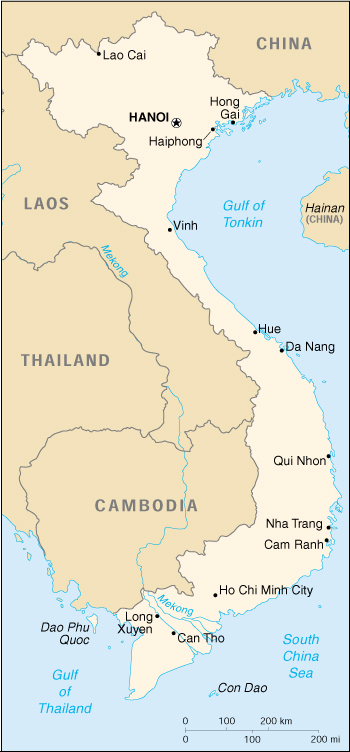
Facts About Vietnam
Background: France occupied all of Vietnam by 1884. Independence was declared after World War II, but the French continued to rule until 1954 when they were defeated by communist forces under Ho Chi MINH, who took control of the north. US economic and military aid to South Vietnam grew through the 1960s in an attempt to bolster the government, but US armed forces were withdrawn following a cease-fire agreement in 1973. Two years later North Vietnamese forces overran the south. Economic reconstruction of the reunited country has proven difficult as aging Communist Party leaders have only grudgingly initiated reforms necessary for a free market.
Government type: Communist state
Capital: Hanoi
Currency: 1 new dong (D) = 100 xu
Geography of Vietnam
Location: Southeastern Asia, bordering the Gulf of Thailand, Gulf of Tonkin, and South China Sea, alongside China, Laos, and Cambodia
Geographic coordinates: 16 00 N, 106 00 E
Area:
total: 329,560 sq km
land: 325,360 sq km
water: 4,200 sq km
Land boundaries:
total: 4,639 km
border countries: Cambodia 1,228 km, China 1,281 km, Laos 2,130 km
Coastline: 3,444 km (excludes islands)
Maritime claims:
contiguous zone: 24 nm
continental shelf: 200 nm or to the edge of the continental margin
exclusive economic zone: 200 nm
territorial sea: 12 nm
Climate: tropical in south; monsoonal in north with hot, rainy season (mid-May to mid-September) and warm, dry season (mid-October to mid-March)
Terrain: low, flat delta in south and north; central highlands; hilly, mountainous in far north and northwest
Elevation extremes:
lowest point: South China Sea 0 m
highest point: Ngoc Linh 3,143 m
Natural resources: phosphates, coal, manganese, bauxite, chromate, offshore oil and gas deposits, forests, hydropower
Land use:
arable land: 17%
permanent crops: 4%
permanent pastures: 1%
forests and woodland: 30%
other: 48% (1993 est.)
Irrigated land: 18,600 sq km (1993 est.)
Natural hazards: occasional typhoons (May to January) with extensive flooding
Environment – current issues: logging and slash-and-burn agricultural practices contribute to deforestation and soil degradation; water pollution and overfishing threaten marine life populations; groundwater contamination limits potable water supply; growing urban industrialization and population migration are rapidly degrading environment in Hanoi and Ho Chi Minh City.
Environment – international agreements:
party to: Biodiversity, Climate Change, Desertification, Endangered Species, Environmental Modification, Hazardous Wastes, Law of the Sea, Ozone Layer Protection, Ship Pollution, Wetlands
signed, but not ratified: Climate Change-Kyoto Protocol, Nuclear Test Ban
Geography – note: extending 1,650 km north to south, the country is only 50 km across at its narrowest point
People of Vietnam
Originating in what is now southern China and northern Vietnam, the Vietnamese people pushed southward over two millennia to occupy the entire eastern seacoast of the Indochinese Peninsula. Ethnic Vietnamese constitute about 90% of Vietnam’s 79.9 million population.
Vietnam’s approximately 2.3 million ethnic Chinese, concentrated mostly in southern Vietnam, constitute Vietnam’s largest minority group. Long important in the Vietnamese economy, Vietnamese of Chinese ancestry have been active in rice trading, milling, real estate, and banking in the south and shopkeeping, stevedoring, and mining in the north. Restrictions on economic activity following reunification in 1975 and the subsequent but unrelated general deterioration in Vietnamese-Chinese relations sent chills through the Chinese-Vietnamese community. In 1978-79, some 450,000 ethnic Chinese left Vietnam by boat as refugees (many officially encouraged and assisted) or were expelled across the land border with China.
The second-largest ethnic minority grouping, the central highland peoples commonly termed Montagnards (mountain people), comprise two main ethnolinguistic groups–Malayo-Polynesian and Mon-Khmer. About 30 groups of various cultures and dialects are spread over the highland territory.
The third-largest minority, the Khmer Krom (Cambodians), numbering about 600,000, is concentrated near the Cambodian border and at the mouth of the Mekong River. Most are farmers. Other minority groups include the Cham–remnants of the once-mighty Champa Kingdom, conquered by the Vietnamese in the 15th century–Hmong, and Thai.
Vietnamese is the official language of the country. It is a tonal language with influences from Thai, Khmer, and Chinese. Since the early 20th century, the Vietnamese have used a Romanized script introduced by the French. Previously, Chinese characters and an indigenous phonetic script were both used.
Population: 83,535,576 (July 2005 est.)
Age structure:
0-14 years: 33%
15-64 years: 62%
65 years and over: 5%
Population growth rate: 1.49%
Birth rate: 21.62 births/1,000 population
Death rate: 6.26 deaths/1,000 population
Net migration rate: -0.51 migrant(s)/1,000 population
Infant mortality rate: 31.13 deaths/1,000 live births
Life expectancy at birth:
total population: 69.27 years
male: 66.84 years
female: 71.87 years
Total fertility rate: 2.53 children born/woman
Nationality:
noun: Vietnamese (singular and plural)
adjective: Vietnamese
Ethnic groups: Vietnamese 85%-90%, Chinese 3%, Muong, Tai, Meo, Khmer, Man, Cham
Religions: Buddhist, Taoist, Roman Catholic, indigenous beliefs, Muslim, Protestant, Cao Dai, Hoa Hao
Languages: Vietnamese (official), Chinese, English, French, Khmer, tribal languages (Mon-Khmer and Malayo-Polynesian)
Literacy:
definition: age 15 and over can read and write
total population: 93.7%
male: 96.5%
female: 91.2% (1995 est.)
History of Vietnam
The victory of communist forces in Vietnam in April 1975 ranks as one of the most politically significant occurrences of the post-World War II era in Asia. The speed with which the North finally seized the South, and the almost simultaneous communist victories in Laos and Cambodia, were stunning achievements. The collapse of the three Indochinese noncommunist governments brought under communist control a region that, over the course of four decades of war, had become the focus of United States policy for the containment of communism in Asia. The achievement was even more phenomenal for having been accomplished in the face of determined United States opposition and for having called into question the very policy of containing communism.
The events of April 1975 prepared the way for the official reunification of North and South in 1976, some three decades after Ho Chi Minh first proclaimed Vietnam’s independence under one government in September 1945 and more than a century after France divided Vietnam in order to rule its regions separately. The departure of defeated Japanese troops, who had occupied Vietnam during World War II, had created the opportunity for Vietnamese communists to seize power in August 1945, before French authorities were able to return to reclaim control of the government. Communist rule was cut short, however, by nationalist Chinese and British occupation forces whose presence tended to support the Communist Party’s political opponents. Between 1945 and 1975, the generation of communists responsible for victory in the South pursued a lengthy war for independence from the French, acquiesced temporarily to division of the country into a communist North and noncommunist South, and engaged in a subsequent war for control of the South against a southern regime supported by the United States. Reunification and independence, however, were goals that predated the communists. They were the long-established objectives of Ho Chi Minh’s nationalist and anticolonialist predecessors, who had resisted Chinese rule for 1,000 years and French domination for a century.
Indeed, Vietnam’s unrelenting resistance to foreign intervention remains a dominant Vietnamese historical theme, manifested in the repeated waging of dau tranh, or struggle to gain a long-term objective through total effort, and motivated by chinh nghia, or just cause. Vietnam’s communist leaders claim that every Vietnamese has been a soldier in this struggle. Paradoxically, Vietnam’s fierce determination to remain free of foreign domination has often been combined with an equally strong willingness to accept foreign influence. Historically, the pattern has been to adopt foreign ideas to indigenous conditions whenever they applied.
China was the chief source of Vietnam’s foreign ideas and the earliest threat to its national sovereignty. Beginning in the first century B.C., China’s Han dynasty (206 B.C.-A.D. 220) imposed Chinese rule that endured for ten centuries despite repeated Vietnamese uprisings and acts of rebellion. Only the collapse of the Tang dynasty (618-907) in the early tenth century enabled Vietnamese national hero Ngo Quyen to reestablish Vietnam’s independence a generation later. The Vietnamese subsequently were able to fend off further invasion attempts for 900 years.
Whether ruled by China or independent, the Vietnamese elite consistently modeled Vietnamese cultural institutions on those of the Chinese. Foremost among such Chinese institutions was Confucianism, after which Vietnamese family, bureaucratic, and social structures were patterned. The Vietnamese upper classes tended also to study Chinese classical literature and to use the Chinese system of ideographs in writing. Emperor Gia Long, in a particularly obvious act of imitation in the early nineteenth century, even modeled his new capital at Hue after the Chinese capital at Beijing. The process of sinicization, however, tended to coexist with, rather than to replace, traditional Vietnamese culture and language. Imitation of the Chinese was largely confined to the elite classes. Traditional Vietnamese society, on the other hand, was sustained by the large peasant class, which was less exposed to Chinese influence.
Vietnam’s lengthy period of independence ended in 1862, when Emperor Tu Duc, agreeing to French demands, ceded three provinces surrounding Saigon to France. During the colonial period, from 1862 to 1954, resistance to French rule was led by members of the scholar-official class, whose political activities did not involve the peasantry and hence failed. The success of the communists, on the other hand, was derived from their ability to organize and retain the peasantry’s support. The Vietnamese Communist Party (VCP–Viet Nam Cong San Dang) and its various communist antecedents presented Marxism-Leninism as an effective means of recovering the independence that was Vietnam’s tradition. Belief in this ideal was instrumental in sustaining Northern and Southern peasant-based communist forces during the lengthy Second Indochina War, which lasted from 1954 to 1975.
In the post-1975 period, however, it was immediately apparent that the popularity and effectiveness of the communist party’s wartime policies did not necessarily extend to its peacetime nation-building plans. Having unified the North and South politically, the VCP still had to integrate them socially and economically. In this task, VCP policy-makers were confronted with Southern resistance to change, as well as traditional animosities arising from cultural and historical differences between the North and South. The situation was further complicated by a deterioration in economic conditions that ignited an unprecedented level of discontent among low-level VCP members and open criticism of VCP policies. The party appeared to be in a state of transition, wavering over the pace and manner of the South’s integration with the North and debating the place of reform in development strategy. The first generation communist leaders, co-founders of the party together with Ho Chi Minh, were aging and were beginning to step down in favor of younger, often reform-minded technocrats. The Sixth National Party Congress held in December 1986 was a milestone; it marked the end of the party’s revolutionary period, when social welfare and modernization were subordinate to security concerns, and the beginning of a time when experimentation and reform were encouraged to stimulate development.
In the 1980s, Vietnam ranked third in population–60 million- -and first in population density–an average of 182 persons per square kilometer–among the world’s communist nations. A 2 percent annual population growth rate and uneven population distribution adversely affected resource allocation, work force composition, and land use. Population projections indicated a population of 80 million by the year 2000, if the growth rate remained unchanged. The Fourth National Party Congress in December 1976 stressed the need to curtail the population growth rate and introduced a plan to relocate 54 million people to 1 million hectares of previously uncultivated land, now organized into “new economic zones,” by the mid-1990s. As of 1988, however, progress toward the plan’s fulfillment was considerably behind schedule.
A predominantly rural society with more than half of its work force committed to agriculture, Vietnam’s standard of living remained one of the poorest in the world. A series of harvest shortfalls that reduced food supplies and a scarcity of foreign exchange that made it difficult to replenish food reserves contributed to this condition. Shortages of raw materials and energy forced production facilities to operate at considerably less than full capacity, and the party bureaucracy remained incapable of acting quickly enough to reduce shortages.
Economic development prospects for the 1980s and 1990s were tied to party economic policy in critical ways. Party leaders, in establishing economic policy at the Fourth National Party Congress, envisioned Vietnam’s post-reunification economy to be in a “period of transition to socialism.” The plan, or series of plans, called for the economy to evolve through three phases: The first, outlining the objectives of the Second Five-Year Plan (1976-80), set extremely high goals for industrial and agricultural production while also giving high priority to construction, reconstruction, and the integration of the North and the South. The second, entitled “socialist industrialization,” was divided into two stages–from 1981 to 1990 and from 1991 to 2005. During these stages, the material and technical foundations of communism were to be constructed, and development plans were to focus equally on agriculture and industry. The third and final phase, covering the years from 2006 to 2010; was to be a time set aside to “perfect the transitional period.”
By 1979, however, it was obvious to Vietnam’s leaders that the Second Five-Year Plan would fail to meet its goals and that the long-range goals established for the transition period were unrealistic. The economy continued to be dominated by small-scale production, low productivity, high unemployment, material and technological shortages, and insufficient food and consumer goods.
The Fifth National Party Congress, held in March 1982, approved the economic goals of the Third Five-Year Plan (1981- 85). The policies introduced were comparatively liberal and called for the temporary retention of private capitalist activities in the South, in order to spur economic growth. By sanctioning free enterprise, the congress ended the nationalization of small business concerns and reversed former policies that sought the immediate transformation of the South to communism. The July 1984 Sixth Plenum of the Fifth National Party Congress’ Central Committee confirmed the party’s earlier decision, recognizing that the private sector’s domination over wholesale and retail trade in the South could not be eliminated until the state was capable of assuming that responsibility. Proposals subsequently were made to upgrade the state’s economic sophistication by decentralizing planning procedures and improving the managerial skills of government and party officials. To attract foreign currency and expertise, the government approved a new foreign investment code in December 1987.
Vietnam’s security considerations in the 1980s also represented a new set of challenges to the party. Until the fall of the South Vietnamese government in 1975, the party had relegated foreign policy to a secondary position behind the more immediate concerns of national liberation and reunification. Once the Second Indochina War had ended, however, the party needed to look outward and reevaluate foreign policy, particularly as it applied to Cambodia, China, the Soviet Union, member nations of the Association of Southeast Asian Nations (ASEAN), and the United States and other Western nations.
By the end of the 1970s, the Vietnamese were threatened on two fronts, a condition which Vietnam had not faced previously, even at the height of the Second Indochina War. Conflict between Vietnamese and Cambodian communists on their common border began almost immediately after their respective victories in 1975. To neutralize the threat, Vietnam invaded Cambodia in December 1978 and overran Phnom Penh, the Cambodian capital, driving out the incumbent Khmer Rouge communist regime and initiating a prolonged military occupation of the country. Vietnam’s relations with China, a seemingly staunch ally during the Second Indochina War, subsequently reached their nadir, when China retaliated against Vietnam’s incursion into Cambodia by launching a limited invasion of Vietnam in February and March 1979. Relations between the two countries had actually been deteriorating for some time. Territorial disagreements, which had remained dormant during the war against the South, were revived at the war’s end, and a postwar campaign engineered by Hanoi to limit the role of Vietnam’s ethnic Chinese (Hoa) community in domestic commerce elicited a strong Chinese protest. China was displeased with Vietnam primarily, however, because of its rapidly improving relationship with the Soviet Union.
A new era in Vietnamese foreign relations began in 1978, when Hanoi joined the Soviet-led Council for Mutual Economic Assistance (Comecon) and signed the Soviet-Vietnamese Treaty of Friendship and Cooperation with Moscow. The agreement called for mutual assistance and consultation in the event either was threatened by a third country. A secret protocol accompanying the treaty also permitted Soviet use of Vietnamese airport and harbor facilities, particularly the former United States military complex at Cam Ranh Bay. In return, Vietnam acquired military and economic aid needed to undertake an invasion of Cambodia and was able to exploit Soviet influence as a deterrent to Chinese intervention.
After China had cut off military assistance to Vietnam, such aid–amounting to US$200 to $300 million annually–was almost exclusively Soviet in origin during the 1980s. As Vietnam’s primary source of economic aid as well, the Soviet Union during this period provided close to US$1 billion annually in balance- of-payments aid, project assistance, and oil price subsidies.
Vietnam’s growing dependence on the Soviet Union concerned Hanoi’s Southeast Asian neighbors. As did China, the ASEAN nations thought that the relationship provided a springboard for Soviet influence in the region and that Soviet support provided a critical underpinning for Vietnam’s Cambodia policy. The ASEAN nations assumed a key role in rallying United Nations (UN) General Assembly opposition to Vietnam’s interference in Cambodia and led the UN in preventing the Vietnamese-supported regime in Phnom Penh from assuming Cambodia’s General Assembly seat. ASEAN members were instrumental in combining–at least on paper–the various Cambodian communist and noncommunist factions opposing the Vietnamese into a single resistance coalition.
The decision to intervene militarily in Cambodia further isolated Vietnam from the international community. The United States, in addition to citing Vietnam’s minimal cooperation in accounting for Americans who were missing in action (MIAs) as an obstacle to normal relations, barred normal ties as long as Vietnamese troops occupied Cambodia. In 1987 Washington also continued to enforce the trade embargo imposed on Hanoi at the conclusion of the war in 1975.
Normalization of diplomatic relations with the United States, however, was not a primary Vietnamese foreign policy objective in 1987. The sizable economic benefits it would yield, plus its strategic value remained secondary to other more immediate security concerns, although the potential economic benefits were judged sizable. Instead, Vietnam prepared to enter the 1990s with foreign relations priorities that stressed extrication from the military stalemate in Cambodia in a manner consistent with security needs, repair of ties with China to alleviate Chinese military pressure on Vietnam’s northern border, and reduction of military and economic dependence on the Soviet Union.
Domestic and foreign policy in 1987 reflected changes initiated by the elevation of reformer Nguyen Van Linh to VCP general secretary at the Sixth National Party Congress. Policies were characterized by a program of political and economic experimentation that was similar to contemporary reform agendas undertaken in China and the Soviet Union. The goal of all three nations was to pursue economic development at the cost of some compromise of communist ideological orthodoxy. In the case of Vietnam, however, the conservative members of the leadership continued to view orthodoxy as an ultimate goal. According to their plan, the stress on economic development was only a momentary emphasis; the real goal remained the perfection of Vietnam’s communist society.
* * *
In 1988 and 1989, the years immediately following the completion of research and writing on this book, Vietnam’s foreign and domestic policy was increasingly determined by economic considerations. The mood of dramatic economic and political reform, inspired by the Sixth National Party Congress and Linh’s appointment to party leadership, however, appeared to have dissipated, and the mood of confidence that had prevailed in 1987 gradually evaporated as disagreement among Political Bureau members over the pace of change stymied the implementation of many policy innovations.
A campaign for political and economic renewal (doi moi) was launched by Linh immediately following the congress, but the progress of change, particularly economic change, failed to meet expectations. Linh was strongly opposed within the party’s leadership, and his economic reforms were initially stalled or blocked by the resistance efforts of a strong conservative coalition of party leaders, made up of ideological conservatives, bureaucrats, and members of the military establishment.
Linh’s initiatives for dealing with the country’s economic problems were bold, but the coalition of conservative party leaders opposing his policies effectively denied him the consensus he needed to implement his plans. Consequently, his powers to effect change appeared to wane as the severity of the country’s economic crisis deepened.
Despite their opposition to reform policy, reform, per se, was viewed as “correct” by most, if not all, members of Vietnam’s Political Bureau. A member’s position on the subject, however, was probably determined less by his view of the process in the abstract than by his willingness to undertake risk, and in 1988 and 1989 the non-risk takers appeared to have the upper hand.
In March 1988 Prime Minister Pham Hung died, and Linh’s choice of conservative Do Muoi over fellow reformer Vo Van Kiet to replace him was viewed as a clear concession to the non-risk takers. National Assembly members, however, for the first time challenged the central committee’s nominee for a key government post by demanding that two candidates be permitted to run. Muoi, the party’s choice, was required to face Vo Van Kiet, the nominee of delegates from the south.
The dissent displayed in the debate leading to Muoi’s selection was not isolated, but mirrored a dramatic increase in all political debate and discussion in 1988. The October 1988 meeting of the Congress of National Trade Unions, for example, was extremely critical of the government’s economic failures. Similarly, the Fourth Session of the 8th National Assembly, held in December 1988, heatedly debated the issues. It was conducted without the customary Central Committee meeting beforehand and, on the surface, appeared to be acting without Central Committee guidance.
Lastly, a campaign against corruption, initiated by Nguyen Van Linh in 1987, invited private and official criticism of public policy and encouraged the press to take the lead in uncovering corruption. By early 1988, the campaign had resulted in the replacement of almost all of the country’s 40 province secretaries and 80 percent of the 400 or so district party chiefs. Eleven-hundred party cadres were tried for corruption in the first six months of the year, and the press was credited with the party’s removal of Ha Truong Hoa, the party Provincial Secretary of Thanh Hoa, whose position was widely regarded as impregnable despite his well publicized abuses of office. The policy of encouraging criticism, however, was mysteriously reversed in early 1989 when the press was urged to moderate its criticism of the Party. It was speculated that the reversal was meant to appease conservatives within the Political Bureau who were concerned about the erosion of party authority caused by public criticism.
Party leaders themselves, however, continued to be critical of party policy. Nguyen The Phan, the head of the theoretical department of the Marxist-Leninist Institute, for example, told a January 1989 meeting of high-ranking officials that by following the Soviet economic model, Vietnam had developed a centralized and subsidized economic system “inferior to capitalism,” and “had abolished motivation in people and society.” He called on party leaders to learn about marketplace competition from capitalist countries.
Goals established and reinforced at the December 1988 meeting of the Eighth National Assembly were consistent with this theme. The primary goal was described as development of an economy that was less controlled by the government and more subject to the rules of the marketplace. This was to be achieved by subjecting all economic transactions to the standards of basic business accountability and by expanding the private sector. Centralized bureaucratism was to be abolished, and some state-run economic establishments were to be guaranteed autonomy in their business practices. Lastly, the system of state subsidies for food, import-export operations, or for losses incurred by state-run enterprises was scheduled to be eliminated.
Beginning in 1988, individual farmers were given more responsibility for the rice growing process in order to increase their incentive to produce higher yields. Land tenure laws were modified to guarantee farmers a ten-year tenure on the land, and the contract system between peasants and the government was revised to permit peasants to keep 45 to 50 percent of their output rather than the 25 percent previously allowed. Other reforms removed restrictions on private-production enterprises in Hanoi and introduced the concept of developing industry outside the state-run sector. A law passed in January 1989 helped free the economy from central control by granting entrepreneurs the right to pool their capital and set up their own business organizations. Such concessions were of particular assistance to entrepreneurs in the South, where the economy in 1988 and 1989 was more or less directed by its own momentum, and where it had become increasingly evident that Vietnam’s economic planners had opted to exploit the region’s economic potential rather than stifle it by employing rigid controls.
The sixth plenum of the party central committee (Sixth Party Congress), held in late March 1989, concluded, however, that despite the establishment of goals and the introduction of some new policies little was actually being accomplished because local cadres were failing to implement reform plans or institutionalize party resolutions in a timely manner. The plenum, therefore, resolved to emphasize the implementation and institutionalization of reforms and resolutions already introduced in order to accelerate the process.
Chinese student pro-democracy demonstrations in Beijing a few months later were watched very closely by Vietnam’s leaders. In their view, the disaffection demonstrated by Chinese students had resulted directly from China’s experimentation with political and economic reforms. Having undertaken similar changes, they were concerned that Vietnam was equally vulnerable to displays of unrest. To avoid China’s experience, the government reportedly dealt with student protesters in Hanoi in May 1989 by acceding to their demands for improved conditions. Progress toward greater political liberalization, however, was subsequently checked.
Vietnam’s world view noticeably altered in the closing years of the 1980s, moving from an ideologically dominated perspective, stressing Vietnam’s independence and the division of the world into communist and noncommunist camps, to a non-ideological view emphasizing Vietnam’s role in a complex world of economic interdependence. The most significant example of a foreign policy initiative motivated by this view was the decision, announced in early 1989, to remove all Vietnamese troops from Cambodia by the end of September 1989. By disengaging from Cambodia, Vietnam hoped to remove the single largest obstacle to gaining admission to the regional and world economic community and to convince its non-communist neighbors, the West and China, that it was ready to end its diplomatic and economic isolation.
Ending the Cambodian conflict itself, however, was another matter, and as events unfolded in 1988 and 1989 it was not clear whether Vietnam’s withdrawal would expedite or prolong a resolution. Initially, the possibility of ending the stalemate appeared to improve. Acting entirely on his own initiative, resistance leader Prince Norodom Sihanouk, in December 1987, arranged unprecedented direct dialogues between himself and Hun Sen, the premier of the People’s Republic of Kampuchea. Although they failed to yield major results, the talks nevertheless initiated valuable face-to-face discussions between representatives of both sides and introduced diplomacy as a means of ending the conflict.
In May 1988, eleven days after the Soviets began their troop withdrawal from Afghanistan and three days before a Moscow summit between President Reagan and Soviet Secretary Gorbachev was to convene, Vietnam announced plans to withdraw 50,000 troops by the end of the year. The withdrawal, commencing in June and ending in December as promised, involved not only the removal of troops, but also the dismantling of Vietnam’s military high command in Cambodia and the reassignment of remaining troops to Cambodian commands.
In July 1988, Hanoi participated in the first meeting of all parties in the Cambodia conflict. The “cocktail party” meeting, or Jakarta Informal Meeting (JIM), convened in Bogor, Indonesia, was termed a limited success because, if nothing more, it established a negotiating framework and set the agenda for future discussion. However, it also shifted the emphasis of the search for a conflict resolution away from Vietnam and to the question of how to prevent the Khmer Rouge from seizing power once a political agreement was reached. At the meeting, Vietnam linked a total withdrawal of its troops to the elimination of the Khmer Rouge and won the support of the ASEAN nations and the non- communist factions of the Cambodian resistance coalition, who also feared that Pol Pot would return to power in the absence of Vietnamese forces.
A second “informal” meeting of the four Cambodian factions, held in February 1989 ended inconclusively, deadlocked on fundamental issues such as the shape of the international force that was to supervise an agreement and the manner in which a quadripartite authority to rule in Phnom Penh would be established. The February meeting was followed by a month-long international conference, held in Paris in August 1989 and attended by twenty nations, which also ended short of a comprehensive agreement. Although the conference had been called to help mediate a settlement between the Vietnamese-backed government in Phnom Penh and the three-member resistance coalition, it foundered over finding an appropriate place for the Khmer Rouge once Vietnam’s troop withdrawal was complete. Thus in September 1989, on the eve of the withdrawal, the promise of an impending political settlement in Cambodia remained unfulfilled. Instead, the inability of the four factions to arrive at a compromise renewed prospects for an escalation of conflict on the battlefield.
In 1988 one of Vietnam’s top foreign policy priorities was finding a way to cut China’s support for the Khmer Rouge. China, Hanoi argued, was the key to a Cambodian resolution because, as Pol Pot’s chief source of supply, Beijing alone had the power to defuse the Khmer Rouge threat. As the year progressed, it became increasingly evident that Beijing was more interested in a settlement than in prolonging the conflict and that its position on Cambodia was shifting to facilitate settlement. This fact was evidenced in July 1988 when a Chinese proposal, repeating long standing demands for a complete withdrawal of all Vietnamese troops and a quadripartite government led by Sihanouk, surprisingly ruled out a personal role for Pol Pot in any post- settlement government. The proposal was also novel because it intimated that Beijing, for the first time, was willing to discuss a provisional coalition government before the departure of all Vietnamese troops. At the International Conference on the conflict held in August 1989, the Chinese appeared to be undercutting their support for the Khmer Rouge by arguing that civil war was to be avoided at all costs and promising to cut off military aid once a settlement was reached. China’s position on the Khmer Rouge, nevertheless, remained ambiguous.
In a 1988 incident, possibly related to Cambodia because it potentially strengthened China’s position at a future bargaining table, the ongoing dispute between China and Vietnam over sovereignty to the Spratly Islands erupted into an unprecedented exchange of hostilities. The situation was reduced to an exchange of accusations following the armed encounter. Vietnam’s repeated calls for China to settle the dispute diplomatically won rare support for Vietnam from the international community, but elicited little response from Beijing.
A conciliatory mood developed on both sides of the Sino- Vietnamese border in 1989, partly because Vietnam’s proposal to withdraw completely from Cambodia responded to a basic Chinese condition for improved relations. Formal talks at the deputy foreign minister level were initiated, and a cross-border trade in Chinese and Vietnamese goods flourished in the Vietnamese border town of Lang Son. The internal turmoil experienced by China in May and June 1989 may have actually benefited the relationship from Vietnam’s point of view. Historically, whenever Beijing had been forced to turn its attention inwardly to quell internal dissension, Vietnam’s security situation had correspondingly improved.
Beijing’s interest in improving ties with Moscow in 1988 and 1989, however, complicated the situation and put Vietnam increasingly at odds with the Soviet Union. As the reality of an eventual Sino-Soviet reconciliation approached, it became increasingly clear that Vietnamese and Soviet strategic interests did not always coincide. The presence of Vietnamese troops in Cambodia, for example, was the leading obstacle to Sino-Soviet reconciliation. Accordingly, the most significant development to occur in Soviet-Vietnamese relations in 1988 and 1989 was the application of increased Soviet pressure on Vietnam to resolve the Cambodian situation, a pressure that undoubtedly helped prompt Vietnam’s policy of withdrawal.
Hanoi was naturally wary of any talks between the Soviet Union and China, fearing that a deal would be made on Cambodia at Vietnam’s expense. The two powers convened bilateral discussions in Beijing in August 1988 and proceeded to normalize relations at a summit meeting in Beijing in May 1989. Very little with regard to Cambodia was actually accomplished, however, and the summit resulted simply in the two sides agreeing to “disagree” on the mechanics of a political solution.
By actively pursuing an end to the Cambodian conflict, Vietnam acted also to further the chances of normalizing its relations with the United States. Both sides in 1988 appeared particularly receptive to improving relations, and Vietnam’s troop withdrawal as well as its participation in the JIM were interpreted by the United States as positive gestures directed toward Vietnam’s disengagement from Cambodia, a requirement imposed by Washington for diplomatic recognition. Hanoi also acted, in the early part of the year, to remove other obstacles to recognition by agreeing in principle to resettlement in the United States of thousands of former political prisoners and by consenting to cooperate in joint excavations of United States military aircraft crash sites in an attempt to locate the remains of Americans missing in action (MIAs). Some remains were returned. In 1989, additional sets of MIA remains were returned, and an accord was reached between Vietnam and the United States granting re-education camp inmates who had worked for the United States permission to emigrate.
Finally, Vietnam sought to improve its regional relations in 1988 and 1989 by extending a conciliatory gesture to its Asian neighbors. In response to a rise in the number of Vietnamese refugees, Vietnam assured its neighbors that it would ease their burdens as countries of first asylum by reversing a policy that forbade refugees to return home. Hanoi also proposed to open discussions with Southeast Asian officials on ending the refugee exodus. In 1989, however, Vietnam permitted only those refugees who “voluntarily” sought repatriation to return to Vietnam. Because genuine volunteers were few in number, the policy was regarded as inadequate by countries with Vietnamese refugee populations. More boat people departed Vietnam in 1989 than in any single year since the beginning of the decade, and their numbers were no longer limited to southerners fleeing political persecution but included northerners seeking economic opportunity. The willingness of countries of first asylum to accept Vietnamese refugees had lessened considerably since 1979, however, and many were seriously considering policies advocating forced repatriation.
Vietnam’s relationship with the Association of Southeast Asian Nations (ASEAN), nevertheless, showed dramatic improvement during this two-year period, and Thailand, in particular, was singled out by Hanoi as critically important to Vietnam’s economic future. The success of a January 1989 official visit to Hanoi by Thai Foreign Minister Sitthi Sawetsila surpassed all expectations and led Thai Prime Minister Chatchai Chunhawan to encourage Thai businessmen to expand trade relations with the Indochinese countries. According to Thai Prime Minister Chatichai Choonhavan, the Thai goal was to turn the Southeast Asian peninsula into an economic “Golden Land” (Suwannaphume in Thai) with Thailand as its center and Indochina, transformed from “a battlefield into a trading market,” as its cornerstone. Although the plan was controversial, it appeared to reflect the shift of regional priorities from security to economic concerns.
Vietnam still lacked an adequate foreign investment structure in 1989, although a Foreign Trade Office and a Central Office to Supervise Foreign Investment had been established along with a State Commission for Cooperation and Investment to draft investment policies. The Ministry of Foreign Economic Relations convened a three-day conference in February 1989, attended by 500 delegates associated with foreign trade, to discuss modifying Vietnam’s existing foreign economic policies and mechanisms in order to more effectively attract foreign investors. Ho Chi Minh City also authorized the establishment of a “Zone of Fabrication and Exportation” where foreign companies would be free to import commodities, assemble products, use low cost local labor, and reexport final products. Ho Chi Minh City, followed by Vung Tau- Con Dao Special Zone, led all other localities in number of foreign investment projects and joint ventures initiated, and a large proportion of the investors were identified as overseas Vietnamese.
Although changes introduced in the closing years of the 1980s stopped short of systemic reform, they demonstrated a new level of commitment on the part of Vietnam’s leaders to resolve the country’s peacetime economic problems. Having known great success in warfare, the government appeared to have accepted that yet another struggle was underway that would require the kind of focused resolve previously displayed in wartime. The process was marked both by the possibility for change and by inertia. Political and foreign policy agendas were opened to redefinition, and strategic goals were re-evaluated to emphasize economic rather than military strength. The process, however, was slowed considerably by party conservatives, who stressed the danger of political liberalization and questioned the pace of economic reform. Change, nevertheless, was evident. In foreign policy, Vietnam moved to attract foreign investment and to end its international isolation by disengaging from Cambodia. Likewise, in the economic sphere at home, where the need for change was determined to be particularly critical, market forces assumed a larger role in Vietnam’s controlled economy then they had previously. In undertaking such changes, Vietnam seemed on the verge of joining the geopolitical trend observed in the late 1980s, in which the behavior of socialist and capitalist systems alike appeared to favor economic over military development. The Vietnamese leadership, however, was not prepared to move quickly. Although committed to the process of change, the Political Bureau’s ability to act was constricted by internal differences over how to proceed and how much to risk. As the country approached the 1990s, the question of whether the need to develop economically was worth the political risk had yet to be fully resolved.
Vietnam Economy
Economy – overview: Vietnam is a poor, densely populated country that has had to recover from the ravages of war, the loss of financial support from the old Soviet Bloc, and the rigidities of a centrally planned economy. Substantial progress was achieved from 1986 to 1996 in moving forward from an extremely low starting point – growth averaged around 9% per year from 1993 to 1997. The 1997 Asian financial crisis highlighted the problems existing in the Vietnamese economy but, rather than prompting reform, reaffirmed the government’s belief that shifting to a market oriented economy leads to disaster. GDP growth of 8.5% in 1997 fell to 6% in 1998 and 5% in 1999. Growth continued at the moderately strong level of 5.5%, a level that should be matched in 2001. These numbers mask some major difficulties in economic performance. Many domestic industries, including coal, cement, steel, and paper, have reported large stockpiles of inventory and tough competition from more efficient foreign producers; this problem apparently eased in 2000. Foreign direct investment fell dramatically, from $8.3 billion in 1996 to about $1.6 billion in 1999. Meanwhile, Vietnamese authorities have moved slowly in implementing the structural reforms needed to revitalize the economy and produce more competitive, export-driven industries.
GDP: purchasing power parity – $154.4 billion (2000 est.)
GDP – real growth rate: 4.8% (1999 est.), 5.5% (2000 est.)
GDP – per capita: purchasing power parity – $1,950 (2000 est.)
GDP – composition by sector:
agriculture: 26%
industry: 33%
services: 41% (1998 est.)
Population below poverty line: 37% (1998 est.)
Household income or consumption by percentage share:
lowest 10%: 3.5%
highest 10%: 29% (1993)
Inflation rate (consumer prices): 4% (1999 est.)
Labor force: 38.2 million (1998 est.)
Labor force – by occupation: agriculture 67%, industry and services 33% (1997 est.)
Unemployment rate: 25% (1995 est.)
Budget:
revenues: $5.6 billion
expenditures: $6 billion, including capital expenditures of $1.7 billion (1996 est.)
Industries: food processing, garments, shoes, machine building, mining, cement, chemical fertilizer, glass, tires, oil, coal, steel, paper
Industrial production growth rate: 10.3% (1999 est.)
Electricity – production: 20.62 billion kWh (1998)
Electricity – production by source:
fossil fuel: 12.95%
hydro: 87.05%
nuclear: 0%
other: 0% (1998)
Electricity – consumption: 19.177 billion kWh (1998)
Agriculture – products: paddy rice, corn, potatoes, rubber, soybeans, coffee, tea, bananas; poultry, pigs; fish
Exports: $11.5 billion (f.o.b., 1999 est.)
Exports – commodities: crude oil, marine products, rice, coffee, rubber, tea, garments, shoes
Exports – partners: Japan, Germany, Singapore, Taiwan, Hong Kong, France, South Korea, United States, China
Imports: $11.6 billion (f.o.b., 1999 est.)
Imports – commodities: machinery and equipment, petroleum products, fertilizer, steel products, raw cotton, grain, cement, motorcycles
Imports – partners: Singapore, South Korea, Japan, France, Hong Kong, Taiwan, Thailand, Sweden
Debt – external: $7.3 billion Western countries; $4.5 billion CEMA debts primarily to Russia; $9 billion to $18 billion nonconvertible debt (former CEMA, Iraq, Iran)
Economic aid – recipient: $2 billion in credits and grants pledged by international donors for 1999 and again for 2000
Currency: 1 new dong (D) = 100 xu
Map of Vietnam