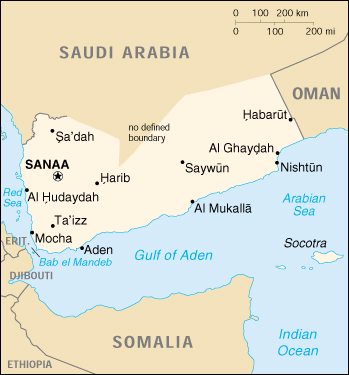
Facts About Yemen
Background: North Yemen became independent of the Ottoman Empire in 1918. The British, who had set up a protectorate area around the southern port of Aden in the 19th century, withdrew in 1967 from what became South Yemen. Three years later, the southern government adopted a Marxist orientation. The massive exodus of hundreds of thousands of Yemenis from the south to the north contributed to two decades of hostility between the states. The two countries were formally unified as the Republic of Yemen in 1990. A southern secessionist movement in 1994 was quickly subdued. In 2000, Saudi Arabia and Yemen agreed to a delimitation of their border.
Government type: republic
Capital: Sanaa
Currency: Yemeni rial (YER) = 100 fils
Geography of Yemen
Location: Middle East, bordering the Arabian Sea, Gulf of Aden, and Red Sea, between Oman and Saudi Arabia
Geographic coordinates: 15 00 N, 48 00 E
Area:
total: 527,970 sq km
land: 527,970 sq km
water: 0 sq km
note: includes Perim, Socotra, the former Yemen Arab Republic (YAR or North Yemen), and the former People’s Democratic Republic of Yemen (PDRY or South Yemen)
Land boundaries:
total: 1,746 km
border countries: Oman 288 km, Saudi Arabia 1,458 km
Coastline: 1,906 km
Maritime claims:
contiguous zone: 18 nm in the North; 24 nm in the South
continental shelf: 200 nm or to the edge of the continental margin
exclusive economic zone: 200 nm
territorial sea: 12 nm
Climate: mostly desert; hot and humid along west coast; temperate in western mountains affected by seasonal monsoon; extraordinarily hot, dry, harsh desert in east
Terrain: narrow coastal plain backed by flat-topped hills and rugged mountains; dissected upland desert plains in center slope into the desert interior of the Arabian Peninsula
Elevation extremes:
lowest point: Arabian Sea 0 m
highest point: Jabal an Nabi Shu’ayb 3,760 m
Natural resources: petroleum, fish, rock salt, marble, small deposits of coal, gold, lead, nickel, and copper, fertile soil in west
Land use:
arable land: 3%
permanent crops: 0%
permanent pastures: 30%
forests and woodland: 4%
other: 63% (1993 est.)
Irrigated land: 3,600 sq km (1993 est.)
Natural hazards: sandstorms and dust storms in summer
Environment – current issues: very limited natural fresh water resources; inadequate supplies of potable water; overgrazing; soil erosion; desertification
Environment – international agreements:
party to: Biodiversity, Climate Change, Desertification, Endangered Species, Environmental Modification, Hazardous Wastes, Law of the Sea, Ozone Layer Protection
signed, but not ratified: Nuclear Test Ban
Geography – note: strategic location on Bab el Mandeb, the strait linking the Red Sea and the Gulf of Aden, one of world’s most active shipping lanes
People of Yemen
Unlike other people of the Arabian Peninsula who have historically been nomads or seminomads, Yemenis are almost entirely sedentary and live in small villages and towns scattered throughout the highlands and coastal regions.
Yemenis are divided into two principal Islamic religious groups: the Zaidi sect of the Shi’a, found in the north and northwest, and the Shafa’i school of Sunni Muslims, found in the south and southeast. Yemenis are mainly of Semitic origin, although African strains are present among inhabitants of the coastal region. Arabic is the official language, although English is increasingly understood in major cities. In the Mahra area (the extreme east), several non-Arabic languages are spoken. When the former states of north and south Yemen were established, most resident minority groups departed.
Population: 20,727,063 (July 2005 est.)
Age structure:
0-14 years: 47%
15-64 years: 49%
65 years and over: 4%
Population growth rate: 3.36%
Birth rate: 43.44 births/1,000 population
Death rate: 9.86 deaths/1,000 population
Net migration rate: 0 migrant(s)/1,000 population
Infant mortality rate: 70.28 deaths/1,000 live births
Life expectancy at birth:
total population: 59.83 years
male: 58.1 years
female: 61.64 years
Total fertility rate: 7.05 children born/woman
Nationality:
noun: Yemeni(s)
adjective: Yemeni
Ethnic groups: predominantly Arab; but also Afro-Arab, South Asians, Europeans
Religions: Muslim including Shaf’i (Sunni) and Zaydi (Shi’a), small numbers of Jewish, Christian, and Hindu
Languages: Arabic
Literacy:
definition: age 15 and over can read and write
total population: 38%
male: 53%
female: 26% (1990 est.)
History of Yemen
Yemen was one of the oldest centers of civilization in the Near East. Between the 12th century BC and the 6th century AD, it was part of the Minaean, Sabaean, and Himyarite kingdoms, which controlled the lucrative spice trade, and later came under Ethiopian and Persian rule. In the 7th century, Islamic caliphs began to exert control over the area. After this caliphate broke up, the former north Yemen came under control of Imams of various dynasties usually of the Zaidi sect, who established a theocratic political structure that survived until modern times. (Imam is a religious term. The Shiites apply it to the prophet Muhammad’s son-in-law Ali, his sons Hasan and Hussein, and subsequent lineal descendants, whom they consider to have been divinely ordained unclassified successors of the prophet.)
Egyptian Sunni caliphs occupied much of north Yemen throughout the 11th century. By the 16th century and again in the 19th century, north Yemen was part of the Ottoman empire, and in some periods its Imams exerted suzerainty over south Yemen.
Former North Yemen
Ottoman government control was largely confined to cities with the Imam’s suzerainty over tribal areas formally recognized. Turkish forces withdrew in 1918, and Imam Yahya strengthened his control over north Yemen. Yemen became a member of the Arab league in 1945 and the United Nations in 1947.
Imam Yahya died during an unsuccessful coup attempt in 1948 and was succeeded by his son Ahmad, who ruled until his death in September 1962. Imam Ahmad’s reign was marked by growing repression, renewed friction with the United Kingdom over the British presence in the south, and growing pressures to support the Arab nationalist objectives of Egyptian President Gamal Abdul Nasser.
Shortly after assuming power in 1962, Ahmad’s son, Badr, was deposed by revolutionary forces which took control of Sanaa and created the Yemen Arab Republic (YAR). Egypt assisted the YAR with troops and supplies to combat forces loyal to the Imamate. Saudi Arabia and Jordan supported Badr’s royalist forces to oppose the newly formed republic. Conflict continued periodically until 1967 when Egyptian troops were withdrawn. By 1968, following a final royalist siege of Sanaa, most of the opposing leaders reached a reconciliation; Saudi Arabia recognized the Republic in 1970.
Former South Yemen
British influence increased in the south and eastern portion of Yemen after the British captured the port of Aden in 1839. It was ruled as part of British India until 1937, when Aden was made a crown colony with the remaining land designated as east Aden and west Aden protectorates. By 1965, most of the tribal states within the protectorates and the Aden colony proper had joined to form the British-sponsored federation of south Arabia.
In 1965, two rival nationalist groups–the Front for the Liberation of Occupied South Yemen (FLOSY) and the National Liberation Front (NLF)–turned to terrorism in their struggle to control the country. In 1967, in the face of uncontrollable violence, British troops began withdrawing, federation rule collapsed, and NLF elements took control after eliminating their FLOSY rivals. South Arabia, including Aden, was declared independent on November 30, 1967, and was renamed the People’s Republic of South Yemen. In June 1969, a radical wing of the Marxist NLF gained power and changed the country’s name on December 1, 1970, to the People’s Democratic Republic of Yemen (PDRY). In the PDRY, all political parties were amalgamated into the Yemeni Socialist Party (YSP), which became the only legal party. The PDRY established close ties with the Soviet Union, China, Cuba, and radical Palestinians.
Republic of Yemen
In 1972, the governments of the PDRY and the YAR declared that they approved a future union. However, little progress was made toward unification, and relations were often strained. In 1979, simmering tensions led to fighting, which was only resolved after Arab League mediation. The goal of unity was reaffirmed by the northern and southern heads of state during a summit meeting in Kuwait in March 1979. However, that same year the PDRY began sponsoring an insurgency against the YAR. In April 1980, PDRY President Abdul Fattah Ismail resigned and went into exile. His successor, Ali Nasir Muhammad, took a less interventionist stance toward both the YAR and neighboring Oman. On January 13, 1986, a violent struggle began in Aden between Ali Nasir Muhammad and the returned Abdul Fattah Ismail and their supporters. Fighting lasted for more than a month and resulted in thousands of casualties, Ali Nasir’s ouster, and Ismail’s death. Some 60,000 persons, including Ali Nasir and his supporters, fled to the YAR.
In May 1988, the YAR and PDRY governments came to an understanding that considerably reduced tensions including agreement to renew discussions concerning unification, to establish a joint oil exploration area along their undefined border, to demilitarize the border, and to allow Yemenis unrestricted border passage on the basis of only a national identification card.
In November 1989, the leaders of the YAR (Ali Abdallah Salih) and the PDRY (Ali Salim Al-Bidh) agreed on a draft unity constitution originally drawn up in 1981. The Republic of Yemen (ROY) was declared on May 22, 1990. Ali Abdallah Salih became President, and Ali Salim Al-Bidh became Vice President.
A 30-month transitional period for completing the unification of the two political and economic systems was set. A presidential council was jointly elected by the 26-member YAR advisory council and the 17-member PDRY presidium. The presidential council appointed a Prime Minister, who formed a Cabinet. There was also a 301-seat provisional unified Parliament, consisting of 159 members from the north, 111 members from the south, and 31 independent members appointed by the chairman of the council.
A unity constitution was agreed upon in May 1990 and ratified by the populace in May 1991. It affirmed Yemen’s commitment to free elections, a multiparty political system, the right to own private property, equality under the law, and respect of basic human rights. Parliamentary elections were held on April 27, 1993. International groups assisted in the organization of the elections and observed actual balloting. The resulting Parliament included 143 GPC, 69 YSP, 63 Islaah (Yemeni grouping for reform, a party composed of various tribal and religious groups), 6 Baathis, 3 Nasserists, 2 Al Haq, and 15 independents. The head of Islaah, Paramount Hashid Sheik Abdallah Bin Husayn Al-Ahmar, is the speaker of Parliament.
Islaah was invited into the ruling coalition, and the presidential council was altered to include one Islaah member. Conflicts within the coalition resulted in the self-imposed exile of Vice President Ali Salim Al-Bidh to Aden beginning in August 1993 and a deterioration in the general security situation as political rivals settled scores and tribal elements took advantage of the unsettled situation.
Haydar Abu Bakr Al-Attas (former southern Prime Minister) continued to serve as the ROY Prime Minister, but his government was ineffective due to political infighting. Continuous negotiations between northern and southern leaders resulted in the signing of the document of pledge and accord in Amman, Jordan on February 20, 1994. Despite this, clashes intensified until civil war broke out in early May 1994.
Almost all of the actual fighting in the 1994 civil war occurred in the southern part of the country despite air and missile attacks against cities and major installations in the north. Southerners sought support from neighboring states and received billions of dollars of equipment and financial assistance. The United States strongly supported Yemeni unity, but repeatedly called for a cease-fire and a return to the negotiating table. Various attempts, including by a UN special envoy, were unsuccessful to effect a cease-fire.
Southern leaders declared secession and the establishment of the Democratic Republic of Yemen (DRY) on May 21, 1994, but the DRY was not recognized by the international community. Ali Nasir Muhammad supporters greatly assisted military operations against the secessionists and Aden was captured on July 7, 1994. Other resistance quickly collapsed and thousands of southern leaders and military went into exile.
Early during the fighting, President Ali Abdallah Salih announced a general amnesty which applied to everyone except a list of 16 persons. Most southerners returned to Yemen after a short exile.
An armed opposition was announced from Saudi Arabia, but no significant incidents within Yemen materialized. The government prepared legal cases against four southern leaders–Ali Salim Al- Bidh, HaydarAbu Bakr Al-Attas, Abd Al-Rahman Ali Al-Jifri, and Salih MunassarAl-Siyali–for misappropriation of official funds. Others on the list of 16 were told informally they could return to take advantageof the amnesty, but most remained outside Yemen. Although many of Ali Nasir Muhammad’s followers were appointed to senior governmental positions (including Vice President, Chief of Staff, and Governor of Aden), Ali Nasir Muhammad himself remained abroad in Syria.
In the aftermath of the civil war, YSP leaders within Yemen reorganized the party and elected a new politburo in July 1994. However, the party remained disheartened and without its former influence. Islaah held a party convention in September 1994. The GPC did the same in June 1995.
In 1994, amendments to the unity constitution eliminated the presidential council. President Ali Abdallah Salih was elected by Parliament on October 1, 1994 to a 5-year term. The constitution provides that henceforth the President will be elected by popular vote from at least two candidates selected by the legislature. Yemen held its first direct presidential elections in September 1999, electing President Ali Abdallah Salih to a 5-year term in what were generally considered free and fair elections. Yemen held its second multiparty parliamentary elections in April 1997. Constitutional amendments adopted in the summer of 2000 extended the presidential term by 2 years, thus moving the next presidential elections to 2006. The amendments also extended the parliamentary term of office to a 6-year term, thus moving elections for these seats to 2003. On February 20, 2001, a new constitutional amendment created a bicameral legislature consisting of a Shura Council (111 seats; members appointed by the president) and a House of Representatives (301 seats; members elected by popular vote).
Yemen Economy
At unification, both the YAR and the PDRY were struggling underdeveloped economies. In the north, disruptions of civil war (1962-70) and frequent periods of drought had dealt severe blows to a previously prosperous agricultural sector. Coffee production, formerly the north’s main export and principal form of foreign exchange, declined as the cultivation of qat increased. Low domestic industrial output and a lack of raw materials made the YAR dependent on a wide variety of imports.
Remittances from Yemenis working abroad and foreign aid paid for perennial trade deficits. Substantial Yemeni communities exist in many countries of the world, including Yemen’s immediate neighbors on the Arabian Peninsula, Indonesia, India, East Africa, the United Kingdom, and the United States. Beginning in the mid-1950s, the Soviet Union and China provided largescale assistance to the YAR. This aid included funding of substantial construction projects, scholarships, and considerable military assistance.
In the south, pre-independence economic activity was overwhelmingly concentrated in the port city of Aden. The seaborne transit trade which the port relied upon collapsed with the closure of the Suez Canal and Britain’s withdrawal from Aden in 1967. Only extensive Soviet aid, remittances from south Yemenis working abroad, and revenues from the Aden refinery (built in the 1950s) kept the PDRY’s centrally planned Marxist economy afloat. With the dissolution of the Soviet Union and a cessation of Soviet aid, the south’s economy basically collapsed.
Since unification, the government has worked to integrate two relatively disparate economic systems. However, severe shocks, including the return in 1990 of approximately 850,000 Yemenis from the Gulf states, a subsequent major reduction of aid flows, and internal political disputes culminating in the 1994 civil war hampered economic growth.
Since the conclusion of the war, the government entered into agreement with the International Monetary Fund (IMF) to institute an extremely successful structural adjustment program. Phase one of the IMF program included major financial and monetary reforms, including floating the currency, reducing the budget deficit, and cutting subsidies. Phase two will address structural issues such as civil service reform. The World Bank also is active in Yemen, providing an $80-million loan in 1996. Yemen has received debt relief from the Paris Club. Some military equipment is still purchased from former East bloc states and China, but on a cash basis.
Following a minor discovery in 1982 in the south, an American company found an oil basin near Marib in 1984. A total of 170,000 barrels per day were produced there in 1995. A small oil refinery began operations near Marib in 1986. A Soviet discovery in the southern governorate of Shabwa has proven only marginally successful even when taken over by a different group. A Western consortium began exporting oil from Masila in the Hadramaut in 1993, and production there reached 420,000 barrels per day in 1999. More than a dozen other companies have been unsuccessful in finding commercial quantities of oil. There are new finds in the Jannah (formerly known as the Joint Oil Exploration Area) and east Shabwah blocks. Yemen’s oil exports in 1995 earned about $1 billion.
Marib oil contains associated natural gas. Proven reserves of 10-13 trillion cubic feet could sustain a liquid natural gas (LNG) export project. A long-term prospect for the petroleum industry in Yemen is a proposed liquefied natural gas project (Yemen LNG), which plans to process and export Yemen’s 17 trillion cubic feet of proven associated and natural gas reserves. In September 1995, the Yemeni Government signed an agreement that designated Total of France to be the lead company for an LNG project, and, in January 1997, agreed to include Hunt Oil, Exxon, and Yukong of South Korea as partners in the project (YEPC). The project envisions a $3.5 billion investment over 25 years, producing approximately 3.1 million tons of LNG annually. A Bechtel-Technip joint venture also conducted a preliminary engineering study for LNG production/development.
GDP: purchasing power parity – $14.4 billion (2000 est.)
GDP – real growth rate: 4% (1999 est.), 6% (2000 est.)
GDP – per capita: purchasing power parity – $820 (2000 est.)
GDP – composition by sector:
agriculture: 20%
industry: 42%
services: 38% (1998)
Household income or consumption by percentage share:
lowest 10%: 2.3%
highest 10%: 30.8% (1992)
Inflation rate (consumer prices): 10% (1999 est.)
Labor force – by occupation: most people are employed in agriculture and herding or as expatriate laborers; services, construction, industry, and commerce account for less than one-half of the labor force
Unemployment rate: 30% (1995 est.)
Budget:
revenues: $1.8 billion
expenditures: $1.95 billion, including capital expenditures of $NA (1999 est.)
Industries: crude oil production and petroleum refining; small-scale production of cotton textiles and leather goods; food processing; handicrafts; small aluminum products factory; cement
Electricity – production: 2.24 billion kWh (1998)
Electricity – production by source:
fossil fuel: 100%
hydro: 0%
nuclear: 0%
other: 0% (1998)
Electricity – consumption: 2.083 billion kWh (1998)
Agriculture – products: grain, fruits, vegetables, qat (mildly narcotic shrub), coffee, cotton; dairy products, poultry, beef; fish
Exports: $2 billion (f.o.b., 1999 est.)
Exports – commodities: crude oil, cotton, coffee, dried and salted fish
Exports – partners: China 31%, South Korea 25%, Thailand 22%, Japan 5% (1998 est.)
Imports: $2.3 billion (f.o.b., 1999 est.)
Imports – commodities: food and live animals, machinery and equipment, manufactured goods
Imports – partners: United States 9%, UAE 8%, France 8%, Italy 7%, Saudi Arabia 7% (1998 est.)
Debt – external: $4.5 billion (1999)
Economic aid – recipient: $176.1 million (1995)
Currency: Yemeni rial (YER) = 100 fils
Map of Yemen